Showing posts with label Farah Ahamed. Show all posts

Thursday, October 12, 2023

"Silence is Golden”—a short story by Farah Ahamed - • published in The Markaz Review - 0ctober 1, 2023


first began to follow the work of Farah Ahamed on  April 3, 2015  .

"Silence is Golden" is  the tenth  of her short stories upon which I have posted. I reserve such coverage for writers whose talent and insight I greatly value.

You may read "Silence is Golden" at the link below

https://themarkaz.org/silence-is-golden-a-short-story-by-farah-ahamed/

The Story focuses on Doctor Patel, assistant human resources director in a large corporation located in Lagore, Pakistan.


The story gets us off to a marvelous start:


"Monday morning and Dr. Fazal was ready for a productive week. Dr. Fazal, to be clear, did not have a PhD, nor was he a medical doctor, but his colleagues called him “Doctor” because he was full of “timeless philosophical wisdoms,” as he said himself.  He’d made the suggestion at an HR meeting in jest when he realized he was always being consulted when there were serious problems to be solved, and the name had stuck. One time, many years ago, he had the feeling that his colleagues were making fun of him, but that was a forgotten memory. When he did remember, he told his wife, “Being wrong is just as powerful as being right. Sometimes even more so.” He’d been at Amber Investments for ten years working as the Deputy Human Resources of HR Manager. He was not in any doubt that a man of his talent and superior intellect was destined for higher places. His favorite saying was, “In six simple words, I can sum up everything I’ve learned about life. It starts and stops with me.”

Doctor Patel is given a big assessment, to represent his company at a conference in London. It seems Doctor Patel does not quite understand what his manager meant when she told him "Silence is Golden".


I do not wish to give away the plot. I really enjoyed the exchanges of e-mails between Doctor Patel and his wife.


Farah Ahamed's short stories and essays have been published in The White Review, Ploughshares,  The Mechanics’ Institute Review, The Massachusetts Review amongst others. Her story “Hot Mango Chutney Sauce,” was shortlisted for the 2022 Commonwealth Prize. She is the editor of Period Matters: Menstruation Experiences in South Asia, Pan Macmillan India, 2022,. She is working on a novel, Days without Sun, a story about grief, friendship, and survival in the backstreets of Lahore. You can read more of her work here.

Farahahamed.com 

Wednesday, August 9, 2023

Rich and Poor People—A Short Story by Farah Ahamed- published July 2, 2023 in The Markaz Review


 You may read today's story at the link below 

https://themarkaz.org/rich-and-poor-people-fiction-by-farah-ahamed/


My main purpose today is to let the followers of my blog know of this wonderful story and to keep my records of her work. I reserve  such coverage for writers whose talent and insight I greatly value.


I first began to follow the work of Farah Ahamed on  April 3, 2015. Today's story is the fourteenth of her work to be featured on The Reading Life.

The narrator of the story has been working as a maid for twelve years for Ma’am Farida and Mr. Abdul.

Now Mr. Abdul has passed away.

Farida has become very concerned with the fact that her neighbours feed KFC chicken to crows. Her maid sees this as a "rich person's problem"

Here is her account of the contrasting problems of the rich and the poor.


"Rich people have no idea what it’s like to be poor.

When you’re poor, you’re used to people dropping dead like flies and spending half your salary every month on funerals. Being poor means you’ll die young, because if you’re ill, you won’t have a car to take you to the hospital. And if by some luck you get there by bus, you’ll have to sit on the cold floor in the hospital corridor and wait for hours. And when the nurse finally takes you in, there’ll be no bed, medicine, or doctor. If you survive, your baby might die. If you hit your chest and cry, everyone will say it was God’s will, and if He took away your child, maybe one day He’ll give you a chance to change your destiny and know what it’s like to live like the rich."

I do not wish to give away any of the plot of this marvelous story.


Farah Ahamed's short stories and essays have been published in The White Review, Ploughshares,  The Mechanics’ Institute Review, The Massachusetts Review amongst others. Her story “Hot Mango Chutney Sauce,” was shortlisted for the 2022 Commonwealth Prize. She is the editor of Period Matters: Menstruation Experiences in South Asia, Pan Macmillan India, 2022,. She is working on a novel, Days without Sun, a story about grief, friendship, and survival in the backstreets of Lahore. 

Mel Ulm 


Saturday, November 12, 2022

Anarkali, or Six Early Deaths in Lahore—A Short Story  by Farah Ahamed 15 October, 2022 • The Markaz Review


Today's Story Can be Read Here

 I have been closely following the work of Farah Ahamed since April 15, 2015.  "Anarkali

Or Six Deaths in Lahore" is  set  in contemporary Lagore, the capital of Pakistan, This  marvellous story focuses on how six connected people die as a result of the corruption and deeply embedded cultural and religious prejudices in Pakistan.


The story is narrated by a twenty year old woman, a street sweeper and a Punjabi Christian. She is approached  in the street by a professor from London teaching at a university in Lagore. He is researching violence against Christians and he knows most sweepers are Christians. She initially thinks he takes her for a prostitute but when he tells her he just wants to pay very her well just to answer some questions she accompanied him to a tea shop. He speaks Urdu. They form a relationship which last a year, living  together before disaster strikes. He teaches her to read and introduces her to famous Urdu poets. He calls her "Anarkali", after a figure in medieval Urdu poetry.


The first person to die is one of Professor Rob's students, Jamel. A policeman come to Rob's flat, demands to know why they live together then takes them in for interrogation. With each subsequent death we are taken further into Lagore.  We learn about Anarkali's family.


I really liked the structuring of the story into six segments.  Reading this story I felt I was walking in the back alleys of Lagore.


 From the author's website -farahahamed.com

" I am a writer and editor. My stories explore people’s lives and how they are affected by culture, religion and politics.

My novel, Days Without Sun, is about friendship and survival. It follows the challenges faced by Amanullah, a traditional sweet-maker in a run-down shop in Lahore. It was shortlisted for the 2020 Screen Craft Cinematic Book Award and a finalist for the Primadonna Award 2019.


I have also written two collections of stories, one based in East Africa, the other in Pakistan.


My work has been shortlisted for the Commonwealth Short Story Prize (2022), the Primadonna Festival Writing Award (2019), and the Canadian CBC Books Short Story Award (2018). In addition, I was joint winner of the inaugural Gerald Kraak Award and highly commended in the London Short Story Prize. 


My essays and stories have been shortlisted for The White Review Prize, The Creative Future Award, The Thresholds Essay Prize, Screen Craft Prize, SI Leeds Literary Prize, DNA/Out of Print Award, and The Asian Writer Short Story Prize. I have also been nominated for The Pushcart and Caine prizes.


My short fiction and essays have been published in The White Review, Ploughshares, The Massachusetts Review, The Mechanics’ Institute Review, and other literary journals.


I have a Diploma in Creative Writing from the University of East Anglia and an MA in Education. I was born in Kenya and have lived in Nairobi, Vancouver, Kampala and Bilbao. I currently live between London and Lahore."

Next month I hope to post on her short story, "Hot Mango Chutney", short listed for the 2022 Commonwealth Short Story Prize.


Mel Ulm


Tuesday, April 12, 2022

“WARM BEERS AND SOGGY BURGERS” BY FARAH AHAMED - A Short Story - published February 22, 2022 in The Mechanic’s Institute Review

You May Read Today’s Story here


“WARM BEERS AND SOGGY BURGERS” BY FARAH AHAMED - A Short Story 


Gateway to Farah Ahamed on The Reading Life


I first began to follow the work of Farah Ahamed on  April 3, 2015.  “Warm Beers and Soggy Burgers”  is the ninth  of her short stories upon which I have posted. I reserve such coverage for writers whose talent and insight I greatly value.


Several of her stories are set in Nairobi, Kenya’s capital and deal with a wonderful character, Dr. Patel, of whom I have become very fond.


My main purpose here is to continue my records of reading the work of Farah Ahamed and to let interested readers know of the availability of this marvelous Short Story online. (There links to several of her other stories on The Reading Life.)


The story is narrated by an affluent married woman living in Kampala, the capital of Uganda. Her husband, Inayat, has booked a family trip to Thailand for next week but neglected to tell her.  She is upset as she has a radio job interview set up 

for next week.  She is looking for work as a script editor.


As their relationship begins to decline, the husband is clueless as to what might be the issue we see her growing frustration:


“About time,’ he said, and turned his attention back to the television. I lifted my arm and aimed the plant at him, hoping its thin, straggly roots would land in the middle of his face. But he ducked and it landed on the rug. 

‘What the hell’s wrong with you?’ he said. 

‘Nothing.’ 

The next morning at breakfast I said to Inayat, ‘Could you pass me the sugar, please?’ From behind his newspaper, he handed me the butter dish. As usual, he hadn’t been listening. I took a teaspoonful of butter and stirred it in my tea. Oil globules floated to the surface.”


From here it get worse.  


The depiction of the marriage is really brilliant.  At my worst I could see a bit of the husband’s failure to understand the feelings of his wife.  He means well but…


Farah Ahamed’s short stories and essays have been published in Ploughshares, The Mechanics’ Institute Review, The Massachusetts’ Review amongst othersIn 2021, Pan Macmillan will publish her non-fiction anthology on menstruation experiences in South Asia. A human rights lawyer with a Diploma in Creative Writing from the University of East Anglia, Farah is currently working on a short story collection and a novel set in Lahore. She also has a complete book of Dr Patel stories. You can read more of her work here: farahahamed.com.


I hope to follow her literary work for years to come and salute her human rights work.


Mel Ulm


Friday, January 15, 2021

A Man of Talent - A Short Story by Farah Ahamed - From Out of Print - December 2020


 A Man of Talent - A Short Story by Farah Ahamed - From Out of Print - December 2020


You may read today’s story. https://www.outofprintmagazine.co.in/farah-ahamed_a-man-of-talent 


Gateway to Farah Ahamed on The Reading Life


I first began to follow the work of Farah Ahamed on  April 3, 2015.  “A Man of Talent” is the eighth of her short stories upon which I have posted. I reserve such coverage for writers whose talent and insight I greatly value.


Several of her stories are set in Nairobi, Kenya’s capital and deal with a wonderful character, Dr. Patel, of whom I have become very fond.


Here were my thoughts on first meeting Dr. Patel:


“In her "Dr. Patel" I see a masterful depiction of a man completely mired in a deep miasma of self-deception, unable to see how he appears to others, desperately seeking admiration. I will try to show how Ahamed creates a very real man in a well developed social environment in just a few pages.


We meet Dr. Patel on the way to a wedding reception of young man from one of the wealthiest families in Niarobi. I will catalogue his deceptions, of self and others.  Firstly he is not a doctor, either medical or academic.  It is just a title he sort of gave himself and thinks others call him that out of respect.  After twenty years working for Amber Investments he has become Human Resources director.  As anyone who has ever worked in the corporate world knows, this is a job normally reserved for time serving lackeys (W. B. Yeats would call him an errand boy).  Dr Patel is wearing his club tie, with the crest of an elite organization of which he is not a member.


 Many of those at the party have inherited their wealth, Dr. Patel tells himself he did not inherit his position.  At the reception he sits at a table near the family, hoping others will take this as meaning he is a close family friend.  He got the groom a job at Amber Investments at the request of the father of the groom and was short sighted enough to request an "administrative fee" for this, thus reducing himself to a petty dishonest minion where honesty might have made him a true family friend.”


In “A Man of Talent”, just a delightful at times hilarious story, we find Dr. Patel facing three challenges.  He has been stooped for speeding in Nairobi by a very officious policewoman who takes away his license when, doing what is customary, he offers her a gratuity.  She tells him he must come down to the police station to retrieve it.  His visit is perfectly realized by Ahamed.  His superior upon his arrival at work decks him down because Human Resources department employees do not seem to know the regulations of the company.  When he then calls in his employees things get worse.


Anyone who has ever worked for a large rule bound corporation will strongly relate to all the depictions of happenings at the company.


I would suggest if possible you read her other Dr. Patel stories, all linked to in my prior posts, to really see what a great character Farah Ahamed has created.  


Farah Ahamed’s short stories and essays have been published in Ploughshares, The Mechanics’ Institute Review, The Massachusetts’ Review amongst othersIn 2021, Pan Macmillan will publish her non-fiction anthology on menstruation experiences in South Asia. A human rights lawyer with a Diploma in Creative Writing from the University of East Anglia, Farah is currently working on a short story collection and a novel set in Lahore. She also has a complete book of Dr Patel stories. You can read more of her work here: farahahamed.com.


I hope to follow her literary work for years to come and salute her human rights work.


Mel u


Friday, May 8, 2020

Sugra - A Short Story by Farah Ahamed - from The Mechanics Institute Review - May 2020


Sugra - A Short Story by Farah Ahamed - from The Mechanics Institute Review - May 2020

You may read this delightful story here


Sugra is the seventh Short Story by Farah Ahamed upon which I have posted.  I have been reading her work since April, 2015. Obviously I see Ahamed  as writer of significant talent and insight.  I was very happy to have an opportunity to read another of her stories.

Sugra is one of four daughters from a very poor family in Lahore.  Here is how she describes herself:

"To tell you the truth, I don’t like to remember that day, or the days that followed, but the memory of it is fresh. I can recall that hot afternoon vividly and in detail, when that man showed up at our doorstep. I suppose I could blame him or my parents for what happened later, even though you could say they had nothing to do with it. 
However, to return to that day, I was sitting on the floor chopping potatoes for a soup. This was my daily chore with my mother scolding over my shoulder. 
‘Chop the vegetables smaller and add more water to the pan,’ she said, ‘unless you want to give up your share.’ My sisters were playing outside, but because I had been born with a bad leg I was always kept indoors."

Her parents are not literate.  They have one room with mattresses on the floor, a nonworking TV, a working computer.  They share a bathroom with neighbors as well as a water tap.  A man, claiming a connection through marriage of third cousins shows up.

After some acrimonious remarks by Sugha's mother who at first things the man wants a wife, we learn he wants to hire Sugra to be a security guard at a tourist site.  After being assured he is not planning to put her in a brothel, the mother agrees under the condition that all her wages beyond maintenance be sent home.
They see being a security guard as a highly prestigious job.

The story is both sad but there is an hilarious side also.

Here is how her new boss explains why he wants to hire her and his the bargain is settled between the man and the mother:

"Job, what job?’ my father said. ‘She isn’t fit for anything.’ 
My mother shook her finger at Joseph. ‘I know what kind of work you’re thinking…’
Joseph leaned forward. ‘Allow me to explain dear sister. At Reliance Security, we have a “quota policy,” and we must recruit a certain number of people with disabilities. I want to employ your daughter, and if you agree, I will take her to Lahore with me today.’
‘Please mother, no,’ I said. ‘Sorry for everything. I’ll be good.’
‘Keep quiet, no one asked you,’ my mother said to me. 
‘Her work will be to sit at the entrance to Jahangir’s tomb and check ladies’ handbags for lighters, bombs, guns and alcohol. She’ll be a security guard.’
‘Security guard? Who knew my prayers would be answered in this way?’ my mother said. ‘Praise the Lord, I knew he would not let me down.’ She kissed the crucifix around her neck.
‘Are you saying women in the city carry such things in their purses?’ my father said. ‘What’s  the world coming to?’
‘Shut up,’ my mother said. ‘Who cares what they carry or they don’t.’ She looked Joseph straight in the eye. ‘How much will her salary be?’ 
‘Ten thousand rupees a month, minus my commission as her sponsor,’ Joseph said.
‘Ten thousand,’ my father said. ‘That’s too little.’
‘What do you want?’ Joseph said. ‘A little while ago you were complaining she was a burden.’
‘Why do you interfere?’ my mother said to my father. ‘Let me handle this. You’ll spoil everything.’
‘No,’ I cried. ‘No, please no…’
My mother came over to me. ‘You listen to me and listen carefully. Whatever we decide is what will happen, and your tears and whining won’t help.’ She turned to Joseph, ‘You can take her today. The money is fine, but you better not be lying to us. If you’re secretly planning to take her to one of those dirty places, then we should know. I don’t want people saying we sold her to you…’

Sugra has an adventure of sorts on her new job.  I laughed so much over the idea of Sugra being told that if she finds a bomb in a ladies purse she should confiscate it and then return when she leaves.


This is a wonderful story.  I hope to follow Ahamed's work for a long time.


Farah Ahamed's short fiction and essays has been published in Ploughshares,The Massachusetts Review, Comma Press, and Kwani?. Her stories are bound by an overall sense of oppression and rebellion and explore how culture, religion, and politics constrain and determine the lives of her characters. The stories range in time from the early days of independence in East Africa to the present.

Recently she was shortlisted for the Primadonna Festival Writing Award, and longlisted for the Canadian CBC Books Short Story Award. Previously, she was joint winner of the inaugural Gerald Kraak Award and highly commended in the London Short Story Prize. Her essays and stories have been shortlisted for the Thresholds Essay Prize, Screen Craft Prize, SI Leeds Literary Prize, DNA/Out of Print Award, and The Asian Writer Short Story Prize. She has been nominated for The Pushcart and Caine prizes.

Farah is a lawyer with a Diploma in Creative Writing from the University of East Anglia. She was born in Kenya and has lived in Nairobi, Vancouver, Kampala, London and Bilbao. She is currently between London and Lahore, working on a short story collection inspired by Lahore. She is also compiling an anthology on menstruation experiences in South Asia which will be published by Pan Macmillan, India.


Friday, February 16, 2018

”Getting Ideas”. - A Short Story by Farah Ahamed - 2018


“Getting Ideas” by Farah Ahamed


Farah Ahamed on The Reading Life


“Getting Ideas” is the sixth Short Story by Farah Ahamed upon which I have posted.  I have been reading her work since April, 2015. Obviously I see Ahamed  as writer of significant talent and insight.  

“Getting Ideas” focuses on Aisha, a Syrian refugee living in the UK and working for a NGO, an international human rights organisation. His father has given her advise: “‘We don’t want any problems with the law. Remember, no one will defend your rights. You’re invisible, a refugee. Give thanks for what you have. Be on your guard and make yourself as inconspicuous as possible.’”  She lives alone.  People pretty much treat her as if she is invisible when she is not at work.  Then one exciting day her boss offers her a position as a Children’s Rights Coordinator in Tanzania.  She will be in charge of evaluating the effectiveness of Aid as it applies to schools supported by her NGO.

Her first assignment takes her on a long journey over rough roads, accompanied by a driver and a  young Tanzanian woman who now works for the NGO.  They are on their way to visit a school, supported by aid from her NGO.  Her young assistant graduated from the school five years ago.  Ahamed does a masterful job letting us see how Aisha feels.  She has gone from the UK, where she was near invisible to an important high status official in rural Tanzania.  Depending on her report the school, and the director, can receive much more aid or be cut out.

In a very subtle scene, we see the driver almost, maybe just to himself, mocking her as a representative of USA provided aid.  He knows he is supposed to be humble before her but I sensed resentment.  Of course aid is subject to misuse and appropriation by corrupt officials and maybe he knows this and Aisha seems naive to him.  

Upon arrival at the school all the students, it is a girl’s school, sing a song in honour of Aisha.  The students have developed a play, on their own, to preform for her.  It is, per the male director, meant to show the aid money is helping the girls.  

The performance of the play is a very powerful emotionally moving scene.  It is important that first time readers be allowed to experience this on their own so I will not say much.  It is right out of the #metoo movement so much in the news.  I felt very proud of all the women in the story.  

“Getting Ideas” is a first rate story .  In just a few pages we experience very different cultures and we see a liberation I was not expecting.  I know Aisha will grow into a strong woman and I hope the girls will also. 

I hope to follow Ahamed for many more years.

Farah Ahamed is a short fiction writer. Her stories have been published in The Massachusetts Review, Thresholds, Kwani?, The Missing Slate, and Out of Print among others. She was highly commended in the 2016 London Short Story Prize, joint winner of the inaugural 2017 Gerald Kraak Award and has been nominated for The Caine and The Pushcart prizes. She was shortlisted for the SI Leeds Literary Prize, DNA/Out of Print Award, Sunderland Waterstones Award, Asian Writer Short Story Prize, and Strands International Short Story.

Mel u


Wednesday, December 27, 2017

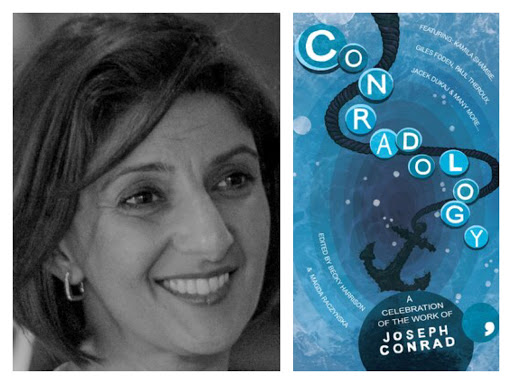
“The Helper of Cattle” - A Short Story by Farah Ahamed - 2017 - Published in Conradology


This will be my sixth post upon a short story by Farah Ahamed.  Obviously I greatly enjoy and respect her work.

I recently acquired a very interesting collection of short stories and nonfiction articles inspired by the writings of Joseph Conrad, focusing on his importance as a post colonial writer of the great cultural importance, Conradology. I was very happy to discover that a story by Farah Ahamed was included.

Dr. Patel, Safari Division Manager for a large Kenyan company, Amber Investments, is at a remote luxury lodge.  He is there to judge the Human Resources potential of the Maasai tribal people, the staff of the lodge.  The accountants and attorneys have already decided it would be a good addition to the luxury lodge portfolio of Amber Investments.  He is there to decide on the viability of the Maasai as staff.  His room is decorated like a Hemingway fantasy hunting lodge.  The company needs the Maasai to make things seem authentic to the wealthy guests.  In his brilliant book on post colonial Irish Literature, Inventing Ireland: The Literature of the Modern Nation, Declan Kiberd talks about how corporations are using the culture of Ireland to create a kind of Disney land of leprechauns and great writers to create money making tourist attractions.  This is just what Dr. Patel is helping Amber Investments do to the ancient cattle culture of the Maasai.  He lacks the self-awareness to understand what he is involved with or why his companies endeavours are resented by the Maasai.

Ahamed does a great job showing us Dr. Patel’s reaction to a huge herd of Wildebeasts crossing a river and being attacked by crocadiles.  When Dr Patel tells his Maasai driver why he is called “Doctor” even though he is not degreed, you can almost feel the  driver’s contempt for him.  It all goes over Patel’s head, he just records in his note book that The Maasai may need additional training to be good servants for the weathy guests.  

We sit in as the lodge manager tells Patel of the cultural impact the loss of their lands has had on the Maasai.  The government of Kenya is concerned largely with keeping foreign investors and tourists happy, not so much in preserving traditions.   

Slowly we see a bit into how much the culture of the Maasai has been destroyed as the land for their great cattle herds, once the source of real wealth and pride, has been taken from them, lately often sold to Chinese investors who bring junkets of guests to gawk at the Maasai and the animals.  Patel could not care less about the Maasai.

Something very interesting happens to Dr. Patel.  I will leave this for you to discover.

This story is very much worthy to be considered in the tradition of the post colonial stories of Joseph Conrad.  We can see the destructive impact the lodge has on the Maasai.  We sense much worse is coming.The entire collection is very interesting.  I do think an important aspect of the work of Conrad is missing in the well done introduction and if I post further on the collection I will speak of this.  There is a deep irony in the use of Doctor Patel as the evaluator of the Maasai, given he is totally a colonial construct with no ties to his ancestral culture left.  


I hope to follow the literary career of Farah Ahamed for many years.  


Farah Ahamed is a short fiction writer. Her stories have been published in The Massachusetts Review, Thresholds, Kwani?, The Missing Slate and Out of Print among others. She was highly commended in the 2016 London Short Story Prize, joint winner of the inaugural Gerald Kraak Award and has been nominated for The Caine and The Pushcart prizes. She was shortlisted for the SI Leeds Literary Prize, DNA/Out of Print Award, Sunderland Waterstones Award, Asian Writer Short Story Prize, and Strands International Short Story.. from the website of Comma Press.

To mark his 160th birthday, 14 authors and critics from Britain, Poland and elsewhere have come together to celebrate his legacy with new pieces of fiction and non-fiction. Conrad felt that the writer's task was to offer 'that glimpse of truth for which you have forgotten to ask.' In an age of increasing isolationism, these celebrations remind you of the value of such glimpses.
Commissioned as part of the Joseph Conrad Year 2017, the book has been published with the support from the Polish Cultural Institute, the Polish Book Institute, and the British Council... from the publisher’s description 

Mel u


Tuesday, July 25, 2017

"Poached Eggs" - A Short Story by Farah Ahamed (short listed for the London Short Story Prize, 2016, Winner Gerald Karak Award)


"Poached Egg" is included in the 2016 London Short Story Prize, purchasable here

Farah Ahamed on The Reading Life - Includes Links to Four of Her Stories


The London Short Story Prize 2016 Highly Commended stories includes
Poached Eggs  by Farah Ahamed


AL Kennedy says:  “Poached Eggs by Farah Ahamed is a gently funny, delicately disturbing and utterly subversive piece which deftly links the domestic, the personal and the political.”


Irenosen Okojie says: “Poached Eggs is an absorbing, nuanced piece. A sneaky, humorous examination on the battle of the sexes. Sharp, intimate… This is well orchestrated storytelling that’s delightful and evocative.”

"Poached Eggs" is the fifth wonderful acutely knowing short story by Farah Ahamed I have so far had the pleasure of reading and posting upon.  Her stories concern, either directly or obliquely, the lives of women in a society which values female submissiveness, which treats wives as servants and for the affluent trophies.  Richer older men are expected to have mistresses as we saw in her delightful set in Nairobi "Dr Patel", her only included story without a central onstage female character.

"Poached Eggs" is contained in a just published anthology of works Short listed for the London Short Story Prize, it cannot as of today be read online.  (Happily her other four stories are available online.)
it focuses on a young recently married woman who met her husband while working as support staff in a government office in Nairobi.  They marry a few months after meeting.  Gradually her husband begins to subject her to more and more rigid rules on running the household.  When she tells him her old boss wants her back at work, he tells her if she returns to work, as she wishes, it will make it look like he cannot afford to take care of her.  She has two full time live in helpers.  Her husband gives her a list of duties, including strict rules about how he likes his eggs Poached.  He provides her with a calendar on which he has the days she will have her period marked.  He tells her he does not wish to sleep with her when she is "unclean".  Soon he gives her another calendar on which he marks the days he will "do his duty" with her in order to produce a child.  He tells her to contact his mother to find out how he likes his meals fixed.

Things keep getting worse and worse but Naru never rebels.  She even writes a hilarious guide for wives for the main newspaper.

I want to leave most of this story unspoiled.  I loved the very subtle ending.

"Poached Eggs" is a really lot of fun as well as a biting satire of life in contemporary Kenya, dissecting sexual roles imposed by society.  It will make you laugh and think and as a married man I pondered how long I would survive if I attempted to impose such rules on my wife!

Hopefully I will post upon another of Ahamed's stories in August.


Farah Ahamed is a short fiction writer. Her stories have been published in The Massachusetts Review, Thresholds, Kwani?, The Missing Slate and Out of Print among others. She was highly commended in the 2016 London Short Story Prize and has been nominated for The Caine and The Pushcart prizes. She was shortlisted for the SI Leeds Literary Prize, DNA/Out of Print Award, Sunderland Waterstones Award, Asian Writer Short Story Prize, Gerald Kraak Award and Strands International Short Story.

Mel u

Sunday, June 11, 2017

"Raag Marwa" by Farah Ahamed (April 15, 2015)


A very good explanation of the Raag Marga in classic Hindu music

You can read "Raag Mawra" here

Farah Ahamed on The Reading Life. Here you will find links to her stories, my posts and a very interesting interview with her


"Raag, in the Sanskrit dictionary, is defined as "the act of coloring or dyeing" (the mind in this context) and "any feeling or passion especially love, affection, sympathy, vehement desire, interest, joy, or delight"? In music, these descriptions apply to the impressions of melodic sounds on both the artist(s) and listener(s). A raag consists of required and optional rules governing the melodic movements of notes within a performance. The rules of a raag can be defined by The manner in which the notes are used, ie. specific ways of ornamenting notes or emphasizing/ed-emphasizing them Manner in which the scale is ascended or descended Optional or required musical phrases, the way in which to reveal these phrases, and/or combine them The octave or frequency range to emphasize The relative pacing between the notes The time of day and/or season when the raag may be performed so as to invoke the emotions of the raag for maximum impact on the mental and emotional state of the performer and listener."  From http://www.surgyan.com - a very comprehensive Singapore based webpage promoting Indian Classical music

"Raag Marwa" is the third story by Famed Ahamed upon which I have posted.  I think in order to get the most from this story it helps to know a bit about the complex very classic Hindu musical work known as the Raag Marwa.  ( I placed a link to very good Singapore based webpage on classic Hindu music at the start of this post as well as a link to a performance that helped me to increase my understanding of the music teacher in the story.). The Raag Marwa is a work in which one can withdraw totally into the music, retreating or rising to a spiritual plane beyond the mundane.

There are only two on stage characters in the story, a fifty year old woman who gives lessons in classic Indian music and a man she lives with in an urban apartment, I think he is her husband.  The woman is very anxious, looking out the window at the bus stop, looking for someone.  She begins to play the Raag Marwa, also singing musical tones. Her husband yells from the bedroom, "are you teaching?"


She goes in the bedroom.  He is evidently disabled, rarely getting out of bed.  He had not eaten the food she prepared and she has to monitor his medication, sometimes he hides his pills.  We learn she is awaiting a special to her music pupil, a twenty seven year old attorney.  We sense she is in love with the pupil.

I will leave the ending of this very moving, poignant Story untold.  She does sink into existential despair, brought out of it only by withdrawing back into the Raag Mawra.

Ahamed has crested a sharp picture of two lives, a woman seemingly trapped by the illness of her husband, now largely indifferent to her but as a caregiver.  We also must question her character, seemingly planning to abandon her husband and cynically we must wonder if the twenty-seven year old attorney really returned her love or is she deceiving herself, ready to foolishly through away her past.

I really liked this story.  As in her other stories, Ahamed creates very real characters to whom we can relate.  I felt sadness for the woman and I admit I winced a bit when the wife asked her husband if he had taken his pills, this having happened to me on numerous occasions.

Take the time to listen to the music in the link above.  If one is interested you might listen to class Hindu music radio stations as background while reading.

This story first appeared in The Miss Slate, April 10, 2015.

I hope to post on another of Ahamed's short stories in a few days.

Farah Ahamed is a short fiction writer. Her stories have been published in The Massachusetts Review, Thresholds, Kwani?, The Missing Slate and Out of Print among others. She has been nominated for The Caine and The Pushcart prizes and shortlisted for the SI Leeds Literary Prize, DNA/Out of Print Award, Sunderland Waterstones Award, Asian Writer Award. She was highly
Recommended in the London Short Story Award and joint winner of the inaugural Gerald Kraak Award.


Mel u


Monday, June 5, 2017

"Life Will Be Better" - a very perceptive short story by Farah Ahamed (2015)


"Life Will Be Better" by Farah Ahamed

A Very Interesting Interview with Farah Ahamed

"Dr Patel" by Farah Ahamed

"Thin Air" - a poem by Farah Ahamed occasied by the kidnapping of Nigerian School Girls by Boko Haram


Five Hundred Years Ago London was home to the world's greatest writers, in the 19th century to writers who will live on as long as people read, the daily bombing for years in World War Two only strengthened the spirit of Londoners, Virginia Woolf and an immigrant, Katherine Mansfield opened up new ways of writing still shaping literature.  Five hundred years from now London will still be the city of the world's greatest writers.  I dedicate this post to the people of London

"Life Will Be Better" is the second short story by Farah Ahamed I have had the pleasure of reading.  As the story opens a husband and wife are stuck in the heavy traffic of Nairobi.  The air is heavy with exhaust fumes and street hawkers push knockoff dark glasses, flags of Kenya and pictures of the president aggressively on them.  The husband gives one money for a cold drink and the wife buys a pair of dark glasses.  The husband is reading the newspaper as she drives.  She asks him "what is the
news?" He tells her women activists are upset over proposed changes in the new marriage bill just voted into law.  The wife worries that if her husband divorces her, evidently made easier by new laws, she will be responsible to pay the car note and house mortgage.   In just a few lines Ahamed lets us see things were once better between the couple.


A policemen has stopped a black Toyota.  They see the officer take the driver's
 license and then get in the passenger side of the car.  The woman asks the woman in the car if she needs help.  She says the policeman wants a tip for Christmas shopping.  Her husband tells her to drive on, don't get involved.

They arrive at their destination, a trendy boutique built to resemble an African hut.  They are there to buy a dress for the wife for a special occasion.  Ahamed lets us see the man is there to decide what dress his wife will wear as his accessory at the big event.  She tries on a little black dress (as I said in a post long ago the influence of Coco Chanel knows no boundaries) which makes the husbanwhistle but he says the dress is not what he wants her to wear, "not right for us".  As she is looking at other dresses, the woman in the black Toyota and her husband enter the boutique.  The wife says "Nairobi is a small world".  Back in the dressing room she peeks out and sees her husband admiring the woman in the little black dress he said she could not have.  (It takes either a brave, maybe no too bright married man or one who just no longer cares to admire another woman in front of his wife.)

I will leave the very interesting and unexpected close untold.  I will say the other woman ends up


leaving with the dress the wife wanted.

I found of interest that in  the wife was the driver.  In both cases the husband has to give his approval for the dress and give his wife money for it.  The wife is as steamed as tropical heavily polluted Nairobi at noon as she leaves the store with the dress she did not want.

In just a few pages Ahamed gives us a look at the life of an at least upper middle class  woman, she does not seem mistreated but she is frustrated by a life and society that makes her opinions of secondary importance.  You feel like you are there in the car, inside the high end boutique and you wonder what will happen when she gets dressed for the big occasion in the dress her husband imposed on her.  My guess is it will be a revenge by silence night.

"Life Will Be Better" first appeared on DNA/Out of Print-Daily News and Analysis, a very interesting Mumbai based webpage, November 22, 2015.  You can read it on the link above.  I greatly enjoyed this story, which I read four times, to all lovers of the form.


Like "Dr. Patel" it is partially about the traps we fall into trying to impress others.  Ahamed is very skilled at developing character, opening up the people in her stories.

Farah Ahamed is a short fiction writer. Her stories have been published in The Massachusetts Review, Thresholds, Kwani?, The Missing Slate and Out of Print among others. She has been nominated for The Caine and The Pushcart prizes and shortlisted for the SI Leeds Literary Prize, DNA/Out of Print Award, Sunderland Waterstones Award, Asian Writer Award. She was highly commended in the London Short Story Award and joint winner of the inaugural Gerald Kraak Award.


Friday, June 2, 2017

"Dr. Patel" - a wonderful short story by Farah Ahamed (2015)


A Very Interesting Interview with Farah Ahamed

"Dr. Patel" by Farah Ahamed 

Farah Ahamed Joint Winner  of the Inaugral Gerald Kraak Award


"He parked in the empty car park and decided to wait until he saw other people enter the apartment block. He usually made a point of seeing his mistress at a time when everyone was coming home from work. He’d alight from his car holding his phone to his ear, and lean against the door with a pre-occupied air. Initially, the neighbours used to nudge each other and snigger. This gave him much pleasure, while he remained intent on his phone conversation. Now they no longer reacted, but this did not bother him. His reputation as a virile lover had been established."


One of the greatest pleasures of book blogging for eight years has been posting on the work of writers just beginning their literary efforts, seeing them develop their talent and receive recognition.  During June I hope to post upon six wonderful, highly perceptive, elegant short stories by Farah Ahamed.  All of the stories but one can be read online.  As I go on in my posts and hopefully increase the depth of my understanding of her work, I will try to talk a bit about why I admire her work so much and what  I think she may have to tell us.  In my first of these posts, on her "Dr. Patel" I see a masterful depiction of a man completely mired in a deep miasma of self-deception, unable to see how he appears to others, desperately seeking admiration. I will try to show how Ahamed creates a very real man in a well developed social environment in just a few pages.

We meet Dr. Patel on the way to a wedding reception of young man from one of the wealthiest families in Niarobi. I will catalogue his deceptions, of self and others.  Firstly he is not a doctor, either medical or academic.  It is just a title he sort of gave himself and thinks others call him that out of respect.  After twenty years working for Amber Investments he has become Human Resources director.  As anyone who has ever worked in the corporate world knows, this is a job normally reserved for time serving lackeys (W. B. Yeats would call him an errand boy).  Dr Patel is wearing his club tie, with the crest of an elite organization of which he is not a member.


 Many of those at the party have inherited their wealth, Dr. Patel tells himself he did not inherit his position.  At the reception he sits at a table near the family, hoping others will take this as meaning he is a close family friend.  He got the groom a job at Amber Investments at the request of the father of the groom and was short sighted enough to request an "administrative fee" for this, thus reducing himself to a petty dishonest minion where honesty might have made him a true family friend.


In a very acute and funny scene, a couple as Dr. Patel if they can join him at the table.  He tries to impress them by saying it is for family only, the couple exchanges a look that Patel misses that says "who is he kidding".  He makes a big show in front of them of putting money in an envelope along with his business card, which he gives to everyone, it seems.  He asks the woman what is the bride's name, I laughed out loud when she told him and he believed it that her name was "Bindi", a bindi is a cosmetic mark in the center of the forehand, any body with any real culture would know this and the fact that the woman feels secure telling Patel this shows the depth of her contempt for him.

When people at the party he has previously met don't recall him, he attributes it to their weak memories, is there end to his self-blindness?

Dr Patel is a huge man, when he orders just a small salad from the waiter The couple exchange looks like who is he kidding.  They ask him if he has come alone, he says his wife did not come and he thinks how in twenty years she is still not comfortable in high society.

Dr Patel leaves the party, heading for the apartment of his mistress, an employee of Amber Capital.  He wants people to see he has a mistress as a proof of his virility and affluence.  The scene between him and the woman are just masterful.  She comes to the door in a negligee, obvious to all but the oblivious Patel that she is expecting someone else.  We learn all he ever does in her apartment is watch TV news.

I have told a lot about this story but first readers will still delight in the skill of this story.  The close of the story in which Patel has no idea who the young man who emerged from the elevator in front of her apartment reminded me of the moment in Madame Bovary where Bovary sees a man climbing

over the fence of his house, on his way out as he unexpectedly returns home and thinks, "oh, now I know who has been stealing apples from my trees".


Ahamed has brilliantly presented a man completely oblivious to the reality of his life, a shallow fool out of touch with his true nature.  She also presents a sharp picture of social class distinctions

This story first appeared in the Out of Print Magazine, September, 2015


Farah Ahamed is a Kenyan lawyer with a Creative Writing Diploma from the University of East Anglia. She currently lives in the UK. Her short stories have been published by Kwani?, Bridge House, Fey Publishing, New Lit Salon Press and The Missing Slate. In 2014 Zoloft for Everyonereceived a commendation at the Winchester Writer’s Festival, and 1972, was nominated for the Caine Prize for African writing. In the same year, she was shortlisted for the SI Leeds Literary Prize for a collection of short stories. Red is for Later was nominated for the 2015 Caine Prize for African writing and the 2016 Pushcart Prize.


Featured Post

Imperial Reckoning: The Untold Story of Britain’s Gulag in Kenya by Caroline Elkins - 2005 - 701 Pages

  Imperial Reckoning:     The Untold Story of Britain’s Gulag in Kenya by Caroline Elkins - 2005 - 701 Pages 2006 Pulitzer Prize Winner From...