Showing posts with label Marcel Proust. Show all posts

Saturday, May 28, 2016

Proust The Search by Benjamin Taylor (2016, from The Yale Jewish Lives Series) Plus suggestions on other books on Proust


In The Guardian's luke warm review of Proust The Search by Benjamin Taylor it is suggested 
that the big question on Proust Taylor addresses  is "How did a simpering, high-class layabout write a work of such profound moral seriousness?"  This for me pretty much wrecked the book.


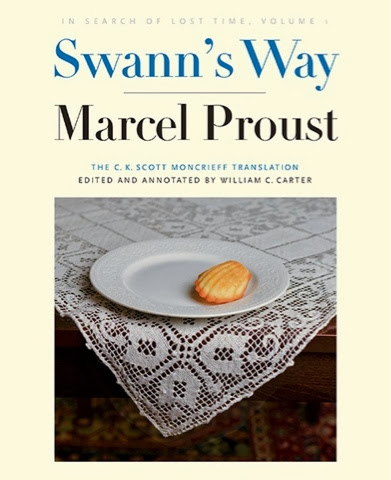
I am currently doing my third read through of Marcel Proust's In Search of Lost Times.  Wayne Carter, the greatest living authority on Proust, is producing, published by Yale University Press, heavily annotated with illuminating data, a revision of the great translation of F. Scott Charles Moncreiff.  I was kindly given an advanced review copy of Volume One which I posted on last year and am now reading a review copy of volume two.  

The standard biographies of Marcel Proust are huge, pushing 1000 pages.  Taylor's sort of biography is just over 200 pages.  Taylor has two basic objectives.  The first is a task he acknowledges as impossible, explaining how Proust's life experiences lead to him producing one of the the very greatest novels ever written, a supreme artistic achievement of the human spirit.  Taylor somehow buys into the notion that because Proust was gay he was of weak character, lacking in the strength to produce a 3500 page masterpiece.  This notion permeates  Taylor's account of the life of Proust.  Taylor also tries  to place Proust in the European Jewish tradition.   Proust's father was Christian, his mother Jewish.  I did not find this tremendously interesting and I think it is counterproductive to limit Proust like this.

Taylor goes into detail on Proust's romantic life with various young men and what Taylor sees, probably rightly, as "cover" relationships with women in his younger days.  It is not pleasant to learn what Proust liked to do at a gay brothel he might have provided start up money for, Proust inherited in today's money five millions dollars from his mother.  Taylor lets us see that Proust was not money smart but was blessed with a good money manager.  He sometimes bought stocks because he liked the company name.  He was a very generous tipper and gave large gifts.  


My thoughts on getting into Proust (check out on YouTube the hilarious Monty Python skit on Proust)

First to state the obvious, read Proust.  It will take awhile, it is very, seven volumes over 3500 pages in most editions, long but it is not "difficult" or hard to follow.  (There is an interesting scene in Taylor's book describing a meeting of Proust and James Joyce.)  I read tne Moncreiff translations but will eventually read newer translations.  Next I would suggest you read Wayne Carter's biography of Proust.  

I have read two good secondary books on Proust.  Roger Shatluck's Proust's Way A Field Guide to Remebrance of Things Past is a work I found interesting and useful.  

Anka Mulstein's Proust's Library is super interesting.

Taylor does talk a good bit about Proust's reading.  He loved The Idiot by Fyodor Dostoevsky.  I must read it again.

On Taylor's book, it is for Proust fanatics only.  There is enough detail to keep readers like me interested but most will be better served by following my suggestions.  

Taylor is an adjunct professor at Columbia University and I guess this book started out as class room lectures and Taylor felt a need to base his work on things young students who most likely have never read Proust could relate to, him being Jewish and Gay.  It was near offensive when Taylor suggested it was surprising when Proust, who joined the military to get his choice of where he would be trained knowing he would be drafted, liked the army and was considered a good soldier.  

Mel u


Friday, August 21, 2015

Proust's Way A Field Guide to In Search of Lost Time by Roger Shattuck (2011, 300 pages,725 KB)

Great Thanks to Max u for Providing an Amazon Gift Card which allowed me to read this book


This is a post by Ambrosia Boussweau, European Correspondent of The Reading Life


"True life, life finally discovered and illuminated, is literature; that life which, in a sense, at every moment inhabits all men as well as the artist." Marcel Proust


In Seach of Lost Time by Marcel Proust is one of the very greatest literary works of all time.  My uncle Ruffington Boussweau was a close friend of the great translator C. K. Scott Moncrieff. The most prevalent myth about Proust is that he was prissy and effeminate.    In Search of Lost Time is, among many things, one of the greatest books about the reading life.  Mel u regards the reading of this work as one of his very peak lifetime reading experiences.  He plans another read through once he has completed Balzac's Comedie Humaine.

The biggest hurdle In Search of Lost Time presents is the length of over 3000 pages.  It is not a difficult book in the way Ulysses or The Sound and the Fury might be.  You can certainly just pick it up and read it on your own, maybe reading a few online articles on Proust for background.  To those who wish to learn a lot about the life and work of Proust, Mel u highly recommends William Carter's biography.  That being said, it is a great of art, complex in structure and narrative meaning with multifarious things to tell us about life.   

Read Proust first otherwise you will be experiencing this transcendent work of art through someone else's eyes.  Shattuck helped me to gain an overview of the novel, how the various elements work together.   It is a very good lesson in close reading.  He also talks a bit about War and Peace and I found his remarks very perceptive and illuminating.   

When I first read these lines, "True life, life finally discovered and illuminated, is literature; that life which, in a sense, at every moment inhabits all men as well as the artist." Marcel Proust I knew I thought I agreed but I was not sure how to understand them.  Literature and Art and Opera all play important roles in Proust.  Shattuck helped, I think, deepen my understanding of Proust's view of the arts.

He also talks about why the book became so long.  He repudiates biographical readings of Proust and discusses the merits of various translations. I have no ability to judge this but I do have a very high regard for C. K. Scott Moncreiff.  His book was published before the new translation's of volume one by Lydia Davis and a revision of the book one by Moncreiff done by William Carter.

New York Times Obituary of Roger Shattuck


In Search of Lost Time is one of the supreme artistic achievements of humanity.  Shattuck's book helped me understand it better.  


Ambrosia Boussweau
European Correspondent, The Reading Life


Tuesday, September 2, 2014

In Search of Lost Time by Marcel Proust (1913 to 1927- translated by C.K. Scott Moncrieff)


For a while I think I will just be doing short reading journal type of posts. 

Living for a while  in the universe of In Search of Lost Time (sometimes translated as Remembrances  of Things Past) has been one of the greatest experiences of my life. I will begin it all over very soon, a common thing for readers to do.   


Tuesday, June 3, 2014

The Magic Lantern of Marcel Proust by Howard Moss (1962, republished 2012 with a forward by Damion Searls)


I am in the midst of rereading Marcel Proust's Remembrance of Things Past (sometimes translated, as Proust preferred, as In Search of Lost Time).  I last read it maybe forty years ago.  It is a supreme work of literary art, a magnificent achievement of the European literary tradition.  Normally I do not read books explaining  literary works, I do like literary biographies, preferring to read the source directly.  I am so glad I made an exception for The Magic Lantern of Marcel Proust by Harold Moss.  As soon as I saw he dedicated the book to Elizabeth Bowen I felt this would be a work of distinction. 

I first read the wonderfully civilized foreward by Damion Searls that the publisher Paul Dry Books has kindly included in their edition.  I admit I did not know anything about Howard Moss.  Moss (1922 to 1987) was a poet and for many years was poetry editor of The New Yorker.  I really liked it when Searls talked of a time when people did not  apologize for being readers of a 4000 page novel and of world where it was assumed any literate person would have read the great French masters of the novel.  

I found Moss's commentary on Proust wonderfully helpful.  He helped me understand the overall architecture of the work.  His explanations of the importance of looking through windows was very illuminating.   He explains in elegant ways the intricate connections between topics as seemingly diverse as homosexuality, the Dreyfus case, being partially Jewish, sexual and social role playing.  Because Proust has such a large canvas to write upon, he is able to give incredibly peceptive accounts  of social and personal relationships, of snobbism, jealousy, painting, food and much else.  The theoretical focus of my blog is on people that lead reading centered lives and Proust's work is a holy text of the reading life.  I have already realized I must read more Balzac.  

Ross helped me see  how Proust creates a world, a personal great mythology.  I will read the remainder of Proust with more enjoyment, and I hope perceptivity, after reading Moss's book.  I did some quick post read research on this book and many consider it the best second work on Proust.  The prose style is elegant and refined. 

           Harold Moss


 I highly recommend anyone looking for some excellent reading ideas to spend a few minutes on the web page of Paul Dry Books


Monday, March 17, 2014

The Guermantes Way by Marcel Proust (1920, trans. By C. K. Scott Moncrieff, Vol. III of In Search of Lost Time)


In Search of Lost Time (also referred to as Remembrance of Things Past) by Marcel Proust is one of the supreme achievements of European art. Maybe it is the very pinnacle. .  I last read it maybe forty years ago. I am so glad I decided to reread it.  I find it a very addictive world it pains me to withdraw from.  It, a work in seven volumes, is the very epitome of a reading life book. I urge all seriously into great literature to read this book as young as they can.  That way you can reread it numerous times and you will have a benchmark to place other works in perspective.  I think the biggest hindrance for most in reading this work is the great length of the seven volumes.  For many busy people, those with unpleasant things like jobs, would be loath to invest what could be a year of their reading time in Proust. Many of his readers seem to be academics.  

Volume Three, The Guermantes Way takes us into great pain for our narrator, his beloved Grandmother dies, and his great friend, Swann, is deathly ill.  Much of the narrative action centers around the fabulously wealthy ultra high society family of the Guermantes.  Marcel's family (the work can be described as fiction masquerading as autobiography) has moved next door to the Duchess de Guermantes and Marcel becomes obsessed with them.  He slowly enters their social circle and much of the work is devoted to a microscopic dissection of the social intricacies involved.  There just is so much in this book.  Balzac is the most referenced author, so far, and French society is divided by the Dreyfus case.   

I think this sentence fragment is among my favorites, especially that portion blued over 

I have begun Sodom and Gomorah.


Friday, February 7, 2014

Within a Budding Grove - Vol.II of Remembrance of Things Past- by Marcel Proust 1919


Rembrance of Things Past by Marcel Proust is one of the supreme artistic achievements of the European Tradition. I think the primary reason it is more admired from afar than read is the daughting length of the seven volumes.   This serves to limit the work's audience largely to those with a generous amount of time for serious reading.  

Here are some of the many things I really liked in Within a Budding Grove, Vol II of the novel.
The sensibility of the narrator becomes more and more refined as he gets older.  Beauty in many forms deeply moves him. As the volume opens thanks to a family friend the narrator makes a visit to the theater to see a famous actress preform.  In one very erotically charged scene the narrator wrestles with the daughter of the Swanns and has his first orgasm on this occasion.  The narrator begins to explore his sexual feelings as the story progresses.  He develops a fixation on a group of girls. He begins to spend a good bit of time at the house of the Swann's and may fall in love with the daughter Gilberte.   The Swann's, Odette Swann was at one time part of demimonde Paris.  He begins to closely observe minute markers of social class.  I loved the narrator's description of varieties of intelligence.  The novel is totally worth reading just for the psychological insights of the narrator. I admit I was not expecting a visit to a brothel but one of the friends of the Swann's take him along on a visit.
As time goes by he seemingly loses interest in Gilberte.  He goes on a trip with his beloved Grandmother to a hotel the family often has frequented.  He meets yet another mentor, from a very aristocratic family, who impacts him greatly.  I sensed the first stirrings of homo-erotic fascination with the narrator's reaction to Robert de Saint-Loup.  He is the grand nephew of an old friend of his grandmother.  

Proust seemingly sees through everything.  The narrator develops greater and greater self awareness as he ages.  There is just so much in this novel to love.  I am so glad I decided to reread In Search of Lost Time (Proust preferred this English name for the novel).  To those pondering reading it, I know for many it will take up much of their precious reading time for perhaps months, I say do so as soon as you can so you will be able to reread it several times.  

Please share your experience with Proust with us.

Mel u
 

Thursday, January 9, 2014

In Search of Lost Time, Volume 1 of 7 - Swann's Way by Marcel Proust (1913) in the Yale Edition edited and annotated by William C. Carter


I last read Marcel Proust's ( 1871 to 1922, France) massive seven part novel Remembrance of Things Past about forty years ago.  In honor of the centenary of the 1913 publication of Swann's Way, Vol. 1 of seven, William C. Carter, widely considered the world's greatest authority on Proust, and Yale University Press have begun what will be a seven year project in which Carter will annotate and where he deems it essential update the translation of Charles Kenneth Scott Moncrieff.  In his very illuminating introduction, Carter says Moncrieff's translation is considered among the best of all translations of a literary master work.  It is the translation that almost all in the English language literary community have read and loved.  Moncrieff (1889 to 1930, Scotland) was an exquisite stylist.  Proust greatly admired his work but was not sure it should have been called Remembrance of Things Past but preferred, as does Carter, In Search of Lost Time.

I was very kindly sent a free advance publication copy of this wonderful book by Yale University Press for which I am very grateful.  I will just talk a bit about the annotations and introduction by Carter and explain as best I can why I loved this book, which is at the pinnacle of high literary art.

Carter begins by talking about the differences between the prose style of Proust and Moncrieff.  Carter says the English style of the translation is written in more "old fashioned" prose than Proust's French.  Where ever, Carter changes the translation, he explains his reasons.  He has the utmost veneration for the incredible work of Moncrieff.  The annotations are very illuminating and edifying. It as if you were in attendance at a post doctoral seminar in French culture.  Carter is particularly detailed in his annotations to the many references to paintings found in Swann's Way.  Carter also provides great insight into the culture of very affluent French Jews and aristocracy.  There is a huge cast of characters and Carter helps us keep track of them and their relationships.  ( I have found in large novels with lots of characters that if one reads on all will fall in place for you.)  The main personages in Swann's Way are the narrator, from a very affluent family, his parents and their friend Swann and a woman, from the demimonde world, Odessa with whom he is obsessed.  Part of the intricate charm of this work is constructing what really happens from the words of the narrator.  I found the relationship between Swann and Odessa totally fascinating as we slowly try to understand it.  I think I liked best the acute observational powers of Proust, his acute psychology, his artistic sophistication and his creation of a world.  


  • Charles Moncrieff 

    I am so glad I experienced this book in Carter's great edition.  

    There is an excellent article by Carter on translating Proust, from The Public Domain Review, which you can read here


    Words and Peace hosts a weekly meme in which you can include a link to any France related books or topics you posted on in the week. It is an excellent source of reading ideas, I have been following it for a long time.

    I will be reading the complete novel straight through and then will reread it, hopefully volume two of Carter's work will be out in early 2014.


  • Sunday, July 21, 2013

    "The Filial Sentiments of a Parricide" by Marcel Proust (1907)

    IMarcel Proust (1871 to 1922), author of the monumental published in seven parts novel, À la Recherché du Temps  Perdu (Remembrance of things Past) is one of the true giants of world literature.  It has been numerous decades since I read this work.   Maybe I will try for one more read. 


    I was very happy to find a short story by Proust in a recently acquired collection. The central event of the life of Proust was the death of his mother.  When that happened he moved into his famous corked line room and rarely came out the rest of his life.  

    "The Filial Sentiments of a Parricide" is a beautiful story.  It treats in a very deeply felt way with the narrators
    Feelings about the death of his mother.  It is interesting to me to read this story right after having read Andre. 
    Gide's story "My Mother".  ( I will leave to amateur psychiatrists to wonder about the consequences of the depth of their love for mothers on their lives and art.). As one would expect, the story brilliantly explicated deep memories.  The story is partially structured through letters of condolences on the death of a parent and responses to these letters.   Proust makes very powerful usage of literary references, drawing from War and Peace, King Lear, and Sophocles, among others.  The narrator's correspondent is a Parricide.   In this act Proust allows us to see much of the deeply tragic nature of the human condition.   There are many layers of meaning and subtlety in this story.  I have barely touched on them.  

    This story was translated by Barbara Anderson and I read it in Modern Masters of the Short Story edited by Charles Neider.   


    I am having a very good time reading short stories set in Paris for Paris in July.

    This is my third year as a participant in the Paris in July Reading Event hosted by Book Bath and Thyme for Tea.   I find this a very interesting and creative event of the sort that helps build the book blog community.  You will find  lots of reading ideas on the host blogs.

    I next intend to read a story by Henri Balzac. 


    Featured Post

    Imperial Reckoning: The Untold Story of Britain’s Gulag in Kenya by Caroline Elkins - 2005 - 701 Pages

      Imperial Reckoning:     The Untold Story of Britain’s Gulag in Kenya by Caroline Elkins - 2005 - 701 Pages 2006 Pulitzer Prize Winner From...