Doctor Jekyll and Mr Hyde by Robert Louis Stevenson (1886, 78 pages-read on line at Dailylit.com)
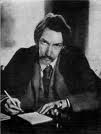
Robert Lewis Stevenson (1850 to 1894-born Edinburgh, Scotland) three most famous works are Treasure Island (1883), Kidnapped (1886) and what I think is his most famous work of all, Doctor Jekyll and Mr Hyde.
Doctor Jekyll and Mr Hyde created a character (or characters) that are known to millions who have never read the book and probably have never heard of the author. It has been made into several movies and I think I recall seeing a cartoon version of it on TV. In this work Stevenson has tapped into something universal in the human experience almost everyone can relate to-dealing with dualities of good and evil within yourself.
If one had never heard of Doctor Jekyll and Mr Hyde before reading it I think you would be totally in suspense and not at all see what is coming before the story line reveals events. The writing style is the work of a wonderful craftsman who truly knows how to tell a story. I almost forgot I knew the plot as I was reading as it is so well told.
The narrator is an attorney and friend of Doctor Jekyll named Gabriel John Utterson. Here is how Utterson describes himself
"I incline to Cain's heresy," he used to say quaintly: "I let my brother go to the devil in his own way." In this character, it was frequently his fortune to be the last reputable acquaintance and the last good influence in the lives of down-going men. And to such as these, so long as they came about his chambers, he never marked a shade of change in his demeanour.
As the story begins to unfold a friend of Utterson's tells him an amazing story. A horrid looking man assaulted in some fashion a young girl (in the streets of London) and her family is paid off with a check drawn on the bank of Dr. Jekyll, a friend and client of Utterson. It is quickly revealed that Utterson has drawn up a will for Dr Jekyll leaving all his estate to Mr Hyde. The story unfolds as Utterson tries to find out what the connection between the very refined modestly behaving Dr. Jekyll and horrid appearing and worse acting Mr Hyde could be. I hope people will not have the feeling that there is no pleasure to be obtained from reading this story as they already know the plot (maybe that is why I have not read it before now) as I completely enjoyed it. I did find it very suspenseful to see exactly how the mystery would be unraveled.
The story does a very good job of creating the atmosphere of London after dark. We go from the refined drawing rooms of Dr Jekyll to the sordid venues of Mr Hyde. Thematically the work is clearly a study of the duality of man. Mr Hyde is given to some sort of sexual vice (all this is evoked rather than shown) that we never have fully explained. I would think that those with serious problems relating to addiction to drugs will be able to relate strongly to some of the cravings of Dr Hyde for the transforming medicines he takes and their increasing hold on him.
It is the wonderful prose (I am at a loss how to describe it) that makes this novella so marvelous a read. Here is a description of Hyde given after the first face to face meeting between him and Utterson:
Mr. Hyde was pale and dwarfish, he gave an impression of deformity without any nameable malformation, he had a displeasing smile, he had borne himself to the lawyer with a sort of murderous mixture of timidity and boldness, and he spoke with a husky, whispering and somewhat broken voice; all these were points against him, but not all of these together could explain the hitherto unknown disgust, loathing, and fear with which Mr. Utterson regarded him.
The city as seen through the world of Mr Hyde is very alien to the upper class London of Dr Jekyll and Mr Hyde:
The dismal quarter of Soho seen under these changing glimpses, with its muddy ways, and slatternly passengers, and its lamps, which had never been extinguished or had been kindled afresh to combat this mournful re-invasion of darkness, seemed, in the lawyer's eyes, like a district of some city in a nightmare. The thoughts of his mind, besides, were of the gloomiest dye; and when he glanced at the companion of his drive, he was conscious of some touch of that terror of the law and the law's officers, which may at times assail the most honest.
We come to understand what Mr Hyde means to Dr Jekyll in this incredible passage:
This was the shocking thing; that the slime of the pit seemed to utter cries and voices; that the amorphous dust gesticulated and sinned; that what was dead, and had no shape, should usurp the offices of life. And this again, that that insurgent horror was knit to him closer than a wife, closer than an eye; lay caged in his flesh, where he heard it mutter and felt it struggle to be born; and at every hour of weakness, and in the confidence of slumber, prevailed against him and deposed him out of life. The hatred of Hyde for Jekyll, was of a different order.
Stevenson lead a very interesting life. The Wikipedia article on him is fascinating.
Amateur Reader of Wuthering Expectations has several very good posts on Stevenson. I am reading this work in observation of his Scottish Reading Challenge.