Showing posts with label Cynthia Ozick. Show all posts

Sunday, March 7, 2021

Antiquities by Cynthia Ozick - forthcoming April 2021- 192 Pages


Antiquities  by Cynthia Ozick - forthcoming April 2021 - 192 Pages


Antiquities is the fifth work by Cynthia Ozick upon which I have had The distinct pleasure of reading and posting upon. I have read one novel, Heir to The Glimmering World, three novellas, and one Short Story.  All of her works can be characterized as related to Jewish themes.  I have also read some of her literary Essays.


Antiquities, forthcoming from Knopf Publishing, will delight all lovers of her work.  The setting is around 1949, a rather elderly man, Lloyd Wilkinson Petrie, is preparing to write a memoir of his days at The Temple Academy for Boys.  He is now one of seven surviving trustees, all of which are being asked to write memoirs.  


The narration, filtered through his faltering at times memory is entrrlaced with curtent events in his Life.  Much detail is devoted to his memories of his, a collector and merchant of real and fake Egyptian antiquities.  We also learn about a cousin who was a famous archaeologist.  The narrator goes into detail about his parents marriage.  


The atmosphere at the School was subtly anti-semetic.  Lloyd was fascinated by a Jewish student, Ben-Zion Elefantin, a mystifying older pupil who claims descent from Egypt’s Elephantine Island.


From here Ozick spins out a fascinsting tale in which we have to find reality through the ancient narrator’s story line.


Like all her work, Antiquities,  manifests a very high intelligence and deep culture.  


Mel u

The Reading Life 


Tuesday, February 19, 2019

Envy: Or, Yiddish in America - by Cynthia Ozick - A Novella - first published November 1969 - Commentary Magazine


“A little while ago there were twelve million people—not including babies—who lived inside this tongue, and now what is left? A language that never had a territory except Jewish mouths, and half the Jewish mouths on earth already stopped up with German worms. The rest jabber Russian, English, Spanish, God knows what. Fifty years ago my mother lived in Russia and spoke only broken Russian, but her Yiddish was like silk. In Israel they give the language of Solomon to machinists. Rejoice—in Solomon's time what else did the mechanics speak? Yet whoever forgets Yiddish courts amnesia of history. Mourn—the forgetting has already happened. A thousand years of our travail forgotten. Here and there a word left for vaudeville jokes. Yiddish, I call on you to choose! Yiddish! Choose death or death. Which is to say death through forgetting or death through translation. Who will redeem you? What act of salvation will restore you? All you can hope for, you tattered, you withered, is translation in America! Hannah, you have a strong mouth, made to carry the future—“

Envy: Or Yiddish in America  shows clearly the brilliance of Cynthia Ozick.  My main purpose in this post is to have it included on The Reading Life.  

About four years ago a contact at Yale University Press gave me the ten volume Yale Yiddish Library (edited by scholars and sponsored by the Yiddish Book Center).  As I began to read these works, starting with The Letters of Menakhem-Mendl and Sheyne-Sheyndl and Motl, the Cantor's Son by Sholem Aleichem, I knew I had come on a culture that truly lived the Reading Life.  Interpreting the Torah was central to Eastern European Jews.  Scholars were greatly respected.  The Holocaust was a war on this culture and by proxy all of us into the Reading Life.   Yiddish culture has older and deeper roots than Anglo-American.  Since then I have kept reading Yiddish Literature and Holocaust studies.  Envy: Or Yiddish in America is an attempt to locate Yiddish literature in post Holocaust America, New York City.  It asks did Yiddish die in the Holocaust?  How is it transformed by Translation?  What does it mean to be a Jew after the Holocaust?

The narrator of the story is a Yiddish writer, he struggles to make a living and is consumed by jealousy over the success of another writer, some say the famous writer is modeled on Isaac Singer.  The famous writer has a translator, our narrator desperately wants to be translated into English.  His envy consumes him.

There just is so much depth in this story.  It can be seen as an attack on American Jews, circa 1969, forgetting the history of pain and suffering.  The narrator is at first elated when he finds the young niece of the other writer, born  in America, speaks Yiddish.  Of course at first he hopes he has found his translator.  Things do not, of course work out.

I will for sure revisit this story.

As of now I have access to eight short fictions by Ozick and two collections of essays.  

I highly recommend this essay 

History, Freedom, and Laughter in Cynthia Ozick’s “Envy; or, Yiddish in America” by Menachem Feuer


Cynthia Ozick’s essays, novels, and short stories have won numerous prizes and awards, including the American Academy of Arts and Letters Straus Living Award, four O. Henry First Prizes, the Rea Award for the Short Story, and a Guggenheim Fellowship. Her work has been translated into most major languages. She lives in Westchester County, New York, and recently ventured into playwriting with an adaptation of her own The Shawl...from her publisher 

Mel u


.


Tuesday, May 29, 2018

“Actors” - A Short Story by Cynthia Ozick, first published in The New Yorker October 10, 1998


Please share your experience with the work of Cynthia Ozick with US.


“Actors” is the fourth work by Cynthia Ozick I have had the pleasure of reading.  Previously I read her novel, Heir to the Glimmering World
and her novella, Dictation.  I like works in which the characters read, where books play an important part.  Heir to the Glimmering World is centred on the family, Jewish immigrants from Nazi Germany.  The husband is a world class scholar, his wife a once famous physicist now gone quite mad.  Dictation is about what happens when the secretaries of Joseph Conrad and Henry James meet.  I also read her beyond praise Holocaust story, “The Shawl”.

“Actors” has wonderful characters.  The lead is a late middle aged stage actor, in New York City.  He fancies himself a great actor.  He has not worked much lately though he was once successful.  His wife Francis is the main breadwinner in the family.  She is crossword puzzle editor.  Every week she is obligated to produce three puzzles, one easy, one of the middle range, and one very challenging.  She is a very erudite polyglot.  They both speak some Yiddish and Matt is very much from the Yiddish theatrical tradition.  She had four miscarriages. He thinks he should not have to audition or seek out roles.  His wife wishes he would work more.

A lot of the fun of this story is following the actor as he visits theatres.  We see the vivid personalities involved.  He is offered a role playing Lear, but not that Lear.  It is a part in a play set in New York City about an elderly man with three adult daughters.  Of course he at first refuses the part saying he is not old enough but he agrees.The playwright has just died but the director says that does not matter.  There are very well wrought minor characters and the depiction of the relationship of the couple is very well done.  The opening of the play was 

“Actors” was a great pleasure to read.  The collection in which “Actors” appears Dictations: A Quartet, has two short stories I am looking forward to reading, in addition to Dictation.

“Her parents were immigrants from Russia – her mother came as a child, her father at 21 to escape the tsarist conscription. They ran a pharmacy together, addressed each other in public as Mr and Mrs O, and brought up their two children in what Ozick now sees as the tail end of the 19th century. "Certainly there were plenty of cars, but the milkman came with horse and truck, in the Bronx, and in the summer the horses turds would be on the sidewalk and the sun was very hot and the streets were made of tar and these straw turds would sink into the tar and they had this fragrance of barn and country and it was not an unpleasant olfactory experience.”  From The Guardian 

The digital list price for the book is $14.95, it is now on sale for $1.95.

Mel u


Sunday, December 17, 2017

“The Shawl” - A Short Story by Cynthia Ozick, 1980, O. Henry Prize Winner


A few days ago I read a very interesting novel by Cynthia Ozick, Heir to the Glimmering World.   Being anxious to read more of her work I was delighted to find her short story dealing with the Holocaust, “The Shawl”, described in The New Yorker as “a miniature masterpiece”, available in the open archives of the magazine and also as a podcast on YouTube, read with great feeling and elegance by the multi-awarded British actress Claire Bloom.   I first listened to Bloom read it, then the next day I read it, then this morning, far from feeling I’m close to the full depth of this story I listened to Bloom’s Reading again.  

I listened then to Ozick talk about how she came to write the story.  (She also talks about growing up loving to read and how the Holocaust impacted her thinking.  This podcast, linked above, is only eight minutes but it is glorious).

Still feeling I must go deeper, I was delighted to find a New Yorker Fiction Podcast in which Joyce Carrol Oates reads the story and talks about the story with the fiction editor of The New Yorker, Deborah Treisman.

As the story opens, Rose  is  being marched to a concentration camp, to be interned.   The woman’s age is indeterminate, she is carrying her baby, Magda, wrapped it in a shawl to hide it from the Germans who killed all babies of Jewish Women.  Babies have no labour value to the Germans.  With  her is her niece Stella, in her teens.  Rose tells us both women are suffering terribly from malnutrition, months ago they stopped menstruating, their legs are like “tuber  covered sticks”.  They can barely walk but if they falter they know the Germans will shoot them.  Rose has no milk to feed her baby.  She wants to give Magda to a woman in a Village they pass through but how does she know if a stranger will accept her baby. She also fears if she steps out of line the guards will shoot her and the baby.  

Once they are in the concentration camp the level of terror, fear and madness becomes incredible.  Rose descends to madness, she fears her niece wants the baby to die so she can eat her.  The ending is the stuff of pure evil.  How do people become this horrible, so full of hate.  

In just a few masterful pages Ozick has evoked the Holocaust.  

This is a deeply disturbing story.  In an interview Ozick, normally a very methodical writer, said she felt almost as if a spirit inhabited her and helped her convey the story of Rose, Magda, and Stella.  

“She wrote it, she says, in a way she has never written anything, before or since. "I'm not a mystic, I don't believe in any of that. I've been on the side of rationalism. I had an experience, just the first five pages – I hate to say it, it's the kind of absurd thing that I mock – that I wasn't writing it, that it was dictated. Just for those five pages." - from The Guardian 

Mel u


Tuesday, December 12, 2017

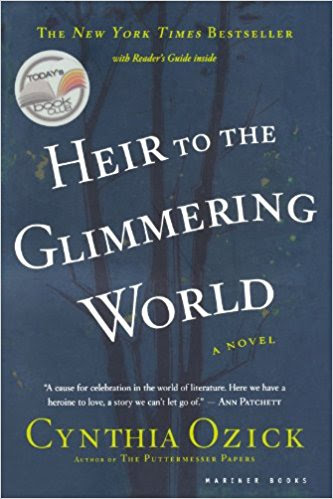
Heir to the Glimmering World by Cynthia Ozick - 2004


A Very Good Biographical Article from The Jewish Woman’s Encyclopaedia


When I was five minutes from finishing Heir to the Glimmering World by Cynthia Ozick I stopped reading.  It was eight PM and I wanted to start my next day with the sad pleasure of completing it still ahead of me.

As the novel opens our narrator Rosa , an eighteen orphan from the Bronx when we first meet her, has just gotten a job as a live in nanny for a family of Jewish refugees from Nazi Germany, it is 1935.  The father was at one time a highly regarded expert on an obscure Jewish sect, far from the main stream.  The mother, in an almost catatonic state when Rosa meets her, was once one of Germany’s leading physicists, an amazing accomplishment for a woman.  As the novel proceeds, we learn gradually the history of the family, she may have had an affair with the famous Ernin Schrodinger, he might be the biological father of one of her sons.  Her husband knows this and we see the impact of this on the marriage.  We see the family dynamics alter and Rosa grows through her relationships.

There is also a difficult teenage daughter and three younger rapidly Americanising sons.  The father is working on a scholarly project, eventually Rosa becomes his helper, the mother’s care giver and nanny for the sons.  

The family has a benefactor, a young man named James.  He was the basis for a highly successful series of children’s books his father wrote , sort of modelled on the Winnie the Poo series.  Once his father died he inherited a fortune with a perpetual income from sales.  

Rosa is a very bookish young woman,  loves Jane Eyre.  We see her develop, we learn about her strange father.  We see what it was like for the once wealthy refugee family.  

The Kindle edition of this book also contains two essays by Ozick, a brief interview and a set of questions to aid teachers and book club groups.

I look forward to reading much more of her work.

Mel u


Wednesday, December 19, 2012

"Dictation" by Cynthia Ozick

"Dictation" by Cynthia Ozick  (2009, 50 pages)

For sometime now I have been seeing references to Cynthia Ozick (New York City, 1928) as one of the best contemporary English language short story writers and I have wanted to read at least one of her stories. I did not really know which one to pick until I found she had written a highly regarded short story (some would call this a novella but I classify it as a short story) about two women who worked for two of the greatest early 20th century English language writers, Henry James and Joseph Conrad.   Their job was to type up the master work in publication ready copy.  I admit I am an easy sell when it comes to works of fiction about great writers and I really liked this very clever story.  As it opens we are in the London home of Henry James and we meet the woman, one of several he has been through, who types up his works for the printer.   Joseph Conrad comes to tea and it was fascinating to be a fly on the wall.   We then meet the woman who does the same work for Conrad and they meet each other.   What happens next is really a lot of fun to read about and discover, it is purely fiction but it could have happened.  

It would not be right to tell much at all of the plot of this wonderful story.   There are some subplots that I loved and Ozick brought these two sideline figures in the lives of two great writers to life for me.  

I read this story in her collection of four stories, also called Dictation.  I will look forward to reading more of her short stories.

Please share your experience with Ozick with us.

Mel u

Featured Post

Imperial Reckoning: The Untold Story of Britain’s Gulag in Kenya by Caroline Elkins - 2005 - 701 Pages

  Imperial Reckoning:     The Untold Story of Britain’s Gulag in Kenya by Caroline Elkins - 2005 - 701 Pages 2006 Pulitzer Prize Winner From...