Friday, March 15, 2024
"The Big River" - A Short Story by Desmond Hogan - 2017 - An Irish Short Story Month XIii Post
Wednesday, June 11, 2014
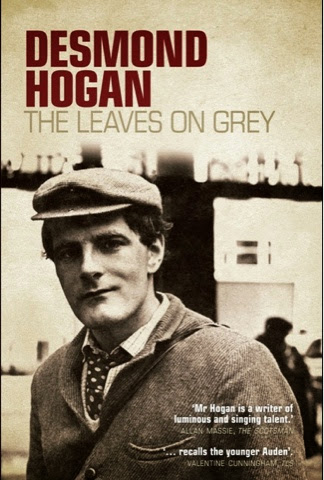
The Leaves on Grey by Desmond Hogan (1980, reissued by Lilliput Press with an author after word 2014)
‘To seek the beginning is to go back a long time ago, when the town in which I am writing was a little different and trees hung at the end of the town, trees hung obsessively, many trees, much green at the end of the street come summer, come the arrival of leaves and sun and buttercup blaze.’
It is the late 1940s, and Sean and Liam, middle-class boys in a small West of Ireland town, share a powerful bond of love and rivalry: each long for the same women. At university together in Dublin, Sean and Liam’s burgeoning sexuality leads them to a deeper, almost mystical level of involvement. They befriend Christine, rich, vulnerable and desperate for affection, and Sarah, glamorous, spoiled, intoxicating; her body is a seductive bridge between the pair, which they ultimately cross with painful and profound consequences.
The Leaves on Grey is the story of Ireland, ‘maker of wounds, tormentor of youth, ultimately breaker of all that was sensitive and enriched by sun, rain, wind’. Sean and Liam, and the men and women who become part of their lives, are both the creators and victims of their birthright.
This sensitive, passionate story is Desmond Hogan’s second novel, originally published in 1980. It is reissued here with a new afterword by the author.
‘Lost innocence, the young and the bright and the beautiful shining and dancing before dusk, is the theme ... Hardly new material, but to it Mr Hogan – one of the most talented writers lately to come out of Ireland or anywhere else – brings a light so brilliant that almost every word dazzles.’ – JANICE ELLIOTT, SUNDAY TELEGRAPH
‘Desmond Hogan establishes himself among the best novelists with The Leaves on Grey. He has a lot to say, which he does with elegance and maturity ... his language is succinct and utterly fresh. He wishes fiction to be a moral force, and his could be.’ – MYRNA BLUMBERG, THE TIMES
I will for sure read this work at least once more and will attempt another post on it then. It is a wonderful book and I loved it. My short post just reflects my own mental state right now.
I urge anyone interested in Irish Literature, Culture, History, or politics to study the webpage of Lilliput Publishers.
http://www.lilliputpress.ie/index.html
Mel u
Wednesday, May 28, 2014
The Edge of The City - A Scrapbook 1976 to 1991 by Desmond Hogan (2012, Lilliput Press)
Sunday, March 30, 2014
"The House of Mourning" by Desmond Hogan A look at page one and two after reading "Death of the Author" by Roland Barthes
Monday, September 9, 2013
A Farewell to Prague by Desmond Hogan (1995, republished 2013 by Dalkey Archives, 2013). My Meeting With Desmond Hogan
Sunday, September 1, 2013
The Ikon Maker by Desmond Hogan (1976, republished 2013 with an epilogue, 146 pages)
Sunday, April 21, 2013
"Kennedy" by Desmond Hogan (2012-in Best European Fiction 2012)

"For instance, there is the kind of seriousness whose trademark is anguish, cruelty, derangement. . Think of Bosch, Sade, Rimbaud, Jarry, Kafka, Artaud, think of most of the important works of art of the 20th century, that is, art whose goal is not that of creating harmonies but of overstraining the medium and introducing more and more violent, and unresolvable, subject-matter. . . . Clearly, different standards apply here than to traditional high culture. Something is good not because it is achieved, but because another kind of truth about the human situation, another experience of what it is to be human - in short, another valid sensibility -- is being revealed." "Notes on Camp" by Susan Sontag.
"Kennedy" (appearing in Best European Fiction 2012) can take us deeply into the importance of the work of Hogan. One of the reasons I used quotes from Kobe Abe, a Japanese master of the literature of cruelty and Susan Sontag, whose world of extreme refinement and culture was very far from that of the people in "Kennedy" is to get people to see that Hogan is very much an inter-textual writer, whose work is squarely in very old deep literary traditions. Everyone of his stories has historical echoes.
I do not plan to explicate the plot of this story. What I want to do is to look at all the incidents of violence and cruelty and to talk about an insight I think I have gained into the Hogan stories I have read by reading a recent article on travelers in Irish culture. This might be a longish somewhat rambling post but I hope those into Hogan will read it and let me know their thoughts.
Here are some of the incidents of violence and cruelty in "Kennedy"-
It opens with a 19 year old Limerick boy being forced to dig his own grave prior to being murdered because gangsters thought he was a police informer. He is wearing a shirt with attack helicopters on it, tools of imperialism used for terrorizing civilian populations. We hear he is murdered. We then are reminded that Saint Sebastian was found murdered in a sewer, just like the boy from Limerick probably will be. We are reminded of the story from the bible of Nebuchadnezzar having three men flung into a furnace because they will not bow before a golden image of him. From this we have an image of Christ being tortured by Roman soldiers. We begin to wonder, is the Limerick boy, clearly a petty criminal really Jesus or perhaps it is the other way a round. I do not think in the religious and classical mythology images Hogan often uses he is suggesting the marginalized people in his story are like ancient Greek heroes or even Jesus but rather he is suggesting these figure were in fact like thugs, boys with wasted lives, he is somehow saying power and masculinity resides in cruelty and government power rests in murder. He is not canonizing the Limerick boy at all.
From here we hear a boy in jail say he would rather be in Auschwitz than a Limerick jail. We learn he was molested sexually by Black as well as Polish guards. We need to maybe stop a second and ask why do the guards have the ethnic identity they do? Is it somehow symbolic of the invasion some would say destruction of Irish culture by outsiders, just as the Romans destroyed many cultures.
Going on (and all this in under 15 pages) we hear of Jehovah's Witnesses attacked by a mob as a priest cheered on. We meet a man whose face looks like it was kicked in by a stallion. We learn of the incredible cruelty of The Christian brothers whose schools have a reputations as places were boys are sexually molested by the brothers. We learn of a man killed when a statue of a Greek boxer from classical days falls on him. We are given an account of brutality in prison and molestation at an industrial school.
All of the government institutions allegedly meant to help people really foster violence and are run by sadists and homosexual rapists.
I think this story is somehow saying we need to overturn these institutions, we need to stop wearing attack helicopter T-shirts made by slave laborers somewhere in the third world.
On another topic, but one closely related to the issues of violence, I have spoken about a good bit, that of why the narrator often mingles with Travellers and often does in fact have sex with young traveller men. I should note there is little joy in these couplings, it is just relief and the will to power. Recently I read a very interesting article in a new online journal about Irish culture, Breac: A Digital Journal of Irish Culure, "Erotic Deterrotorializations in the the Traveller Fiction of Liam O'Flaherty and Eilis Ni Dhuibhne" by Adam Lawrence that helped me to understand this a bit. Everything is beginning to come together, you have to see that the narrator in the stories is often a Dandy (see my post here for why this is so important). You have to understand what Shuana Gilligan is talking about when she talks about how homelessness is one of the basic themes of Hogan, the Dandy is a hero without a culture in which his heroism matters. These stories also develop themes that go deep into western culture, that of masculinity and how it always has to be defined against women and non-masculine males. This is part of why there is so much male on male eroticism in Hogan's stories. It is why the encounters are joyless. the stories are also about how culture and societies come from murder and cruelty. Hogan is using his often beautiful images to force us to see this, this is in part why his stories are not straightforward narrations. Some of the truths in these stories cannot be told in school, you have to figure them out for yourself. This is also tied in with all of the not taught in school references in his stories, things some autodidact might know but the school masters won't. Here is what Lawrence basically says about the role of travellers as figures in Irish literature and society that relate direclty to the stories of Hogan and what I have wondered about what we are to make of the use of Travellers in the stories and why the narrator has sex with so many of them, with him always as the active participant. Lawrence says on the one hand Traveller men seem hyper-masculine, very into bare knuckle boxing, wild horses and living a seemingly free life style. Also Travellers historically married very young, starting at about 14. This in a culture where the average marriage age is higher than most first world countries and in a culture where sex outside of marriage was very much a sin. This meant that Travellers were somehow a sub-group the Irish fixated on sexually. A fourteen year old Traveller boy or girl was often married and sexually experienced 10 years earlier than many non-travellers. On the other hand, Travelers were viewed as rootless, near criminals, with no sense of responsibility so on this hand they were viewed as not having masculine characteristics, somehow the traveller men, especially the younger ones seemed liked they were almost like loose women so why not take them sexually if you want. So Traveller men were seen both as hyper-masculine and as effeminate and childish. Thus Irish masculinity, which stands in for the western culture (that is another reason for all the cultural references in the stories of Hogan) defines itself in contrast to Travellers. This is much as the English once defined themselves in contrast to the Irish (Declan Kiberd, Franz Fanon and Edward Said helped me understand this) just as white Americans in the old south defined themselves in contrast to African Americans. In one of the questions I have asked almost all those who have done Q and A sessions I talked about how the English viewed the Irish as very skilled at telling stories, preforming, writing poetry and such while seeing them as inferior and barbaric and I asked people if this is an accurate perception. I also think in a sense the Traveller is the stage Irishman for the Irish, and I think this is part of why Hogan uses him so much. He is trying to get people to see the beam in their own eye.
There are lots of other wonderful points to ponder and images to marvel at in this story. The Dandy is a identified as a camp figure by many, rightly so, but is also central to the modern literature of cruelty and anguish. The dandy roasts his hot dog on his jeweled walking stick in the fire of Nebuchadnezzar and revels in the garbage dumps in the back alleys of Dublin.
I see the short stories of Hogan as world class cultural treasures. I know I have made assertions in this post that some may not agree with or even take offense at which is OK it just means we care deeply about what we read.
Author Data
Mel u
Wednesday, March 20, 2013
"Pictures" by Desmond Hogan
I first heard of Desmond Hogan through an article about him in the online edition of The Manchester Guardian. The Manchester Guardian has the best literary section of any online paper in the world, in my opinion. When I saw that they had an article about an Irish writer of course I read it and I was really intrigued by what it said about Desmond Hogan (1950, County Galway, Ireland). I felt a small personal connection with him when I read he often swims up to two hours a day, partially for exercise and partially to have a time to himself to think. I have been doing pretty much the same thing for a long time. I also discovered he had a strong interest in Gypsies and by coincidence maybe a decade ago I got very interested in Gypsies after reading a great book Bury Me Standing by Isabel Fonseca. I ended up reading all of the books I could find in English on Gypsies.
Before I bought his collection I consulted with Shauna Gilligan who has given me much good advise regarding Irish literature, and she strongly endorsed his work. After reading only two or three of the stories in Lark's Eggs and Other Short Stories I became, and still very firmly am, convinced that the short stories in this collection were world class literary treasures. I have written a number of posts on his stories, some simply commenting on a story and others attempt to deconstruct his works and explore various leitmotifs in his work. I take his work very seriously and probably, not sure how to say this so I will just say it, some of my posts on Hogan are probably among the hardest to understand by casual readers of any on my blog. I wrote these posts for myself to increase my understanding and for others who feel about Hogan as I do not to convince those who do not feel as I do or more likely have not read his work.
In a post on Juan Luis Borges I said I saw him as belonging to the tradition of literature with cosmic ambition: the Bible, The Iliad, The Divine Comedy, Ulysses..works that strive to convey complete universes, containing everything. I think it is useful to see Hogan in this same tradition with the qualification that he is trying to convey the complete world of the inhabitants of his stories, their history, their culture, their way of being in the world. He is also, I think, recreating mythic structures among the debris and detritus of the times of his stories. I think for sure that is part, though far from all, what is behind the many references to Irish Travelers and Gypsies in his stories. I also think that the stories of Hogan are very inter-textual, they reverberate off the walls of the literary culture of the world.
There are several keys questions to help us understand the stories of Hogan. To me one of the biggest questions concerns the nature of the narrator. Why do so many of the stories feature a male narrator, a youngish man, very cultured in the way of an autodidact, with all sorts of odd not taught in school knowledge. He is not a Traveller but he often lives among them and he spend a good bit of time telling young Traveller men stories about Art and History despite the fact that they are not interested. Is he with Travellers just because is he somehow metaphorically or spiritually homeless? It would be easy to say that and it is not wrong to do that. But I think it limits our understanding of these stories. We need to ponder how the narrator is used to reconstruct the world he is in and from. We almost must accept and deal with the fact that the narrator often talks of having sex with young Traveller men. I think there is an artistic reason why the narrator is often a Gay man and I think understanding it goes deeply into these stories. I will try to talk about it.
Larks' Eggs and Other Stories by Desmond Hogan can be purchased from Lilliput Press, a premier source for quality books from and about Ireland.
Happiness Comes From Nowhere, Shauna Gilligan's marvelous debut novel, can be found here.
Thursday, February 21, 2013
"Players" by Desmond Hogan
Happiness Comes From Nowhere.
Happiness Comes From Nowhere, Shauna Gilligan's marvelous debut novel, can be found here.
Featured Post
Imperial Reckoning: The Untold Story of Britain’s Gulag in Kenya by Caroline Elkins - 2005 - 701 Pages
Imperial Reckoning: The Untold Story of Britain’s Gulag in Kenya by Caroline Elkins - 2005 - 701 Pages 2006 Pulitzer Prize Winner From...
-
Book Blogger Appreciation Week Sept 13 to Sept 17-2010-Giveaway- Katherine Wish by Linda Lappin Leave a comment to win! Open to all f...
-
The Reading Life Guide to Getting Started in the Indian Short Story One of my reading hopes for this year is to read a large number of the s...
-
My blog is two years old today. To the readers of my blog I can say only . My blog is a very big part of my life no...