Showing posts with label Johannes Urzidil. Show all posts

Monday, November 27, 2017

“Siegelmann’s Journey”. - A Short Story by Johannes Urzidil- 1962-translated from German by David Burnett-2016-Included in the Last Bell


“Johannes Urzidil is the Last great troubadour of a long lost Prague” - Max Brod

Works I Have So Far Read for German Literature Month, November, 2017

  1. “You’d Have Larvae Too” by Nora Wagener, 2016
  2. Vertigo by W. G. Sebald, 1990
  3. The Last Weynfeldt by Martin Suter, 2006
  4. “An Earthquake in Chile” by Heinrich Von Kleist, 1809
  5. Who is Martha? by Marjana Gaponenko, 2012
  6. “The Legal Haziness of Marriage” by Olga Grjasnowa, 2015
  7. “Aladdin, COB” by Isabelle Lehn, 2015
  8. “The Last Bell” by Johannes Urzidil, 1968
  9. The Rings of Saturn by W. G. Sebald, 1995
  10. Late Fame by Arthur Schnitzler, written 1892, published 2016
  11. Blood Brothers by Ernst Haffner, 1933
  12. Berlin Alexanderplatz by Alfred Döblin, 1929
  13. Confessions of a Murderer by Joseph Roth, 1936
  14.   “Compulsion” by Stefan Zweig,  1929
  15. “Borderlands”by Johannes Urzidil, 1956 (no post)
  16. “A School Boy’s Diary” by Robert Walser, 1910 (no post
  17. Austerlitz by W. G. Sebald, 2001, Second Reading 
  18. “The Duchess of Albanera” by Johannes Urzidil, 1965
  19. Gigli by Irmgard Keun, 1931
  20. Gay Berlin -Birth of a Modern Identity by Robert Beachy, 2014
  21. “Siegelmann’s Journey” by Johannes Urzidil, 1962

Mel has posted on three short stories by Johannes Urzidil.  He has asked me, I have also read all the stories in the collection The Last Bell, assembled, translated and introduced by David Burnett to comment briefly upon his story,”Siegelmann’s Journey”.

Richard Siegelmann, living in Prague, is a travel agent, a real job requiring significant expertise and knowledge in the days before the internet.  He is an expert at putting together trips for his clients.  He knows where to get the best wood carvings in Bali, the most sarap seafood in New Orleans, The Paris train schedules and much more.  He has read hundreds of Guide books and histories.  Everyone assumes he is a world traveler but in fact he has never been more than fifty miles from Prague.  He is a confirmed bachelor with a settled routine he is comfortable with.  One day he has a change encounter with a woman while out walking.  Overtime they get to know each other and begin spending time together.  She assumed he has been many places, he can talk with great fluency about traveling, and he leads her to believe she is correct.  One day, out of the blue, she asks him “Where will we go on our honeymoon?”   At first her assumption of what he sees as  her taking for granted what he never had in mind miffs him but they marry.  From here as his deception unravels a terrible disaster ends the story.  The closing is interestingly similar to that of his “Borderlands”


This is a good story, well developed though Mel and I agree that the title story in the collection, “The Last Bell” about a maid adjusting to life in Nazi occupied Prague is the best story.  

We endorse the purchase of this collection.


Johannes Urzidil - Biography
Johannes Urzidil (February 3, 1896 - November 2, 1970) was a Czech-German writer, poet, historian, and journalist. Born in Prague, he died in Rome.
Urzidil was educated in Prague, studying German, art history, and Slavic languages before turning to journalism and writing. His initial efforts in poetry were influenced by Expressionism, and were published under the pseudonym Hans Elmar. He also worked as a writer and editor of the monthly journal Der Mensch. Among his acquaintances during this period were Franz Werfel and Franz Kafka. From 1922 until 1933 he advised the press section of the German embassy in Prague. Czechoslovakia was occupied by Nazi Germany in 1939, causing Urzidil to take refuge in Britain; in 1941 he came to the United States, acquiring American citizenship in 1946.


Although he published poetry, Urzidil is best known for his prose which, though written in exile, reflects his Bohemian heritage. Among his more notable works are a collection of short stories, The Lost Beloved (1956; the title refers to Prague); the novel Der Trauermantel, and the story collection Prague Triptych (whose composition is derived from that of an altarpiece).
Urzidil won a number of prizes in his career, including the Charles Veillon Prize (1957) and the Großer Österreichischer Staatspreis (1964). He died in Rome in 1970.

The main-belt asteroid 70679 Urzidil is named after Urzidil.

Bio above data from


Avant Bousweau 


Friday, November 17, 2017

“Borderlands”. - A Short Story by Johannes Urzidil - 1956 - translated from German 2016 by David Burnett- included in The Last Bell


Works I Have So Far Read for German Literature Month, November, 2017

  1. “You’d Have Larvae Too” by Nora Wagener, 2016
  2. Vertigo by W. G. Sebald, 1990
  3. The Last Weynfeldt by Martin Suter, 2006
  4. “An Earthquake in Chile” by Heinrich Von Kleist, 1809
  5. Who is Martha? by Marjana Gaponenko, 2012
  6. “The Legal Haziness of Marriage” by Olga Grjasnowa, 2015
  7. “Aladdin, COB” by Isabelle Lehn, 2015
  8. “The Last Bell” by Johannes Urzidil, 1968
  9. The Rings of Saturn by W. G. Sebald, 1995
  10. Late Fame by Arthur Schnitzler, written 1892, published 2016
  11. Blood Brothers by Ernst Haffner, 1933
  12. “Borderlands” by Johannes Urzidil, 1956

Earlier this month I read a wonderful short story, “The Last Bell” by Johannes Urzidil set in Prague, right after the Nazis took control of the country.  The story is narrated by a maid whose Jewish employers have fled the country leaving her with their apartment and a good bit of money.  She gets involved with German soldiers in a really wonderful story.

“Borderlands” is completely different from “Last Bell”.  We never really learn where the story is set other than somewhere in a forest in Europe.  It is likewise
 very vague as to the era of the story.  I will say at once I loved this story for the 
portrayal of the magical child, at the heart story.  This story reads like a fairy tale at times.  It is narrated by a man from the city, a writer, who comes to stay with a country family.  Their daughter has strange powers, she can call fish, summon rain but she cannot learn the simplest arithmetic.  The ending is heart rendering.   

Johannes Urzidil - Biography
Johannes Urzidil (February 3, 1896 - November 2, 1970) was a Czech-German writer, poet, historian, and journalist. Born in Prague, he died in Rome.
Urzidil was educated in Prague, studying German, art history, and Slavic languages before turning to journalism and writing. His initial efforts in poetry were influenced by Expressionism, and were published under the pseudonym Hans Elmar. He also worked as a writer and editor of the monthly journal Der Mensch. Among his acquaintances during this period were Franz Werfel and Franz Kafka. From 1922 until 1933 he advised the press section of the German embassy in Prague. Czechoslovakia was occupied by Nazi Germany in 1939, causing Urzidil to take refuge in Britain; in 1941 he came to the United States, acquiring American citizenship in 1946.


Although he published poetry, Urzidil is best known for his prose which, though written in exile, reflects his Bohemian heritage. Among his more notable works are a collection of short stories, The Lost Beloved (1956; the title refers to Prague); the novel Der Trauermantel, and the story collection Prague Triptych (whose composition is derived from that of an altarpiece).
Urzidil won a number of prizes in his career, including the Charles Veillon Prize (1957) and the Großer Österreichischer Staatspreis (1964). He died in Rome in 1970.

The main-belt asteroid 70679 Urzidil is named after Urzidil.

Bio above data from


There are three more stories in The Last Bell.  I hope to read them all this month.


Mel u


Thursday, November 9, 2017

“The Last Bell” - A Short Story by Johannes Urzidil (1968, translated from German, 2016, by David Burnett)


“All the money in the world is nothing but the interest on Judas’s thirty pieces of silver. They’re still in circulation and are multiplying, and Jesus is still being bartered away.“ Johannes Urzidil


Works I Have So Far Read for German Literature Month, November, 2017

  1. “You’d Have Larvae Too” by Nora Wagener, 2016
  2. Vertigo by W. G. Sebald, 1990
  3. The Last Weynfeldt by Martin Suter, 2006
  4. “An Earthquake in Chile” by Heinrich Von Kleist, 1809
  5. Who is Martha? by Marjana Gaponenko, 2012
  6. “The Legal Haziness of Marriage” by Olga Grjasnowa, 2015
  7. “Aladdin, COB” by Isabelle Lehn, 2015
  8. “The Last Bell” by Johannes Urzidil, 1968

Every year so for during German Literature Month, now in my seventh year of participation, I read a work by a writer I had not even heard about before the month begins and determine I want to read as much of their work as I can.  (For   me this means translated into English and published in a digital edition.)  For sure Johannes Urzidil is now added to my read all I can list.  The just published by Pushkin Press edition of five of his short stories, The Last Bell, is sadly all there is of his work available in translation.  

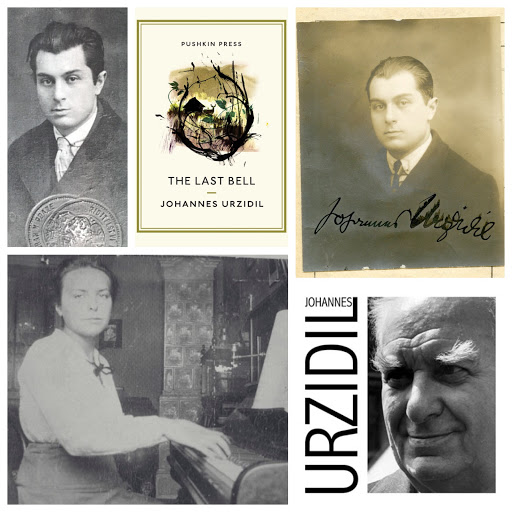
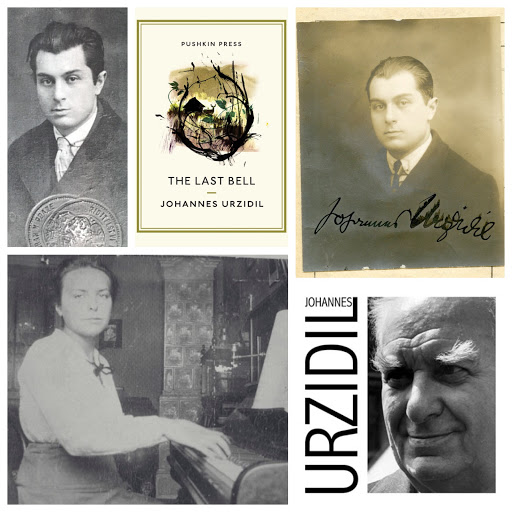
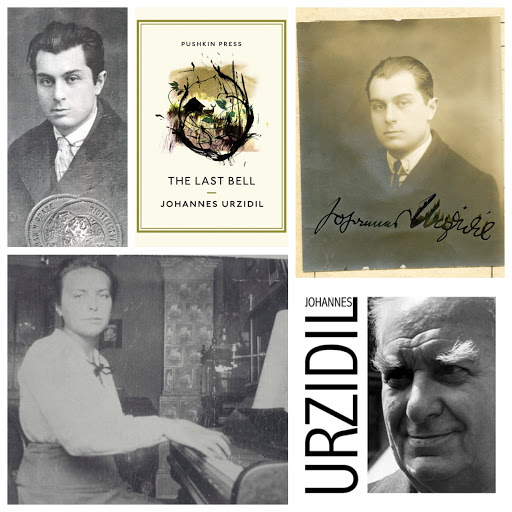
Johannes Urzidil was a German language historian, poet, novelist, and short story writer.  He was born in Prague in 1896, he died in Rome in 1970, while on a speaking tour.  He was friends with Kafka.  Highly educated, from 1922 to 1933 he worked for the German Embassy in Prague, as advisor in the press section.  In 1933 when the Nazis took over Czehoslovakia, he was fired from his job because his mother was Jewish, his father a Bohemian German.  Like so many other writers, his roots were dervived from The Austro-Hungarian Empire.  After being briefly detained he wisely emigrated to England, along with his wife, herself a poet (pictured in my collage).  In 1941 they moved to The United States, settling in The Queens area of New York City.  He stayed there the rest of his life. He developed basic fluency in English and read, among others, Emerson, Thoreau, Twain, and Hawthorne.  He wrote about them in German, he felt he had much higher skills in that language and wanted to do what he could to preserve what he saw as the destroyed Cultural heritage of the old Empire, especially that of Bohemian Germans, largely driven out of Czehoslovakia after the war.  

My knowledge of The background of Urzidil comes largely from David Burnett’s very well done introduction to the collection, The Bomb Magazine article linked above and a very comprehensive article in The Atlantic.  


The lead story in the collection, which Burnett assembled from several sources, “The Last Bell” is set in Prague around 1933, just as Nazi troops began to occupy the city.   Our main character is a maid, or maybe we should say was a maid.  She worked for years for a Jewish couple, they treated her decently, she tells us her Master, her terms, never made advances on her, as was evidently common.  When we meet her she is seeing them off at the Prague train station.  She is crying, decent employers are hard to find.  They have decided to leave the country, they give her ten thousand marks, a huge sum for her, they can take no cash out of the country, tell her the rent is paid on their apartment for the next six monthes.  All they ask is that she tell no one they have left.  Of course she is initially discombobulated, but she soon begins to relish her new wealth.  In an hilarious scene, she goes to a fancy resturant, orders a dish she has obviously never had before and whose French name she butchers, you can imagine the waiter sneering.  Then, to prove she is “high class” she sends the dish back,claiming it smells “funny”, not realizing it is perfect.  Then she orders apple strudel and sends it back also.  

She is initially made just a little uneasy by the uniformed Germans but everyone says only the Jews have to worry.  She invites her younger sister to come stay with her, so she will have someone to lord it over, now that she fancies herself rich.  Time goes by and both of the single but experienced young women find German boyfriends.  A terrible fight does break out between the sisters and two  “black uniformed” Germans, they have learned enough now to both fear the Germans and use their connections to intimidate others.  The younger sister ends up in jail for three weeks but still stays involved with her German Gestapo boyfriend whom she fought with.  As we knew they would , terrible things happen, slowly what is happening to Prague begins to sink in for the older sister.  When the six months of free rent runs out, the Jewish landlord, who lives in the building, fearing the women’s boyfriends tells her not to worry about the rent.

There are lots small touches help make this story a delight.  The lead character, her sisters, the Germans are all perfectly done.  

I have left the ending unspoiled.  This is a truly great story.

I hope to get to all of the four remaining stories this month.

You can learn more about German Literature Month on their link page


Pushkin Press deserves to be highly commended for the many wonderful works they have published in Translation.

Here is the publisher’s description of The Last Bell

“Discover ‘the great troubadour of a Prague forever lost’ – Max Brod
Johannes Urzidil, one of the great writers of the Prague circle, has been woefully overlooked, unlike his friends Franz Kafka and Max Brod. Pushkin Press is delighted to bring you The Last Bell: the first collection of stories in English by Urzidil.
These tales, set against the backdrop of twentieth century life in Bohemia, handle humanity with a wit and originality that demonstrates the author’s ability to understand and celebrate all people.
Urzidil deserves to take his place amongst his friends and fellows in the literary cannon.
In the title story, a miserly maid is suddenly given her employers’ riches while they flee from Nazi persecution. A curmudgeonly clerk becomes enthralled by a Spanish noblewoman’s portrait in The Duchess of Albanera. A widowed villager’s ‘magnetic’ twelve-year-old daughter witnesses a disturbing event in Borderland, and in Where the Valley Ends, an entire village is thrown into civil war over the disappearance of a freshly baked cheesecake.
Playful, often philosophical, always emotionally perceptive, these tales of the ordinary and the extraordinary are vividly told. Now that they are available in English for the first time to not read them is akin to pretending Kafka didn’t exist. Such subtle, intriguing stories are perfect to read at in between times and to reflect on much later.”


Mel u


Featured Post

Imperial Reckoning: The Untold Story of Britain’s Gulag in Kenya by Caroline Elkins - 2005 - 701 Pages

  Imperial Reckoning:     The Untold Story of Britain’s Gulag in Kenya by Caroline Elkins - 2005 - 701 Pages 2006 Pulitzer Prize Winner From...