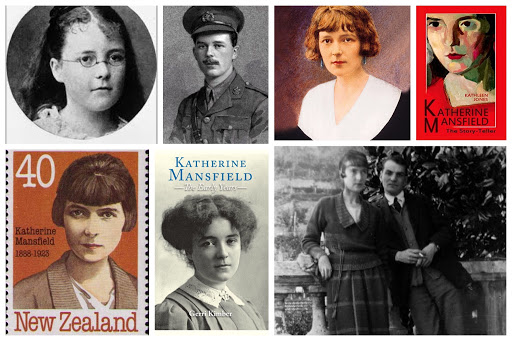
Showing posts with label Katherine Mansfield. Show all posts

Sunday, October 13, 2019

Katherine Mansfield-A Getting Started Guide - In Obervation of her 131th Birthday


A post in observation of the 132nd  Birthday of Katherine Mansfield

Born: 14 October 1888, Wellington, New Zealand

Katherine Mansfield-A Getting Started Guide

As Irene Nemirovsky went to her death in a cattle car to Auschwitz, she had with her The Notebook of Katherine Mansfield.
Katherine Mansfield died January 9, 1923.   Like many another writer who died far too young (1888 to 1923-New Zealand) we wonder what she might have produced had she lived on another thirty years.    All of Mansfield's stories are now in the public domain so anyone can easily read them online.   I have read and posted on nearly all of her stories (the exceptions being a few very young age stories that I have not yet found online).     I have received number of E-mails asking me where one should start with Mansfield.    (I am a reader not a scholar.    I read a Mansfield story almost by accident ten  ago and fell in love with her work.   I also have read and posted on three great books about her as well.)

In observation of the anniversary of her death I have selected three Katherine Mansfield stories that will get a new reader into her work.   All of these stories are easy to read  and enjoyable.   

"Miss Brill"

Because I have a posting each one of Mansfield's stories, I found I can use my blogger stats to see which of her stories are being most widely read.  People from all over the world (including Bethlehem on Christmas Day!) have come  to my blog to read my post on "Miss Brill".   Most of the visitors were probably students so I can  for sure say "Miss Brill" is the most assigned in universities worldwide of her stories.     "Miss Brill" is my suggestion for your first (and if it comes to it your only) Katherine Mansfield story.   I have read it several times since my first  post and each time get more from my reading and continue to enjoy the experience.   The first time I read this wonderful story (about 5 pages) I was struck by how much Mansfield was able to put in a few pages and by the stunning undercutting of what I thought was my understanding of the plot as the story closes.     It is a very fun, sad, wise story.


from Katherine Mansfield journal


Villa Isola Bella, Menton, France
I mean something though. Its a very queer thing how craft comes into writing. I mean down to details. Par exemple. In Miss Brill I chose not only the length of every sentence, but even the sound of every sentence – I chose the rise and fall of every paragraph to fit her – and to fit her on that day at that very moment. After Id written it I read it aloud – numbers of times – just as one would play over a musical composition, trying to get it nearer and nearer to the expression of Miss Brill – until it fitted her.
Don't think I'm vain about the little sketch. Its the only method I wanted to explain. I often wonder whether other writers do the same. If a thing has really come off it seems to me there mustn't be one single word out of place or one word that could be taken out. Thats how I AIM at writing. It will take some time to get anywhere near there.

"The Doll''s House"

"The Doll's House" is set in the New Zealand of the 1890s.     Mansfield has a great passion for her native New Zealand.      "The Doll's House"  is a very closely observed account of children at play.   It showed me how the play of children reflects what they learn from their lives.    In the smallest of details Mansfield builds a world for us.    

"The Garden Party"

As "The Garden Party" opens Laura Sheridan under the supervision of her mother is planning a garden party.   Readers in the 1920s in England and New Zealand would be aware that a garden party was meant to be a prestigious near formal occasion and an affair that was found only among the upper classes.   One of the most coveted English society invitations was to the annual Garden party at Buckingham Palace.   Laura is supposed to be in charge but we can quickly see her mother is a bit overbearing.  Rather near the home of the Sheridan's there is what the Sheridan family views as a wretched squalid community.   Right before the party is set to begin they learn one of the workers for  their party who lives in that area was killed in an accident.   Laura wants to stop the party but her mother will not hear it.   After the party the mother has a jolly good charitable idea.   Why not pack up all the left over party food and take it to the family of the man that was killed?  (Of course with no thought to the fact that the cottagers had never eaten food like that all their lives.)   Laura goes into the area where the cottages are located.    Mansfield is such an artist that you can feel Laura's fear as she goes into this area.   It all seems dark and evil and ever so wretched.    Laura goes into the cottage and views the body of the deceased.   It is Laura's reaction to the body of the  man and the multiple interpretations that can be made of this that seem to give this story its power and lasting appeal.


"There lay a young man, fast asleep--sleeping so soundly, so deeply, that he was far, far away from them both. Oh, so remote, so peaceful. He was dreaming. Never wake him up again. His head was sunk in the pillow, his eyes were closed; they were blind under the closed eyelids. He was given up to his dream. What did garden-parties and baskets and lace frocks matter to him? He was far from all those things. He was wonderful, beautiful. While they were laughing and while the band was playing, this marvel had come to the lane. Happy...happy...All is well, said that sleeping face. This is just as it should be. I am content."


Mansfield does not tell us what to make of this.   Is Laura just a silly rich girl who did not know that the poor have lives too or does she experience some kind of revelation when she sees the body?   Is this a mockery of  accepted views of death or is it a celebration of  them?   There is a nuch more to the story but I hope some may want to read it so I will not tell more of the plot.


I have read this story several times now and it is a marvelous account of class structures in the 1920s, among many other things.   I quoted a bit from the text so new readers can see her beautiful prose at work.

All these stories can be read at the New Zealand Electronic Text center, a great reading web page.   If you go to Youtube.com you will also find a number of videos relating to Katherine Mansfield.   

Here is a link to all of my Mansfield posts-The Reading Life Katherine Mansfield Project


The best book on her life and work is Katherine Mansfield: The Story Teller by Kathleen Jones


I highly recommend Katherine's Wish by Linda Lappin, a novel based on the last year of Mansfield's Life


The Katherine Mansfield Society website is a very valuable resource


Mel u


Sunday, August 4, 2019

Katherine Mansfield:  The Story Teller by Kathleen Jones (2010, 524 pages)


Kathleen Jones was born and brought up on a hill farm in Cumbria and now lives on the edge of the Lake District. She has been writing since she was a child and has published seventeen books including nine biographies, two novels and four collections of poetry. She lived for several years in Africa and the Middle East, where she worked for the Qatar Broadcasting Corporation. Since then she has written extensively for BBC radio and contributed to several television documentaries. Her poetry appears regularly in poetry magazines and anthologies in the UK, North America and New Zealand.

Kathleen was appointed as a Royal Literary Fund Fellow in 2007 and is currently also a Fellow of the English Society. Her two most recent biographies are ‘Katherine Mansfield: The Storyteller’ (published by Penguin NZ and Edinburgh University Press) and ‘Norman Nicholson: The Whispering Poet’, (published in 2013 by The Book Mill).

‘Mapping Emily’ won the Iota Shots pamphlet award in 2017 and is published by Templar Poetry. A collection of poetry that began on the remote Pacific islands of Haida Gwaii, ‘The Rainmaker’s Wife’,  was published by Indigo Dreams in September 2017. 


Katherine Mansfield:  The Story Teller by Kathleen Jones
(2010, 524 pages)


I was very privileged to have been given the opportunity to read shortly after its publication what I am sure will be the definitive biography of Katherine Mansfield,  Katherine Mansfield:  The Story Teller by Kathleen Jones.    There have been four other major biographies of Katherine Mansfield (the last one was Kathleen Mansfield:   A Secret Life by Claire Tomalin published in 1989.)     Only Kathleen Jones has had full access to the vast correspondence that has been published  since 1989 as well as the full notebooks of Katherine Mansfield.

  Kathleen Jones spent more than ten years working on Katherine Mansfield:  The Story Teller during which she spent a great deal of time in New Zealand studying archives there and meeting with people who had actually known Katherine Mansfield or her family.     She traveled extensively in England and France visiting the places where Mansfield lived out her life.    She has also written highly regarded biographies of Margaret Cavendish, The Duchess of Newcastle (A Glorious Fame),   Christina Rosetti (Learning Not to Be First); and an account of the lives of women who lived with the English Lake Country Poets (Passionate Sisterhood)..    More information on the background and career of Professor Jones can be found at her web page.)

My history with Mansfield began in May of this 2010 when I read her story "Miss Brill" when it was selected as the classic short story of the day on  a web page I follow.    I confess I had never heard of Katherine Mansfield prior to that day.    I was  very taken by  "Miss Brill".    I thought it was a brilliantly illuminating look into a sad and lonely life.    I did a bit of research and read a few more of her stories.     I like to know something of the lives and import of the writers that matter to me and I soon discovered many consider Katherine Mansfield the best ever female writer of short stories.     She is considered to have radically altered the nature of the short story.    I then decided I wanted to read and post on each of her 85 or so short stories individually.   As I posted on the stories I tried to gradually learn something about Mansfield and her life and background.     Virginia Woolf famously said of Mansfield that she was the only writer that ever made her jealous.    Mansfield has clear ties to Joyce and Woolf but unlike them she is also a writer for lonely people who never quite fit in anywhere, for people who retreat into visions of beauty,  for those happy to sit for hours alone in a cafe watching people walk by with no hope of understanding them.        I think Woolf was also a bit afraid Mansfield saw into the roots of her madness.   Anyway, I thought I should explain a bit why I am interested in Mansfield.   I will talk more on it when I shortly post my The Reading Life Guide to getting into Katherine Mansfield.

When I first received my copy of Katherine Mansfield:  The Story Teller I was very impressed by the very high production values of the book (published by Penguin/Viking).    It includes a lot of wonderful photographs of Mansfield, her parents and siblings, her husband John Middleton Murry, and others that were close to Mansfield.  

One of the dominant themes of Katherine Mansfield:  The Story Teller is the acknowledgement of the very deep   impact of the beauty of New Zealand on Mansfield's  mind and sensibility.   As I read Mansfield's stories   I tried to get to know at least a little the person behind them, to see beyond the mask.   I saw a woman caught up in an ugly time in England and France.     I saw a woman used to being taken care of (her father was the chairman of the Bank of New Zealand) reduced to trying on occasion to figure out how to pay for her meals.    I also saw a woman with a very powerful sensuous nature.    She liked beautiful exotic to her women and handsome near fey young men.    Mansfield is considered to have had affairs and brief encounters with both men and women.    As she lived in the days before people felt comfortable disclosing their full sex lives in public on talk shows, the Internet, and in tabloids and tell it all autobiographies we have no precise knowledge of her exact sexual preferences and proclivities.

Jones gives us beautiful descriptions of the natural beauty of New Zealand.    Unlike any other writer I am aware of, Jones talks about the influence of the Maoris on Mansfield.    Mansfield had a relationship with a Maori princess that many felt was a romantic one.    We do not know if this was simply a school girl crush or if it was an intimate relationship.     I confess I did not know much concerning the culture of the Maoris in early 20 century New Zealand and was a bit surprised to learn that one of the cousins of Mansfield's  father  married a rich Maori woman.   Jones writes in a very interesting way about the colonial roots of Mansfield.    She made me see what a backwater New Zealand must have seemed like to people in London and Paris and how much Mansfield felt initially liberated when she moved to London.    Later Jones made us see how Mansfield often seemed to long to return to New Zealand.  

Jones gives us a good look at the day- to- day struggles of Mansfield to feed and house herself.   Mansfield got a  modest allowance from her father that she could have lived on if she lived very modestly.   Jones tells us in a very clear fashion of all the various men and women with  whom Mansfield was linked with romantically.   Jones spends a lot of time talking about D. H. Lawrence's and Frieda Lawrence's relationship to Mansfield and her husband.   Jones also helped us understand  Mansfield's relationship with Virginia Woolf but does not exaggerate it.    The relationship was close but there was no real intimacy and their times together were more like meetings than two friends spending time together.    We learn a bit about various Bloomsbury figures (Mansfield was not for a number of reasons a member of the Bloomsbury set).     The general atmosphere of the set Mansfield moved in can be described as erotically charged.     Mansfield was attracted to guru - like men ranging from her second husband John Middleton Murry to D. H. Lawrence.     Mansfield went through a "Russian phase" also.   Jones deals with the issue of the claim that Mansfield plagiarized a Chekhov story.     Basically Jones says the whole matter is much ado about nothing and I agree completely.

Jones goes into enough details about the terrible effects of tuberculous on Mansfield so that we understand it.   We see how an effort to cure it while at the same time ignoring it dominated the last few years of Mansfield's  short life.

Jones also spend a lot of time helping us understand the role of Ida Baker in Mansfield's life.    I would say I still do not quite understand fully the relationship of Baker and Mansfield but I understand a good bit more than I did before I read Katherine Mansfield:  The Story Teller.    This relationship shows us an ugly side of  Mansfield where she would use Ida when she needed her and push her away when she did not.

Jones takes two risks in Katherine Mansfield:  The Story Teller.   One of the risks is a stylistic one.   Most of the book is written in the present tense as if it were happening now.   Some reviewers of the book have not liked this.    To me it is brilliant touch on the part of Jones to let us live in the present with Mansfield, not see her as remote long -dead woman from an era we can barely relate to.    Jones brought Mansfield very much to life for me.     Many of the backgrounds and autobiographical nature of the most important stories are  explicated in a very illuminating fashion by Jones.  

The second risk is her treatment of the life of John Middleton Murry (1889 to 1957) who lived on long after Mansfield died.   Mansfield and Murry had an odd at times difficult relationship.   Mansfield was not nearly as good a husband as Leonard Woolf.    I think Jones has seen that one of the keys to understanding Mansfield may be in trying to understand why Murry meant so much to her.   Jones deals in sort of interlude chapters in Katherine Mansfield:  The Story Teller with each of Murry's  three post Mansfield marriages.   One of the wives looked very much like Katherine and I admit I got chills when that wife, Violet,   was happy to learn that she had Tuberculous just like Katherine Mansfield did.    Each of the three other women seemed to embody a part of the full psyche of Mansfield.    We can decide for ourselves how we feel about the way Murry handled the literary estate of Mansfield and the wealth it brought him.

Katherine Mansfield:  The Story Teller will be the definitive  Mansfield biography for a long time, I think.    Jones knows Mansfield well and has read deeply and widely in her work and era.   Katherine Mansfield:  The Story Teller is not just about Mansfield.   It has a lot   to teach us of the historical period it deals with and the  diverse set literary figures  in Mansfield's world.   It tells us a lot about the state of relations between the sexes in the period.   We get  look at life in Edwardian England from the ground up through the eyes of an outsider who never really fit in anywhere.  Jones also lets us understand a lot about how the creative process works by letting us see the struggles of Mansfield.

Mel u
Ambrosia Bousweau 


Saturday, November 25, 2017

Katherine Mansfield - How the Germans and English Saw Each Other. in 1909, from “Germans at Meat” In a German Pension


I have been greatly enjoying focusing on German Literature this month. I thought it might be a bit of fun to see how Germans are treated in works by some of my favourite writers.  Today I will take a quick look at the treatment of how the English saw Germans in 1909, just before World War One Started, and how the English thought the Germans saw them, through the deeply perceptive eyes of Katherine Mansfield.  I will focus on her famous “Germans at Meat”

Her first collection of short stories was derived from the period May 10,1909 to Jan 4, 1910 when she stayed, by herself, in Bad Woishofen, Bavaria, a town famous for the alleged curative power of the waters.  Her mother, visiting from New Zealand brought her their in order for her to be cured of a sexual attraction to women, her mother at once returned to London and on arriving back in New Zealand cut KM from her will. The cure involved bathing and being hosed down.  While there she stayed in an upscale pension that served spa visitors.  Most of the guests were Germans and it is  her observations and interactions with them that helped inspire her stories.  These are her first published in a collection stories and are not among her great works but still are wonderful.  

While in Germany she was exposed to Chekhov and Russian literature which deepened her writing.  It is also likely she contacted gonorrhoea, which went untreated for years and which something increased the impact of the tuberculosis which was to kill her.  She returned to London in January, 1910.

“Germans at Meat”, the first story in the collection is set at the dining table during the evening meal at the pension.  The narrator is an English woman, or maybe the Germans cannot tell an English accent from that of New Zealand (small point, I will just assume she is English.  In this story The Germans are o presented as obsessed with eating Meat and are worried they are being over charged by the pension owner.  A Baron, prestigious guest, tells everyone that when he visited England he discovered the English ate huge a hugr breakfast:

“All eyes were suddenly turned upon me. I felt I was bearing the burden of the nation’s preposterous breakfast —I who drank a cup of coffee while buttoning my blouse in the morning. “Nothing at all,” cried Herr Hoffmann from Berlin. “Ach, when I was in England in the morning I used to eat.” He turned up his eyes and his moustache, wiping the soup drippings from his coat and waistcoat. “Do they really eat so much?” asked Fraulein Stiegelauer. “Soup and baker’s bread and pig’s flesh, and tea and coffee and stewed fruit, and honey and eggs, and cold fish and kidneys, and hot fish and liver?”  

The narrator seems to be pretend if to be married to avoid unwanted mala attention and nosey questions from the women.  Here is The reaction when she says she is a vegetarian.  


 ““There now, you see, that’s what you’re coming to! Who ever heard of having children upon vegetables? It is not possible. But you never have large families in England now; I suppose you are too busy with your suffragetting. Now I have had nine children, and they are all alive, thank God. Fine, healthy babies —though after the first one was born I had to—” “How WONDERFUL!” I cried.......“Germany,” boomed the Traveller, biting round a potato which he had speared with his knife, “is the home of the Family.”

The German take on the English is that they are a low spirited people, unlike the Germans, of course. 


There was constant talk in the papers of a possible impending war between Germany and England.  Given what happened shortly after In a German Pension was published this conversation is very poignant.

“Said the Traveller: “I suppose you are frightened of an invasion, too, eh? Oh, that’s good. I’ve been reading all about your English play in a newspaper. Did you see it?” “Yes.” I sat upright. “I assure you we are not afraid.” “Well, then, you ought to be,” said the Herr Rat. “You have got no army at all —a few little boys with their veins full of nicotine poisoning.” “Don’t be afraid,” Herr Hoffmann said. “We don’t want England. If we did we would have had her long ago. We really do not want you.””

All the Germans turn on her 


““We certainly do not want Germany,” I said. “This morning I took a half bath. Then this afternoon I must take a knee bath and an arm bath,” volunteered the Herr Rat; “then I do my exercises for an hour, and my work is over. A glass of wine and a couple of rolls with some sardines—” They were handed cherry cake with whipped cream. “What is your husband’s favourite meat?” asked the Widow. “I really do not know,” I answered. “You really do not know? How long have you been married?” “Three years.” “But you cannot be in earnest! You would not have kept house as his wife for a week without knowing that fact.” “I really never asked him; he is not at all particular about his food.” A pause. They all looked at me, shaking their heads, their mouths full of cherry stones. “No wonder there is a repetition in England of that dreadful state of things in Paris,” said the Widow, folding her dinner napkin. “How can a woman expect to keep her husband if she does not know his favourite food after three years?” “Mahlzeit!” “Mahlzeit!” I closed the door after me.”

For those new to KM I suggest you read her four collections in publication order, less than a Victorian novel in length.   I am fascinated by the person of KM, if you want to learn more about her I suggest you, after completing the stories, read The Story Teller-A Biography of Katherine Mansfield by Kathleen  Jones, Katherine Mansfield-The Early Years by Gerri Kimber, and then an award winning novel by Linda Lappin on the final year of KM’s life, Katherine’s Wish.  Then you can go back and reread her major stories or better still reread them all.

I was deeply touched when I learned the last book Irene Nemirovsky read before being sent to Auschwitz was The Note Book of Katherine Mansfield.  


Mel u


Said the Traveller: “I suppose you are frightened of an invasion, too, eh? Oh, that’s good. I’ve been reading all about your English play in a newspaper. Did you see it?” “Yes.” I sat upright. “I assure you we are not afraid.” “Well, then, you ought to be,” said the Herr Rat. “You have got no army at all —a few little boys with their veins full of nicotine poisoning.” “Don’t be afraid,” Herr Hoffmann said. “We don’t want England. If we did we would have had her long ago. We really do not want you.”  From Germans at Meat

Saturday, June 10, 2017

Word Counts in The Short Stories of Katherine Mansfield- with comparisons to contemporaries


An Article I Contributed to  The Journal of The Katherine Mansfield Society, republished here with their permission, April 2013, Issue 14. - with new introduction by myself

Having recently read Gerri Kimber's wonderful new book, Katherine Mansfield The Early Years I was motivated to look at a word count spreadsheet on the short stories of Mansfield i dida few years ago.  Kimber let me see a young woman never really at home where she was born, Wellington New Zealsnd.  Her mother was a bit emotionally remote and her father did not accept her idea of being a professional writer, both were agast at her open bisexuality.  Neither really could truly relate to her.  From 1903 to 1906 she attended college in London.  She returned to Wellington in 1906 but London called her back.  In 1908 she moved back to London, never to return in London.  In London, and in her Continental travels, she was basically rootless, moving often, changing lovers, marrying
dubiously and never having a permanent home.  In London she began in her fiction to write stories inspired by her childhood, drawing on the beauty of New Zealand.  To me Kimber showed me a woman who had no real sense of home.  In her longed for new home in London she struggled to survive, provided with a begrudged small allowance by her father, entered in a one day marriage before eventually marrying John Middleton Murry.  She sought out "guru like men" and increasingly was frought with health issues.  She seemingly had few close women friends, besides a strange relationship with Ida Baker who was totally in love with KM.  KM exploited her and used her as a servant.

To me this craving for a home is strongly brought out in my word counts.  The results were more striking that I expected.


My Post on Katherine Mansfield The Early Years by Gerri Kimber- contains links to important Mansfield related webpages


Introductory Note in Orginal Article

KM chose her words very carefully, once insisting that she check the proofs of ‘The Man Without a Temperament’ for before its publication in Art & Letters: ‘Every word matters. This is not conceit—but it must be so. ... I cant afford mistakes. Another word wont do. I chose every single word’ (To JMM February 2nd 1920, Letters: III, 204). Words certainly matter in KM’s writing, as is amply suggested by the preliminary research undertaken by Mel u (editor of the blog rereadinglives.blogspot.com) detailed below. Mel has begun to examine the frequency with which certain words recur across a selection of short story collections, including KM’s collected stories, and we’re sure you’ll agree that it has raised some fascinating questions! - introductory note by The Editor of The Journal of the Katherine Mansfield Society, Gerri Kimber


I am the editor and founder of The Reading Life, a literary book blog I began four years ago. About three years ago I read my first Katherine Mansfield short story when it was selected as a story of the day on a webpage I follow. It was ‘Miss Brill’. At that time I had never heard of Katherine Mansfield. I went on to post all of the short stories by Mansfield I could find online. I began to get hits on my blog from all over the world reading my posts. I went on to post on Kathleen Jones’ biography of Mansfield and Linda Lappin’s novel based on her last years.


For those interested my blog gets about 100,000 hits a month. I will begin tracking where readers of my Mansfield posts live. I often see a sudden jump in readerships in a cer- tain area and I know a university there is teaching her work. Because I watch my blog stats very closely, I know that Mansfield is read in a much wider venue than most people might think, far beyond the traditional English language high-end literary world. I am going to try to track her readership. My assumption is almost anyone seriously interested in a Mansfield short story, certainly most students, will google the story and they will often be lead to my blog.


Thursday, June 8, 2017

Katherine Mansfield The Early Years by Gerri Kimber (2016, Edinburgh University Press


The Katherine Mansfield Society - Your First Resource

Edinburgh University Press

Website of Linda Lappin- author of Katherine's Wish, a wonderful historical novel based on last years of Mansfield

Homepage of Kathleen Jones - author of The Story Teller A Biography of Katherine Mansfield- highly recommended

The Reading Life Guide to Getting Started in Katherine Mansfield


Born - Wellington, New Zealand, October 14, 1888

Died -  Fontainebleau, France January 9, 1923 (of Tuberculosis)


1903 - sent by wealthy parents to attend school in London1903 to 1906 -  travels Europe, especially Germany

1906 - returns to New Zealand

1908 - returns to London, never to go back to New Zealand, begins trying to live as a professional writer, partially supported by her father, chairman of the Bank of New Zealand who disapproved of her profession and life style

1911 -  first collection of short stories published, In a German Pension

1911 - meets John Middleton Murry whom she will marry in 1918

1915 - her beloved brother is killed in a training accident in France while serving in the  New Zealand Army.  Mansfield begins  to write of her childhood in New Zealand


I was deeply moved when I learned that Katherine Mansfield's Note book was the last work Irene Nemirovsky read before she was transported to Auschwitz


When I first began The Reading Life almost eight years ago, I had never heard of
Katherine Mansfield.  I had the common place prejudice against short stories, thinking I needed something I could "sink my teeth into".  Over a long year period of continuous reading, I might have read ten short stories.   In a short story of the day webpage I followed, "Miss Brill" was recommended.  I ended up reading all of the short stories in her four collections, two books about her and even ended up doing an article for The Journal of the Katherine Mansfield Society.  Every day people from all over the world log onto my blog to read my posts.

Some readers say they are not interested in learning about the lives of authors, only about their stories.  To me this is deeply misguided, why read a writer with any real effort unless you think they can add to your understanding of life? .


Why would you not want to know the well springs of  their creativity?  This is not an endorsement of biographical interpretation, nor do I reject it, as perhaps long ago I did.  Literature belongs to each reader.

Katherine Mansfield The Early Years covers her life from her birth in 1888, detailing her family history in New Zealand, up to 1908, when she left New Zealand for the second time, never to return.  Kimber lets us see how the early life experiences of Mansfield shaped her fiction.  We learn a lot about life in Wellington during the last years of the 19th century up to 1908.  The poor and the rich lived in close proximity.  There were not enough people affluent enough to send their children to private school so Katherine and her siblings mingled with children from all classes. We see a treatment of the poor kids in what many consider her best story, "The Doll House".  Kimber lets us see New Zealand was very much a country of emigrants, even the
Richest residents grandparents left England seeking better circumstances.  Kimber lets us see his this produced a more open society than England.


 Kimber goes into detail about Mansfield's early romantic and sexual involvements, with men and women.  It was fascinating to learn of her affair with a rich beautiful Maori princess.  One of her uncles was married to a Maori woman.  Learning of the relative comfortable intimacy with the Maori helped me understand the story, "The Kidnapping of Pearl Button".

Mansfield was a lonely child, not really fitting the pattern her parents wanted, graduate from school and marry a nice young man from upper crust Wellington society, have kids and run a house.  Part of Mansfield's problem was that she was simply too smart, too curious, overly rebellious to settle into such a role.

In 1903 her father sent her to live in London while going to Queen's college.  London was at first a great cultural shock.  She met lots of literary and artistic people, had some more romances.  She tried her hand at writing stories and became enamored with becoming a professional writer.


After three years in 1906 she returns to Wellington.  She realized right away she did not want to spend the rest of her life there, bohemian London called out.  Her parents tried to fix her up with nice young men but this never worked out.  Kimber ends her wonderful narrative in 1908 when Mansfield returns to London.  The rest is the stuff of legends.

Kimber has studied the work of Mansfield for many years.  I greatly enjoyed her tying in of various stories to events in Mansfield's life.  We see her early closeness with her brother Harold.

There are many images of the natural world in her stories.  In the backstreet rooming houses and hotels in which she lived in London and Europe these must have been very fond memories.  There is a great deal of spectatorship, train and ship trips.

Katherine Mansfield The Early Years is a marvelous example of a literary biography.  Kimber had access to conversations with survivors, previously unused in biographies correspondence as well as fragments of stories not included in her four official collections.  There are a good number of previously unpublished photos that alone will make this a must have for Mansfield lovers.


Mansfield was one of the founders of the modern short story, the story of her early years tells how she came to write her very influential stories.

I highly recommend this book to all interested not just in Mansfield, who really must read this book, but in the development of the modern short story.  To those who have an overview of Mansfield's remaining years, this book will help you understand her life path, her involvement with John Middleton Murry (I would love to read an account by Kimber of this relationship) and her strength to struggle with her health and financial difficulties.

The prose is elegant, the documentation impeccable without being overly academic

Gerri Kimber, Visiting Professor in the Department of English at the University of Northampton, is co-editor of the annual yearbook Katherine Mansfield Studies, and Chair of the Katherine Mansfield Society. She is the deviser and Series Editor of the four-volume Edinburgh Edition of the Collected Works of Katherine Mansfield (2016) and the author of Katherine Mansfield: The View from France, and A Literary Modernist: Katherine Mansfield and the Art of the Short Story. - from Edinburgh University Press


Mel u


.


Saturday, April 22, 2017

Leonora Carrington and Katherine Mansfield -- Two Fly Centered Short Stories


A link to "Mr Gregory's Fly"

Leonora Carrington- Britain's Last Surrealist Tate Shots. A wonderful beautifully done video -  (By the author of The Surreal Life of Leonora Carrington, Joanna Moorhead, includes a conversation with  Carrington as well as images of her art)

Leonora Carrington A Surrealist Trip from Lancashire to Mexico. From the BBC


I first began reading the short stories of Katherine Mansfield almost eight years ago, I read my first work by Leonora Carrington eight days ago.  I recently completed (post coming soon) a very illuminating and valuable work on Mansfield by Gerri Kimber, Katherine Mansfield The Early Years which has inspired me to reread her stories.  The centenary observation of the birth of Carrington has stimulated renewed interest in her stories (she is most famous for her Surrealistic art).  Two editions of her stories have just been published as well as a biography by Joanne Moorhead, The Surrealistic Life of Leonora Carrington, which I hope to post upon next month.  The NYRB has just brought back into print Carrington's memoir of her mental breakdown, Down Below with a very informative introduction by Marina Warner.  I have been able to locate eight of Carrington's stories online and will post on all of them individually just as I did with Mansfield.  My quick research indicates that several of Carrington's works are out of print but hopefully renewed interest will bring them back into print.  You can view, and I think you will be fascinated as I was, many of her paintings online.  

I don't yet know if Carrington read Mansfield's short stories or not but for sure there are significant Life similarities worth remarking upon.  Both came from wealthy families, Carrington's father was a wealthy industrialist, Mansfield's was Chairman of the Bank of New Zealand.  Both women had serious  issues dealing with dominating fathers with little sympathy for their artistic interests.

Both left their home countries at an early age, never to live there again.  Both began to seriously pursue their passions only after becoming an exile.  Both drew inspiration for their work from their adolescent angst, it shines through in the first story I posted on by Carrington, "The Debutante".  Both had an interest in the Occult, Carrington's the stronger.  Both were drawn to "Guru" type men.  

After reading  Carrington's "Mr Gregory's Fly" I decided to reread a Mansfield story I read eight years ago, "The Fly".  I was happy to see I could recall almost all the story.  The first time I read it I was doing a "read through" of Mansfield's stories, about eight core works.  I wanted to see if I would still love it after eight years of reading short stories.  I found the story deeply moving for the  portrayal of the grief of two old men, both from England, one was once the other's boss, who talk over their mutual loss of a son during WW One (Mansfield's beloved brother was killed in the war).  One of the men is now retired, he has had a stroke and his wife and daughters supervise him closely.  On Tuesdays he is allowed to go out on his own and he often goes to visit his former boss at his office.  You can see both men are normally emotionally reserved but the conversation about their lost sons causes the boss to breakdown.  When left alone he notices a fly has gotten some ink on his wings (people used fountain pins and inkwells in 1922).  He watches the fly try to dry his wings.  I don't want to impair the first time experience of new readers on this story so I will tell no more of the plot.  In the fate of the fly the man seems to see the fate of his son, on another level the man takes on the role of the cruel Gods that took his son from him, that took all meaning from his life accumulating business which he intended to pass to his son.  The close is open to numerous views and I am sure this would be a very good classroom story for advanced students. 

"Mr Gregory's Fly" is a surrealistic story, very different from "The Fly".  Gloria Orenstein in her introduction to the 1975 collection of six of Her says

"Leonora Carrington's express the system of being through occult parables whose true meaning becomes accessible to those initiated into the specific form of symbolism that a work displays. The symbols are emblems derived from a deep knowledge of alchemy, Cabala, Magic, the Tarot, witchcraft and mythology".

I have issues with the notion of short stories having "a true meaning" but this is an illuminating remark.  Long long ago I was quite into the occult, I studied various system of Magik.  I know Katherine Mansfield had some acquaintance with occult theories on the order of those expounded by The Order of the Golden Dawn but I did not recall any specific occult symbolism about flys.  I did a Google search and did not find any big revelations so I decided just to enjoy "Mr Gregory's Fly" as fun very brief surrealistic story poking fun at a pretentious business man. 

"Once there was a man with a big black moustache. His name was Mr. Gregory (the man and the moustache had the same name). Since his youth Mr. Gregory was bothered by a fly that used to enter his mouth when he spoke, and when somebody spoke to him, the fly would fly out of his ear. “This fly annoys me,” said Mr. Gregory to his wife, and she answered, “I understand, and it looks ugly. You ought to consult a doctor.” However no doctor was able to cure Mr. Gregory of his fly. Although he went to see several doctors, they always said that they had never heard of this disease. One day Mr. Gregory went to see another doctor, but he got the wrong address and by mistake went to see a midwife. She was a wise woman and she knew a lot of other things besides childbirthing."

This captures well the flavor of the prose.  The wise woman says she can get rid of the fly but the man must give her three quarters of his assets to her.  He agrees knowing he actually owns little or nothing.  He follows her suggestion, the fly is gone but there is a side effect:

"Later Mr. Gregory took the pills in the tea made of little drops of mustard in noodle water, according to the instructions of the wise woman. Next day the fly had totally disappeared, but Mr. Gregory had become navy blue with red zip fasteners over his orifices. “It’s worse than the fly,” said his wife, but Mr. Gregory didn’t say much because he knew that he had cheated the wise woman. I deserved it, he thought. If I only had that little fly again, I’d be happy. But he was still navy blue with red zip fasteners and stayed like that till the end of his days, and this was very ugly, especially when he was naked in his bath."

To me "Mr Gregory's Fly" is and was meant to be fun but I don't doubt there are deeper meanings.

Mel u


Featured Post

Imperial Reckoning: The Untold Story of Britain’s Gulag in Kenya by Caroline Elkins - 2005 - 701 Pages

  Imperial Reckoning:     The Untold Story of Britain’s Gulag in Kenya by Caroline Elkins - 2005 - 701 Pages 2006 Pulitzer Prize Winner From...