Showing posts with label Jacob Dinezon. Show all posts

Friday, June 14, 2019

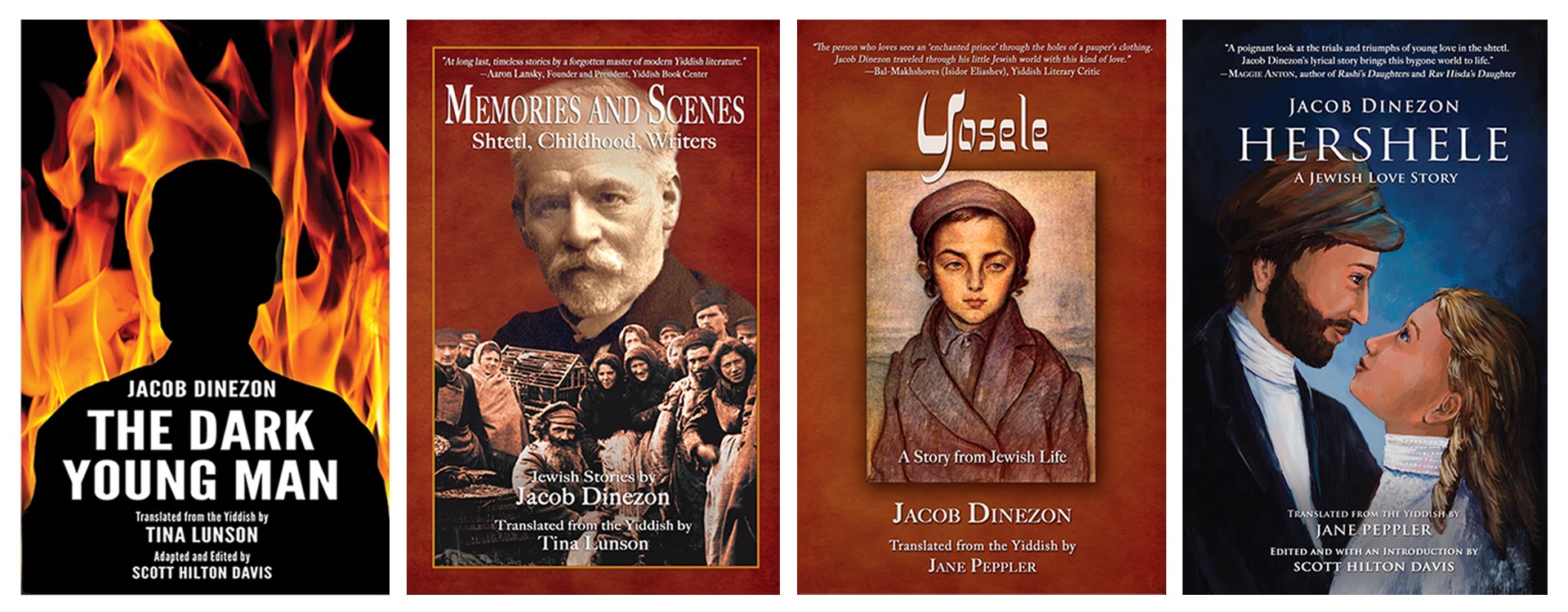
Hershelle: A Jewish Love Story by Jacob Dinezon - 1891 - translated from Yiddish by Jane Peppler - 2016


1851 - New Zhanger, Lithuania

1891- Publishes  Hershelle:A Jewish Love Story

1919 - Warsaw


I first began reading Yiddish literature in translation in December of 2012.  Yale University Press inspired my interest with a gift of The Yale Yiddish Library Collection. The alleged theme of my blog is literary works about people who lead reading centered lives and I quickly came to see how central reading was to Yiddish culture.  

I think my favorite work of Yiddish literature is the deeply hilarious profoundly revealing The Letters of Menakhem-Mendl and Sheyne-Sheyndl by Sholem Aleichem, on whose work the movie The Fiddler on the Roof is based.  In the stories of pogroms by I. L. Peretz a terrible history was brought to life with incredible depth and feeling.  Dinezon was friends with them both.


Thanks to the selfless dedication and strongly focused work of Scott Davis, Jacob Dinezon (I urge all to read the very informative webpage on Dinezon I link to at the start of this post for background information on Dinezon and his relationships with other now much better known writers) Dinezon will soon become a canon status Yiddish writer.

Hershelle: A Jewish Love Story is the third novel by Jacob Dinezon I have had the pleasure of reading.  I also read and posted on a few of shid shorter fictions, all published in new translations from the Jewish Story Teller Press.

Hershelle is a student at a yeshiva, a traditional Jewish seminary.  He is considered a brilliant young man, a fine young scholar.  His family is poor.
Poorer students often ate one of their evening meals at the home of one of the richer families of the community, called a charity meal.  This helps the student and the school.  Unintentionally it was often, especially in times of transition like Poland in 1890, a way different social elements of society could interact.  


Here is how Dinezon masterfully sets the events in motion:


The widow is unhappy with every boy that comes for a charity meal.  She keeps rejecting all the boys,  all big eaters, until she is finally happy with one of them, Hershelle. 


“Finally, God saw her misery and sent her a boy of the exact sort she wanted: a quiet child, not much of an eater, but one who was so refined and shy that she often came to him and asked him to eat a bit more. This boy was Hershele. Because the head of the yeshiva needed a favor from Brayndl, he convinced Hershele to accept her paltry Wednesday meal. He then arranged for Hershele—who certainly deserved it for his clever head, zeal, and quietness—to take his Thursday meal with Borekh the butcher. Borekh was known to provide the best charity meal in the whole village. But over time, Hershele came to enjoy Brayndl’s Wednesdays more than Borekh’s Thursdays. Her house was always clean, rich, and bright—it was a pleasure to sit there even without anything to eat. Borekh’s house was always dirty and full of shouting and tumult. And though Hershele quickly became tired of eating, Borekh’s wife hurled more of everything onto his plate. He could barely finish one piece of meat before she laid on another. He sweated, lost his strength to eat, and tried to slow down to catch his breath, but Borekh shouted in his butcher’s voice: “As long as you have a soul in you, keep at it! If you eat as you should, you’ll also learn as you should. Eat like a big fellow and that will give you the strength to be a big fellow before the Torah, which I know can sap your strength!” While eating at Brayndl’s, Hershele felt more refined, but at Borekh’s he became coarser, stuffing himself with meat, kishke, and tripe, and listening to coarse words, curses, and abuse—words he was embarrassed to even think about. Borekh found only one defect in his yeshiva student: “If only he had the strength to eat as he should. He’s a great boy. He can explain the law or a complicated story from the holy Torah. If he’d just eat like a proper person!” Brayndl, on the other hand, found this a fine trait in Hershele. “He’s a refined child, very genteel,” she’d say, “quiet as a mouse, eats like a bird. No matter how much one gives him, he thinks it’s too much. God grant that he’ll eat up what I don’t begrudge giving him—I know I’m getting a mitzvah through this.”

Of course a problem develops. The young and beautiful daughter of the widow and Hershelle fall in love.  In a culture where marriages were largely arranged, such a match was socially unacceptable.  The widow has engaged a marriage broker who does all they can to make Hershelle look like a horrible potential husband.  However, the butcher wants Hershelle and his dsughter to marry.  He turns against Hershelle, who he feels is insulting him and his dsughter.  Now nobody likes Hershelle.  The Widows sees him as a fortune hunter way below her daughter and the butcher is outraged by his rejection of his daughter.

From this conflict a lot of exciting turns of events are generated.  Hershelle gets in trouble.  The ending Is very powerful.

Hershelle: A Jewish Love story gives us a look at life in a Polish sthetl.  There is humour and pain in this story.

I highly recommend all three of the Jacob Dinezon novels.

I would suggest you read them in publication order, The Dark Young Man, Hershelle, and Yosele.


JANE PEPPLER - Translator

Jane Peppler graduated from Yale University with a degree in Russian language and literature. She began singing Yiddish songs in 1983 and directed the Triangle Jewish Chorale in North Carolina for fourteen years. Peppler studies with Yiddish professor and textbook author, Sheva Zucker, and has attended two intensive summer Yiddish courses at the Medem Bibliotheque in Paris.
In addition to translating Yiddish stories by Sholem Aleichem, Ayzik Meyer Dik, and Mendele Moykher Sforim, Peppler has completed English translations of Jacob Dinezon’s Yosele (www.jewishstorytellerpress.com/yosele.html), Alter, and Hershele.
In 2014, Peppler published Yiddish Songs from Warsaw 1929-1934: The Itsik Zhelonek Collection. She has also produced and performed on several albums of Yiddish music, including “I Can’t Complain (But Sometimes I Still Do),” “Cabaret Warsaw: Yiddish and Polish Hits of the 1920s-1930s,” and the three volume set, “Yiddish Songs from Warsaw.”

Mel u


Wednesday, April 10, 2019

Yosele: A Jewish Life by Jacob Dinezon - 1877 - translated from Yiddish by Jane Peppler - 2015 - 139 pages.


Jewish Storyteller Press


1851 - New Zhanger, Lithuania

1899 - Publishes Yosele: A Jewish Life

1919 - Warsaw


I first began reading Yiddish literature in translation in December of 2012.  Yale University Press inspired my interest with a gift of The Yale Yiddish Library Collection. The alleged theme of my blog is literary works about people who lead reading centered lives and I quickly came to see how central reading was to Yiddish culture.  

I think my favorite work of Yiddish literature is the deeply hilarious profoundly revealing The Letters of Menakhem-Mendl and Sheyne-Sheyndl by Sholem Aleichem, on whose work the movie The Fiddler on the Roof is based.  In the stories of pogroms by I. L. Peretz a terrible history was brought to life with incredible depth and feeling.  Dinezon was friends with them both.


Thanks to the selfless dedication and strongly focused work of Scott Davis, Jacob Dinezon (I urge all to read the very informative webpage on Dinezon I link to at the start of this post for background information on Dinezon and his relationships with other now much better known writers) Dinezon will soon become a canon status Yiddish writer.

Yosele gives us a detailed vivid vision of what it was like to be a poor school boy, maybe 12, in a traditional Jewish School focusing on the Torah.  (They were known as cheders.) Through focusing on Yosele we learn of the abuse and cruelty they were common in such schools.  Yosele's mother is the mainstay of the family, her husband can be violent with his children and her.  Yosele is often the subject of his anger. His mother very much wants to enroll him in a school normally reserved for boys from afluent families.  She begs the teacher's wife to let Yosele enroll, she will work double to pay his fees.

Because he is much poorer than the other boys, they feel free to ridicule him.

The teacher takes his anger on other boys out on him, then claims it was a mistake.  Failure to learn your lessons, memorizing text, could lead to a beating.

The teacher's wife makes him do household work for her.  We see the humiliating way he is treated.  His parents come to resent him. On what should've been a lucky day Yosele finds a rubble and gives it to his mother.  His parents assume he stole it.  From here things spiral badly down for Yosele.  He is expelled. He is branded all over the area as a thief  when someone frames him for stealing a pin knife.  From here things get much worse.  He ends up expelled, his siblings are farmed out as servants.  I don't want to tell to much more but the depiction of the death of his mother, caused by her humiliation was powerfully real.

There are good people in the story.  A man finds Yosele sleeping in the street on  a cold night and takes him in.  His wife feeds and clothes him.  They cannot believe he was treated so cruelly.

Yosele can stand with the classic novels by Dickens about schools. We learn a lot about life in Jewish communities in Eastern Europe.  

Through it all young Yosele wanted but to study the Torah and to honor his parents.

Dinezon does a very good job with the characters.  Everyone was very convincing.  

Dinezon was heavily involved in school reforms.  

I highly recommend this work.  

As a Kindle edition it is very fairly prized at $3.95

JANE PEPPLER - Translator

Jane Peppler graduated from Yale University with a degree in Russian language and literature. She began singing Yiddish songs in 1983 and directed the Triangle Jewish Chorale in North Carolina for fourteen years. Peppler studies with Yiddish professor and textbook author, Sheva Zucker, and has attended two intensive summer Yiddish courses at the Medem Bibliotheque in Paris.
In addition to translating Yiddish stories by Sholem Aleichem, Ayzik Meyer Dik, and Mendele Moykher Sforim, Peppler has completed English translations of Jacob Dinezon’s Yosele (www.jewishstorytellerpress.com/yosele.html), Alter, and Hershele.
In 2014, Peppler published Yiddish Songs from Warsaw 1929-1934: The Itsik Zhelonek Collection. She has also produced and performed on several albums of Yiddish music, including “I Can’t Complain (But Sometimes I Still Do),” “Cabaret Warsaw: Yiddish and Polish Hits of the 1920s-1930s,” and the three volume set, “Yiddish Songs from Warsaw.”

I'm hoping to read another novel by Dinezon Hershelle:A Jewish Love Story in May.

Mel u

Friday, September 18, 2015

"Apocalypse" by Jacob Dinezon. ( from Memories and Scenes, Shetl, Childhood, Writers, edited and introduced by Scott Davis, translated from Yiddish by Tina Lunson)


Home Page of The Jacob Dinezon Project


"“My dream,” says Scott Davis, “is to see an English translation of Jacob Dinezon’s stories sitting on the bookshelf beside the works of his friends, Sholem Abramovitsh, Sholem Aleichem, and I. L. Peretz. And to know that Jacob Dinezon has finally returned to his rightful place as the beloved uncle of modern Yiddish literature.”


I first began reading Yiddish literature in translation in December of 2012.  The alleged theme of my blog is literary works about people who lead reading centered lives and I quickly came to see how central reading was to Yiddish culture.  ( I know there are lots of complicated notions packed into the expression "Yiddish Culture" but this not the place and I am far from the person to talk at length on them.)

I think my favorite work of Yiddish literature is the deeply hilarious profoundly revealing The Letters of Menakhem-Mendl and Sheyne-Sheyndl by Sholem Aleichem, on whose work the movie The Fiddler on the Roof is based.  In the stories of pogroms by I. L. Peretz a terrible history was brought to life with incredible depth and feeling.  These two writers along with Sholem Abramovitsh whom I have not yet read are considered the classic must read Yiddish writers.  Of course the issue in any literary culture of whose work endures is only partially based on merit, writers come in an out of fashion.  I think in the case of a literature like Yiddish from a partially destroyed culture dependent on translations for works to be read this is very much true.  Of course most publishers are shy to produce the works of relatively unknown writers in translation for fair to them business reasons,  

Thanks to the selfless dedication and strongly focused work of Scott Davis, Jacob Dinezon (1851 to 1919-Warsaw - I urge all to read the very informative webpage on Dinezon I link to at the start of this post for background information on Dinezon and his relationships with other now much better known writers) Dinezon will soon become a canon status Yiddish writer.

There a good number of short stories and some posts more like essays in Memories and Scenes, Shetl, Childhood, Writers- Jewish Stories by Jacob Dinezon edited and marvelously introduced by Scott Davis, with translations by Tina Lunson.  Over all I think anyone already into Yiddish literature needs this book and it is probably an excellent starting point for neophytes.  My custom in posting on a collection of stories is to talk about the works in the collection one at a time and I will follow that here.  


Apocalypse" is set in a Polish shtetl, a small mostly Jewish community. This is a delightful story, hilarious at times, very poignant at others.  It focuses on Mehulemis, a teacher and a widower.awaiting the coming of his third wife.  He spends a lot of his time reading old texts, arguing with other men at the prayer house.  It was fascinating to sit in as he argued with his friend Fighl, supported by the earning from a store his wife owns. They began to debate as to whether or not Rothchild really existed, if he was as rich as claimed, and if he was buying up land in Palestein for a homeland for Jews.  Mehulemis decides he will seek out Rothchild and ask him for money.  His friend tells him he is crazy.  He starts out on a Quixote like quest through Poland which takes a very dark turn.  I want to quote enough from the text to give you a feel for the delightful style.


"Apolacypse" is a first rate story, there is also a lot to be learned about Yiddish history in the story.  The question of the wealth and even existence of Rothchild takes us deeply into a lot of things.  Davis conveniently provided a vocabulary of  Yiddish terms at the end of the collection.

Yiddish literature is one of the great treasures of the reading life.  I salute Scotf Davis and Tina Lunson for making another great Yiddish writer easily accessible.  


"Scott Hilton Davis is a storyteller, playwright, and collector of Russian and Eastern European Jewish short stories from the late nineteenth and early twentieth centuries. Convinced of the historical, cultural, and ethical significance of stories by Sholem Abramovitsh, Sholem Aleichem, I. L. Peretz, and the lesser-known writer, Jacob Dinezon, Scott now uses storytelling and playwriting to bring works by these beloved Jewish writers to new audiences. He is the author of Souls Are Flying! A Celebration of Jewish Stories and Half A Hanukkah: Four Stories for the Festival of Lights. Scott is a former public television executive with more than thirty-five years of experience writing, producing, and directing documentaries and dramas. He lives in Raleigh, North Carolina."


Tina Lunson is the former administrative director and senior consultant to the Vilnius Program in Yiddish Language and Literature. She worked with the United States Holocaust Memorial Museum as an expert consultant, researcher, and translator for several exhibitions, including “The Hidden History of the Kovno Ghetto,” and served as historical consultant and on-site guide for two Holocaust-era film projects. Tina received her Master of Arts in Jewish History from Baltimore Hebrew University and has completed post-graduate work at Columbia University in Jewish Studies. Her English translations of works in Yiddish include Jacob Dinezon’s Zikhroynes un bilder and Der shvartser yungermantshik, Yizkerbukhs (Holocaust memorial books), and commissioned translations of family letters, personal papers, correspondence, and diaries.


Featured Post

Imperial Reckoning: The Untold Story of Britain’s Gulag in Kenya by Caroline Elkins - 2005 - 701 Pages

  Imperial Reckoning:     The Untold Story of Britain’s Gulag in Kenya by Caroline Elkins - 2005 - 701 Pages 2006 Pulitzer Prize Winner From...