Showing posts with label Nabokov. Show all posts

Monday, January 3, 2011

Lolita by Vladimir Nabokov

Lolita by Vladimir Nabokov (1955, 317 pages)


Not long ago I read Vladimir Nabokov's (1899 to 1971)   Pale Fire and was totally taken in my the beauty of the language and the sheer originality of the book.   I loved Pale Fire.    Of course I knew it was not his most famous book and also not the book that he himself set most store on.

Lolita is a book about a lot of things.    In the mind's of those who have not read it and never will it is about a middle aged pedophile in love with his step daughter.    If we say a man has a "Lolita Complex" people will have an idea what you mean.   I was trying to think who the previous author might be who had created the name for a complex of some kind and I had to go back to Sophocles to come up with an author's name.     Lolita is already considered by many to be a classic and it appears on a lot of best 100 novels of all times list.   The success of this book gave Nabokov the ability to write full time.

The lead male  character of the book, who calls himself Humbert Humbert, is a very cultivated European who by circumstances not fully of his own choosing is living in America.   One of the themes of the book is the seeming contrast of European culture and decadence with American naivety and obsession with consumerism.

As I began to read Lolita, of course I already knew the basics of the book before starting it (or at least I thought I did).    I was really struck by the beauty of the language then I was a bit shocked by what he was talking about.    It seems Nabokov is trying to pull from us a response that makes us feel partially complicit in what happens.     The fact that Lolita herself has such few redeeming qualities makes it hard to care about what is happening to her.    Of course given how she was raised it is not surprising that she has serious issues.

It is hard to care about Lolita even though she is a terribly abused and exploited young girl.     I think this is somehow a commentary on the fact that those who seem "nice and sweet" get more of our sympathy than others, no matter how young they are.

I am not inclined  to feel a need to  post a lot about Lolita.    It is exquisitely written by one of the master prose stylists of the English language.     It is not a celebration of pedophilia, quite the opposite.  

A very interesting pairing of reads might be Lolita and Naomi by Junichiro Tanizaki.    Naomi (1924) is about a man's obsession and virtual enslavement by a 14 year old girl.  

Of Pale Fire and Lolita I guess I would suggest Lolita first for the sake of its great fame but do not deprive yourself of the pleasure of Pale Fire.

If anyone has any suggestions as to my third Nabokov please leave a comment.

Also please leave a comment as to whether or not you think Lolita or Pale Fire will still be in print and widely read in 2060.    

Thanks

Mel u

Sunday, October 24, 2010

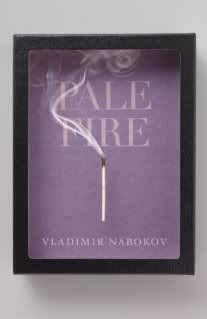
Pale Fire by Vladimir Nabokov


Pale Fire by Vladimir Nabokov  (1962, 315 pages)

"One cannot read a book: one can only reread it. "-Vladimir Nabokov

Pale Fire by Vladimir Nabokov (1899 to 1971) is a wonderfully creative, very funny work of genius.     The prose is dazzling in its brilliance and beauty.    As I read the book I began to wonder what is Nabokov doing in this work.    Sometimes it seemed like Pale Fire was an incredible work of art that speaks deeply about a large range of topics and sometimes it seemed like an elaborate semi-private joke.  Of course maybe in the end it is both of these things.    It is also a great commentary on the reading life and a lesson in how to read.   

There are two central figures in Pale Fire, set in an imaginary small town in up state New York.   One is John Shade who has written a 999 page poem called Pale Fire.   The poem is part of the novel and we get to know Shade directly only through the poem.    The eighteen page poem is itself a mystery.   Is it supposed to be silly  or we just not able to understand the great brilliance of it all?   The bulk of the novel is taken up with a commentary on the poem written by Shade's very crazy neighbor, Charles Kinbote.   In the mind of Kinbote, the poem Pale Fire contains great wisdom and hidden truths that it is his sacred duty to reveal to the world. 

     Kinbote is as crazy a character as I have encountered in a long time.   He lives next door to Shade.    He is an unreliable a narrator as one could find.    Sometimes Kinbote seems like a crazed stalker.   Much of Kinbote's commentary on the poem seems totally based on his own obsessions and multifarious delusions and has little to do with the poem.    Some of the time it seems Shade and Kinbote are life time close friends and some times it seems they barely know each other.    Kinbote constantly talks of the history of the  "The Northern Kingdom of Zembla" and at times seems to think he is the king in exile.  Kinbote wants desperately to see a hidden meaning about Zembla and its politics in the poem.   .    We are left wondering whether the kingdom even exists at all or if it is just a strange fantasy.   

Pale Fire is, among other things, a satire on overly intellectualized literary commentary.   As I was reading Pale Fire I at first tried to "understand" the book then I stepped back and simply decided to enjoy it.  

Most of the works I have blogged on in the last year can be readily  compared to other works.   I cannot think of any easy comparisons  for Pale Fire.   It would well repay numerous readings.     Even if it is an elaborate joke it is still a stunning work of art.       When you read this book, just give yourself over to the wonder of the language and the strangeness of the narration and do not over stress on understanding it.   Nabokov said that the best of  literature was what he called  "ecstatic fairy tales"  and to me Pale Fire is in this category for sure.   

A lot of people in their Goodreads.com or Amazon.com reviews of Pale Fire stress that it was a difficult to understand but quite profound work.   This is no doubt  true but it also accepts the joke as straight and misses the great fun of this work.   I read his only really famous work, Lolita,  a long time ago.   I recently acquired a copy of it in a book trade and will be rereading it soon.   

Mel u


I have since I posted this read and posted on Lolita

Featured Post

Imperial Reckoning: The Untold Story of Britain’s Gulag in Kenya by Caroline Elkins - 2005 - 701 Pages

  Imperial Reckoning:     The Untold Story of Britain’s Gulag in Kenya by Caroline Elkins - 2005 - 701 Pages 2006 Pulitzer Prize Winner From...