Showing posts with label maupassant. Show all posts

Thursday, February 14, 2013

"Tombstones" by Guy de Maupassant-Project 196-France

"Tombstones" by Guy de Maupassant  (1881, 5 pages)


France

Country 26 of 196
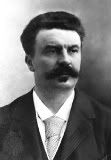
Guy de Maupassant


Project 196 is my attempt to read and post on a short story from an author from each of the 196 countries of the world.  Of the prior 25 countries, only the United States can come close to challenging France in a literary shootout.    France is home to the consensus second best short story writer that ever lived, Guy de Maupassant.  I am in the process of reading all the short stories in the ebook of the Gutenberg Edition of  The Complete Short Stories of Guy de Maupassant.  (I do not doubt that there are stories left out of the ebook but it is enough de Maupassant for most people!)  
People who know a lot about the short story like Frank O'Connor say de Maupassant wrote about ten truly great short stories and most of them dealt with prostitutes and/or soldiers.  "Tombstones" is not one of his great short stories, it relies on a surprise ending for its impact and was probably written fast to get money.  It is in a way very typical of one of his stories.   (I will provide a link where you can read it online if you want.)
"Tombstones" begins with a very well done scene setting paragraph:

The five friends had finished dinner, five men of the world, mature, rich, three married, the two others bachelors. They met like this every month in memory of their youth, and after dinner they chatted until two o'clock in the morning. Having remained intimate friends, and enjoying each other's society, they probably considered these the pleasantest evenings of their lives. They talked on every subject, especially of what interested and amused Parisians. Their conversation was, as in the majority of salons elsewhere, a verbal rehash of what they had read in the morning papers.
De Maupassant sets for us a sophisticated opening.  We can see into the world of the men just from these few lines.  Our story will focus on an interesting adventure (we know he will tell his friends all about it) of one of the men:

One of the most lively of them was Joseph de Bardon, a celibate living the Parisian life in its fullest and most whimsical manner. He was not a debauche nor depraved, but a singular, happy fellow, still young, for he was scarcely forty. A man of the world in its widest and best sense, gifted with a brilliant, but not profound, mind, with much varied knowledge, but no true erudition, ready comprehension without true understanding, he drew from his observations, his adventures, from everything he saw, met with and found, anecdotes at once comical and philosophical, and made humorous remarks that gave him a great reputation for cleverness in society.  

Here is what happens (spoiler alert).  On one of his walks he ventures to a cemetery to  pays his respects to a friend killed in a recent war.   He sees a very pretty woman weeping at a tombstone.  He takes the time to comfort her and finds she is the widow of a soldier, killed only a few months after they married.  She is so overwrought she can barely stand up so he offers to escort her home.  At her apartment she asks him if he can kindly walk her up the four flights as she feel shaky.  If course he says yes and accepts the offer to come in for some tea.  He then invites her out to dinner and she changes form her widow's wear into a lighter gown and he is struck by how lovely she turns out to be, barely twenty-one.  A three week romance starts and ends when the man gets bored with her.


This friendship, begun amid the tombs, lasted about three weeks. But one gets tired of everything, especially of women. I left her under pretext of an imperative journey. She made me promise that I would come and see her on my return. She seemed to be really rather attached to me.
1850 to 1893
"Other things occupied my attention, and it was about a month before I thought much about this little cemetery friend. However, I did not forget her. The recollection of her haunted me like a mystery, like a psychological problem, one of those inexplicable questions whose solution baffles us.


He loses touch with her and one day he walks through the same cemetery where he first met her.   He sees a well dressed affluent looking man helping walk away from a tombstone, she fraught with grieve.  Only this time she is at another tombstone!    Here is how de Maupassant ends the story:


But as I wandered in another direction of this great city of the dead I perceived suddenly, at the end of a narrow avenue of crosses, a couple in deep mourning walking toward me, a man and a woman. Oh, horrors! As they approached I recognized her. It was she!
"She saw me, blushed, and as I brushed past her she gave me a little signal, a tiny little signal with her eye, which meant: 'Do not recognize me!' and also seemed to say, 'Come back to see me again, my dear!'
"The man was a gentleman, distingue, chic, an officer of the Legion of Honor, about fifty years old. He was supporting her as I had supported her myself when we were leaving the cemetery.
"I went my way, filled with amazement, asking myself what this all meant, to what race of beings belonged this huntress of the tombs? Was she just a common girl, one who went to seek among the tombs for men who were in sorrow, haunted by the recollection of some woman, a wife or a sweetheart, and still troubled by the memory of vanished caresses? Was she unique? Are there many such? Is it a profession? Do they parade the cemetery as they parade the street? Or else was she only impressed with the admirable, profoundly philosophical idea of exploiting love recollections, which are revived in these funereal places?
"And I would have liked to know whose widow she was on that special day."


Now he wonders, is she a hunter of the cemetery?   Does she make fools of a series of men she meets there?  Will she still be there in twenty years?  What will the man tell his friends?  Sometimes a mediocre story by a great writer is still a very good story.


You can read this story here.


Wednesday, July 11, 2012

"The Father" by Guy de Maupassant

"The Father" by Guy de Maupassant (1881, 12 pages)

As one of my long term reading projects I am working my way through the complete, as translated into English, short stories of Guy de Maupassant (1850 to 1893-France).   I am using as my text the Guntenburg edition, in nine volumes, of his complete stories.  (I do not doubt that there maybe stories missing from the collections but there are enough for me and the famous ones are in the collection.)  The consensus is that Maupassant wrote ten or so short stories that are of world literary heritage class, lots (near 400 in all I think) lots that are decent stories and lots that seem written really rapidly which some think are sentimental to the point of mawkishness and were just churned out to sell to support his expensive life style.   Anyway the great stories are wonderful and the rest are quite good and they are for sure important texts for anyone into the short story.

I guess "The Father" does seems very sentimental and is written to pull on our emotions in a style that  lacks any real subtly.    It is still a good story and I am very glad I read it and will push on through his collection.   "The Father" is about a very ordinary man living in Paris.   He took the omnibus into Paris to his cleric job and every day a lovely girl would sit near him.   She was a "little brunette with a complexion like ivory".   He liked her face the first time he saw her.   He longed to hold her in his arms without knowing why he felt that way.  She begins to notice he is staring and her and she blushes over his attention.  They gradually strike up an acquaintanceship which passes into a friendship and becomes a sort of romance when he asks her to dinner.   She accepts on the condition he will totally respect her and make no untoward advances.   He of course agrees.   They begin to keep company but  when she will not allow any advances he ends the relationship.   One day he hears a knock on door and it is her.   A few months go by and the romance has been consummated and  he wants to figure out how to get her out of his life.  She lives with her mother and the shame is terrible when she has to tell her she is pregnant and abandoned.   Ten years go by and the man continues to barely make a living, live in his shabby apartment and never finds another love.   Then he sees the woman out  in the park.  But now she is no simple shop girl, she is dressed as a fine lady.   She has a ten year old boy with her and a girl of five.   The man begins to stalk her and he soon knows the boy is his son.   He finds where she lives, speaks with her and discovers she has married a gentleman who accepts her son and knows her full past.   The man is consumed with a desire to meet his son.   He send the woman's husband a letter fully accepting him to want revenge on him.   He receives a letter back inviting him to their house.   When he gets there the man is formally polite and shows him no overt bad will.   The ending is very emotional.   Francois meets his son for the first time and cries out good bye and runs from the house as if her were a thief.

I concede this is a very melodramatic story that plays on our feelings in a pretty obvious way.   Still it is worth reading and it shows the good and bad side of a father, one by biology and one by love.


This post is also part of my participation in Paris in July 2012 hosted by Book Bath and Thyme for Tea.

Mel u

Maupassant meets Swinburne -A short story and an Essay by Julian Barnes

"An Unlikely Lunch:   Maupassant met Swinburne" by Julian Barnes (2012, 5 pages-essay)

"The Englishman of Etretat" by Guy de Maupassant (1873, translated 2012 by Elliot Lewis)

Agitated Sea at Etretat, by Claude Monet from 1883, depicting the famous rocky archway through which Swinburne was swept out to sea in 1868.


Anytime you can read an essay by Julian Barnes for free, especially one on French literature, you should take the time time.   My main purpose in this post is to make sure my readers know about a new to me resource that looks like it has wonderful potential.   The Public Domain Review carefully selects and introduces texts, videos, music, and art work that is in the public domain.   They are very eclectic in their choices including everything from early 20th century Japanese art prints from little known magazines, to rare videos to records of really old singers I never dreamed I could hear online and best of all for me, lots of things I never heard of before.

Guy de Maupassant (there is some background information on him in my prior posts) is pretty much the consensus second best short story writer of all time.   Maupassant wrote a lot of short stories (pushing 400), my guess (backed up by Frank O'Connor) is that about ten of them are totally great world heritage stories, most of the rest are good stories however a lot of them were written fast by formula and some say they are sentimental to the point of mawkish.

"The Englishman of Etretat" can perhaps best be classified as a non-fiction story or a memoir.  Told in the first person in the voice of the author, it is about the time he met the famous English poet Algernon Swinburne who had come to France to meet Victor Hugo.   Here is a sample of this intriquing work

I believe it was in 1867, perhaps 1868; a young Englishman of unknown origin had bought a little thatched cottage under the trees in Étretat. There he cultivated an uncommon, even unusual existence, largely alone amidst a local population both sly and small-minded that granted him little beyond a customary distrust. We’re led to believe that this eccentric Englishman dieted exclusively upon monkey (whether, sautéed, roasted, boiled or preserved; no matter) and that he would talk aloud for hours, though quite alone. In fact there abounded a hundred such stories serving only to confirm in the minds of the neighbourhood gossips that this fellow was far from ordinary. Perhaps most remarked upon was his living on terms of intimacy with a large monkey: had it been a dog or a cat, surely nothing would have been said, but a pet ape? How awful! What savagery! 

The very real fun in this work, maybe not accurate to call it a short story even though it reads just like one, is in Maupassant's reaction to the very strange Swinburne.  Maupassant knew that he he met someone very special and quite out of the ordinary.  He said of him.
possessed of an uncommon intellect, illuminated undoubtedly by the kinds of nocturnal reveries that inspired Edgar Poe. He had translated a volume of extraordinary Icelandic Legends of which I would most urgently welcome a French translation. Predisposed to the most intricate of spiritual distortions, he inclined instinctively towards the supernatural, the macabre, the profane, but nevertheless and with typically English phlegm, spoke utterly naturally of such unsettling subjects, his calm and quiet voice conferring thereupon a hallucinatory degree of normality. 

I urge anyone interested in either Swinburne or Guy de Maupassant to take the time to read this work.

Julian Barnes fascinating essay is in part about the encounter of Swinburne and de Maupassant but a lot of it is devoted to explaining English tourism on the coast of France and the pilgrimages of literary English to Normandy.   (I have posted on two of Barnes's novels and their is some background information on him in them.)   British artists also began to come to Normandy shortly after the Napoleonic wars ended.  Oscar Wilde came there as soon as he got out of jail.   Swinburne nearly drowned there and on the day that happened de Maupassant was in close vicinity, maybe in  a nearby fishing boat and he was invited to have lunch with Swinburne.   The lunch was a truly bizarre event, in the eyes of de Maupassant it seems an English lunatic with a poetic genius has landed on Normandy and who may have served him monkey meat for lunch.   The belief among the locals in Normandy was  that Swinburne ate only monkey, he did have several monkeys in his house.   Barnes does just a wonderful job describing the luncheon and there is a lot of fascinating quite new to me literary history in the essay.   I cannot imagine anyone with an interest in either writer or English or French literary history not being delighted by the essay of Barnes.

This post is also part of my participation in Paris in July 2012 hosted by Book Bath and Thyme for Tea.

Mel u

Friday, February 10, 2012

"Queen Hortense" by Guy de Maupassant

"Queen Hortese" by Guy de Maupassant (1885, 12 pages)

Words and Peace does a very interesting meme every Thursday, I Love France, where we are asked to leave notes of our posts on anything related to France.     I am currently reading The Complete Short Stories of Guy de Maupassant through a Kindle edition.   He published nearly 200 or so short stories in his life so this may seem, like a lot but the volume is no longer than three Trollope novels.   The quality of the stories vary a lot.   Some justify his claim to be the second best short story writer in world history and some clearly were written by formula in a hurry.   I am a bit past the 50 percent point in the collection.


One of the common themes in his stories is a sense of lives ruined by steps not taken, whether from reticence, fear, vanity, love or any of a hundred reasons.  "Queen Hortense" is about a older woman who never married, her two sisters did.   She is queen over the court yard at her modest house.   Her subjects are the cats, chickens, and stray dogs she feeds and holds court over.


She never had a lover of any kind or even it seems many friends. That is the way she wanted things.  Her sisters do not seek a lot of contact with her and Hortense has let her appearance and her health go for way to long.   One day the sisters are notified that Hortense is on her deathbed.   They along with their children and husbands go to see her.    As they enter her room she is giving advise to children who are not there, she is scolding a nonexistent husband and swearing her love to a man that never existed.   Her sister conclude she is fantasizing about the life she never had and always told everyone she totally did not want.   The sisters go in her room and try to talk to her while her brother in laws wait in the outer room.    As the attending doctor comes out to tell the men she has passed away, one of them says to the other "that did not take as long as we feared it might".


Not a story for the best short stories of the world list (Guy de Mauapassant has at least ten stories that could go on such a list) but it brings a woman to life for us in just a few pages and has a solid meaning.  


 Hortense Bonaparte (1783 to 1837) was the stepdaughter of Napoleon and became Queen Consort of Holland so maybe de Maupassant is making a  political point with the name of the central character in this story


Mel u

Tuesday, December 13, 2011

"The Maison Tellier' by Guy de Maupassant

"The Masion Tellier" by Guy de Maupassant (1881, 20 pages)
The Lonely Voice:   A Study of the Short Story by Frank O'Connor (1965)  Chapter Two, "Country Matters" (on Guy de Maupassant, 16 pages)

Frank O'Connor's pick for the best 
Guy de Maupassant short story

From French Public Television Production of
"The Tellier Mansion"
Also a Pic of French women in Lingerie might be good
for my blog stats!

Frank O'Connor's The Lonely Voice;   A Study of the Short Story is far from a faultless work.   It seems pretty clear in it that O'Connor was homophobic, perhaps anti-Semitic, and certainly did not see women as close to his equal.   This being said, his book is the best and maybe the only book worth reading on the short story.  I think O'Connor is near the top of his form when he writes about  writers he sees as like himself meaning Chekhov and Turgenev.   The writer he seems to most relate to is Guy de Maupassant.  His chapter on Katherine Mansfield needs a lot of correction.

The theme of The Lonely Voice is that the short story at its best is about "submerged population groups" that have no one to speak for them.   Leaving aside the huge irony that O'Connor seemingly cannot see Gays as historically such a group, I think he is for sure expressing a very fundamental truth.  ( I have posted before on several of Guy de Maupassant's short stories and his novella, Jean and Pierre and there is some background information on him in my prior posts.)

O Connor tells us (page 63) that the submerged population group that the very best of  de Maupassant's  short stories are about is workers in brothels and their clients.    O'Connor points out that there is a kind of tragic irony in this in that once de Maupassant started to make real money from his stories about prostitutes he spent the money he made on the stories on prostitutes and died at 43 from a then incurable venereal disease.   O'Connor rightly points out that others had written stories about prostitutes before he did  but only in a snickering school boy kind of way.   

Madame and the Girls in Church
"The Mansion Tellier" is O'Connor's pick for the absolute best of the short stories of de Maupassant (out of around 180, I think).   It is set in a small town brothel in  France, a long way from Paris.    It is run by Madame Tellier, who inherited the business.   The villagers accept it as just another cash business, more or less.   De Maupassant does a very good job of describing the owner, the bouncer, the clients and above all the girls.   We do not really learn how the girls wound up in the Mansion Tellier but we know their personalities and what they look like.   Clearly tastes ran to more corpulent women in those days and this was not a fancy expensive place so the girls are not great beauties (unlike the ones in the photo from the French TV production of the story-OK just a gratuitous excuse on my part to post a picture of French women in lingerie on my blog!)    The place is as much a social meeting, get away from your wife kind of place as it is sex dispensing establishment.    One day Madame Tellier gets an invitation to the first communion  of her niece.  Her brother wants his childless sister to name the girl as her heir.   Madame Tellier ends up deciding to close down her house and take all the workers to the communion, a full day trip away, where they will stay overnight at her brother's house.   

The wonder of the story is in the reaction of the customers when they find a closed sign on the door as well in the interaction of the girls, the niece, the sister in law and the respectable people at church.  De Maupassant creates a perfectly realized world in twenty pages or so.  (There is no translator credit given at my source for the story.)    

"The Masion Tellier" is a flawless story.

On a side note, once the Japanese began to write short stories and novels in the European style they took as their role model de Maupassant and Flaubert.   Many of the best of the Japanese authors from 1910 or so on focused on stories set in what was called "The Water World" of geishas, prostitutes, actresses and tea house/brothels.   

I downloaded a Kindle edition of the complete short stories of Guy de Maupassant yesterday.    It seems to come to under 2,000 pages and I hope to read all the ones I have not yet read in 2012.   It might seem like a lot but Les Miserables was around 1400 pages.   I will refrain from posting on all but the ones that seem the very best. I will list them on my short stories page as I read them for my records.  I know he wrote a lot of stories really rapidly and the ones he wrote fast I will in turn read rapidly.    


You can download all of his translated short stories and most of his longer works from Manybooks.

Mel u

Thursday, September 8, 2011

Two Famous American Short Story writers double team the world's second best short story writer

"The Story of a Farm Girl" by Guy de Maupassant (1884, 9 pages)
"War" by Sherwood Anderson (1921, 6 pages)
"The Girl and the Habit" by O. Henry (1905, 5 pages)

Whose Story is Best?

Guy de Maupassant (1850 to 1893-France) is often listed, behind Anton Chekhov, as  the second greatest short story writer in the world.    He certainly was one of the most prolific with over 250  stories to his credit.     O Henry (1862 to 1910-USA) is famous for his "surprise ending" short stories like "The Ransom of Red Chief" and "The Magi".    He is very much an American writer and the leading annual American short story award is named for him.     Sherwood Anderson (1876 to 1941-USA) is most famous by far for his linked collection of short stories, Winesburg, Ohio.    Readers of O Henry like his work, they chuckle at the ones with good endings, where readers of Anderson love his work and are shocked by the sheer depth of his seemingly simple stories.   Today, just for fun, I will look at a story by each of these writers (not their best but I will explain why I picked them) and decide which one has the most merit and give some reasons.

"The Girl and the Habit" by O. Henry is third best, no way around this he is out of his class here.   "The Girl and the Habit" is set in a restaurant in the financial  district in New York City.    O Henry does a good job of describing the restaurant and its clients.   Most of the trade is at lunch and most of the customers are men who work in the area.   The cashier is totally beautiful.   All of the men flirt with her as they pay their checks.   She puts them off in a friendly bantering way that O Henry shows us.   How he does it is OK but could be better done.   One day a wealthy financier passes out in the restaurant.   When he wakes up the first thing he sees is the beautiful cashier.   He and his wife ending up adopting her and training her in all the social graces and she dreams of a lofty marriage.   They give her classes to refine her speech so she sounds like she is strictly upper class .  Then one day she is at a big charity even where earls and dukes  are in abundance.   She has been assigned to a both where she will sell items for charity.   An earl who she and her new parents want her to marry comes up to pay her for an item.   The girl does as a total flash back and speaks to him in her best "streets of Ne York" accent and when he asks her to dinner treats him just like she did the patrons in the restaurant.   As you read the story you are pretty much waiting for the surprise ending.   I found it a bit flat, the characters are one dimensional and the social satire kind of weak.   Not a horrible story but not close to "high art".     I read this story because it was one of the stories of the day at East of the Web:  Short Stories.


"The Story of a Farm Girl" by Guy de Maupassant is our second place story.   It goes into some detail about the farm woman who is the central character in the story.   As we meet her  she awakes from her nap in the barn to find she is being molested by Jacques, one of the farm hands.     She pushes him away and then they go for a walk together during which Jacques declares his love and says he wants to marry her.    She falls in love with him based on this.   When she finds she is pregnant and reminds Jacques of his promise he tells her he just said that to get her into bed and laughs.    Compressing a bit, he shortly disappears.   She has her baby at her mother's house (who dies when the premature baby is born) but she gives it to a neighbor to raise.    She returns to the farm and is a tremendous farm manager in dealing with vendors and such.   The widowed farm owner offers to marry her.  She says no, then He rapes her and then she agrees to marry him.   Six years go by and they have violent fights because she never gets pregnant and he wants a child very badly.    After a very bad fight she tells him she already had a six year old child.   The man is overjoyed and says he wanted to adopt a child since they have not had one.   All the fighting is forgotten and they are both totally happy now.   This story made me feel sympathy for the woman but  it is too sentimental and the ending does not seem right.   I am not sure what to make of rape as prelude to marriage, if it was normal or not but I have read enough of de Maupassant's stories to know he has a thing for robust women with large breasts.    You can easily find this story online.

"War" by Sherwood Anderson (from his collection The Triumph of the Egg) shows us that there is for sure more to Anderson than Winesburg, Ohio:  A Group of Stories of Small-Town Ohio Life.   I think it is clearly the best of these stories.

Pretty much every one who reads Anderson likes his work but some are, I think, put off  from reading his work by the setting of his stories.  "War" is set on a train in the USA.   The time is the years right after WWI.    There are two characters basically in the direct story (there is a story within the story-not easy to do well in six pages but he does).   One is an American man and the other is a Polish woman with a bad facial injury who is sitting near him on the train.   He talks to her a bit, she is traveling with a man who is asleep, and she learns the woman is a refuge from the war in Europe.   She begins to tell the story of how she escaped from Europe.    During the war, she was part of a group of refugees who were being directed toward a camp by a fifty year old German professor drafted into the war efforts.    In a very strange event  open to various readings the man gets into a terrible fight with a quite old refuge woman and seemingly their spirits cross.   The woman takes on the role of the man and the man acts just as the woman had done.   He says over and over he just wants to be left alone and will not move.   The old woman takes tight control of the refuges and leads them on and the man stays behind.   In the confusion the Polish woman and her lover steal some paper work and end up escaping to America (no details given as to how they do this).    I think this is the best of the stories as it does not try to force an emotional response from us.   It makes us think about what really happened during the transfer of spirits in the fight.   "War" is a deep look into how a conflict changes the lives of a few people who never wanted any changes in the first place.   I was happily lead to read it when it was the short story of the day at AmericanLit.com (they have 1000s of short stories on hand and good reading suggestions also).   Anderson makes his characters come to life by showing us small details about their faces, their clothes and such.   He does not tell us how to feel about what happens.   There is great power in what he leaves out

This not meant to suggest that Anderson is a better writer than de Maupassant for I do not think that at all.   Of de Maupassant I think you either have to get some help to find and read his best or just accept you will read some stories that are just formulas and some that are wonderful.

I am always happy to get suggestions for short stories I might like.

Mel u


Friday, June 24, 2011

Three Surprise Ending Short Stories-American, English and French

"Two Thanksgiving Day Gentleman" by O. Henry (1905, 6 pages)
"Cousin Theresa" by Saki (1908,  5 pages)
"The Adopted Son" by Guy de Maupassant (1881, 4 pages)

Ocean Hopping with Three Surprise
Ending Short Stories

Magazine editors have had a lot to do with the way the short story has developed.   During my reading project on short stories of the Australian Bush (Outback Tales from 1870 to 1920 or so) I found the Australian short story first began to blossom when a nationwide weekly publication, The  Bulletin,  began to  publish short works of fiction about "real life" in the Australian outback.   The stories had to be of a certain length and style to be accepted.    During Irish Short Story Week I became aware of how important The New Yorker has been for sustaining the quality of the Irish Short Story.    The standards of the magazine were high and so was the pay.

In India, The Hindu published many of the short stories of R. K. Narayan and others.    They imposed length requirements on their writers and catered to readers whose first language was not English.    Magazine editors liked surprise ending short stories or for sure they thought that is what magazine buyers wanted.   The modern short story almost began to develop in revolt against the surprise ending short story.    This morning I want to spot light three surprise ending short stories by three very famous short story writers.

"Two Thanksgiving Gentlemen" by O. Henry (1862 to 1910-USA) is a classic surprise ending short story.   (There is some background information on O. Henry in my prior posts on him.)   Almost the whole point of the story is building up to the surprise ending.   I sort of saw it coming but not totally.   The story opens on the very American holiday of Thanksgiving.    The central character of the story is a homeless man.    We never learn how he wound up homeless.    For the last nine years a man  has found him on his park bench on Thanksgiving day and taken him out to an elegant Thanksgiving Day lunch (it is a big feasting day).    O. Henry does a great job of bringing the mysterious benefactor to life.   We learn this annual gift of a lunch is the biggest thing in his life.     Maybe the surprise ending is very sentimental and half predictable but the story is worth reading for the people it creates.   O. Henry some times seems like he is just going through the motions of pleasing his editors but there are moments of real brilliance in his work.

All of O.  Henry is in the public  domain.    I read this story HERE.   You can find nearly all his stories online.

"The Adopted Son" by Guy de Maupassant (1850 to 1893-France-he  wrote about 300 short stories) is a classic surprise ending, tear the rug out from under you short story.     Maupassant is often listed as the world's second best short story writers, right behind Anton Chekhov.   (There is some background information on him in my prior posts on him.)      Maupassant supported an expensive life style through the sales of short stories and novellas.     He wrote to please the public and magazine editors.   A number of his short stories (I have read 14 of them since I began my blog  on July 7, 2009) do seem like they were written by a formula and rely on melodrama and the evoking of feelings of guilt for their power.   A lot of them are surprise ending short stories.   At his best he a great master of the genre.   As the story opens we meet two poor country families who had sons about the same time.
Both families struggle to survive.   One day a wealthy woman passes in her carriage and the lives of one of the families is changed forever while the second family endures on in resentment of their luckier neighbors.    There is sentimentality about the poor in France in Maupassant for sure.   At the ending of the story a terrible surprise is brought down on one of the families but I did not really see it coming.   This is a decent story and though not a work of genius.

You can read "The Adopted Son" HERE

"Cousin Theresa" by Saki (Henry Munro-1870 to 1916-UK)  is very much a typical Saki surprise ending short story.   (There is background information on Saki in my prior posts on him.)     Saki's stories are normally gentle social satires on the foibles of the upper and middle classes in Edwardian England.   Nobody is poor in his stories, unlike those of  O. Henry and de Maupassant.    There is no playing on guilt and little real characterization.    The pleasure of his stories, which is very genuine, is in his elegant prose and the kind of "super smart child" feel that his stories seem to have.     His stories are fun.   Some will find the prose too mannered.    Some will lollipop there way to the end of a Saki story to see what the surprise ending will be.    "Cousin Theresa" is a pretty self indulgent story.     It is about a father and his two sons.    One of the sons has just returned from a long posting at some remote place in the British Empire.  The son had some sort of big accomplishments or other.    His other son seems to be a lay about who devotes all his time to scribbling out plays.   The father tells himself, "OK one of my sons may be wasting his life but at least the other will bring the family fame through his governmental service."     The slacker son's play "Cousin Theresa" gets preformed on the stage in front of the Royal family.   I bet you can probably see the ending coming now.   "Cousin Theresa" exists pretty much just for the surprise ending.   It takes only a moment or two to read it and it will make you smile (and feel smart if you see the ending coming).

You can read "Cousin Theresa" HERE.

What are your feeling about "surprise ending" short stories?

Mel u

Wednesday, June 8, 2011

"Idylle" by Guy de Maupassant-I need Some Help on this story!

"Idylle" by Guy de Maupassant (1881, 4 pages)


I need some help on this one!
woman breastfeeds a stranger on a train
how should we see this story

"Idylle" is open to several interpretations.   The facts of the story are fairly simple.    A man is riding on a train in the same compartment of a corpulent young woman (this was an acceptable even desirable body style in the times) with quite large breasts.     The man can see that the woman is lactating as her milk is flowing out and staining her clothes.    We are told the man is hungry and cannot help but stare at the large breasts of the woman.   We are told that the man is a carpenter by trade.   The woman is embarrassed by her condition and says unless her breasts are drained three times a day she will have considerable pain.   (We do not know if the woman is nursing her own child or is a wet nurse.)   The man is described for us as thin, dark, and carrying his carpenter tools.   


In the train compartment with them are an Italian farmer and his wife.   As the train enters a tunnel they open a large basket and have a feast.    As the pass through the tunnel the woman opens her blouse and lets her "huge" breasts out saying she can no longer stand the pain.   The man offers to relief her.


"The young man, confused, stammered: "But ... Madame ... ... I could relieve you."

She replied in a broken voice: "Yes, if you want. You will do me good service. I can not hold out, I can not."

He knelt in front of her, and she leaned toward him, carrying to his mouth in the gesture of a nurse, the dark tip of her breast. In the movement she made by taking her two hands to bring it towards this man, a drop of milk appeared at the top. He began to drink it eagerly, seizing that heavy breast in his mouth like a fruit. And he began to suckle in a greedy and regular way.

He had passed both his arms around the waist of the woman that he was holding to approach her, and he drank with slow sips with a movement of the neck, similar as the children one.
Suddenly she said: "That's enough for this one, take the other one now."
And he took the other with docility.
She had placed her hands on the back of the young man, and she was breathing forcefully now, happily, enjoying the breath of flowers mixed with blasts of air movement being thrown into the cars."
The question then becomes is the woman to be see as a Mary Magdalene type of woman feeding a Christ like figure with the flesh of her body in a kind of reversed Eucharist.    Is it a metaphor for the treatment and condition of the poor in France?
Is there a sexual element in this story?    The man's description seems to put him in the role of both child and sexual supplicate.    Interestingly, when I Googled this story,  I could find it translated only  on a web page that seems to be devoted to those who have a fetish for lactating women. Perhaps it is translated into English with another title but given that I could find about 300 of his other stories translated into English I wondered if this story is considered by some too sexual or near pornographic to place online.  
Guy de Maupassant (1850 to 1893-France-there is some background information on  him in my prior five posts on him) wrote about 300 short stories.   I have isolated (I think) about 10 of his most highly regarded stories and hope to post on them.   I think one of the best chapters in Frank O'Connor's The Lonely Voice-A Study of the Short Story is on de Maupassant and I will be initially concentrating on the stories he endorses as well as a few from book blogs I respect greatly.    I will also be taking a closer look at this chapter in O'Connor's book.   

I do not know if I am up for reading all 300 or so of his stories.   I have already read some I did not feel motivated to post on.   

Not long ago I read Issac Babel's short story "Guy de Maupassant", a very good work.   Babel said if he were asked to do an anthology of world's best short stories half of them would be by Anton Chekhov and half by Guy de Maupassant.

What is your favorite de Maupassant story or short novel?

You can read the story in English HERE-just keep in mind the web page is close to R-Rated-it is also available online in French

Mel u

Friday, January 28, 2011

"Mademoiselle Fifi" by Guy de Maupassant

"Mademoiselle Fifi" by Guy de Maupassant (1882, 13 pages)

Amateur Reader of Wuthering Expectations has recently done some very insightful and inspiring posts on Guy de Maupassant (1850-1893-France) in which tells us what seem to be the consensus on the best short stories of de Maupassant.    I have already posted on four works by de Maupassant, including what seems to be regarded as his greatest short story, "Boule de Suif" which is set in the period of the Franco-Prussian War (1870-1871) and has as one of its central characters a French prostitute.    "Mademoiselle Fifi" is also set during the Franco-Prussian War and has a prostitute as a central character.   (My main source of knowledge about de Maupassant comes from Frederick Brown's great book, Flaubert:  A Biography.   Maupassant was a disciple of Flaubert.    For better or worse, both men were very into prostitutes.)  

The male characters in "Mademoiselle Fifi" are all German officers occupying a conquered Paris, living in a confiscated chateau.      As you might guess, the characters are not portrayed in at all a flattering way.   Some evidently regard this story as almost a self parody and I think it may be from the very stereotypical portrayal of the German characters.    (Some of Katherine Mansfield stories in  A German Pension and Other Stories -1911-also make fun of Germans.)    All of the Germans are depicted as very uncultured, pompous and arrogant.    All have huge mustaches (I think this is a sign of hyper masculinity in the 1870s) and red or blond hair.   One of the officers is called Mademoiselle Fifi by his fellow German officers because he has an effeminate air.   He is the worst of all.   He is violent and he loves to smash up the beautiful objects of art in the chateau.   His manner is contemptuous to all.

The officers in the chateau have been stuck inside for almost three weeks due to heavy rains.  They are all very bored.     They decide to have a party and they arrange for each of the men to have his own French prostitute for the day.  The main French character is a prostitute, Racheal who is identified as Jewish, who is assigned to service the very offensive and insulting to France Mademoiselle Fifi.      Perhaps de Maupassant makes use of prostitutes here to show that the lowest elements of French society have more dignity than Prussian army officers (and one would also have to assume using prostitutes in your  works  increased sales then just as it does now!)  

I do not want to tell to much of the plot of the story as the ending is a lot of fun and I am sure it was loved by the target audience of the story.    This story is probably not real popular in Germany!

I do not know near enough about the short stories of de Maupassant to say if this story is a kind of "dumbing down for the masses" story or not.   It seems written by formula.    I do not thing it is a bad story but it does not have the finely crafted feel of "Boule de Suif" or a Katherine Mansfield short story.


If possible, please leave any suggestions you have for best de Maupassant short stories in a comment-thanks


Mel u

Friday, October 1, 2010

"The Diamond Necklace" by Guy de Maupassant

"The Diamond Necklace" by Guy de Maupassant (1884, 5 pages)

Guy de Maupassant (1850 to 1893-France) is considered one of the founders of the modern short story.   I have already posted on two of his short stories, "A Father's Confession" and "Boule de Suif".     I also posted on his very highly regarded short novel, Jean et Pierre.      I was motivated to read "The Diamond Necklace" (some times simply called "The Necklace")  by Amateur Reader's comment that it was among the most read of Guy de Maupassant's short stories.      

As the short story became popular a demand arose in the publications of the day for works that would be popular with the widest possible audience.    There developed to meet this demand what is sometimes called the trick ending genre of short story.    O Henry is the American archtype in this form and Saki in England.   The appeal of these stories did not come from how well they were written or the quality of the character and plot development.    I have nothing against a good trick ending story but these stories lose their interest once you begin to look for the trick ending or know what is coming.    Guy de Maupassant wanted and needed to have his stories appeal to a wide audience but he also was schooled by Flaubert and even Turgenev and Tolstoy looked over his shoulder so we have a right to expect more from him.

As our story opens, we meet Mathilde and her husband.   Mathilde has always fancied that she is somehow entitled to great luxury and wealth even though her husband is but a simple clerk.    The descriptions of her mental state and her surroundings are very well done.   

She suffered endlessly, feeling herself born for every delicacy and luxury. She suffered from the poorness of her house, from its mean walls, worn chairs, and ugly curtains. All these things, of which other women of her class would not even have been aware, tormented and insulted her. The sight of the little Breton girl who came to do the work in her little house aroused heart-broken regrets and hopeless dreams in her mind. She imagined silent antechambers, heavy with Oriental tapestries, lit by torches in lofty bronze sockets, with two tall footmen in knee-breeches sleeping in large arm-chairs, overcome by the heavy warmth of the stove.
One day her husband comes home in a great mood.   He and his wife have been invited a party given by the head of the government ministry he works for.    He thinks his wife will be elated but she becomes abusive toward him and tells him she cannot go as she has nothing to wear.    I do not want to give away any more of the plot as it is fun.   The story does a great job of showcasing the hardships of the very poor in contrast to the rich.    De Maupassant  brings to our minds the physical impact of poverty in just a paragraph.

De Maupassant does a lot in just five pages and I can see why "The Diamond Necklace" might be a story commonly anthologized  and taught in  literature classes.

I see no reason not to endorse this story as well worth the few minutes it will take to read it.     I would say do not make it your only de Maupassant but it would be an ok first story.

"The Diamond Necklace" can be read online here


Mel u


Monday, September 20, 2010

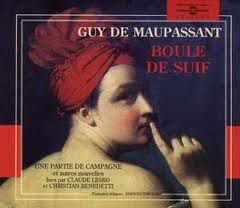
"Boule de Suif" by Guy de Maupassant

"Boule de Suif" by Guy de Maupassant (1880, 15 pages, trans. from the French)

"Boule de Suif" is set in the FrancPierre et Jeano-Prussian war (1870 to 1871).    "Boule de Suif" is considered the first masterpiece of Guy de Maupassant (1850 to 1893-France).    It is the work that first made de Maupassant a star of the French literary scene.    Flaubert said the story would be an enduring master work and he was right.   The popularity of this story created a great demand for future works by the author.  There is not a false note in this wonderful story.   I am so glad I took the time to read it.

So far I have read and posted on two works by de Maupassant.   A short story, "The Confession" and a short novel Pierre et Jean.    The story begins with ten people on a stage  coach leaving Rouen ,France in order to get away from the occupying Prussians.   The people on the stage represent a microcosm of French society.     The title character of the story, Boule de Suif-this translates roughly as "fat dumpling butterball", is a prostitute.   In the culture of the time, such physical characteristics were not considered a negative matter.   There is a suggestion that in the lean times of the Franco-Prussian war, which the French lost (I almost wrote, which "of course" the French lost!) a heavy woman was a comforting and desirable image.    

As the coach proceeds very slowly on through the terrible weather it seem Boule de Suif is the only person on the stage coach with the foresight to bring any food.    Others on the stage, especially the married women and perhaps for show their husbands, are very offended that they must share a coach with a prostitute.    But in time they agree to accept her offer of food and a small effort is made to speak with her by some of the others on the coach.   The interaction between the characters on the stage is brilliantly done.    It exposes the way in which the behavior and perceptions of the people on the stage are dictated by their social position.   It was fun to see the shallow hypocrisy of some of the people on the stage coach exposed.

The plot of the story is just marvelous.   I do not want to tell any more of the action of the story so others will have the pleasure of discovering this story for the first time, just as I have.   As the story ended I felt ashamed for everyone on the stage but one person.

For sure this story will well repay the few minutes it will take you to read it.  

"Boule de Suit" can be read  online here

If anyone has any suggestions as to other short stories I should read please leave a comment

Mel u


Thursday, July 29, 2010

"A Confession" by Guy de Maupassant

"A Confession" by Guy de Maupassant 1887-five pages-trans. unknown

July in Paris is almost over.     When I saw that the story of the day on East of the Web:Short Stories was "A Confession" by Guy de Maupassant I decided to read it.    I have already post on two of his works, Pierre Et Jean his  highly regarded novella and "A Father's Confession".     Having read only three of his works now it already appears family secrets and confessions of old sins are among the dominant themes of de Mausassant.   

Guy De Maupassant  (1850 to 1893-France)  was a very successful and highly productive writer.  He wrote six short novels, over 200 short stories and a vast amount of journalism.       He was a protege of Gustav Flaubert.   Guy De Maupassant made a very good amount of money from his writings.   He served in the Franco-Prussian War in 1870.   For ten years after the war he was a civil service clerk.   Flaubert, who knew his mother, encouraged him to pursue his literary interests.   One of his first short stories, about a prostitute during the Franco-Prussian, war was proclaimed a masterpiece by Flaubert and was hugely popular.   From the success of this De Maupassant began a career as a professional writer.   Through Flaubert he became friends with Zola and Turgenev.   (I will post soon on the story set in the Franco-Prussian War, "Duex Amis" -"Two Friends"-some of his works even when translated are still commonly referred to by their French titles)

"A Confession" is about two sisters who spent all of their lives together.     As the story opens the youngest sister is on her death bed and tells her older sister she has something she must confess in her presence.    I will tell a little of the plot.    The older sister had a true love who died when she was twenty five.    The woman put on widows clothes and mourned for the rest of her life.    Her younger sister, then twelve,  promised never to marry and never to leave her sister.    De Maupassant brilliantly creates a life in a few words:

They lived together all the days of their life, without ever being separated a single time. They went side by side, inseparably united. But Marguérite seemed always sad, oppressed, more melancholy than the elder, as though perhaps her sublime sacrifice had broken her spirit. She aged more quickly, had white hair from the age of thirty, and often suffering, seemed afflicted by some secret, gnawing trouble.
It is the cause of that trouble that is the subject of her confession.     I found the ending of this story very moving and powerful.   The story can be read in only a few moments and it might stay with you for life.     In just a few pages de Maupassant creates a world in miniature.    Some who do not like short stories may bemoan the fact that we do not have the details we would have in one of the behemoths of the 19th century novel and they are right.     We are given the freedom to create our own details by the genius of de Maupassant.  

This story can be read online here

If anyone has any suggestions as to other short stories I might like (an preferably can read online) please leave a comment.  

Thanks

Mel u


Wednesday, February 24, 2010

"Pierre Et Jean" by Guy De Maupassant

Pierre Et Jean by Guy De Maupassant ( 1888, translated by Julie Mead with an introduction by Robert Lethbridge, 2001,  129 pages, Oxford World Classics)

Guy De Maupassant (1850 to 1893) was an very successful and highly productive writer.  He wrote six short novels, over 200 short stories and a vast amount of journalism.   He is often called a father of the modern short story.    He was a protege of Gustav Flaubert.   Guy De Maupassant made a very good amount of money from his writings.   He served in the Franco-Prussian War in 1870.   For ten years after the war he was a civil service clerk.   Flaubert, who knew his mother, encouraged him to pursue his literary interests.   One of his first short stories, about a prostitute during the Franco-Prussian, war was proclaimed a masterpiece by Flaubert and was hugely popular.   From the success of this De Maupassant began a career as a professional writer.   Through Flaubert he became friends with Zola and Turgenev.   Henry James considered Pierre Et Jean a small masterpiece both for its style and for the great psychological depth shown in the work.

In both George Sand's Indiana and in Pierre Et Jean we can see the authors have given serious reflection on the methods of narrating a story.   I take this to be at least in part the result of the influence of Flaubert.    We can see Sand struggle with this issue in the first half of Indiana.   De Maupassant in his marvelous preface to Pierre Et Jean reflects on what he feels the role of the literary artist should be in the face of the demands of the reading public:

In short the reading public is made up of many groups crying out to us 'Console me',  'Amuse me', 'Make me sad', 'Make me dream', 'Make me laugh', 'Make me shudder', 'Make my cry', 'Make me think'.   Only a few minds ask the artist:  'create something beautiful in the form that best suits you and according to your own temperament'
Pierre Et Jean is considered the best of his six novels.    The plot is straightforward.   Pierre and Jean are two brothers, both in their twenties.    One has recently graduated from medical school and one from law school.  Their parents are of the middle class and are proud of both of  their sons, as who would not be.    It gives us one of  the best looks at sibling rivalry I have ever seen in a novel.    (In this it compares well to The Brothers Karamazov.)   The brothers have a cordial relationship but there are undercurrents of resentment based on perceptions on each of the brother's parts that their parents preferred the other.    One day the younger brother Jean, the attorney, inherits a fortune large enough to keep him in comfort for the rest of his life from an old family friend.    Pierre, the doctor,  had always thought that the family friend liked him just as much as he did Jean.   The friend was a single man the age of their parents with no children of his own.   Pierre is stunned by this and can at first see no reason for this preference.   He begins to obsessively think about why this happened as he is driven to know why the family friend ignored him.   We see growing feelings of resentment in Pierre and we see Jean, who was always somehow in the shadow of his older brother, begin to look down on those around him not in his economic class.   We also get a great look at relationships of the  parents to each other and to the brothers.   Pierre Et James provides us with a brilliant look at a family whose children are no longer children but still somehow less than full adults.   We also along the way see how the fishing industry in France worked and we enjoy the brothers'  love of sport fishing.  We go along as the older brother goes out on the town to places his parents would not care to know about.   One of the most interesting bits of knowledge conveyed in the books was an account of the economics of life as a cruise ship doctor in the 1880.   There is a beautiful (if there can be beauty is such a thing) description of the steerage area of the cruise ship that is as vivid as anything in Dickens.   In that short passage De Maupassant shows he need not take a lower berth to his friend Zola in depicting the life of the poor.

Pierre eventually discovers why his younger brother received the inheritance.  What he learns is crushing and has still the  power to shock us.    Pierre Et James is considered a kind of transitional work in late 19th century fiction.    I really enjoyed this book.   It is a near perfect example of the art of the short novel.

De Maupassant lead an interesting if short life (43 years).   One bit of trivia I found very interesting was the fact that he once saved the English poet Charles Swinburne from drowning.    You can see for sure the influence of Flaubert in this story in its minute observations and its efforts to particularize people and in the narrative mode.    The introduction to the book by Robert Lethbridge gives us useful cultural background on the novel.    The second half of the introduction does contain spoilers and I read it after I finished the book and suggest others do the same.    I think Oxford World Classic paper backs normally have very good introductions and the production quality is high and the print is not too small.   I have mentioned this before but I think anyone interested in the 19th century novel would enjoy Flaubert:  A Biography by Frederick Brown.  The prose in the translation is beautiful. 

I am including this book for these challenges.

New Authors Challenge (means new to you)
Mutual Reads (Victorian Era novels)
Themed Reading Challenge (my theme is Flaubert and Friends)
French Historicals Oh La la! Reading Challenge.

Mel u


Featured Post

Imperial Reckoning: The Untold Story of Britain’s Gulag in Kenya by Caroline Elkins - 2005 - 701 Pages

  Imperial Reckoning:     The Untold Story of Britain’s Gulag in Kenya by Caroline Elkins - 2005 - 701 Pages 2006 Pulitzer Prize Winner From...