Showing posts with label Clarice Lispector. Show all posts

Monday, October 29, 2018

"Remnants of Carnival" by Clarice Lispector (from The Complete ShortStories of Clarice Lipsector, published August, 2015, translated byKatrina Dodson, edited and introduced by Benjamin Moser)


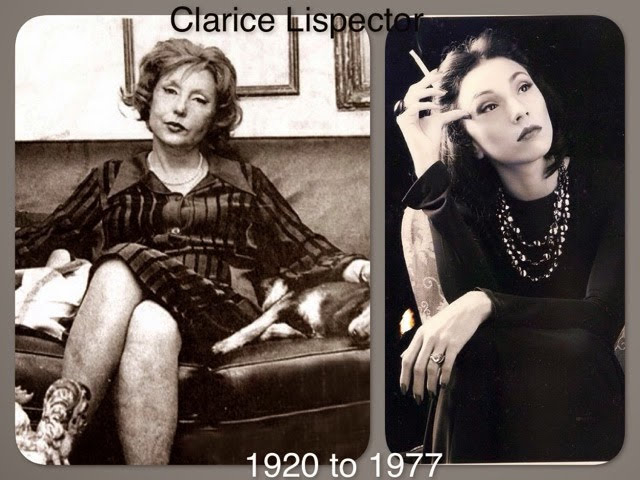
When I first starting reading The Complete Short Stories of Clarice Lispector about four months ago I felt I was witnessing the exploding of a star upon the English language short story world.  I wondered if others would respond as strongly as I did.  Reviews are beginning to appear in top venues.  I have read all those I have seen, all are laudatory and insightful but I feel somehow they don't quite get Clarice.  As I read her stories, and now two of her novels, and admitting  I was under the spell of the ice cold beauty of her youth and the coldness and pain in her eyes as she matured, I wanted to find a way to shout out to short story lovers and writers all over the world to stop what they are doing and read her collection.   

As Toibin says in his review, happiness does not come easy if at all in the works of Clarice, I call her by her first name not out of familiarity but reverence, some of her stories are about how small incidents can haunt us forever and block our hope of being fully at home in the universe.  


Recife in Brazil is considered by afficiados to have the best, wildest most  exuberant of all carnivals. This story is about the involuntary memories of the narrators  first carnival, around age ten.  It draws on the life experiences of Clarice, the impact of her mother's illness and death when she was ten on her life.  A crepe paper dress in the color of a deep red rose is being made for her good friend.  She accepts her family cannot buy her a carnival dress.  She is so happy when there is enough material left for a dress to be made for her.  The friend's parents pay to have it made and it is so beautiful. She is remembering these events of years ago.  Just as she was ready to go to carnival, nearly overwhelmed with the excitement of the event, she cannot go to the carnival because her mother has gotten sicker (Clarice's mother was raped in a porgam in the Ukraine and would after years of illness from syphillis die when she was young.)  The narrator has the burden of guilt of having greatly resented her mother while knowing soon after this she would die.  This is what Carnival now brings to her mind.

In just a few pages  Clarice takes us deeply into the ways memories can flood in and destroy happiness.


Mel u


Saturday, October 27, 2018

"Waters of the World" by Clarice Lispector. ( From The Complete ShortStories of Clarice Lispector. (2015)

"Waters of the World" can be read in translation here


Most of the press reviews of The Complete Short Stories of Clarice Lispector, translated by Katrina Dodson, edited-and introduced by Benjamin Moser, 2015) say the stories can be seen as an account of the life of a woman, from her early twenties down to her ending years.  Much is made of the once stunning beauty of Clarice.  If someone speaks only this in talking of the stories collectively it tells me they no doubt only read a few of the 85 stories.  My main purpose in posting on "The Waters of the World" is to let my readers know the great translator Katrina Dodson has kindly placed this story online.

This is as good a short story as I have yet read about the primal power of the sea.  One of the deeper themes in Lispector is the ability of the strength of raw nature to bring us a sense of near cosmic connection with our atavistic nature. 

"And now she steps onto the sand. She knows she is glistening with water, and salt and sun. Even if she forgets a few minutes from now, she can never lose all this. And she knows in some obscure way that her streaming hair is from a castaway. Because she knows—she knows she has created a danger. A danger as ancient as the human being."

Mel u

Tuesday, April 3, 2018

The Chandelier by Clarice Lispector 1946, translated by Benjamin Moser and Magdalena Edwards, 2018


““She’d spend days reading; she read. like a painted prostitute. , full of keenness and of a boredom that burned her soul and quickly dried her out.” From The Chandilier.  

I first encountered Clarice Lispector in August 2015 when I was given an advance review copy of The Complete Short Stories of Clarice Lispector.  I quickly became under her sway.  Since then I have posted on 35 of her short stories (out of 85), three of her novels as well as Benjamin Moser’s magnificient biography.  I was delighted to find last week that her second novel, The Chandilier, was now available in traslation.

It is December, 1946, the war is at last over.  You are enjoying a drink in a bar in The Copacabana Hotel, the premier hotel in Rio.  The patrons of the bar include younger sons of disposed Eastern European monarchs, war profiteers from all sides, Hollywood stars, and the elite of Brazilian society. No one asks how you got that scar or what you did in the War as long as you have enough Reals.  Suddenly all heads turn as perhaps the most stunningly glamourous woman ever to enter the hotel takes a seat at the bar.  Ambrosia Bousweau, there with her uncle Ruffington,  thinks, “I wonder if she is a mistress of a Rothchild?” The men are for a time unable to speak.  No one would ever dream the woman, just twenty four, has already published two novels that will still be avidly read in seventy years, ranked among the greatest works of the century.  She is considered Brazil’s greatest writer.  She also was one of the first Brazilian women to graduate from Law School. 

Benjamin Moser has said The Chandilier is her most complex and difficult work.
It is certainly strange, mysterious and beautiful. I dont care to retell the action of the work to any degree. 

Here is New Directions blurb on the book:

“Fresh from the enormous success of her debut novel Near to the Wild Heart, Hurricane Clarice let loose something stormier with The Chandelier. In a body of work renowned for its potent idiosyncratic genius, The Chandelier in many ways has pride of place.“It stands out,”her biographer Benjamin Moser noted, “in a strange and difficult body of work, as perhaps her strangest and most difficult book.” Of glacial intensity, consisting almost entirely of interior monologues—interrupted by odd and jarring fragments of dialogue and action—the novel moves in slow waves that crest in moments of revelation. As Virginia seeks freedom via creation, the drama of her isolated life is almost entirely internal: from childhood, she sculpts clay figurines with “the best clay one could desire: white, supple, sticky, cold. She got a clear and tender material from which she could shape a world. How, how to explain the miracle …” While on one level simply the story of a woman’s life, The Chandelier’s real drama lies in Lispector’s attempt “to find the nucleus made of a single instant … the tenuous triumph and the defeat, perhaps nothing more than breathing.” The Chandelier pushes Lispector’s lifelong quest for that nucleus into deeper territories than any of her other amazing works.”

If you love Clarice,not everyone does, then I hope you will have the opportity to read this masterpiece.  For sure it will benifit from rereading.

I hope to read an additional work by Clarice in May and hopefully June also.  

Mel u


Thursday, August 17, 2017

"COVERT JOY (“ FELICIDADE CLANDESTINA”) - A Short Story by Clarice Lispector (1971, translated from Portuguese)


The Complete Short Stories of Clarice Lispector, translated from Portuguese by Katrina Dodson (2015) is one of the great translation projects of the 21th century.  I was kindly given a review copy of this work a few months prior to publication. As I read through it in amazement I knew this book would capture the hearts of all lovers of the short story.  Benjamin Moser in his very well done introduction warns us that the work of Clarice Lispector can be like witchcraft craft to those vulnerable to her spell.  I admit to being captivated.  I proudly put her image on my blog sidebar long ago.  Anyone interested in her will surely do a Google search.  They will learn her family, she was very young, left her native Ukraine to move to north eastern Brazil, where many Jews had relocated, to escape vicious anti-Semitic pograms.  They spoke no Portuguese on but Clarice became the greatest of all Brazilian writers.  Sadly as I read this I thought few countries today, including 
America, would welcome a poor family of five from the Ukraine as new citizens.  


I could not let Women in Translation Month pass without including a post upon a short story by Clarice.  I have read all of her stories at least twice, and am slowly reading them  again and hopefully will eventually post on all 85 stories.  I found a short story perfect for the primary theme of my blog, literary works about people who lead reading centered lives.  


"Covert Joy" centers on a young girl living in Recife, where Clarice grew up.  She loves books totally.  There is a rich 
girl, a cruel bully girl, who lords it over her poorer but much better looking fellow students.  The narrator can afford to buy books so the bully girl keeps telling her to come to her house and she will loan her a book.  For days on end she makes the girl come back, always with an excuse why there is no book for her today.   Finally the bully's motherintervenes and give the girl a book.  The girl is overwhelmed with joy.  You have to love the close of the story:

"Hours later I opened it, read a few wondrous lines, closed it again, wandered around the house, stalled even more by eating some bread and butter, pretended not to know where I had put the book, found it, opened it for a few seconds. I kept inventing the most contrived obstacles for that covert thing that was joy. Joy would always be covert for me. I must have already sensed it. Oh how I took my time! I was living in the clouds . . . There was pride and shame inside me. I was a delicate queen. Sometimes I’d sit in the hammock, swinging with the book open on my lap, not touching it, in the purest ecstasy. I was no longer a girl with a book: I was a woman with her lover."


I highly recommend Why This World:A Biography of Clarice Lispector by Benjamin Moser.

Mel u


Tuesday, June 27, 2017

"One Day Less" - A Short Story by Clarice Lispector (1970?)


"What matters is the magnetic love she inspires in those susceptible to her. For them, reading Clarice Lispector is one of the great emotional experiences of their lives. But her glamour is dangerous. “Be careful with Clarice,” a friend told a reader decades ago, using the single name by which she is universally known. “It’s not literature. It’s witchcraft."  Benjamin Moser

THE COMPLETE SHORT STORIES OF CLARICE LIPSECTOR, PUBLISHED AUGUST, 2015, TRANSLATED BY KATRINA DODSON, EDITED AND INTRODUCED BY BENJAMIN MOSER


"I doubt that death will come. Death? Could it be that the days so long will end? That’s how I daydream, calm, still. Could it be that death is a ruse? A trick of life? Is it persecution? And that’s how it is."  From "One Day Less"

"One Day Less" is one of Clarice's final stories (I do not call her by her first name out of a foolish familiarity but because that name is enough to invoke a universe for those of us under her spell.)   This is a very sad story.  In approaching her short stories, I think one should first read all eight five.  Lots of reviewers have said taken this way we meet our narrator first as a young girl in Recife and later Rio de Janeiro, then we see her married, then her final days.  I suspect Print reviewers who have said this have not read the full collection.

As "One Day Less" opens our unmarried thirty year old female narrator is pondering the boredom and emptiness of her life.  Her deceased parents left her enough money to get buy in the apartment in which she had lived all her life.  She thinks about what she would do if a man invited her out for a drink. She seems much older than thirty.  Her self esteem has been badly hurt by her weight gain.

Her maid, the same one that has worked for her parents and then her for thirty years is off for a month.  She has to cook her own food.  Boredom hangs heavy in this story.  She received a distraction from a wrong number call from a woman who ends up inviting her over to play bridge.

The ending is very sad.  There is much to thing about in this story.

Please share your experience with Clarice with us


Thursday, May 25, 2017

The Passion According to G. H. by Clarice Lispector - translated by Idra Novey


"What matters is the magnetic love she inspires in those susceptible to her. For them, Clarice is one of the great emotional experiences of their lives. But her glamour is dangerous. “Be careful with Clarice,” a friend told a reader decades ago. “It’s not literature. It’s witchcraft.” Benjamin Moser, in his introduction to The Collected Short Stories of Clarice Lispector 


My Prior Posts on Clarice Lispector

I first entered the world of Clarice Lispector when I was kindly given a digital review copy of The Complete Short Stories of Ćlarice Lispector.  With a marvelous introduction by Benjamin Moser, I think many will find the reading of these stories the start of a deep fascination with Lispector's work and life.  I think the publication of this collection of short stories will be at least the most important translated work of short stories in 2015.  It is said among short story people that Kathernine Mansfield is the only writer that ever frightened Virginia Woolf, I would just say she never met Clarice Lispector.  

After I finished my first read through of the short story collection, I have posted on about ten of the stories and will be rereading and posting more as time goes on, I read Why This World:  A Biography of Clarice Lispector by Benjamin Moser.  This is a truly excellent biography which goes deeply into her cultural roots.  By coincidence shortly before I encountered Lispector I read the complete Yale Yiddish Library and Moser helped me understand the ways in which Lispector is part of the tradition of Jewish Kabbalstic thinkers and how her early life in the Jewish shetls in the very anti-Jewish Ukraine shape her fiction.    Also in the very long ago I studied Spinoza and this helped me.  Moser lets us see the impact of Spinoza in the work of Lispector, especially in her perhaps most overtly philosophical work The Passion According to G. R.  

G.R is the female narrator of the novel.  She is an affluent well regarded  sculpturor living in Rio de Janeiro.  The novel is all about a long very widely ranging interior monologue initiated in the mind of G.R. when she enters the room of her live in maid who recently quit.  She was shocked to see a drawing of herself on the wall.  There are strong post colonial and racial matters in The Passion of G.R, the maid was black.  She then sees a roach on the floor of the maid's room.  She has a horror of roaches and she slams the door on the roach.  He is partially crushed but not killed.  

She begins to reflect on the very ancient, long before man, history of the roach.  Soon all human history unfolds before her.  She begins to reflect on the nature of divinity and of God.

This book way transcends my ability to describe it.  I knew pretty much what exoect in The Passion of G.R. as Moser talks about it a lot in his biography but it still shocked me.  


Mel u


Saturday, February 18, 2017

Near to the Wild Heart by Clarice Lispector (1943)


This is the 3000th post on The Reading Life.  I think for me Near to the Wild Heart by Clarice Lispector (1920 to 1970)is a perfect subject for this post.  She is one of my favorite writers, her image is on my blog sidebar. If I had never started my blog I would have, I am quite sure, died having never heard about much less read her great work.  There are hundreds of other writers of which the same can be said featured on the blog.  

As of now I am still dealing with a painful and strength sapping illness, but nothing on the level of the pain of the terminal cancer Clarice dealt with in the final days of her life.  In Clarice's family and life story much of the history of the 20th century can be encapsulated.  

Near to the Wild Heart, the title comes from Portrait of the Artist as a Young Man, was her first novel, published at age twenty three when she was still in law school and working as a journalist.  Her prose style mesmerized Brazilian literary society.  Early critics proclaimed it the best novel ever written in Portuguese by a woman.  


It is a stream of consciousness work, not conventionally plotted, in which Joana, a recently married woman in her early twenties, recalls incidents from her life.  I was struck by her extensive quotations from Spinoza.  

There is background information on Clarice in my prior posts.  


Friday, July 22, 2016

"One Day Less" - A Short Story by Clarice Lispector (1968?)


From The Complete Short Stories of Clarice Lispector. (2015)

"I doubt that death will come. Death? Could it be that the days so long will end? That’s how I daydream, calm, still. Could it be that death is a ruse? A trick of life? Is it persecution? And that’s how it is"


"One Day Less" is one of the very last short stories of the great Clarice Lispector.  It is a story about a thirty year old woman, her parents passed and left her enough money to get by without working. She describes herself as "fat".  She is a virgin.  She has a maid who does the household duties. She has nothing really at all to do, her only interest in life, and that is low key, is that a man she recently met will ask her to tea.

One afternoon  her phone rings and it is an obviously elderly lady asking for "Flavia".  The woman does not believe it when told she has the wrong number.  She is told that this has been the woman's number for thirty years.  They engage in conversation and the caller ends up inviting her over to play cards.  The lady of the house says her father did not allow card playing.  The story ends.

This is a story about boredom, about what happens when you have no inner resources, nothing to do and all day to do it.  It is a very sad story.

Mel u

Friday, December 11, 2015

"He Drank Me Up" by Clarice Lispector 1974 (from the Complete Short Stories of Clarice Lispector, August 2015, translated by Katrina Dodson, edited by Benjamin Moser


"He Drank Me Up" starts in front of the Copocabana Palace Hotel, one of the most glamourus hotels in the world.  Two friends , a beautiful woman and her gay male companion, a make up artist have been waiting for a cab for over an hour.  A wealthy man of fourty tells the woman is chauffeur will arrive shortly and asks if he can offer them a ride.  They accept and are soon back at his elegant apartment. 

He invites them to,dinner at a fashionable restaurant, one still open in Rio. Soon the three of them are a kind of item, frequently going out.  The woman fears the man is more attracted to her friend than to her. 

At night before they go out, the make up artist works on her.  She begins to fear he is draining the life from her.

As I read this entertaining story it seemed very much like a work of Colette. 

Mel u

Thursday, December 10, 2015

"Miss Alvarez" by Clarice Lispector. 1974 The Complete Short Stories of Clarice Lispector August, 2015, translated by Katrina Dodson, edited-and introduced by Benjamin Moser)


"Miss Alvarez" is a story about a red headed Irish virgin working in London who is proud of her large breasts, she is a typist in London who is seduced by an invisible being from Saturn.  It is weird, wonderful and will leave first time readers loving being stunned by Clarice.  It was written in about three hours. 


Clarice wrote all of the thirteen short stories in the 1974 collection, The Via Crucis of the Body over the course of a single weekend. (My source for this and most all I know of the life and literary career of Clarice comes from the essential biography by Bernard Moser, Why this World:  A Biography of Clarice Lispector).  By this time she was more than thirty years into her literary career and did not care what the critics said of her work.   Some contemporary Brazilian critics called these stories "near pornogrsphy".  In one of them two women freely share the bed of one man then murder him and cut up his body to use to mulch their roses.  In a terrifying story I have posted upon, "Pig Latin" a woman avoids being raped on a Rio commuter train by acting as if she were a mentally deranged prostitute.  She knew the men wanted a virgin,  which she in fact was, thinking rightfully that would make them look for another woman The train conductor turned her into the police who kept her in jail for several days.  She learns a woman was raped and murdered on the train.  The story I posted on yesterday, "Via Crucis" is about a recreation of the birth of Jesus in Rio.

Miss Alvarez finds the very idea of sex repulsive.  Couples embracing in the Piccadilly Park disgust her, she cannot imagine her parents having sex, during her weekly bath she keeps on her underwear so as not to see her naked body.  In her free time she likes to write letters to the newspaper venting her feelings about the corruption and vice of London.  She is plagued by terrible loneliness.  One night she hears something.  

"“I am an I.” “Who are you?” she asked trembling. “I came from Saturn to love you.” “But I don’t see anyone!” she cried. “What matters is that you can sense me.” And indeed she sensed him. She felt an electric frisson. “What’s your name?” she asked fearfully. “It doesn’t really matter.” “But I want to call your name!” “Call me Ixtlan.” They understood one another in Sanskrit. His touch felt cold like a lizard’s, he made her shiver. On his head Ixtlan had a crown of intertwining snakes, tame from the terror of possible death. The cloak that covered his body was the most agonizing shade of violet,"

After this night her mind set radically alters.  Unlike before, she relishes eating steak, seeing the blood.  Being overwhelmed with sexual desire, she picks up a man on tne streets and takes him home. He gives her money even though she to,d him it was not needed.  She becomes a street walker honing her sexual skills while she waits for Ixtlan to return.  

As I read this I wondered is this a story of the impact of repression on a good Irish girl, is it a fantasy created to explain her sexual desires or is it real?  Is Ixtlan a figure from the collective unconsciousness or is he real.  Nothing in her life experiences would have planted this figure in her mind.

Mel u


Wednesday, December 9, 2015

"Via Crucis" by Clarice Lispector 1974 (The Complete Short Stories of Clarice Lispector August, 2015, translated by Katrina Dodson, edited and introduced by Benjamin Moser)

I


Clarice wrote all of the thirteen short stories in the 1974 collection, The Via Crucis of the Body over the course of a single weekend. (My source for this and most all I know of the life and literary career of Clarice comes from the essential biography by Bernard Moser, Why this World:  A Biography of Clarice Lispector).  By this time she was more than thirty years into her literary career and did not care what the critics said of her work.   Some contemporary Brazilian critics called these stories "near pornogrsphy".  In one of them two women freely share the bed of one man then murder him and cut up his body to use to mulch their roses.  In a terrifying story I have posted upon, "Pig Latin" a woman avoids being raped on a Rio commuter train by acting as if she were a mentally deranged prostitute.  She knew the men wanted a virgin,  which she in fact was, thinking rightfully that would make them look for another woman The train conductor turned her into the police who kept her in jail for several days.  She learns a woman was raped and murdered on the train.

In "Via Crucis" a woman is told by her doctor she is three months pregnant. The married woman says her husband has never touched her.  The doctor suggests perhaps in her sleep he has. She says no he is impotent.  When she tells her husband this he says then he must be Sainf Joseph, husband of the Virgin Mary.  She begins to somehow be.ieve she will give birth to a son of God.  Her husband begins to grow his hair and beard very long just as Sainf Joseph did.  As she becomes huge with child, she seeks out and finds a manger in which to give birth. She wonders what three wise men will come bringing gifts, what star from the east will guide them.  She wonders if her son, she sine how knows the baby is a boy, will walk the way of the cross.  The story title refers to a section of the road to Golgatha. 

The profound beauty of this story for me is in the complete acceptance of the virgin birth.  The love of the husband, his acceptance.  If they are mad, then are all Christians.  Maybe she is deluded or deceiving her husband and herself but if so it is not hinted at. In an interesting segment we learn why she decides not to name her son "Jesus".  In a way Clarice is turning Rio into a kind of strange holy land.

Mel u

Friday, December 4, 2015

"Forgiving God" by Clarice Lispector (The Complete Short Stories of Clarice Lipsector, published August, 2015, translated by Katrina Dodson, edited and introduced by Benjamin Moser)


"What matters is the magnetic love she inspires in those susceptible to her. For them, reading Clarice Lispector is one of the great emotional experiences of their lives. But her glamour is dangerous. “Be careful with Clarice,” a friend told a reader decades ago, using the single name by which she is universally known. “It’s not literature. It’s witchcraft."  Benjamin Moser

The Complete Short Stories of Clarice Lipsector, published August, 2015, translated by Katrina Dodson, edited and introduced by Benjamin Moser 


With the publication of this collection, it is as if a star has exploded in the short story world.  Many will see her stories as among the greatest of their lifetime reading experiences.  Some will not feel her power.  Benjamin Moser says her work is "witchcraft, not literature".  

I think soon her stories will be heavily analyzed by post-colonial scholars, feminist readers, South American studies, and those who follow the lead of Moser and see her as in the tradition of Jewish writers.  Historians of race and social class in Brazil will find her works a gold mind.  I also strongly urge the reading of Benjamin Moser's biography.  Her works will be studied as if they are texts in an ancient religion, ones for a dark time like those we may now be entering.  I know those who have not yet entered her world or even heard of her will find my words hyperbolic.  On the other side, there will be found those who will say I am holding back, not articulating her full power.  


The Setting for "Forgiving God". Avendia Copacabana Rio de Jeniro


A while ago I was taking a stroll in Santo Domingo, the capital city of the Domincan Republic.  To my great amusement a large brown rat crossed my path.  I thought it is good to be in a city where rats are right out in the open.  I enjoyed the experience. In "Forgiving God" the narrator is taking a walk down one of the most beautiful streets in the world, Avenedia Copacabana in Rio de Jeniro.  Having shared this experience with the narrator made this story all the more meaningful to me.

This is a very "philosophical story".  The narrator is imaging she is the mother of God.  She feels a deep oceanic pathesostuc bond with God.  Then a rat runs in front of her and she sees him as God's attempt to throw her into despair.  This launched her into questioning why God would find it necessary to do this to her.

"Not only do I not forget the blood inside but I allow and desire it, I am too much blood to forget blood, and for me the spiritual word has no meaning, and neither does the earthly word. There was no need to throw a rat in my bare naked face. Not right then. What could easily have been taken into account was the terror that has hounded me and made me delirious since childhood, rats have mocked me, in the past of the world rats have devoured me quickly and furiously. So that’s how it was?, with me roaming through the world not asking for a thing, not needing a thing, loving out of pure, innocent love, and God shows me his rat? God’s coarseness hurt and insulted me."

In this brief short story Lispector deals with some very deep issues.  I read it four times.


Mel u

Saturday, November 28, 2015

The Hour of the Star by Clarice Lispector. 1977. Translated by Benjamin Moser 2011


"Silence. If one day God comes to earth there will be great silence. The silence is such that not even thought thinks."  From The Hour of the Star


The Hour of the Star is the last novel of the great Brazilian writer Clarice Lispector.  I have fallen deeply under her spell.   So far I have read all of her eight six short stories and her novel The Passion According to G. H.  

The Hour of the Star was first published shortly after her death.  It is an amazing work of art.  The story is narrated by a very urbane, sophisticated and more than a bit smug Rodrigo S.  He is relaying to us the life history of a poor girl from North Eastern Brazil (an impoverished area from which many seek escape in Rio de Jeniro).  Lispector grew up in the region, in Recife so she understood what it meant to be a woman from the north east in the ultra urban flash city of Rio.  The region has a distinct culture and food.  Rodrigo is telling the story of Macabee.  She is nothing like the stereotype of the oozing sexuality Carioca lady, she is scrawny, ugly, lacking in all feminine charm and undernourished.  She lives in a sprawling favella with four young women who work as typists.  She loves Coke A Cola, movies and her despicable user of a boyfriend.

The Hour of the Star sort of could be classified as bordering on meta fiction.  We see the narrator, fad from always right in his perceptions and way to snobbish to be secure, trying to find a way to explain Macabee to his readers, who he addresses.  He struggles with how to ms,e her come to reality, how to explain how she is somehow free as she has never seen a vision of herself with anything.  Long ago I read a very good book about life in a slum in Rio called Laughter in the Favella and I think there is some of this in this novel.  

It is also a work of philosophical reflections on the a wide range of topics. 

The Hour of the Star is a wonderful work of art.  


Mel u


Friday, October 9, 2015

"Another Couple of Drunks" by Clarice Lispector (1953)


The Complete Short Stories of Clarice Lipsector, published August, 2015, translated by Katrina Dodson, edited and introduced by Benjamin Moser 


With the publication of this collection, it is as if a star has exploded in the short story world.  Many will see her stories as among the greatest of their lifetime reading experiences.  Some will not feel her power.  Benjamin Moser says her work is "witchcraft, not literature".  

I think soon her stories will be heavily analyzed by post-colonial scholars, feminist readers, South American studies, and those who follow the lead of Moser and see her as in the tradition of Jewish writers.  Historians of race and social class in Brazil will find her works a gold mind.  I also strongly urge the reading of Benjamin Moser's biography.  Her works will be studied as if they are texts in an ancient religion, ones for a dark time like those we may now be entering.  I know those who have not yet entered her world or even heard of her will find my words hyperbolic.  On the other side, there will be found those who will say I am holding back, not articulating her full power.  

My Prior Posts on Clarice Lispector 


Have you ever, late at night and if you were very fortunate in Rio de Janeiro, went out to the bars and even the streets looking for an anonymous person to have sex with?  Well if you have I think Lispector has depicted the experience, as seen through the eyes of a cultured refined, very well, in all its  bad faith and darkness.  If you have, as of course you have not, not ever done this then this story may let you see how it feels.  At the very least we you can fantasize you are in a bar in Copacabana and a gourious Carioca seems to be looking at you with hungry eyes.  

As the story begins the narrator has spotted the man she wants, drunk in a late night bar.  Of course she has read great books, studied the thoughts of the Buddha and can trace her ancestors back many generations where the drunk can do none of these things. Or so she thinks.  But wait, after she, I am assuming g the narrator is a woman, has paid for his drinks he seems not to want to have sex with her.  How can he so dare?  

She begins to walk the streets looking for anyone to have sex with, desperate for a release that this purely physical act can, she hopes bring her.  We get the feeling this is something she has done before.  She has to denigrate those she encounters to put herself above them, almost as if they are but animals in comparison to her.  Maybe she does not realize they look at her in the same way.


Mel u


Saturday, September 26, 2015

"Profiles of Chosen Beings" by Clarice Lispector (1964)


"All this, paradoxically, increasingly gave the being the kind of profound joy that needs to be revealed, displayed, and communicated. In this communication the being was helped by his innate gift for liking. And this was something he hadn’t even gathered or chosen, it was a gift indeed. He liked the deep joy of others, through his innate gift he discovered the joy of others. Through his gift, he could also discover the solitude that other people had in relation to their own deepest joy. The being, also through his gift, knew how to play."  From "Profile of Chosen Beings"


The Complete Short Stories of Clarice Lipsector, published August, 2015, translated by Katrina Dodson, edited and introduced by Benjamin Moser 


With the publication of this collection, it is as if a star has exploded across the short story world.  Many will see the reading of her stories as among the greatest of their lifetime reading experiences.  Some will not feel her power.  Her stories have cast a spell on me, going beyond the mere reading of literary works.

I think soon her stories will be heavily analyzed by post-colonial scholars, feminist readers, South American studies, and those who follow the lead of Moser and see her as in the tradition of Jewish writers.  Historians of race and social class in Brazil will find her works a gold mind.  I also strongly urge the reading of Benjamin Moser's biography.  Her works will be studied as if they are texts in an ancient religion, ones for a dark time like those we may now be entering.  I know those who have not yet entered her world or even heard of her will find my words hyperbolic.  On the other side, there will be found those who will say I am holding back, not articulating her full power.  

My Prior Posts on Clarice Lispector 


"Profile of Chosen Beings" is "philosophical" short story, among other things.  The climate of opinion that made Existentialism an influential part of the culture after the war also influenced Clarice.  The story is partially a play on the notion that people create themselves through the chooses they make.  It I also can be seen with dealing with the religous notion of the chosen one.  Clarice repudiated all religions so it will take a lot of thought to unravel this.  Toward the end of the story she speaks of a statue so maybe it is also about Brazilian or other fascistic leaders who have chosen themselves to be the chosen one of history.  Is the chosen one  megalomaniac, is the concept of the one chosen by God being mocked?   There seems perhaps an underlying tone of mockery in the story.  I read it four times. 

Mel u

Monday, September 21, 2015

"The Solution" by Clarice Lispector (1964)


The Complete Short Stories of Clarice Lipsector, published August, 2015, translated by Katrina Dodson, edited and introduced by Benjamin Moser 


With the publication of this collection, it is as if a star has exploded in the short story world.  Many will see the reading of her stories as among the greatest of their lifetime reading experiences.  Some will not feel her power.  Benjamin Moser says her work is "witchcraft, not literature".  

I think soon her stories will be heavily analyzed by post-colonial scholars, feminist readers, South American studies, and those who follow the lead of Moser and see her as in the tradition of Jewish writers.  Historians of race and social class in Brazil will find her works a gold mind.  I also strongly urge the reading of Benjamin Moser's biography.  Her works will be studied as if they are texts in an ancient religion, ones for a dark time like those we may now be entering.  I know those who have not yet entered her world or even heard of her will find my words hyperbolic.  On the other side, there will be found those who will say I am holding back, not articulating her full power.  

My Prior Posts on Clarice Lispector 


"The Solution" is a brief very powerful story with a shocking close.  It centers on two young female office workers.   One is heavy and sensitive about this.  She seems to have a crush on one of her coworkers.  They take lunchs together and the heavy girl is always very solicitous of the feelings of her friend, who does not reciprocate.  One day the slender woman is late for work and when she arrives all can see she is very distraught and has been crying.  Her friend is very worried and offers to treat her to lunch.  

At lunch the coworker blurts out that her boyfriend has left, moved away.  She calls her friend "fatso" and asks her if she is happy over this news.  The other woman takes a fork and stabs her in the neck. We next meet her in prison where she at last has people around her that care about her.

A very moving story about loneliness, body images and the destructive power of words spoken in anger.

Mel u


Tuesday, September 15, 2015

"Preciousness" by Clarice Lispector


Greetings to Rowan University Students.  Feel free to leave a comment on your thoughts on Clarice Lispector 

The Complete Short Stories of Clarice Lipsector, published August, 2015, translated by Katrina Dodson, edited and introduced by Benjamin Moser 


With the publication of this collection, it is as if a star has exploded in the short story world.  Many will see the reading of her stories as among the greatest of their lifetime reading experiences.  Some will not feel her power.  Benjamin Moser says her work is "witchcraft, not literature".  

I think soon her stories will be heavily analyzed by post-colonial scholars, feminist readers, South American studies, and those who follow the lead of Moser and see her as in the tradition of Jewish writers.  Historians of race and social class in Brazil will find her works a gold mind.  I also strongly urge the reading of Benjamin Moser's biography.  Her works will be studied as if they are texts in an ancient religion, ones for a dark time like those we may now be entering.  I know those who have not yet entered her world or even heard of her will find my words hyperbolic.  On the other side, there will be found those who will say I am holding back, not articulating her full power.  

My Prior Posts on Clarice Lispector 


When I first posted on a short story by Clarice Lispector I was already certain the publication of her complete short stories would be the most important event in short stories in translation in 2015.  I now think for sure it will be seen as the most important event in the short story world in 2015 and  I see it as almost certainly the major literary event in the Anglophone world.  The 86 stories in the collection should be all read so you can see Clarice develop.  Then you should go back and read the stories that speak most deeply to you several times.  

"Preciousness" is told in the persona of a fifteen year old Rio school girl.  She is up early to make her long commute to school.  A focus of the story can be seen as the girl's awakening sense of her sexuality.  As she makes the commute, she sees her self as "not pretty", she fears men in the bus will look at her.  She also has a sense if class consciousness, she comes from an affluent family with a maid and the men on the bus are working class.  She seems to dread her sexual development, talks almost of becoming a nun to avoid sex.  There are a few brief lines in her conversation  with  the maid that are just so amazing.  They are almost a history of race relations in Brazil.  Long story short, maids and workmen are dark, the affluent lighter skinned.  Brazil hid from its African roots for generations and this is buried deep in this story.  


Mel u

Saturday, September 12, 2015

"The Sharing of the Loaves" by Clarice Lispector


The Complete Short Stories of Clarice Lipsector, published August, 2015, translated by Katrina Dodson, edited and introduced by Benjamin Moser 


My Prior Posts on Clarice Lispector 


"What matters is the magnetic love she inspires in those susceptible to her. For them, Clarice is one of the great emotional experiences of their lives. But her glamour is dangerous. “Be careful with Clarice,” a friend told a reader decades ago. “It’s not literature. It’s witchcraft.” Benjamin Moser"

Yes, Clarice is witchcraft.  


"There was no holocaust: it all wanted to be eaten as badly as we wanted to eat it. Saving nothing for the next day, there and then I made an offering of whatever I was feeling to whatever was making me feel. It was a way of living that I hadn’t paid in advance with the suffering of waiting, a hunger born when the mouth is already nearing the food. Because now we were hungry, a complete hunger that encompassed everything down to the crumbs."

The more I read of the stories of Clarice, the more drawn under her spell I fall, the more I read, the more mystified I become.  Sometimes I feel a contempt for people and a deep hatred for the human condition in her work combined with a striving not so much to rise above that, Clarice knows that will not happen, but to simply be in an unreflective way. To eat, to bask in the sun of Rio while pondering the holocaust.  In the story the narrator is on a train trip on Saturday to go to dinner with people she does not care about, she resents to lose of her Saturday.  The food served becomes. almost a religious experience, eating an act of worship.  

I love this so perhaps all the more because I know my three readings and my Lispector  neophyte status make it beyond my comprehension.  Maybe like the feast, it simply is. 

"The food was saying crudely, happily, austerely: eat, eat and share. All that belonged to me, it was my father’s table. I ate without tenderness, I ate without the passion of piety. And without offering myself to hope. I ate with no longing. And I really did deserve that food. Because I can’t always be my brother’s keeper, and I can’t be my own any longer, oh I don’t want myself any longer. And I don’t want to shape life since existence already exists. It exists like some ground over which we all advance. Without a word of love. Without a word. But your pleasure understands mine. We are strong and we eat. Bread is love among strangers"

Mel u


Wednesday, September 9, 2015

"Where Were You at Night" by Clarice Lispector (1973)


The Complete Short Stories of Clarice Lipsector, published August, 2015, translated by Katrina Dodson, edited and introduced by Benjamin Moser 


My Prior Posts on Clarice Lispector 


"He-she was already there atop the mountain, and she was personalized in the he and he was personalized in the she. The androgynous mixture created a being so terribly beautiful, so horrifically stupefying that the participants couldn’t take it all in at once: as a person adjusts little by little to the dark and gradually starts to discern things. Gradually they discerned the She-he and when the He-she appeared before them in a brightness that emanated from him-her, they paralyzed by the Beautiful would say: “Ah, Ah.”

As Clarice becomes more read and taught in the short story world, people will begin to make comparisons of her work with other female short story writers.  I see resemblances in her early stories to the work of Katherine Mansfield, who she greatly admired.  That being said "Where Were You at Night" is a simply amazing work that has left me deeply puzzled and stunned after five days of reading the story.  I think I am beginning to understand that the opening segment of the story is a kind of composite dream or vision of the Rio night world infused with ancient religious cult beliefs from a period beyond our conscious memory.  The story is like a deep dive into our collective unconsciousness.  It does reek of the sensual power of Rio de Jeniro. 

I was tempted to include many more quotes but I did not.

I would love one day to feel I can say, "Yes, Clarice, I understand the extreme depths of this story, the pain, the dark wisdom, the loneliness" but I fear I never will.

Many will, I think, be near repulsed by the baffling power of this story, others will be sucked into depths few other short stories can take us.

As I read on in Clarice, my obsession grows.   

Mel u

Friday, August 28, 2015

"Praca Maua" by Clarice Lispector (1971)


Feeling Lonely, Bored, Badly in Need of  a Night Out?  Join Clarice at Club Erotica.


" it was nearly three in the morning. The “Erótica” was full of men and women. Lots of housewives went there for fun and to make a little extra cash."


The Complete Short Stories of Clarice Lipsector, published August, 2015, translated by Katrina Dodson, edited and introduced by Benjamin Moser 


My Prior Posts on Clarice Lispector 


"Praca Maua", named after a street in  on the ocean, is a brilliant compelling story about a Rio stripper. She is thirty or so, married to a carpenter, their work hours mean they rarely see each other and she sleeps with customers at the bar she works at to make extra cash.  She does not hate her work at all, sometimes finds it exciting, sometimes boring.  Customers buy her drinks and she make commisions from this even though her drinks are just colored water.  She is friends with a man who also works the bar.  He takes hormones, comes from an upper class family, is popular with sailors, and has adopted a four year old girl on whom he dotes.  

The woman is perfectly realized.  She is a hooker for the easy money, beats working in a store.  Clarice does a great job of bringing her to life.  As the story closes, her and her man friend have a fight over a customer when the woman says he is so handsome she would sleep with him for free.  She achieves a brief ephinay as the story closes.

To me this story shows the very broad range of people and situations Clarice can write upon convincingly.  I read this story three times and liked it more each time.  I think the only right way to experience the short stories of Clarice is to read them all in publication order then go back and read as your instincts dictate.  

I think in time I will develop a sense of Clarice's presentation of the status of women in Brazil.  I think "Praca Maua" is an important part of this matter.

Me, I'm heading off to Erotica.  


Featured Post

Imperial Reckoning: The Untold Story of Britain’s Gulag in Kenya by Caroline Elkins - 2005 - 701 Pages

  Imperial Reckoning:     The Untold Story of Britain’s Gulag in Kenya by Caroline Elkins - 2005 - 701 Pages 2006 Pulitzer Prize Winner From...