Showing posts with label Post Challenge Japanese Reviews. Show all posts

Saturday, May 29, 2010

The Housekeeper and the Professor by Yoko Ogawa


The Housekeeper and the Professor by Yoko Ogawa (2003, trans. by Stephen Snyder, 2009, 180 pages)

The Housekeeper and the Professor by Yoko Ogawa (1962-) is one of the most blogged about Japanese novels of the last year.    Everyone loves this book.    I have wanted to read it for a long time but have not been able to find it in any of the book stores I frequent here in Manila.    I did find and post on her collection of three short novels, The Diving Pool about six weeks ago.   I liked that so much I finally decided to order her most famous book  from Amazon.com.    Even with the high shipping charges, I am very glad I did.

There are many very good posts on this book.   (Normally after I read a book I do a book blog search so I can benefit from the insights of others.   If I know I will read a book I often wait until I have read it before I read other posts.)   I will just keep my post here very brief.   

 The professor was once a famous mathematician but 25 years ago he got in a bad accident that damaged his brain.    He now has only 80 minutes of short term memory and can remember nothing that happened earlier than 20 years ago.    His sister in law hires a series of housekeepers to take care of him and everyday he has no memory of who they are.   He has developed coping mechanisms for this problem such as putting notes on his clothes to explain things to himself.    A new housekeeper is hired by sister in law and she and her son develop a special fondness and relationship with the professor.   The professor becomes very attached to her ten year old son.    I will tell no more of the plot but is very well done and I cared about everyone in the book, even the sister-in-law.   

This book tells us a lot about how memory works.   It goes into the beauty of mathematics.    It shows us how relationships can develop even when there seems little hope of real human contact.    The story is told in a very elegant fashion.     I also learned a good bit about baseball in Japan.   I liked this book a really lot and endorse it for all.    

In the interest  of full disclosure, the publisher has sent me a free copy of her latest book, Hotel Iris and I will post on it for the Japanese Literature 4 challenge starting soon.

Mel u

Wednesday, May 26, 2010

Harp of Burma by Michio Takeyama

Harp of Burma by Michio Takeyama (1948, tran.  from the Japanese 1966 by Howard Hibbett, 132 pages)

Michio Takeyama (1903 to 1984-Osaka, Japan) was a professor of German and translated works by Goethe, Nietzsche, and Albert Schweitzer into Japanese.  After graduating from Tokyo Imperial University he was sent by the Imperial Ministry of Education to study in Paris and Berlin.   He was not a supporter of the alliance of Japan with Italy and Germany and wrote a newspaper article opposing the Tripartite Alliance of the three countries prior to the start of WWII.   After the war he wrote The Burmese Harp (his only translated work) which made him world famous.  It was made into a very successful movie.  The translation of his work was sponsored by UNESCO.   The Burmese Harp tells the story of a group of Japanese soldiers in Burma who know the war is lost and who do not want to die for nothing.   The standard image of the Japanese soldier is that of a mindless fanatic who wishes to do nothing more than die for his Imperial God.     The soldiers in The Burmese Harp have been through hell.   They have been through years of constant fear from the British troops who are successfully taking back Burma (I decline for my own reasons to call it Myanmar) and from the Gurkhas whose knives they fear even worse.   They have been hungry for years, many have tropical diseases, they know somehow that Japan has been nearly destroyed by Allied Bombing and they do not know how their family and loved ones are doing back in Japan.

The soldiers in this unit do have something special.   They have a captain who encourages them to sing and a wonderfully strong corporal who plays the Burmese harp to keep up their spirits.   Compared to other units, the morale of the men in this group is very high.    The Captain gets word that the war is over and they surrender to the British.   As was normal, his unit was placed in a POW camp where they were told they would stay for a few months before being sent back to Japan.   The British Captain treats them with respect.   One day he approaches the Japanese captain and tells him he wants him to send a man into the jungle to advise a Japanese unit there that the war is over.    This is a very dangerous mission.    The harp player volunteers knowing he may well be killed as a coward by the men he will approach.    The harp player never returns from the mission.   He was sort of the heart of the unit.    The story is narrated in the first person by one of the soldiers and he often talks about the Burmese monks.   One day they see a Burmese monk who looks just like the harp player.     Some of the men in the unit ask him if he is their missing comrade but he denies it.    As the story goes on the narrator talks of how the culture of the Japanese lead them into a horrible war which devastated their country and took them to a terrible defeat while the much simpler almost primitive seeming Burmese want only to live in peace.   It does turn out the monk is the missing harp player.   He admits his identity when he finds out his old unit is being released and sent back to Japan.   He had been observing them the whole time and longed to be with them.     While in the jungle he had undergone a kind of conversion to the core values of Buddhism.    He had lived for months as a Burmese monk wandering the jungle and supported by the offerings of the Burmese.   Everywhere he went in the jungle he was increasingly horrified to see 1000s of unburied bodies of fallen Japanese.   He had committed to make his life mission to bury as many of these bodies as he could.    He sent a long letter to his friends to explain his decision:

We Japanese have not cared to make strenuous spiritual efforts.   We have not even recognized their value.  What we stressed was a man's abilities, the things he could do-not what kind of man he was, how he lived, or the depth of his understanding.   Of perfection as a human being, of humility, stoicism, holiness, the capacity to gain salvation and to help others to it-of all these virtues we were left ignorant.   I hope to spend the rest of my life seeking them as a monk in this foreign land...Our country has waged a war and lost it and is now suffering.   That is because we were greedy, because we were so arrogant that we forgot human values.  
Harp of Burma is an amazing book.    It affirms the deepest values of Buddhism and makes us see the horrors of war.    For western readers, it lets us see the humanity of the Japanese soldier.   You can read it in a few hours but I do not think you will soon forget the sound of the Burmese harp echoing a message of peace and faith through the Burmese jungle.    We can all learn a lot from the attitude of the Burmese people as depicted in this marvelous tale.   I recommend this book without reservation.   I think it is the first post WWII Japanese novel to harshly condemn the role of the Japanese in causing the horrors of WWII.    UNESCO was right to treat this book as a world class cultural treasure.

Tuesday, May 25, 2010

Five Modern No Plays by Yukio Mishima


Five  Modern No Plays by Yukio Mishima (1957, trans. and introduced by Donald Keene, 199 pages)


I am becoming increasingly convinced that one of the defining characteristics of the Japanese novel (and I think there is more to this concept than just the language) is an assumption that the audience for the novels will be familiar with the conventions of various types of Japanese theater.   One of the first Japanese novels I read was Yukio Mishima's The Sailor Who Fell From Grace with  the Sea.    If you merely look at this as purely European novel the plot line is cliched and the characters are not fully developed.    When I stepped back and came to see this as a novel that assumes the ritualized and representational features of classical Japanese theater I was able to see the brilliance in the work.    After reading Kenzaburo Oe's Somersault I read a number of the Amazon and Goodreads reviews.    Many said the characters are not well developed and seem almost like cartoon figures.  Somersault is also, in part, a theatrical novel which assumes a familiarity with the conventions of Japanese theater.   This knowledge is not something arcane that only professors would understand , it is (or maybe better said now was) part of the common culture of the Japanese novel reader.

A year ago or so when I read my first Japanese novel I was just looking for some new to me good books.   Then I moved on to looking for the best of  the Japanese novel.  Now I am trying to understand the Japanese novel as a cultural entity.  That is why I was very happy when I saw this book in a local bookstore.   Donald Keene, the translator  and author of the very informative and well written introduction,  deserves much of the credit for opening up Japanese literature to the English language world through his translations of many books and through the scholars and translators he educated and inspired in nearly 50 years as a professor.    Yukio Mishima (1925 to 1970)   is on all lists of best five Japanese novelists.   One of the themes of his work is the destruction of traditional Japanese culture through the defeat in WWII and the subsequent total adoption of the values of consumerism by most Japanese.    Mishima felt deeply enough about his views to commit ritual suicide in support of them.

Each of the five plays in this book could be performed or read in an hour or so.   The plays have from three to ten characters.    The actors' lines in the plays range from one line to paragraph long dissertations.    Some of the plays border on the drama of the absurd (they probably owe a lot to  the post WWII French theater) and others are simple encounters.   The essential action in the first drama in the collection comes from the conversation of a man who claims to be a poet and a very old woman (she claims to be 99) who says she was once a great beauty.  It is up to the reader to decide if they are what they say they are.  Some of the lines have a brilliant epigrammatic quality that made me read them several times.    I would love to see these performed though the odds of that are pretty low.

I recommend this book to devotees of Mishima (which I have now become also), those who want to acquire a bit of the cultural background to more deeply appreciate the Japanese novel  and to those interested in modern drama.   I am grateful to Vintage International Press for keeping in print so many of  Mishima's works.     There is convincing biographical evidence in the form of reports from multiple sources that Mishima can be listed as a GLBT author.   There are it appears 13 novels in print from Vintage and three collections of plays.   One of  the plays is entitled "My Friend Hitler".    I hope to eventually read all of his translated works.

Here is a link to some more Japanese posts

Mel u

Monday, May 24, 2010

The Cage by Kenzo Kitakata-Japanese Crime Novel

The Cage by Kenzo Kitakata (1983, translated from the Japanese by Paul Warham, 2006, 231 pages)

The Cage by Kenzo Kitakata (1947-) is the first Japanese novel I have read that focuses on the world of the yakuza gangsters.     It is the first novel that centers on a professional criminal and the police officers who combat him.   I have posted on the much better than this novels of  Natsuo Kirino which also have a crime as their central focus but in her case they are sort of accidental crimes committed by ordinary if socially marginal  people at the end of their ropes.     One of my goals in reading Japanese novels is not just to get to know individual writers (I have now placed four Japanese novelists on my "read all I can list" and I think there are numerous more that will be added as Japanese Literature 4 gets underway soon) but to come to at least a partial understanding of the Japanese novel as a whole.   So I thought I should read this new to me type of crime novel plus I figured it might be fun to learn about the yakuza.   

The Cage is about a former yakuza member now trying to lead a respectable life as the manager of a super-  market.   He is having problems with sabotage in the store.   Red dye is being put in the milk and rats are being mixed into his meat display.   Soon he finds out a big supermarket chain that wants his store to be closed down or sold to them is behind all this and finds they are employing a yakuza gang to force his store to sell out at a low cost.    The supermarket manager confronts an enforcer for the gang and is soon drawn into a conflict with local yakuza.  The plot moves on from here to show the role of the police in fighting the yakuza etc.   I was disappointed in this book as it really does not give us much of a look at the world of the yakuza.

The only people I would recommend this book to are those really into crime novels.   If you just want a look at the lower depths of Japanese society, there are better options such as Kirino.   I found this novel a bit boring and ended up speed reading my way through it.   If you check some of my other posts on the Japanese novel you will find at least 50 books better than this one.   Still I am glad I read it as every book broadens my understanding of the Japanese novel as a whole.   


Mel u

Thursday, May 20, 2010

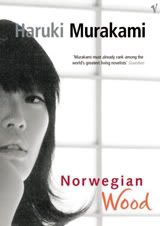
Norwegian Wood by Haruki Murakami

Norwegian Wood by Haruki Murakami (1987, 296 pages, translated from the Japanese by Jay Rubin, 2000)


Please Leave a Comment 

My Other Posts on Murakami

Japanese Literature on the Reading Life


I am developing quite a fondness and admiration for the work of Haruki Murakami.   Murakami (1949-) is for sure the best known outside of the country Japanese novelist writing today.   Perhaps he is not regarded with the reverence that Kenzaburo Oe is (winner Nobel Prize 1994) but millions of people world wide are devouring his books.   So far I have read (in this order), After Dark,  Dance, Dance, Dance, South of the Border West of the Sun, Sputnik Sweet Heart, and The Wild Bird Chronicles.    So far I think the scenes set in WWII in The Wild Bird Chronicles are the most masterfully written of his work and I think Sputnik Sweet Heart is the most fun of the works.   That is until I read Norwegian Wood.  There are common themes and artifacts in all of these works.   I have posted on them in my other  posts on his novels so I will just post briefly on Norwegian Wood.   

Norwegian Wood was Murakami's first multi-million copy book.   A lot of people say it is their favorite of his works.   I liked it a really lot also.   It kept my attention throughout.   I felt I came to know the lead characters and I felt sympathy for them.   I have said before (and explained this is not a derogatory label) I see Murakami as kind of writing bookish boys fantasy books.   Norwegian Wood, set in the 1960s and full of American and British pop culture references and well as references to serious novels (Japanese and Western) read by the college student male character is for sure a fantasy book, among other things, for bookish boys and the men they become.    To give a bit of an example a beautiful female friend of the male character constantly talks to him about sex (but he will not get involved with that with her as he has a girl friend of sorts) and tells him she really wishes she had a way to learn about oral sex.   A very erotically described 13 year old lesbian seduces a woman who has never had a same sex encounter in a vivid passage.    In a bookish boys' book the male lead does not have an adult world job (the lead is college student in the 1960s), beautiful women throw themselves at him (Murakami is very good at describing women) and he sees through the corruption of the world of grown ups.    Norwegian Wood  lacks the magic realism element found in some of his other works.    

Obviously I really enjoy reading the work of Murakami.   I think I will read Wild Sheep Chase for my next of his works next as it  is a prequel to Dance, Dance, Dance.     There are deep themes about loneliness etc that are part of all of his novels but this is a book you can enjoy without a lot of heavy thinking.   If it were made faithfully into a movie it would be x rated and some would scream over the scenes with the 13 year old lesbian.

Mel u

Monday, May 17, 2010

"Somersault" by Kenzaburo Oe


Somersault by Kenzaburo Oe (570 pages, 1999, translated from the Japanese by Philip Gabriel)

Somersault is the 11th work of Kenzaburo Oe (1935-) on which I have posted since I first discovered him last year.   Oe won the Nobel Prize in 1994.    He is a towering figure in contemporary Japanese literature.   In a revealing scene in Norwegian Wood by Haruki Murakami (which I am currently reading) the lead character says his family owns a simple neighborhood book store that sells popular books, not "Tolstoy or Oe".

Somersault is Oe's longest book by far, being twice as long as most of his prior novels.  (The Japanese novel as a rule seems shorter than typical American or English works.)    I think it is not nearly as widely read as some of his earlier books.   The reviews of it on Goodreads.com are more mixed than those for nearly all his other works.    As far as I could find there are no prior book blog posts on it.    Unlike many of his other works, there is little of an autobiographical nature in this book.   

Somersault is a strange kind of book.   I think most of those who do not like or "get" it are trying to hard to see it as a novel purely in the European tradition and this causes a failure of understanding.   I have talked about a similar matter in my post on The Sailor Who Fell From Grace With the Sea by Yukio Mishima.  
To get the flavor of this work, imagine Samuel Beckett writing a Kabuki play about the origin of religion with characters with names like "Patron", "Guide" and "Dancer" intended for an audience as cultured in the Japanese tradition as James Joyce and Ford Madox Ford are in the western.   Then your throw in some sex scenes (hetro and otherwise) worthy of Henry Miller just for fun.   Add in a terrorist plot and you get a bit of the idea.  

The book centers on a religious cult led and begun by Guide and Patron.   Ten years ago they did what is referred to as a somersault in which it was announced that the fundamental provisions of the religion which they then advocated and created were a deliberate fraud and that their religion was created for purely self seeking reasons, among them to have sex with adoring believers.   Now it is decided to revamp the religion (many of its thousands of followers-the figure is given as about 30,000) never accepted the literal truth of the somersault and saw it as a kind of revelation.    The religion of Guide and Patron is not an offshot of Christianity but they make use of Christian imagery in describing their beliefs.   Some try to see Guide and Patron as Antichrists-the response (one wonders if the play on words is as close in Japanese) is that they are antechrists.   They are making the way for the true God or his earthly representative.   The suggestion is there must be many antechrists and the true Christ will come only after there are many anti and ante Christs.   The leaders of the religion feel they will do best (some of the leaders are at least partially venal in their motives, others are true believers) if they can create a state of terror and chaos in society through terrorists acts.   They plan a spectacular act of terrorism that reminds us of the subway attacks in Tokyo.   A lot of Somersault is about the nature of religion and how religions get started.   Meaning to offend no one, it can almost be seen as a a fun house mirror account of the origins of several of the worlds major religions.  We have Guide who receives what some see as hallucinations and others see as divine revelations.   He is surrounded by followers of varying degrees of devotion and he dies a kind of martyr's death.   His word is then spread by Patron, sort of the Peter of his religion.   I think Oe choose to model his religion on that of Christianity as the way in which Christianity originated is central to the reasons to believe it.   Somersault can be see as a mockery of religion in general.    I recall in Oe's non-fiction work Hiroshima Notes his tremendous admiration for an elderly female bomb survivor who was badly injured and who lost many family members in the blast.  Oe saluted her for her ability to face what happens strongly without the crutch of a faith to prop her up.   

I recommend Somersault to those who have read at least 5 of his other works first and really liked them.   I would not advise anyone to make it their first Oe.    I understand why some do not like it, mainly for the fact that none of the characters are really developed much (this again comes from it being seen wrongly  as a purely European Novel).   Some will see it as a general attack on religion  and are probably right in thinking this.    I see Somersault as a very serious powerful  work and one of the major books of the post WWII Japanese novel.    

Tuesday, May 11, 2010

"Sputnik Sweetheart" by Haruki Murakami

Sputnik Sweetheart by Haruki Murakami (1999, translated by Philip Gabriel from Japanese, 229 pages)


Sputnik Sweetheart is to me a really enjoyable very worthwhile read.    Sputnik Sweetheart is the 5th work by Murakami that I have read and blogged on.    It is fun, smart, uninhibitedly sexy in its depiction of  the dawning lesbian feelings of one of the characters, in its description of the bodies of the female characters and in the sex scenes, it is fast moving, has some cliffhangers and lets us see the real life of the three lead characters.   As a bonus from the perspective of my blog, all of the central characters love reading and are into the reading life.   In some novels the reading life of the characters is not quite credible,  Murakami has for sure overcome this.

There are basically only three characters in Sputnik Sweetheart.   The narrator, a young man whose name we never learn, works hard at fitting himself into a society that stresses and enforces conformity at the cost of expressing or even feeling his true emotions and thoughts while working as an elementary school teacher.   The narrator is good friends with a woman named Sumire.   Sumire has always had negative feelings toward sex but she begins to develop strong sexual feelings toward the third character in the novel, Miu.   Miu is in her late thirties and is beautiful but does not seemingly return the feelings of Samire.   (All of the women in the works of Murakami are very described almost as if they were works of art.)   Samire is put through significant stress by her feelings for Samire as they are not the kind of feelings society expects her to have.

SH of Books, Quote Poetry made a very perceptive comment on my post on The Wild Bird Chronicles, namely that there are recurring things in the novels of Murakami.   In reading just four of his novels and six of his short stories I can see recurring falls down wells, sheep, trips to Greek Islands with beautiful women, a preoccupation with prostitutes, a central character without a real world adult job (I am assuming that a male elementary school teacher is as uncommon a figure in Japan as it is in the Philippines and the USA), conversations with girls below 18 about sex  and a lots of cats.    I do not want to give away much of the plot of Sputnik Sweetheart as I think a lot people will read this book in time.   Some shocking things happen and there are interesting side plots along the way.   The section devoted to the Ferris wheel is really well done.

Sputnik Sweetheart can be very much enjoyed for the fun of the narrative, the sex scenes, a mystery at the heart of the book and the trip to the Greek Islands.   Murakami is also what I have called "a bookish books writer" in that a lot of what he writes about plays into the fantasies of male readers.   For example, in Sputnik Sweetheart a beautiful woman offers to fly the elementary school teacher for free to Greece.   The novel centers around themes of loneliness and the inability to really bond with others caused in part by the demands of society.    The use of the term "Sputnik" evolves from a misunderstanding of an English word but the image of a satellite revolving in isolation around a central figure with which it has no real contact can be seen as a kind of a summery  for the themes of the book.  

Sputnik Sweetheart was a very enjoyable read.    I recommend it without reservation.

I am debating what Murakami to read next and would be happy to get some suggestions.


Mel u

Sunday, May 9, 2010

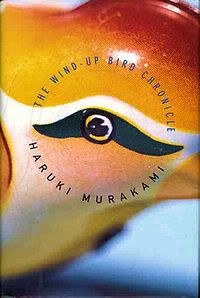
"The Wind Up Bird Chronicles" by Haruki Murakami


The Wind Up Bird  Chronicles by Haruki Murakami (1997, trans. by Jay Rubin, 607 pages)

The Wind Up Bird  Chronicles is my fifth work to read and post on by Haruki Murakami (1949- Kyoto, Japan).     It is one of the "big books" of the post WWII Japanese novel, literally at 607 pages and in terms of the place of esteem it occupies in that body of literature.

There have been a number of recent blog posts on this work.   In The Spring it is the Dawn began a read along some time ago (which I missed out on as I had other items I was reading) which generated a lot of really good posts which cover a lot of the themes of the book.    Given this I will just say a bit about the book and explain what I like about it and make a random observation or two.


The book centers on an unemployed (he quit an OK job because he did not enjoy it) man, Toro, whose cat has disappeared.    He begins a search for his cat and then his wife disappears also.   Toro meets a lot of very interesting characters in his search for his wife and his cat.       He employs a female medium to help him find his cat and his wife.   Her sister was a prostitute at one time and is now a psyche prostitute of sorts.   I noticed in Dance Dance Dance that one of the themes of what I called "Bookish Boys Lit" (as a play on chic lit) is a central character who has no real adult world job (like Toro had and quit).   One of the near defining marks of a bookish boys lit book is the appearance in the story line of  beautiful prostitutes who seemingly fall for the lead male character and provide him with super high quality free sex.   In Dance Dance Dance the adult male lead character also has extensive conversations of a sexual nature with a female under 18, just like Toro does.   I am not making a negative value judgement in seeing this as a bookish boys book.   Here is the genre (I think I made up this category but maybe I read it years ago somewhere) in a nutshell: male character with no adult job who does not like the adult world, beautiful women   who fall for no reason one can see for the lead character, picaresque adventures and secret wisdom gained or revealed.

The book revolves around  the adventures Toro has on his search for his wife and his cat.   A lot of the book is taken up with stories by characters he meets along the way.   I thought the parts of the book that were devoted to the experiences of a now elderly ex soldier about his experiences in the Japanese Army while serving in China were a complete marvel, simply a master piece of narrative exposition.   I for sure felt like I was getting an honest account of the ex-soldiers experiences.   There is a kind of emotional disconnect in the mind of the lead character (hence the preoccupation with prostitutes) but he is deeply moved by the story of the ex soldier
  

I liked The Wind Up Bird  Chronicles a lot.   In fact I am already 1/2 way through another one of Murakami's books now, Sputnik Sweetheart.  The Wind Up Bird Chronicles  is a good adventure story and keeps us reading with cliff hangers throughout the book.   I do not mean to suggest this a light weight book.   There are some very deep themes in this work.   I am trying to keep my posts shorter and I lot of people have posted on this book in the last year so I will simply say I enjoyed it a lot and hope to read all of his novels in the next year or so.


Mel u


Tuesday, April 27, 2010

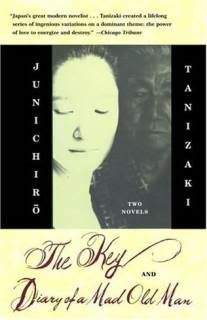
"Diary of a Mad Old Man" by Junichiro Tanizaki

Diary of a Mad Old Man by Junichiro Tanizaki (1961, translated  by Howard Hibbett, 197 pages)

Junichiro Tanizaki (1886 to 1965, born in Tokyo)  is on my read everything they have written (or in this case, has been translated) list.    This will be the 8th work of his on which I have posted.    I first discovered his work about nine months ago and now I look at any list of great novelists of the 20th century that does not include him as reflective of the Euro-Centric limits of the education of the list maker.  

I have written at some length in prior posts explaining why I feel as I do about Tanizaki.   I will keep this post short.    Diary of a Mad Old Man is the diary of a man in his late 70s who is in the grip of the illnesses of old age.   He lives with his wife, son and daughter in law.   Even now he can still feel sexual stirrings brought on by the presence of his daughter- in- law.    The daughter- in- law functions on occasion as his care giver.    She begins to allow him minor sexual favors such as allowing him to kiss her neck and advances to letting him see her in the shower and wash her feet.   In exchange for this the man buys her western consumer goods.   The old man is very self aware and conscious of the impropriety in his actions.   This does not stop him from enjoying it all a great deal. The daughter-in-law may protest a bit but she enjoys the power this gives her over her father-in law.    One of the themes of Tanizaki is sexual fixation and we see this treated  in very intelligent fashion here.   We also get a look at the dynamics of the family relationships.  Diary of a Mad Old Man seems to be Tanizaki's last published work.   He was 75 when it was published.    

I am well past the mid-point in reading all of Junichiro Tanizaki's work.  I will be sad upon the completion of this reading project.   I think he has a number of untranslated works and perhaps more will be translated.   


Saturday, April 24, 2010

"Grotesque" by Natsuo Kirino


Grotesque by Natsuo Kirino (published initially 2003, translated 2007 by Rebecca Copeland, 530 pages)

Grotesque is the third book by Natsuo Kirino that I have read since starting my blog in July, 2009.   I first reviewed her work Real World which is a vivid look at the life of four late teenage girls and a boy that one of the girls becomes involved with.   The boy beats his mother to death.   I next read her Out, another murder story centering around the lives of four women who work the night shift at a factory that makes box lunches.    Kirino is known for spot lighting the dark side of modern Japanese life.   She writes about the people who do not fit into corporate Japan, people on the edge of breakdowns, people who do not feel quite comfortable in  lighted rooms  One of the things we can learn from her work is that a failure to succeed in society is not always a failure of intelligence, sometimes it comes from seeing through things we are not supposed to.

Grotesque centers on two women.    It is narrated by the sister of one of the women.    Yuriko, the sister of the narrator, is incredibly beautiful.   She is so beautiful she has never felt any need to cultivate any other attributes or develop any talents.   Yuriko's looks have always gotten her what she wants.   As the story begins, the narrator and her sister have begun attendance at the prestigious Q High School in Tokyo.   The narrator, a teenage girl of course, comes to hate and have contempt for everyone at the school.   She develops a special dislike for a classmate at the school, Kazue Sato.   Yuriko learns in High School how to use her body to get what she wants.    She progresses from "paid dating" in High School, to super expensive call girl when in her late teens and twenties down to horribly ugly street walker as she passes forty.   We also see the classmate, Kazue enter prostitution and its effect upon her.   

Most of the narrative is told in the first person by the narrator as she tries to understand the forces that pushed both of these girls into prostitution.   The two have another thing in common (this is not a spoiler, it is on the back cover).   They are both murdered by the same customer.   The narrator wants to understand how this could have happened.   She thinks deeply about the dysfunctional elements in the upbringing of her and her sister.   She also has found a journal  kept by her sister Yuriko and she shares that with us also.   I tried to understand the reasons behind the horrible decline of Yuriko from this journal.   We also read the disposition of the man that killed the two women, an illegal immigrant laborer from China.    We also are given an idea as to what motivates the customers of the women.    Most of the men are married so it is not a simple unfilled needed for sex.   

Kirino does a very good job in making these characters come to life for us.    Yuriko loves her work, she loves the power she has over men and she loves the sense of having a night as well as a day identity. She loves the feel of the streets at night.   Her life is not pretty and no details are left out in depicting her decline.   She  goes from a million yen escort (about $8000.00) for the wealthiest men in Japan  to a 3000 yen street walker (about $23.00) taking on the homeless in vacant lots.   There are no details left out and if made into a movie this would be x-rated in parts.   (In fact the USA publisher censored the translation by removing a section on male on male prostitution).    For better or worse we are along for the ride as Yuriko spirals toward a death she almost seems to  seek.   The classmate also has her own story to tell.   

Grotesque is an exciting book, sort of.   I say sort of as we do not really feel sympathy for the characters.   It also gives us a voyeuristic look at the business encounters of the women in the narrative.   Maybe these scenes are fun to read (somebody must like them as her books are million plus sellers in Japan) but our pleasure in this is not something to make us proud of our literary refinement!   The characterizations in this book are very good.   The descent, if it should be called that as this term assumes a value judgement, is very credible.   There a lot to learn about Japanese society in Grotesque.   

Here is what I would suggest on the work of Natsuo Kirino.     She is worth reading for her insight into Women, her look at the darker side of contemporary Japanese society.   This entry from Wikipedia on Noir Fiction describes the world of her novels well

In this sub-genre, the protagonist is usually not a detective, but instead either a victim, a suspect, or a perpetrator. He is someone tied directly to the crime, not an outsider called to solve or fix the situation. Other common characteristics...are the emphasis on sexual relationships and the use of sex to advance the plot and the self-destructive qualities of the lead characters. This type of fiction also has the lean, direct writing style and the gritty realism commonly associated with hard boiled fiction.   

Change "he" to "she" and you have a great description of  Kirino's Work.   I would advise those new to her work to start with her shortest translated novel, Real World.   If you like that book a lot then in a few months read Out, then go on to her longest work Grotesque.   I liked Grotesque, I am glad I read it and when another one of her 16 or so novels is translated I will probably read it.   Some would say, and not be wrong, that her three books are very similar.

Saturday, April 17, 2010

"Train Man" by Hitori Nakano-Some reflections on Japanese Literature

Train Man by Hitori Nakano (2004, 403 pages-translated from Japanese by Bonnie Elliot)

About six months ago I began reading Japanese novels.   I started out just buying what I could find in the book stores here in Manila, popular,  well known books.   I did it more or less to satisfy my curiosity.     Soon I discovered Japanese novelists to match nearly any European heritage writer.    I see now that I have to concede there may not be Japanese novelists to equal the very Pantheon of the western canon but there are numerous ones as good or better than western writers of the second tier and for sure third level.    I do not see this as controversial assertion.   I will say that Japanese novelists are in fact very much Euro Centered writers.  Many of the best of them have advanced degrees in French or English literature.   One of my goals now is to read all the available translated works of the best Japanese writers.   I have only just begun in this project.  Having done a bit of research (though I do need some more info and help on this) I think since WWII about 1000 works of Japanese literature have been translated into English.   Goodreads.com has a list of about 600 works in translation. (of course many are no longer in print.)   I also want to get to know better the Japanese novel as a whole.  To this end I have read a number of types of books:   historical  novels, existential novels, love stories, crime novels, pre-WWI classics, collections of short stories, magical realism, novels by Nobel Prize winners and best sellers you can read on the subway.    

With Train Man I have now read my first Internet chat room novel.   This novel was a million seller in Japan in just a few short months.   It was made into a movie and  TV series also and there have been several mangas based on it.  The lead character, known simply as Train Man is a self styled Geek with no experience whatsoever with women.   He seems to be in his early 20s.   One day while riding a train in Tokyo he sees a woman being harassed by a drunk.   He tells the drunk to leave the woman alone and the drunks runs  away.   The woman is so grateful she asks for the man's name and address so she can send him a token of her appreciation.    She send him an expensive set of cups.   The train man is shocked.   He is a regular in a message  room where all the participants seem to be young men like himself.   He posts his experience and he begins to be flooded with advise and questions.  What does the  woman look like, was she flirting with him etc.   Some how he works up the courage to ask her out for dinner.   He is very slow to move and he posts everything he does in the room along with constant requests for advice.   We see his messages and messages from numerous others.   Much of it is as completely inane, just like such places are.    We get to learn a bit of the lives of the train man as well as the woman, Hermes.   We see the advice his Internet friends give him-work your way into her life-make your self indispensable along with some silly advice about how to push her into a romance which it takes him a long time to figure out if she wants.   

In my recent post on Parade's End by Ford Madox Ford  I used a term of Edwardian era slang when I said it was not a work you should "lollipop your way through" (meaning read casually only paying half attention etc).   Train Man is a book that should be lollipoped through.   I thing it became a best seller as it is so easy to read and I bet it was read on many a train and subway and bus in Tokyo and left behind when finished.   I guess you keep going because we do kind of like the Train Man  ("train man" becomes his message room name) and we want to see what will happen next.   I guess it is OK escapist fiction for those interested in seeing how a message board novel works or who just, like me, want to read a lot of different types of Japanese novels.   I could see this book as a sold at the grocery counter check out or subway booth kind of item.   I am glad I read it but I see no reason for most people to run out and read this book.   A lot of people will see this book as just silly.   I could find almost no information on the author on line.   If anybody has seen some please point me to it.

In terms of future reading, I am looking for Japanese "chic lit",  science fiction, and good historical novels and would greatly appreciate any suggestions.

Monday, April 5, 2010

"The Dormitory" by Yoko Ogawa

"The Dormitory" by Yoko Ogawa (in a collection of three novellas, The Diving Pool-1991, translated from Japanese by Stephen Snyder, 55 pages-Picador Publishing)

"The Dormitory" is the third novella by Yoko Ogawa I have blogged on.    Prior to this I read the title piece, "The Diving Pool" about a strange obsession of a young woman, then "Pregnancy Diary", a very odd work in a diary format about the pregnancy of the diary keeper's sister.   Both of these stories have a fey, near otherworldly feel to them.    I liked them both a lot.    I think the last story in the collection, "The Dormitory" is the best of the three.    

The narrator of "The Dormitory" is a woman, about age 28, living by herself in Tokyo.   Her engineer husband is working on a big long term project in Sweden and his wife is preparing to join him,  it seems.   We learn a lot about her day to day routine.   To me it seems she enjoys being alone and is in no rush to go to Sweden.   Sweden is to her a very far away very exotic place.    One of the themes of Ogawa's work seems to be about being alone-the sadness and the pleasures of being alone.   One day the soon to  start college male cousin of the narrator comes for a visit.   He will be going to the same college his cousin graduated from.   He asks her if she knows a good place he could live.   She suggests he live in the same private dormitory that she lived in during her college days.    She contacts the owner of the dorm to be sure he is still in business and has room for her cousin.   Yes he does but he advises her that things have some how changed in a \way that feels a bit sinister to the narrator though she cannot articulate it.   She advised her cousin that the two of them will go visit the dorm and tells him do not be shocked when you see the dorm owner has both legs and one arm amputated.   The dorm has for sure gone downhill in its appearance and looks a bit shabby.   It is nearly vacant compared to the old days.   I do not want to give away any more of the story.   It reads like the build up of an old fashioned horror story.   The personality of the narrator is a bit strange and quite interesting.

 The best known work of Yoko Ogawa (1932)    is The Professor and The Housekeeper which I hope to read soon.   

I am in the process of expanding my appreciation for the short story as a literary art form.   If any one has any suggestions as to "the world's best short stories" please leave a comment-

Mel u

Saturday, April 3, 2010

"South of the Border, West of the Sun" by Haruki Murakami


South of the Border, West of the Sun by Haruki Murakami (1992, translated from Japanese by Philip Gabriel, 1999,    213 pages  Vintage Books)

First I want to express my thanks to Dolce Bellezza for hosting the contest in which I was lucky enough to win a copy of South of the Border, West of the Sun and being generous enough to send the book internationally.   

I have so far read and posted on two other novels by Murakami.    After Dark was the first Japanese novel I had ever read.    I think it is a good selection as a first Japanese novel. (Since then I have read works by over 50 works by Japanese authors.   The more I read the more I appreciate the incredible richness of the Japanese novel.)      My second work by Murakami was Dance, Dance, Dance.   Dance Dance Dance is a middle book in a three part series which I read in part because I got it in a book swap.    I enjoyed it but would probably have gotten more into it had I read the other book in the series, Wild Sheep Chase first.  I also read about half of the short stories in his collection Blind Willow, Sleeping Woman.    I liked these three books but I did not become a real fan of Murakami until reading South of the Border, West of the Sun which I think is a much better book than the first two novels I read.   

One of the things I personally appreciated about South of the Border, West of Sun was that the narrator and one of the central female characters were very much into the reading life.   Some depictions of characters with a love of reading are convincing, some are not and Murakami's were very well done and quite convincing.  

Basically, the novel is the story of the life of Hajime, a man who we first meet in his adolescence.   He is your typical awkward bookish young man but that does not stop him from being obsessed with girls!   In Dance Dance Dance it seemed to me that the protagonist had an immature fantasy based relationship with the women in his life.   I even referred to the book as "Bookish boys lit".   In South of the Border, West of the Moon we see Hajime have his first sexual encounter (described in a very erotic fashion-this is an erotic book).   We see him get his first job, a boring drone type of job he has and dislikes for years.   He grows out of his social awkward stage but he stays pretty much of a loner.   He meets a girl while in high school, Shimamoto who is like him, an only child.   She had polio as a child so she drags one leg behind her.   She is very beautiful and also a reader.   In Japan at the time, only children were considered to have a weak character brought on by over pampering, or so Hajime tells us.   Nothing ever happens with his infatuation with Shimamoto and after high school he loses track of her.   He has some other adventures but one day in a fix up date he meets the woman he will marry.    This changes his life in many ways and does lead to him being a prosperous owner of two very trendy bars in Tokyo.   One day nearly 20 years since he saw her last Shimamoto walks into his bar.   I will not relay what happens as the plot twists are a lot of fun (and as I said there is some very  clearly  described erotic encounters).    We get a good look at Hajime's marriage.  He is a good father and over all was a pretty good husband.   We learn something about how big business works in Japan.   And for sure there are unsolved mysteries and marvelous happenings.    South of the Border, West of the Sun is above all else a lot of fun to read.

This was the first Murakami novel that really worked for me.   I am now a convert to the Murakami camp even though Kenzaburo Oe has been critical of the content of his work, not his talent.  (Basically it seems to be that  Murakami is considered "Too American" in his cultural frame of reference but this has zero to do with literary quality).    

Tuesday, March 30, 2010

"The Diving Pool" by Yoko Ogawa

"The Diving Pool" by Yoko Ogawa (50 pages, 1991-translated from Japanese by Stephen Snyder) is the lead story in a collection of three short stories by Ogawa under the title The Diving Pool.   The Professor and the Housekeeper also by Ogawa has to be one of the most blogged about Japanese novels of the last year.    Everyone loves it.   (Sadly, I have yet to find it in a  book store here in Manila but I was so happy when I saw The Diving Pool in a local book store.    As soon as I read the quotation from Kenzaburo Oe on the cover ("Yoko Ogawa is able to give expression to the most subtle workings of human psychology in a prose that is gentle yet penetrating")  I knew it was a must read for me.   

The central character and the narrator of  "The Diving Pool" is a teenage girl.   Her father is a Christian minister in a Protestant church in Japan in the early 1990s.   He and his wife, the mother of the narrator, run and live in an orphanage for children in most cases abandoned by their parents.   Most of the children find adopted homes as infants.   A few with special needs stay on in the orphanage.   Our narrator grew up among children who had no real parents.   We see relayed in  very subtle ways how this has shaped her psyche.   The narrator loves to watch a boy, a bit older than herself, who has been in the orphanage about ten years (older orphans are rarely adopted from the home) diving from high dive into the diving pool.    She loves the beauty of his body and of the dives.   She some how has kept a mental collection of all the dives by Jui, who she sees as a step-brother, in her mind.   Clearly she is feeling sexual desire and love mixed together.   There is a mentally disabled girl at the orphanage.   This girl, Rui, is several years younger than our Narrator and seems to very much look up to her.   For reasons that are not on the surface clear, our narrator does something very cruel to this girl.    One would think under these circumstances the narrator would be appreciative of her parents.   Instead, she wishes they were, in her darker moments, dead so she could also be an orphan.   I somehow wondered if the father's love for the church and the doing of good deeds had turned him away from his duties as a father.    The narrator feels no real human connection to any one but the Jui, the diver and she does not understand what those feelings are and they are further confused by the fact that Jui is her step- brother.  Jui is a person of near saintly temperament.   When he is asked if he is upset that his parents abandoned him because of drug addiction he says no they could not help what they were.    We wonder how he found such a kind wisdom so young and we wonder what is behind his obsession with achieving a perfect form in diving.   We see the loneliness of the narrator and we also must wonder how the parents became involved in the Christian ministry in a country in which Christians are a very small minority.   We wonder if this cutting off from traditional religious roots through the adoption of an alien religion is in any way behind the angst of the lead character. Is the seeming emptiness of the life of the narrator a commentary on Christianity as a religion brought into Japan as a result of its defeat in war?    The imagery of the novel is very beautiful.   There is clearly a powerful artistic intelligence at work here.    There are two other stories in this collection and I look forward to reading them.   

Yoko Ogawa was born in 1962.   She has written over twenties books but only a few have yet been translated.   One of her novels was made into a movie and she has won numerous Japanese literary prizes.  

"Death March: A Documentary Novel" by Jiro Nitta

Death March:   A Documentary Novel by Jiro Nitta (1971, translated from Japanese by James Westerhoven, 1992, Stone Bridge Press , 204 pages)

Death March:   A Documentary Novel is a historical novel written in near journalistic style about a military exercise in the middle of winter in 1902 on Honshu Island in northern Japan.    This is not an at all well known book in its English translation.   There are no book blog entries on it and no goodreads.com reviews.   It was a million copy best seller in Japan on publication.    It is the fictionalized account of a military training routine gone tragically wrong.  It is set right before the time of the Japanese-Russian War (1904 to 1905).    The military leaders knew war with Russia was on the horizon.    The Imperial Japanese Army leaders wanted to prepare themselves for a possible land invasion of Russia.   With this in mind they assembled a group of about 200 men and officers to do a march with full military equipment around a huge mountain on Honshu Island in the middle of the winter.   It is the coldest place in Japan.    The leaders of the march are all quite uninformed as to the needs and dangers of leading an army on a march in the middle of a horrible winter.   As luck would have it, a severe blizzard broke out in the middle of the march.   


One of the most interesting aspects of the novel was seeing how things got done in the Japanese Army in 1902.    Most of the officers were descended from Samurai families and those few officers who were not were looked down upon and had little chance for advancement.     Unquestioning obedience is expected and seen among all soldiers.   It is common for Japanese officers to slap soldiers for even seeming to question an order.   The common soldiers are all young and mostly were drafted.   Seven local guides were hired by the lead officer of the regiment to guide them on their march.    Things quickly turn very wrong in terrible way.   Nitta gives us a very good feel as to what this march was like for the soldiers and officers.   He gives us a very clear idea as to how death comes to people during the march and we can really almost see and feel the men freezing to death.   We see the efforts of the officers to help their men deal with frost bite by suggesting they make boots of straw.   We see their efforts to ration food and sake.  (The officers could have easily brought all the food they might have needed but they intentionally made this a hardship march for training purposes and to learn how to fight in sub-zero conditions.)   The death scenes are very well done and we can see what happens easily.   (The book was made into a movie in Japan).   Of 210 in all who started the march, only 21 survived plus all of the seven guides (the guides, civilians, returned home when they decided among themselves they were not being paid enough now that a blizzard had begun).    The officers were completely incompetent.   


When the few surviving troops were rescued the army tried  to keep what happened quiet.   They could not do it as the parents of the soldiers (many in their teens) demanded to know what happened to them.  In one very moving scene a father confronts the commander of officer over the march and tells him if his son had died in battle he could have accepted it but to die at the orders of a fool cannot be accepted.   The incident gets in the media and there is a public outcry.   All of the higher officers deny any knowledge of it, of course.   Payments are made to the families of the dead.   The payments were actually quite substantial and were enough for them to buy land which could support the survivors from then on.   Of course, this must be seen as more or less a payment for silence.  

Jiro Nitta was by profession a meteorologist.   When he retired from the Japanese government meteorological department in his middle fifties he became a professional writer.   The description of the weather conditions show his extreme knowledge on this.   Three of his books have been translated into English but this book is the only one in print.   

In his very good afterword, the translator James Westerhoven (a teacher at Hirosaki University very near the actual setting of the novel) says one of the dominant themes of Nitta's work is the effect of the cult of blind obedience on Japan.   Nitta served in the Japanese army in WWII in China and ended the war in a POW camp.  (I tried to find out more about his war experiences but I could not.)    Westerhoven also tells us what happened to the surviving men in real life and how the investigation of the march turned out.   Westerhoven does let us know that Nitta had a problem with authority in most forms, even on a personal level.   

Death March:   A Documentary Novel  does a very good job of doing what Nitta says he wanted to do, that is see and feel what the march was like.   It feels somehow like a novel a skilled newspaper reporter might have written.   The writing about weather are superb.    I have also posted on another novel set in the very same time frame, Kusamakura by Natsume Soseki.   By contrast, Kusamakura is a near lyrical deeply beautiful work.    Jiro Nitta has numerous works not yet translated.   

Death March:   A Documentary Novel  is easy to read and follow.  (The production qualities of the book are high.)     It teaches us a lot about the Japanese army.   When I read of the common practice of slapping soldiers I was reminded of One Man's Justice by Akira Yoshimura in which I learned that after the war Japanese who had slapped American POWs were hung as war criminals.    Death March:   A Documentary Novel is not a work of great genius, it is not a "must read" Japanese or war novel but it is a good solid book by a man with very strong values whose goal is to let us see the truth about the things he writes about.     
Jiro Nitta was the pen name of Hiroto Fujiwara (1912-to 1980).


Mel u

Sunday, March 21, 2010

"Blind Willow, Sleeping Woman" by Haruki Murakami

Blind Willow, Sleeping Woman by Haruki Murakami (trans by Philip Gabriel and Jay Rubin, 2006, 362 pages)


Blind Willow, Sleeping Woman is a collection of short stories that were originally published from 1981 to 2005.     A number of the stories were first published in translation in the New Yorker magazine.   I am not normally drawn to collections of short stories.    I was asking myself why.   I think the basic answer for me and a lot of others is that I like to be drawn into another world when I read and the vehicle of the short story is not, for me, conducive to this most of the time.   When I do read a good short story I enjoy it and I tell myself I should read more.    With this in mind I recently acquired Blind Willow, Sleeping Woman, a collection of short stories in a book trade.   None of the stories in Blind Willow, Sleeping Woman are over 25 pages long and some are much shorter.    In my readings of Japanese literature I have not begun really to read much of Murakami's work.    He is  widely considered a writer of great quality as well as an entertainer of the highest order and were it not for the fact that two Japanese authors have won since WWII many think he would be in line for a Nobel Prize.    Basically you cannot say that you have begun to know the post war Japanese novel until you have read most of his work.  

I read half the stories in this collection and will read the rest one a time as the year goes on.   Each of the stories is unique and are set in modern Japan or at least begin there.   Murakami does a good job in bringing to life the characters in the stories in the short space he has to do it.

 A very typical story and one I liked a lot was "Man Eating Cats" (19 pages).    It centers on a man and woman, college educated young corporate employee sorts, both married who begin an adulterous affair with each other.    Their passion for each other does not seem deep and the affair seems motivated almost  out of boredom.    In time through unlucky accidents each of the spouses finds out about the affair and their marriages and lives are ruined.    The couple decide if they pool their money they can live for about three years without income.   After some research they decide the best place for them to move to (they want to escape their shame) is to a small Greek island, off the tourist track.    While there the male partner reads an article in an Athens newspaper about a 70 year old woman who lived with a number of cats.    The woman dies alone in her apartment and her body is not found for weeks.   In the mean time her starving cats had begun to eat her body.    The man comes to see this as metaphor for his life.   He feels his life has been thrown away for nothing, any future to live a good life beyond mere subsistence was destroyed by his adultery, done just because he could do it.   Here is the ending of the story:

I returned to the apartment and downed a glass of brandy.  I tried to go to sleep but I could not.  Until the eastern sky grew light, I was held in the grip of the moon.   Then suddenly I pictured those cats, starving to death in a locked apartment.   I, the real me, was dead, and they were alive, eating my flesh, biting into my heart, sucking my blood.   Far away,  I could hear them lapping at my brains.   Like Macbeth's witches, the three little cats surrounded by broken head, slurping up the thick soup inside.    The rough tips of their tongues licked the soft folds of my mind.   And with each lick, my consciousness flickered like a flame and faded away.
In most of the stories we are introduced to ordinary people.    We get to know them a bit then we  begin to see their lives are not so ordinary.    Seemingly small decisions change  the courses of the characters lives in ways they cannot quite fathom.    The introduction of the element of "magic realism" found in Murakami's longer works is found here in several of the stories.    It might be seen as the attempt of people to make sense of their lives by creating their own myths and  using personal magic to explain to themselves elements of their lives that make sense no  any  other way.

The stories I read in the collection were all well done, all entertaining and all made me think.    I hope to read Wild Sheep Chase, Kafka on the Shore, and  The Wild Bird Chronicles soon.

I am reading this book for the POC challenge (now completed with 15 books-I will continue to read for it)
I am also reading this in conjunction with Murakami Month on In the Spring it is The Dawn


I would appreciate any and all suggestions as to my next Murakami read.   I have already read Dance, Dance, Dance and After Dark


Tuesday, March 9, 2010

"A Personal Matter" by Kenzaburo Oe

A Personal Matter by Kenzaburo Oe (1964, translated by John Nathan , 157 pages)
Six months ago I am sad to say I had never heard of Kenzaburo Oe.   Now, after having read and posted on four of his novellas, two novels, a work of non-Fiction on Hiroshima survivors, and a collection of short works by atom bomb survivors selected and edited by Oe I consider him one of the great literary artists of the 20 the century.   I see him as creating  wisdom much as I see Samuel Johnson as doing.     The wisdom of Oe is that of a world turned inside out on itself, that of Johnson is of a world sure of itself.   The best of Oe feels not so much written as discovered.  
A Personal Matter is the most popular of the novels of Oe.    The central character Bird is very hard to like, in part because it is hard not to see yourself in him.    His estranged wife has given birth to a son who seems to have a severe birth defect resulting in terrible brain damage.    Bird secretly wants his son to die but he must go along with the doctors who say they can possibly operate on him once he gets stronger and save him.    Bird is not gratified by this as the odds are very high that the child will be severely handicapped mentally.    Much of the few days in the life of Bird we see him trying to escape from thoughts pressing in on him that he knows are a violation of acceptable morality.   He wants very much to go on a trip to Africa and he spends a lot of time thinking about this.   He indulges in a great deal of sexual activity with an ex-girl friend that he care little about, he drinks too much, he gets fired from a job he does not like,  and shows little real interest in anything.   He does love the poetry of William Blake.   
A Personal Matter is saturated with animal references and metaphors.   I did an informal count as I was reading the novel and there are about 150 such references.
The meagerness of her fingers recalled chameleon legs..the toad like rubber man rolling the tire down the road....Bird stared for an instant in the numerous ant holes in the ebonite receiver...the glass chatter at the bottle like an angry rat...like a titmouse pecking at millet seeds..like an orangutan sampling a flavor..Bird and Himiko exchanged magnanimous smiles and drank their whiskey purposefully, like beetles sucking sap..whiskey-heated eyes dart a weasel glance...
There are numerous references to sea urchins, grasshoppers and shrimp.   Some of the animal references are amazing in their cleverness and all of them made me see more deeply into the world projected by Oe.   (Oe  has a brain damaged son.)  

A Personal Matter is a very intense work.   Once you realize the central character Bird wants his son to die it is hard to like him and also hard to admit we do not understand why he feels that way.    The novel is very explicit sexually.    Attitudes toward suicide are considered briefly.    A Personal Matter kept me in suspense throughout.   I wanted to learn what would happen to the child and how things would turn out among Bird, his wife, and his girlfriend.    Oe is not afraid to look a monster in the face.   His work can help us do the same and if it turns out one of those monsters is buried within ourselves and our mythic past then at least we know it.  

The next work of Oe that  I will read will probably be Somersault (1999).   This is Oe's longest work and departs from his autobiographical mode.   It centers on a religious cult.   Oe has just had his latest novel, The Changeling published in English by Grove press.   Oe has said he will write no more novels and with the publication of this work he sees himself as ready for death.   

Here is a link to all of my Japanese literature posts.

Mel u

Saturday, March 6, 2010

"The Key" by Junichiro Tanizaki

The Key by Junichiro Tanizaki (1956, trans. from Japanese by Howard Hibbett)
The Key is one of the last works of Junichiro Tanizaki 1886 to 1965).   It is the seventh of his works that I have now posted on since I first discovered him when I read his marvelous and amazing work The Secret History of the Lord of Musashi.  
The format of The Key is extremely inventive and near unique.  It is in the form of two diaries, one might almost call them dueling diaries.    One is by the 55 year old man and the other is kept by his wife, age 44.    It is a very erotically charged book.    The long married couple have a strained relationship.   The wife says numerous times that she both loves and hates her husband.    She is very frank in her description of how she feelings about the declining physical prowess of her husband and about her growing revulsion toward his aging body.   The wife has a very powerful sexual hold over the husband, though his love for her has faded away over the years.   At age 44 she is still very attractive to the husband.    Her body is described in detail in the diary of the husband.    Part of the theme of The Key is sexual fetishism, the reduction by men of women to body parts seen apart from a human to which the parts belong.    This is one of the themes of the work of Tanizaki.   Sexual fetishism can be seen as like a metaphor for the reduction of the human to the mechanical.
As we read the two diaries (we read an entry by the man then one by the wife covering the same same time sequence) we see how each views the other.    We are given a deep look at a very flawed marriage with little but habit to hold the partners together.    We get to know the 20 year old daughter and a man of that age the parents think would make a good husband for her.   There are some very interesting and exciting plot twists here and it is a bit shocking to see how explicit this 55 year old novel is.    There are no extremes in the language but it is erotically powerful.   The ending came very much as a surprise to me.    Taniazki sometimes likes to completely turn us on our heads at the end of a novel and make us see that we got things wrong as we were reading.     The Key gives us great insight into its characters and the format is very interesting.   It is also a lot of fun to read.    Tanizaki is on my read everything they have written list (or in this case translated into English).   I am near to completing this goal now.   I will read next The Diary of a Mad Old Man, published by Vintage Press in the same volume as The Key.
There is in print (from Vintage) a collection of seven short stories as well as a work of artistic theory.    Another one of his novels has been translated into English, Two Women, A  Cat and a Man as well as a partial autobiography.    Both of these are available for low prices on Amazon.com sometimes and I will read them also.   There do appear to be numerous untranslated works also.   I am grateful to Vintage Press for the wonderful production quality of this book and for bringing so many works into English.
To me Junichiro Tanizaki should be on any list of great novelists.    Many consider him the greatest Japanese novelist (for sure in the top five).   His work is a world class cultural treasure.     He also translated a number of western classics into Japanese and was widely read in classical Japanese literature, American writers such as Faulkner (The Sanctuary is mentioned as being read by the husband in The Key) and European classics.
I wish to thank Michelle for suggesting this work to me some time ago.   I have found her blog  su (shu) a consistent source of great insight that has given me lots of good ideas.

Wednesday, February 17, 2010

"Captain Shigemoto's Mother" by Junichiro Tanizaki

Captain Shigemoto's Mother by Junichiro Tanizaki (1949, translated from Japanese by Anthony Chambers)


Captain Shigemoto's Mother is the 8th work I have posted on by Junichiro Tanizaki.   Tanizaki's wife Matsuko said it was her favorite of her husband's books.   Often by a happy coincidence something read in one book will give more life to your reading of a prior book.   This work is set among the middle ranking nobility in the first half of the 10th century in Japan.   I was so happy to see one of the lead characters was Heiju, the poet depicted in The Tales of Ise, a collection of 10th century courtly love poems.    The short poems and stories in this collection (called "dons") are very formal in structure and all seem pretty much the same to modern readers.    We do not get much of a sense of the characters and lives of the people in the dons. 

Captain Shigemoto's Mother essentially brings the people in these poems to life.    We see Heiju, portrayed as an assistant commander in the military guards of the court, who is a serial seducer of women ranging from wives of high ranking officials to servant girls.    Heiju is a seeker of sensation, a lover of beauty whether in a woman or 7th century poems.    He also seems a thrill seeker in that he takes a lot of chances in some of his seductions.    We see the ends and outs of court life and his use of servants as helpers in his efforts.    We also get to know three  high ranking officials of 10th century Japan.   We get a close up look at the arranged marriage of a 20 year old woman from a noble family to higher ranking man fifty years her senior.   Most of the characters are portrayed as skilled poets and full readers of the literary traditions that were dominant in 10th century Japan.

Captain Shigemoto's Mother is told very much in the style of another medieval story by Tanizaki that I really like The Secret History of the Lord of Musashi.  

Both are written as if they were 17th century biographical narratives about great figures from history.   In the real histories, the central characters are all people of flawless character totally devoted to their tradition and leaders.   The people in Captain Shigemoto's Mother are real people, far from flawless.    I loved seeing that the central character, Heiju, was deeply into the reading life.   Sometimes it seems like he was interested in women almost as much as subjects to bring to mind poems he had internalized as much as for the women themselves.    As in other works of Tanizaki,  there is a focus on sexual fixations and fetishes.   There is one scene so flat out twisted I actually laughed out loud reading it which is not something one would expect would happen while reading a work set in  medieval Japan.   You can tell Tanizaki had a lot of fun writing this  novella (123 pages) and with a little bit of patience with all the literary references to works unheard of most readers will have fun reading it.   Part of the pleasure of this work is the contrast  of the courtly very much of another era style of the narration and the very strange and out of the moral high road events that are narrated.  

Obviously I like and admire Tanizaki's work very much.   He had an interesting life (1886 to 1965).   The Wikipedia article on him is very informative.    He is on my read everything they have written (or in this case has been translated) list.    I will soon read and post on two more of his works, The Key and Diary of a Mad Old Man.   Besides this, Vintage Press has in print a collection of seven short stories and a work of aesthetic theory.    There appears to be one other novel translated, Two Women and a Cat, available used on Amazon.com sometimes and a another collection of short fiction (which may overlap the Vintage) that are no longer in print.    Not all of the translated works have prose of the same quality.   I prefer the translations of Anthony Chambers in terms the quality of the writing.    I am grateful to Vintage Press for keeping his work in print.    

I am including this book for these challenge
Tournament of Reading (Medieval)
POC Challenge

Mel u


Wednesday, February 10, 2010

"The Reed Cutter" by Junichiro Tanizaki

The Reed  Cutter by Junichiro Tanizaki (1932, 50 pages translated from Japanese by Anthony H. Chambers-1993-Vintage Publishing)
The Reed Cutter is the seventh work by Junichiro Tanizaki which I have read.   (It is published jointly by Vintage with Captain Shigemoto's Wife.)    The more of his work I read the more impressed I become by the range and versatility of his writing as well as his sheer intelligence and deep wisdom.   
The narrator of The Reeder Cutter, a man aged 45 to 60 (my guess) decides one day to go for a walk.    Like the narrator in Arrowroot and the father in law in Some Prefer Nettles he is deeply read in classical Japanese literature and often sees the world through the filter of these works.    As he goes on his walk he recalls works of literature he read many years ago.   He is walking on the banks of a river and he imagines a 9th century poet being inspired to write about the beauty he sees.    As the narrator walks further he comes to an area once famous for the quality of courtesans in the area.   The narrator begins to recall courtesans celebrated in the poetry of Tan Fu and Po Chu both from the 8th century.    In this area of the river it was said all of the females of age were available for sex for hire.   From courtesans celebrated in the poems only to the most elite down to ordinary women who went out on the river in small boats to attract clients.  Lest we think these women are regarded with contempt consider this
Where have these floating women gone?   It is said that they took professional names redolent of Buddhism in the belief that selling sexual pleasure was the act of a bodhisattva.   Would it be possible to raise them to the surface of this stream for a time, like bubbles forming on the surface-these women who likened themselves to avatars of Samantabharda and were even revered by a venerable sage?

As our narrator proceeds on he hears a rustling in the reeds, it is the reed cutter.   The narrator begins a very extended conversation with the reed cutter, a man he identifies with as they are about the same age.   The narrator begins to converse about aging with the reed cutter.  The reed cutter begins to talk about walks along the river he used to take with his father. (The reed cutter in fact comes from an aristocratic family and cuts reeds for pleasure and exercise.)  The father of the reed cutter wanted to marry a woman (this is a story of 25 years or so in the past of the reed cutter.    The woman he wants to marry is promised to another.    The father of the reed cutter ends up marrying the sister of the woman he loves, reasoning if he cannot be the husband of his beloved perhaps he can be her sister.   One of the themes of  the work of Tanizaki is erotic enslavement.   We have seen this theme brilliantly treated in Naomi and The Secret History of the Lord of Musashi.   In one of the most striking parts of the book the woman the father loved, his wife, and he go on a trip along the river.   They stop at an inn.   The sister he loved had recently had a baby.   They employed a wet nurse who was left home with the baby.   Normally the wet nurse would also drain out the milk produced by the mother of the child.   She does not come along on this trip so the mother drains herself the milk, places it in a glass and the father drinks it.   The wife of the father of the reed cutter knows he loves her sister and married her only to stay close to her sister.   He is also offered the opportunity to nurse from the woman but he finds the power to decline this given his wife is in the room.   Like the protagonist in Naomi, we see male characters making women into fetish objects and investing them with great power through their erotic grips.   Of course in the dynamics of human relationships this is continually shifting and can easily be lost to the next woman or to the effects of aging.   This is one of the deeper themes related to women's issues in Tanizaki's work.

There are lots of interesting literary references, observations about poetry, the aging process, sex  and family life in the work.   Nothing really happens, just a two men talking next to a river.   For sure it is a beautiful story of a man deeply into the reading life whose view of the world has been hugely enriched  by the works that are part of his interior life.   We may not be able ever to enter deeply into the works that were part of his reading life but we can see a brother of the life in him.

This probably should not be your first Tanizaki  (1886 to 1965) but for sure it is a wonderful novella.  

I will soon read and post on The Key, Diary of a Man Old Man, and Captain Shigemoto's Mother, also by Tanizaki.   Tanizaki is on my "read all they have written list" (or in his case all translated into English-I am grateful to Vintage press for having the courage and I must say class to publish and keep in print so many of his works-12).  

  
As we grow older we come to a sort of resignation, a state of mind that lets us enjoy our decline in accordance with the laws of nature, and we come to wish for a quiet balanced life, do we not?

Featured Post

Imperial Reckoning: The Untold Story of Britain’s Gulag in Kenya by Caroline Elkins - 2005 - 701 Pages

  Imperial Reckoning:     The Untold Story of Britain’s Gulag in Kenya by Caroline Elkins - 2005 - 701 Pages 2006 Pulitzer Prize Winner From...