Showing posts with label Russia. Show all posts

Thursday, December 28, 2023

Russia : Revolution and Civil War, 1917–1921 /by Anthony Beevor - 2022 - 576 Pages


 Russia : Revolution and Civil War, 1917–1921 /by Anthony Beevor - 2022 - 576 Pages is a highly informative well documented history of a shape shifting era in not just Russian History but that of the world.  

"Riveting . . . There is a wealth of new information here that adds considerable texture and nuance to his story and helps to set Russia apart from previous works.”—The Wall Street Journal

An epic new account of the conflict that reshaped Eastern Europe and set the stage for the rest of the twentieth century.

Between 1917 and 1921 a devastating struggle took place in Russia following the collapse of the Tsarist empire. The doomed White alliance of moderate socialists and reactionary monarchists stood little chance against Trotsky’s Red Army and the single-minded Communist dictatorship under Lenin. In the savage civil war that followed, terror begat terror, which in turn led to ever greater cruelty with man’s inhumanity to man, woman and child. The struggle became a world war by proxy as Churchill deployed weaponry and troops from the British empire, while contingents from the United States, France, Italy, Japan, Poland, and Czechoslovakia played rival parts.
 
Using the most up to date scholarship and archival research, Antony Beevor assembles the complete picture in a gripping narrative that conveys the conflict through the eyes of everyone from the worker on the streets of Petrograd to the cavalry officer on the battlefield and the doctor in an improvised hospital." From the publisher 

Beevor details how White Russian force, dedicated to the restoration of the monarchy, were animated by extreme hatred for Jews who they saw as behind the revolution.  This hatred fed that of the Germans and other European countries and directly contributed to the start of World War Two and the Holocaust. There is not a terrorist organisation existing today that does not share extreme Anti-Semitic ideological views.

"The Whites lost the civil war largely because of their inflexibility, including their refusal to contemplate land reform until it was far too late or to allow any autonomy to the nationalities of the Tsarist Empire. Their civil administration was so useless that it barely existed. Paradoxically, they also lost for reasons very similar to the way the left-wing side lost the Spanish Civil War less than two decades later. In Spain, the fractious anti-fascist alliance of the Republic could not hope to prevail against Franco’s disciplined and militarised regime. In Russia, an utterly incompatible alliance of Socialist Revolutionaries and reactionary monarchists stood little chance against a single-minded Communist dictatorship. Extremes fed on each other in both cases, and the vicious circle of rhetoric and violence was a major factor leading to the rise of Hitler and the Second World War itself. For far too long we have made the mistake of talking about wars as a single entity, when they are often a conglomeration of different conflicts, mixing national resentments, ethnic hatreds and class warfare. And when it comes to civil wars, there is also a clash of centralism against regionalism and authoritarianism against libertarianism. The idea of a purely ‘Russian’ civil war is another misleading simplification. It prompted one historian recently to describe it instead as ‘a world war condensed’." From Beevor's conclusion 

The author's website details his many accomplishments, awards and other books.


 Russia : Revolution and Civil War, 1917–1921 /by Anthony Beevor is history at its highest level.

Mel Ulm 


Saturday, December 10, 2022

Revolutionary Russia:1891 to 1991 A History by Orlando Figes - 2014 - 336 Pages


 Revolutionary Russia:1891 to 1991 A History by Orlando Figes 


In October I read The Crimean War by Orlando Figes. I am very interested in Romonov era Russian History, especially the last days of the dynasty, so when his history of the Russian Revolution was on sale as a Kindle for $2.95 I acquired it. (It is now back up to $12.95.)


The central thesis of the work is that Russian History from 1891 up to 1991 can best be understood as a working out of radical changes brought to society by the Revolution.


Figes,as one would expect, lays out very well the huge social inequities that created the conditions that brought about the revolution. He shows how the completely incompetent leadership of Czar Nicholas during World War One, his marriage to a German Princess, the involvement of Rasputin and his belief in his divine right to rule greatly aided the arguments of anti-Tsarist ideologues. When peasants attempting a peaceful protests were gunned down by Cossacks the fate of the Romonovs was sealed. Figes goes into detail about the infighting between different Revolutionary groups, leading to the rule of Lenin, 1917 to 1924


Lenin wanted to create a Marxist state where there was no private property. Upon the ascension of Stalin to power (1924 to 1953) the government began the collectivation of farms owned by farms owned by Kulaks, rich peasants. Soon, for reasons Figes explains, this lead to a disastrous food short. In May of last year I read a highly regarded book by Anne Applebaum, Red Famine: Stalin's War on The Ukraine in which she shows that Stalin made a decision to take food from the Ukraine and divert it to Russia, thus preventing Russians from turning on the government. I was shocked by this from Figes:  


"In the reported words of Lazar Kaganovich, who oversaw collectivization and grain procurements in Ukraine, the death of a ‘few thousand kulaks’ would teach the other peasants ‘to work hard and understand the power of the government’.9 But no hard evidence has so far come to light of the regime’s intention to kill millions through famine, let alone of agenocide campaign against the Ukrainians. Many parts of Ukraine were ethnically mixed. There is no data to suggest that there was a policy of taking more grain from Ukrainian villages than from the Russians or other ethnic groups in the famine area. And Ukraine was not the only region to suffer terribly from the famine, which was almost as bad in Kazakhstan."


This is the polar opposite of Applebaum's very thoroughly documented conclusions.  


Figes made another remarkably inaccurate remark that undermined my reliance on his insights into Russian society:


"Russia is no longer an aggressive state. It does not start foreign wars. Economically it is a pale shadow of the powerhouse it was on the eve of the First World War. Seventy years of Communism ruined it. Yet the authoritarian state tradition has revived in Russia in a manner unexpected twenty years ago. This resurgence, based on Putin’s reclamation of the Soviet past, demands that we look again at Bolshevism—its antecedents and its legacies—in the long arc of history"


This is totally wrong, of course. Figes does provide a lot of information about the structure of government under Stalin.


I am glad I read this and would read other books by Figes if they were on sale. 


ORLANDO FIGES is the author of numerous books on Russia, including A People’s Tragedy, Natasha’s Dance, The Whisperers, and The Crimean War. His works have been translated into twenty-seven languages. A professor of history at Birkbeck, University of London, and a frequent contributor to The New York Review of Books, Figes is the recipient of the Wolfson History Prize, the W. H. Smith Literary Award, the NCR Book Award, and the Los Angeles Times Book Prize, among others.


Mel Ulm 


Thursday, November 3, 2022

A Month In The Country-A Drama by Ivan Turgenav(1850) Translated by Constance Garnett, 1899


Last month I read a marvellous book The Anna Karenina Fix -Life Lessons From Russian Literature by Viv Groskup. In a chapter on Ivan Turgenav she focuses on his drama A Month In The Country. I have read a bit of his work but never a play. So inspired by Groskup I have read now this play, in translation by Constance Garnett.


"This is where Turgenev comes in. No one writes better about unrequited love. Real life is about quiet, slow, awkward moments of humiliation. And what greater humiliation is there than loving someone far, far more than they love you?" Viv Groskup

A Month In The Country,set in a rural dacha, is a story about ill-advised unrequited love,lives ruined with no hope but to try to move on emotionally.
.
Turgenev was for fourty years madly in love with a married French opera singer, Pauline Viaradot. Groskup talks a lot about this. For sure he loved her much much more than 

The cast

Natalya Petrovna, wife of a rich landowner, 29

Mikhail Aleksandrovich Rakitin, a family friend, in love with Natalya, 30

Aleksei Nikolayevich Belyaev, a new young tutor of Natalya's son Kolya, 21

Arkadi Sergeyevich Islayev, a rich landowner, husband of Natalya, 36

Kolya, son of Natalya and Islayev, 10

Vera Aleksandrovna (Verochka), Natalya's ward, 17

Anna Semyonovna Islayeva, Arkadi's mother, 58

Lizaveta Bogdanovna, a companion, 37

Adam Ivanovich Schaaf, a German tutor, 45

Afanasi Ivanovich Bolshintsov, a neighbour, 48

Ignati Ilyich Shpigelsky, a doctor, 40

Matvei, a servant, 40

Katya, a servant, 20

Natalya Petrovna, a 29 year-old, is married to Arkadi Islaev, a rich landowner seven years her senior.She is Bored with life and welcomes the attentions of Mikhail Rakitin as her devoted but frustrated admirer, without ever letting their friendship develop into a love affair.

The arrival of the handsome 21-year-old student Aleksei Belyaev as tutor to her son Kolya ends her boredom. Natalya falls in love with Aleksei, but so does her ward Vera, the Islaevs' 17-year-old foster daughter. To rid herself of her rival, Natalya proposes that Vera should marry a rich old neighbour, but the rivalry remains unresolved.

Rakitin struggles with his love for Natalya, and she wrestles with hers for Aleksei, while Vera and Aleksei draw closer. Misunderstandings arise, and when Arkadi begins to have his suspicions, both Rakitin and Aleksei are obliged to leave. As other members of the household drift off to their own worlds, Natalya's life returns to a state of boredom.

Groskup sees as the life lesson of A Month In The Country to be careful not to fall in love with someone who will never love you back. Sometimes male characters talking to each other see love as a curse. 


Saturday, July 9, 2022

After the Romanovs- Russian Exiles in Paris from the Belle Époque to Revolution and War by Helen Rappaport - 2022


After the Romanovs- Russian Exiles in Paris from the Belle Époque to Revolution and War by Helen Rappaport - 2022


This will be my eighth year participating in a wonderful event, Paris in July.  The event hosts are Reader Buzz and Thyme for Tea.  Posts on any and all things Paris are welcome.  You can share your memories of a trip to Paris, your favorite French recipes or restaurants, art in the  Louvre, your favorite set in Paris Movies (mine are Ninotchka and Midnight in Paris).  Of course the French literary masters as well as contemporary writers are great subjects.


Last year I posted on six short stories by Russian Émigré writers who loved to Paris after the fall of the Tsars among others works.  Three of them are given illuminating coverage 

in After the Romanovs.


Paris in July is an excellent way to meet bloggers outside the Book Blog world, to expand your knowledge of Parisian history and culture.


Like those depicted in  my first post for Paris in July, Yiddish Paris by Nicolas Underwood, Russians moved to Paris because they felt they no longer had a safe home, free from the threat of death.


The book opens in 1900 at the most elite restaurant in Paris.  Among the clientele are Russian Grand Dukes and their French Courtesan mistresses. (This courtesy title was borne by the sons and male-line grandsons of the Emperor of all the Russias, along with the style of His Imperial Highness. They were not sovereigns, but members and dynasts of the House of the reigning emperor. From Wikipedia) Grand Dukes often had no actual responsibilities, this combined with great wealth, arranged marriages and the eagerness of the French to cater to them drew them to Paris. Some bought mansions and gave huge tips, lavishing fortunes on a French mistress .  Then came the Russian Revolution and everything changed.

Some had the foresight to bring liquid wealth to Paris, some ended up as waiters or cab drivers.  Many of the Romanov women became employed as seamstress or models. Most Russian exiles never  stopped believing the Bolsheviks would be overturned and they could return.


Soon after the fall of the Tsar 1000s of ordinary Russians moved to Paris, struggling to fit in, speaking no French and looking for work.  2500 became cab drivers, a relatively desirable occupation. 1000s worked in Renault and Citroen factories.  Richer Russians did try to help those in poverty.  As the French economy went into decline, some resentment was felt toward Russians taking jobs.  Younger Russians born in France had little nostalgia for Czarist days.  Rappaprt estimates there were about 75,000 Émigrés at the peak.


After the Romanovs is an excellent work of narrative non-fiction, very well documented and written.


Details on Rappaports background and other books can be found here


https://helenrappaport.com/about/


Mel Ulm


Saturday, June 18, 2022

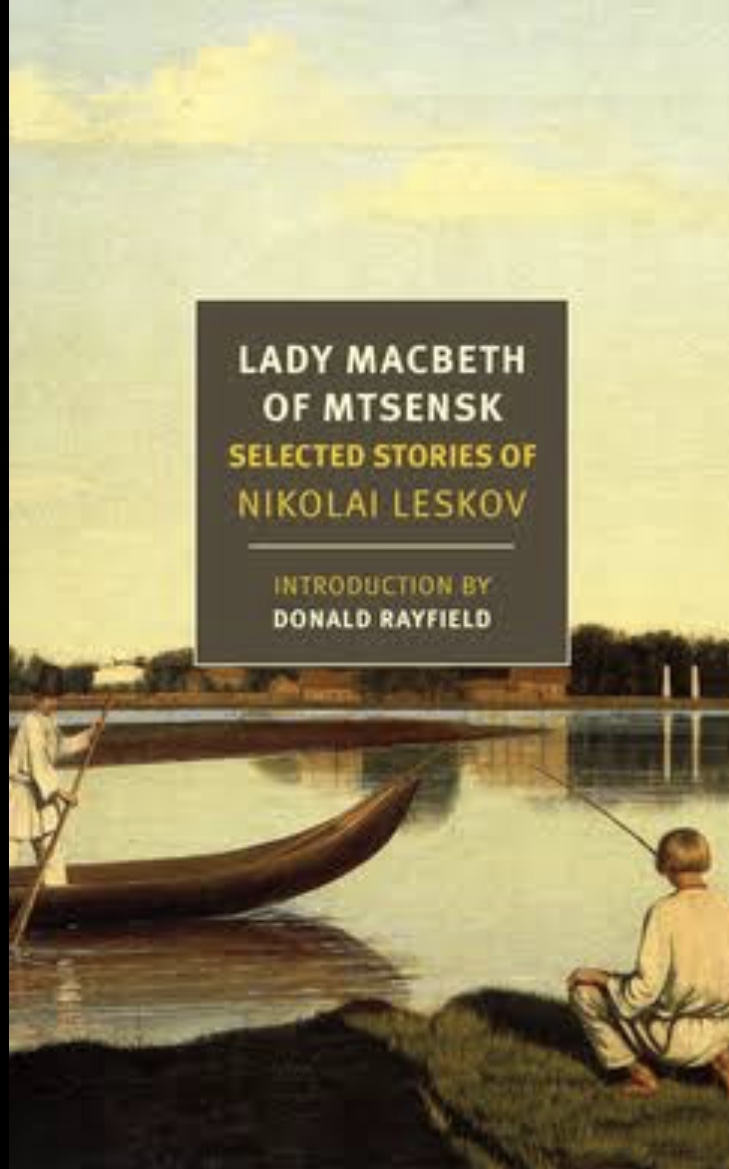
THE STEEL FLEA The Tale of the Cross-Eyed, Left-Handed Gunsmith from Tula and the Steel Flea by Nikolai Leskov - A Short Story - 1881- included in Lady Macbeth of Mtsensk and other Stories by Nikolai Leskov - 2020- with an Introduction by Donald Rayfield - translated by William Edgerton


THE STEEL FLEA The Tale of the Cross-Eyed, Left-Handed Gunsmith from Tula and the Steel Flea by Nikolai Leskov - A Short Story - 1881-  included in Lady Macbeth of Mtsensk and other Stories by Nikolai Leskov - 2020- with an Introduction by Donald Rayfield - translated by William Edgerton 


Nikolai Leskov


Born February 4, 1831 in Oryol Oblast, located in Western Russia 


Died March 5, 1895 in St. Petersburg, Russia 


He lived for eight years in Kiev where he began to write for Ukrainian and Russian publications.  His wife was born in Kiev.


The collection also includes The Enchanted Wanderer and today’s story  as well as three other works besides Lady Macbeth of Mtsensk.


Last month I read Lady Macbeth of Mtsensk, a work of great depth about meaningless murders  caused by sexual jelousy. Leskov’s The Steel Flea could not be more different, an amazingly creative story that amazed and delighted me as I think it will many others.


Set in the early 19th century, as the story begins we are on a tour of England with Emperor Alexander the First and his Entourage.  The English want to convince him that they have the best of everything.  His assistant Pavlov wants to go back to Russia, missing his family and his farm.  He tells the Emperor everything is better back in Russia.


The English show Alexander a nearly microscopic steel flea. It is an operational miracle, the product of incredible English craftsmenship.  From this Lekhov takes us back to Russia, with the steal flea where Russian craftsmen try to duplicate the flea.


The  creation of the steel  flea is just so original.


This story is just a pure delight.


If you wish to expand your reading of 19th century Russian literature beyond the best known writers this collection of Leskov’s works would be good start.


Mel ulm


Sunday, June 12, 2022

The Primer of Love by Ivan Bunin - A Short Story - 1915. - translated by David Richards - 1984 - included The Gentleman from San Francisco and other Stories by Ivan Bunin


The Primer of Love by Ivan Bunin - A Short Story - 1915. - translated by David Richards - 1984 - included The Gentleman from San Francisco and other Stories by Ivan Bunin 


Ivan Bunin


October 22, 1870 - Born Voronezh, Russia


March 28, 1920 - moves to Paris where he Will spend The rest of his Life, with countryside interludes


1933 - first Russian to win the Nobel Prize


November 8, 1953 - dies in Paris 


The Primer of Love” is considered one of Bunin’s three greatest works, along with “The Gentleman from San Francisco” and “Chang’s Dreams”.


Today’s story begins with a journey through the Russian country side.   The story begins with a trip


“Ivlev was travelling once at the beginning of June over to the far side of his province…Ivlev gave himself over to that calm and aimless watching the world pass by which goes so well with the rhythm of hooves and the tinkling of halter-bells.”


He was staying at his brother-in-laws estate.  He loaned Ivlev a three horse cart with a driver.  The driver is concerned about not tiring the horses out too much.  They make a stop at the home of a countessa.  The driver waits out in the rain, Ivlev enjoys tea with the countess.  


“The countess was wearing a flowing pink tea-gown, which revealed her powdered neck. She was smoking, inhaling deeply, and constantly adjusted her hair, baring her firm round arms to the shoulder. Inhaling and laughing, she kept bringing the conversation round to love and amongst other things spoke about her near neighbour Khvoshchinsky, who, as Ivlev had known since he was a child, had all his life been unhinged by love for his maidservant Lushka who’d died very young.”


His destination is the home of now deceased Lushka, he has been thinking about her since childhood.  When they arrive Ivlev meets her only child,a man in his late teens.  He tours her house, stopping at the library which he says he might buy.


He finds a hundred year old book, The Primer of Love, full of advise on all aspects of a man’s love for a woman.  Ivlev reads much of the advise.  It ends up being the only book he buys.


This story deals with the power of love to control lives, with the simple pleasures of existence as well as a celebration of late Czarist Russia.


There are 17 works in collection, including a novella.  I will, i hope read them all.  


Mel Ulm

Monday, June 6, 2022

“The History of the Village of Goriukhino” by Alexander Pushkin - A Short Story - 1830- - - from Peter The Great’s African - Experiments in Prose - published by The NYRB, forthcoming 2022- translations by Robert and Elizabeth Chandler


“The History of the Village of Goriukhino” by Alexander Pushkin - A Short Story - 1830- translated by Robert and Elizabeth Chandler - 2022 - from Peter The Great’s African - Experiments in Prose - published by The NYRB, forthcoming 2022- translations by Robert and Elizabeth  Chandler


Alexander Pushkin


Born: May 26, 1799, Moscow, Russia

Died: January 29, 1837, Saint Petersburg, Russia


The History of the Village of Goriukhino is narrated by Belkin, an imaginary figure.  Like Pushkin,he was from a minor Noble Family.  In the Afterword Robert Chandler says it can be seen as Pushkin parodying Russian historians of early 19th century.


In twenty pages Belkin traces the history of a rural community.  The residents are mostly surfs, as time goes on they go from being fairly free and prosperous to tighly ruled and heavily taxed as an outsider buys the village. Any one who objects finds himself drafted into the Russian army.  Much of Belkin’s alleged data comes from records he accidently acquires.


I found “The History of the Village of Goriukhino” a very entertaining story.


The collection also contains an uncompleted novel, Peter the Great’s African, as well as two fairly long Short Stories.  The Afterword is highly informative.


This work is a very valuable edition to English translations of Pushkin.


Mel Ulm


Saturday, May 28, 2022

“Lady Macbeth of Mtsensk” by Nikolai Leskov - 1864 - included in Lady Macbeth of Mtsensk Selected Stories by Nikolai Leskov - 2020- with an Introution by Donald Rayfield- translated by Robert Chandler


“Lady Macbeth of Mtsensk”  by Nikolai Leskov - 1864 - included in Lady Macbeth of Mtsensk and other Stories by Nikolai Leskov - 2020- with an Introduction by Donald Rayfield- translated by Robert Chandler 


Nikolai Leskov 


Born February 4, 1831 in Oryol Oblast, located in Western Russia 


Died March 5, 1895 in St. Petersburg, Russia 


He lived for eight years in Kiev where he began to write for Ukrainian and Russian publications.  His wife was born in Kiev.


The collection also includes The Enchanted Wanderer and The Steel Flea as well as three other works besides Lady Macbeth of Mtsensk.


“NOW AND again in these parts you come across people so remarkable that, no matter how much time has passed since you met them, it is impossible to recall them without your heart trembling. One such person was Katerina Lvovna Izmailova, a merchant’s wife who was once the center of a drama so terrible that our local gentry, taking their cue from someone’s lighthearted quip, took to calling her Lady Macbeth of Mtsensk.”


As Robert Rayfield says in his very well done introduction, Leskov, as did Turgenev, recast famous Shakespeare characters in Russia.


I was shocked by muderous brutality of the central female character in this story, a woman consumed by jealousy.  

Katrina is bored with her life as the wife of a lumber merchant, much older than herself. He is away most of the time.  She starts a romance with one of her husband’s workers. When Katrina’s father in Law later finds them in bed together, a fight ensues in which Katrina and the man kill him.  They bury him Right away so no one can see his wounds.  From this two more murders follow. Bringing about a trip to Siberia for Katrina and her lover.


Levkov vividly brings to the plot the pervasive corruption in Russia.  People are out for themselves only.


Chekhov and Tolstoy greatly admired the work of Leskov.


“Lady Macbeth of Mtsensk”  is a masterwork.  I look Forward to reading more by Nikolai Leskov.


Mel Ulm


Thursday, July 22, 2021

City of Thieves by David Benioff - 2008, 258:pages


City of Thieves by David Benioff - 2008 - 258 pages


A New York Times Best Seller 


Set in Leningrad during 1942 during the German siege of the city, 16 year old Lev Beniov is arrested for looting and thrown in the same cell as a 19 year old deserter from the Russian Army.  Both are at risk for quick executions.  The deserter goes by Kolya.  He is blond, handsome, a smooth talker and fancies himself a ladies man.  Of course he denies he is a deserter, claiming he is on a secret mission. Lev looks like he is Jewish.


They are taken to the office of a colonel.  Going in they spot s beautiful young woman ice skating on the Neva River.  Both the boys can see she eats meat every day, she must have a powerful father.  The colonel is her father.  She is getting married in a week and is demanding s big cake, one requiring a dozen eggs.  Eggs are nearly impossible to find.  The colonel offers the two boys a deal.  He gives them a week to roam free and return with the eggs needed,  if they do, they go free, if not he will have them captured and executed.  He feeds them,food anciety dominated almost everyone’s Life, gives them some rubles and sends them on their mission.


Lenigrad is a wasteland, a near necroplolis.  People are even resorting to canabalism.  The Germans are incredibly cruel, vicious monsters.  The Boys have several close calls. They join for a while a group of Russian partisans.  Among them is a female sniper with over 200 confirmed kills. Besides being perpetually hungry, the Boys are preoccupied with sex. The sniper is wrapped up in heavy clothes but they speculate on the size of her breasts.  Of course Koyla brags about his experience with women.


In s very powerful segment the Boys come upon a fancy dacha which turns out to be a comfort House for German officers stocked with Young Russian women.  Everywhere they ask for Eggs but with no luck.cruelty, death, and starvation are around any turn.  The Germans are depicted as worshipping a mad man who wants everyone in Leningrad killed or starved.  


Lev does return with a dozen Eggs.  I would describe the ending as partially happy, partially more meaningless death.


There are lots of close calls, the conversations of the boys are marvelous, Lev’s father was a famous poet.


The minor characters are very well done.  


The Kindle edition is currently available for $1.95


David Benioff worked as a nightclub bouncer in San Francisco, a radio DJ in Wyoming and an English teacher/wrestling coach in Brooklyn before selling his first novel, The 25th Hour, in 2000.


He later wrote the screenplay for Spike Lee’s adaptation of 25th Hour starring Edward Norton and Phillip Seymour Hoffman. In 2005, Viking Press published Benioff’s collection of short stories, When the Nines Roll Over.


“Benioff’s screenwriting credits include Troy (2004), directed by Wolfgang Petersen, and Stay (2005), directed by Marc Forster, The Kite Runner (2007). Jim Sheridan produced Benioff’s screenplay Brothers, and Hugh Jackman reprised his role as the clawed mutant in Benioff’s Wolverine. He is also screenwriter and executive producer of Game of Thrones, HBO's adaptation of George R.R. Martin's A Song of Ice and Fire series of novels.

Viking published his most recent novel, City of Thieves, in May 2008.


Benioff is married to actress Amanda Peet; the couple has three children.”

From Goodreads 


Sunday, July 18, 2021

Opyt’, - A Short Story by Yury Felsen (pen name of Nikolai Freudenstein), first published in the magazine Zveno (1927). ‘An Experiment’ translation copyright © Bryan Karetnyk, 2017.


‘Opyt’, - A Short Story by Yury Felsen (pen name of Nikolai Freudenstein), first published in the magazine Zveno (1927). ‘An Experiment’ translation copyright © Bryan Karetnyk, 2017.


Paris in July - 2021 - Hosted by Thyme for Tea


This is part of my participation in Paris in July 2021


This story is included in Russian Émirgé Short Stories from Bunin to Vanovsky - edited by Brian Karetnyk.  I highly reccomend this wonderful collection


Nikolai Berngardovich Freudenstein - real name of Yury Felsen


Born 1894 - St Petersburg, Russia 


1917 - with his Family after The October Revolution he moves to Riga, Latvia 


1923 - Settles in Paris


Dies 1943 - Auschwitz - upon arrival he was judged unfit to live and sent at once to the gas chamber - this was made possible by the cooperation of French authorities who had placed him in The Drancy concentration camp located in an eastern suburb of Paris to await being deported 


Works read so far for Paris in July 2021


  1. Lost in Paris by Elizabeth Thompson - 2021
  2. Loving Modigliani by Linda Lappin - 2020
  3. Russian Émirgé Short Stories from Bunin to Yanovsky - edited by Bryan Karetnky. 2018 - an overview 
  4. Pancakes in Paris - Living The American Dream in France by Craig Carlson - 2016
  5. The Paris Apartment by Kelly Bowen- 2021
  6. The Paris Architect by Charles Belfoure - 2013
  7. “Requiem” - A short story by Gaito Gazdanov - 1960
  8. The Ice Swan by J’nell Ciesieski - 2021
  9. Two Short Stories from the 1920s by Teffi
  10. “Dimanche” - A Short Story by Irene Nemirovsky - 1934- translated by Bridget Patterson 2015
  11. “The Life of Madame Duclos” -1927-  A Short Story by IRINA ODOEVTSEVA 


Most Russian Émigrés were sympathetic toward the attempts of White Russian  Armies to overthrow the Bolsheviks and restore a pre-revolutionary form of government.  White Russians blamed Jewish intellectuals for the fall  of the Tsar and the destruction of their privileged way of life.   There were Jews among those who left Russia for Paris.  When the Germans took over Paris most, not all French people, were fine with the removal of even French born Jews to concentration camps.


One of the things Russian Émigrés often had to cope with was the psychological impact of just getting by, struggling to survive without a secure income, a comfortable residence or servants.  .  


As today’s story open, the narrator and his journalist friend have just been picked up by a Hungarian woman and her Parisian friend.  They take them to a cafe the narrator could have afforded in his younger days, offering to pay.  He feels like a prostitute but thinks what does it matter now.  The four of them leave the cafe to go to a late night place.  They pickup a young French woman and a man.


The narrator gets bored, walks around until he encounters a Russian he knows 


“We ask each other a thousand questions. Russians have still not grown used to the fact that there are thousands of them in Paris, and they are congenial and curious about one another, like men in a barracks who hail from the same parts.”


He then takes to his apartment a Frenchman and a woman from the club.  They end up robbing him.


From the narrator I got the feeling of a man now just going through the motions of life.


Featured Post

Imperial Reckoning: The Untold Story of Britain’s Gulag in Kenya by Caroline Elkins - 2005 - 701 Pages

  Imperial Reckoning:     The Untold Story of Britain’s Gulag in Kenya by Caroline Elkins - 2005 - 701 Pages 2006 Pulitzer Prize Winner From...