Wednesday, November 7, 2018

"The Intoxicated Years" - A Short Story by Mariana Enríquez . 2017 from. her collection Things We Lost in the Fire- translated from the Spanish by Megan McDowell


Gateway to Mariana Enríquez on The Reading Life


You may read “The Intoxicated Years” here


Very Perceptive post from The Kenyon Review on Things We Lost in the Fire


“I realized she had slept with him. Andrea smelled different, and sometimes she looked at us with contempt and fake smiles. I told her she was a traitor. I reminded her of Celina, a girl from our school a little older than us who had died after her fourth abortion, bleeding out in the street as she tried to get to the hospital. Abortion was illegal and the women who performed them sometimes just threw the girls into the street afterwards. There were dogs in the clinics, they said the animals ate the fetuses so they wouldn’t leave any traces behind. She looked at us angrily and said she didn’t care if she died. We left her crying in the plaza.”  

Recently i did a Google search on “The best short story collections of 2017".  Of course the list is just the opinion of the maker, or maybe something they were paid to write.  I found on the list Things We Lost in the Fire by Mariana Enriquez.   I read one of her stories (see the link above) and wanted to enter further into her vision of the mean streets of Argentina.

"The Intoxicated Years" (see the link above) begins in 1989 with three late teenage girls learning to use cocaine.  Enriquez makes you wish for a razor.  

We skip to 1994.  The friends have moved onto acid.  We are their as they are splitting a tab.  One of them now has a boyfriend who is with them.  Lots goes on with them in this session.  The descriptions are marvelous.

I hope  to read more of her work, eventually her entire collection.


Monday, November 5, 2018

Doctor Faustus The Life of the German Composer Adrian Leverkuhn As Told by a Friend by Thomas Mann - 1948 - translated from The German by Joseph Wood


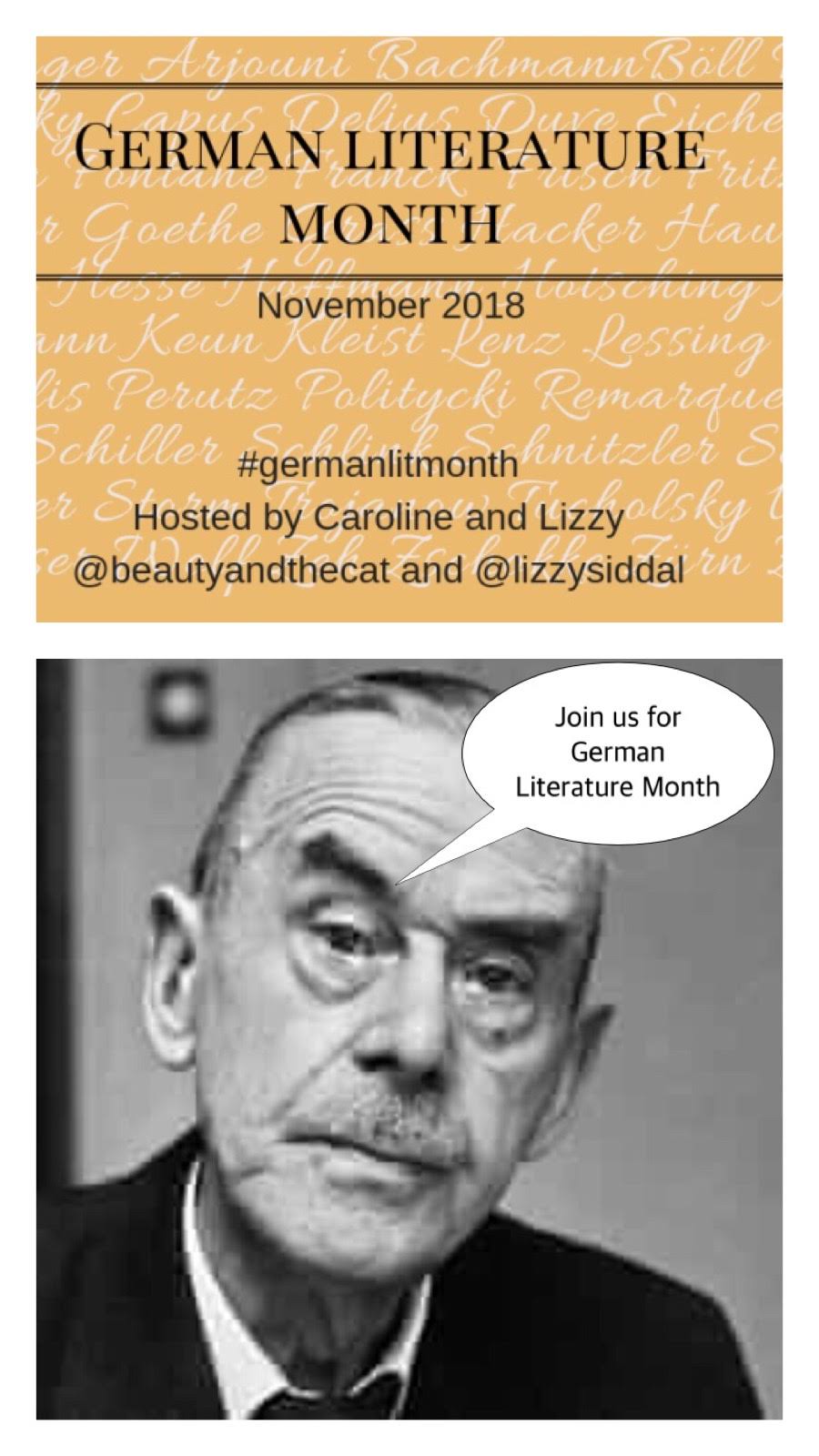
German Literature Month Eight - Links to Reviews and More

The Reading Life Greater Germania Gateway


Thomas Mann on The Reading Life


Read so far during 
German Literature Month Eight 

  1. Once a Jailbird by Hans Fallada - 1947


 2.    The Loser by Thomas Bernhard - 1988

  1. Doctor Fausus by Thomas Mann - 1948

Thomas Mann

Born June 6, 1875


Buddenbrooks - 1901

Magic Mountain - 1924

Awarded Nobel Prize 1929

1939 - moves to U.S.A


1944 - Becomes U.S.A citizen

He never again lived in Germany but he made frequent post war visits 

Doctor Faustus is the fifth work by Thomas Mann upon which I have posted.  During prior German Literature Months read Buddenbrooks, Magic Mountain, Death in 

Venice and Royal Highness.

This year I read a work long on my list, Doctor Faustus.  I must first observe that The Vintage Press Kindle edition is an error riddled mess showing contempt for consumers.  In the bio included of Mann, one of hundreds of issues, he is described as the author of “Suddenbrooks”.   It appears it was scanned into a Kindle format but never even looked at 

before it was placed on Amazon.

My mental state now is somewhat low.  If you need home work help on this Wikipedia has a good article.  I am glad I read this book and was elated when I got to the end.

I liked his reflections on Germany a lot.  


Sunday, November 4, 2018

“Melvin in the Sixth Grade” - A Short Story by Dana Johnson - from her collection Break Any Women Down::Stories- 2001


Website of Dana Johnson


Roxane Gay’s Top Ten Books


Three things lead me to read today's story.  Very recently I read Roxanne Gay's introduction to Best American Short Stories 2018.  Obvious to me was her love of the form and her knowledge of the contemporary American Short story.  In a commercial website I follow (linked above) she listed her top ten books.  Break Any Woman Down by Dana Johnson, a collection of short stories centered on the experiences of African American women in California was on her list.  I discovered the collection won The Flannery O'Connor Award for 2001 for American authored short stories.   Johnson's website (linked above) drew me further toward reading her work.  Here is her bio data:

"Dana Johnson is the author of the short story collection In the Not Quite Dark, from Counterpoint in August 2016. She is also the author of Break Any Woman Down, winner of the Flannery O’Connor Award for Short Fiction, and the novel Elsewhere, California. Both books were nominees for the Hurston/Wright Legacy Award. Her work has appeared in The Paris Review, Callaloo, The Iowa Review and Huizache, among others, and anthologized in Watchlist: 32 Stories by Persons of Interest, Shaking the Tree: A Collection of New Fiction and Memoir by Black Women, and California Uncovered: Stories for the 21st Century. Born and raised in and around Los Angeles, she is a professor of English at the University of Southern California."

Now for the clincher.  The lead story in the collection is "Melvin in the Sixth Grade".  Having once been a Melvin in the Sixth Grade I decided I wanted this story referenced on The Reading Life👀

An African American girl, in the Sixth grade, maybe 13, and her family have just moved from the dangerous gang violent part of Los Angeles, with mostly African American residents to a safer part of the city.   Starting school mid term is always stressful and bring the only none white student made it really stressful.  She forms a bond with a white boy from Oklahoma, Melvin who hatesvhis name.  He is also an outsider among the California students.  We see the difficulty of their relationship.  Her father is against it.  To me the most moving moment in the story was when she begins to realize her old way of speaking is fading away.

I liked this story a lot.  I enjoyed getting to know Melvin also.  I hope to read more by Dana Johnson.

Mel u


Friday, November 2, 2018

“The Four Seasons”. - A Short Story by Mavis Gallant - i1976


August 11, 1922 born in Montréal, in 1950 she moves to France to pursue her dream of being a writer 

February 18, 2014, dies in Paris, a place she dearly loved


“Women love a fascist, the boot in the face”. Sylvia Plath


Buried in Print, a Blog I have happily followed for years, is embarked on a grand project, a read through of all of the nearly two hundred Short Stories of Mavis Gallant.  I have access to about half of the stories and am Reading along as I can.  

Today’s story, “The Four Seasons” is the opening work in her collection of nine stories, The Fifteeth District, named for a section of Paris.  The post of Buried in Print elegantly covers the essence of the plot of the story, the publisher, NYRB called it as a novella, I will just talk a bit about what struck me.

The setting is small town Italy, starting a bit before World War Two begins and ending in the opening days of the war.  The Unwins are an English couple, with a naive admiration for Mussolini (fascist leader of Italy 1922 to 1943).  We know a bit about the Unwins but with characteristic subtly Gallant makes us figure out most of their story.  They seem in their late thirties or early forties.  The wife has a grown son from another relationship, they have two children under three Mrs Unwin seems to regret having, thinking she might be too old.  They have just enough money to barely get buy, from an income in England. There are a few other Anglophone expats there.  Gallant lets us see the various class distinctions between them.

Carmela, 13, is their newly hired Italian servant girl.  She speaks no English at first but she is a fast learner.  She and the children quickly bond.  Soon she is essential to family, through her we learn more about the Unwins and Italy in the period.  Mrs Unwin seems to especially admire Mussolini.  Lots of the English saw him as a bulwark against the Communists.  We see how panic spreads as Italy declares war on England.


I came to like Carmela a lot.  I will leave the ending untold.  It was gratifying to learn that many years later Carmela still had small items the Unwins had given her.  Small touches like this are the mark of a master.I wondered how she survived the war, it appears her father was killed fighting in North Africa, if she would one day be married and have her own family.  She is already wise beyond her years.

I look forward to reading along with Buried in Print for years 

Mel u


The Loser by Thomas Bernhard - 1983- translated from German 1991 by Jack Dawson


Read so far during 
German Literature Month Eight 

  1. Once a Jailbird by Hans Fallada - 1947

Thomas  Bernhard

Born 1931 in The Netherlands 

Died 1989 in Austria by assisted suicide,

The Loser: A Novel by Thomas Bernhard - 1991

Wittgenstein’s Nephew was my first encounter with the work of a man many consider Austria’s greatest post World War Two novelist, Thomas Bernhard took place during German Literature Month in November of 2014.  Since then I read, in this order, Woodcutters, Gargoyles, Concrete, and Extinction.  After adding Loser to my read list, there remain two novels translated into English and available as Kindles I have not read, Frost and Lime.  I decided to read Loser this year as I found it a while ago on sale for $1.95. (It is now back up to $11.95.

All of his novels are long monologues, very long, mostly of a man, never a woman, thinking about events, people, whole countries, especially Austria, his family, old acquaintances, all of which he holds in near total contempt.  

As is common in his works, the narrator of The Loser has a significant inheritance, of course he has no gratitude for this.  There are two prominent off-stage persons in the monologue, the Canadian piano virtuoso Glenn Gould and an acquaintance of the narrator.  Both the narrator and his friend aspired to be concert pianists until they heard Glenn Gould play.  They knew they could never approximate his work.  The narrator never really found any direction in his life, his friend became a piano teacher.  The Loser is a refracted reflection on genius, on music, suicide, and a number of other random topics.

The long monologue is interesting, you can slowly recover the actual events of their lives if you read carefully.

I enjoyed The Loser.

Thomas Bernhard is not for everyone.  His narrators may bore some.
I will, I hope, eventually read the remaining two of his books still on my list.


Thursday, November 1, 2018

Once a Jailbird: A Novel by Hans Fallada - 1934 - translated from German 2014 by Eric Sutton


German Literature Month

Once a Jailbird: A Novel by Hans Fallada - 1934 - translated from German 2014 by Eric Sutton 

Born 1893 Greifswald, Germany 

Died 1947 Berlin

I am glad to be initiating my participation in German Literature Month Eight with     a novel by Hans Fallada.  This is the fourth work by Fallada to be featured on The Reading Life, all during a German Literature Month.  In 2015 I posted on two of his novels.  A Small Circus is centered on just that. Wolf Among Wolves is a grand sweeping panorama of society in Weimar Germany (1919 to 1933).  Some call it the Vanity Fair of the era. In 2016 I read his consensus masterwork, Every Man Dies Alone.  Primo Levi said it was the best presentation of life in Nazi Germany.  It is the best by far of the four Fallada books I have read.   For sure start Fallada there.

 Once a Jailbird is set toward the end of the Weimar Era (1919 to 1933), we meet our central character, Klaus, as he is finishing up a five year prison term for embezzlement.  We learn quite a bit about what life was like in the prison.  Klaus was a three star prisoner, awarded more privileges for good behavior.  He keeps his cell very clean and he works diligently at the piece work the prison assigns him.  He will be paid for this work upon release.  He has only a few days to go.  The warden, not too bad a person, asks him his plans.  His parents are passed and his brother in law will not help him. He was an experienced typist before he was arrested and hopes to get a job doing that.  He wants to move to Hamburg where no one knows him.  The warden refers him to a service that houses ex-convicts and the unemployed and luckily runs a business typing addresses on envelopes. He finds the money he thought he was getting, maybe three months living expenses, will be paid him through the manager of the home.  When he objects the warden tells him it is for his own good to prevent him from squandering his money

Of course after five years he wants a woman, they call them girls, and this being The crashed German economy the streets are full of cheap women.  He soon wants a real girlfriend, some decent food, some drink, and to make money.

Fallada devotes a lot of time to showing us how ex convicts were taken advantage off, cheated and of course looked down upon.  Klaus meets lots of shady characters.  He and eight others decide to start their own typing business after discovering they were being ripped off by their employer.  Of course it starts out well but......

No one wants to trust him.  We hear the refrain “once a jailbird” quite a few times.  Klaus sometimes wishes he was back in jail where at least he got food and had no rent.

Fallada gives a vivid picture of life on the mean streets of Weimar Hamburg.  There are lots of interesting people.

Once a Jail Bird was an enjoyable read for me.  

There are several more Fallada novels available as Kindles and I hope to read one in German Literature Month in 2019.

I purchased the Kindle edition on a flash sale for $1.95.  It is back up to $11.95.  My guess is it will go back on sale soon and I don’t endorse this book to those I do not know at the full price.  


Bio Data from Melville House
Before WWII, German writer Hans Fallada's novels were international bestsellers, on a par with those of his countrymen Thoman Mann and Herman Hesse. In America, Hollywood even turned his first big novel, Little Man, What Now? into a major motion picture

Learning the movie was made by a Jewish producer, however, the Nazis blocked Fallada's work from foreign rights sales, and began to pay him closer attention. When he refused to join the Nazi party he was arrested by the Gestapo--who eventually released him, but thereafter regularly summoned him for "discussions" of his work.

However, unlike Mann, Hesse, and others, Fallada refused to flee to safety, even when his British publisher, George Putnam, sent a private boat to rescue him. The pressure took its toll on Fallada, and he resorted increasingly to drugs and alcohol for relief. Not long after Goebbels ordered him to write an anti-Semitic novel he snapped and found himself imprisoned in an asylum for the "criminally insane"--considered a death sentence under Nazi rule. To forestall the inevitable, he pretended to write the assignment for Goebbels, while actually composing three encrypted books--including his tour de force novel The Drinker--in such dense code that they were not deciphered until long after his death.

Fallada outlasted the Reich and was freed at war's end. But he was a shattered man. To help him recover by putting him to work, Fallada's publisher gave him the Gestapo file of a simple, working-class couple who had resisted the Nazis. Inspired, Fallada completed Every Man Dies Alone in just twenty-four days.

Mel u


German Literature Month Year Eight - My Reading Life Hopes For November, 2018


Home Page For German Literature Eight - Links to Reviews and Much More


German Literature Month is one of my favorite international 
.book blog events.  Lizzy and Caroline have been marvelously running it for eight years.  This will be my seventh year as a participant.  Through the reviews over the years I have discovered writers now very dear to me.  It is a good way to meet other book bloggers and to attract quality readers to your blog.


What I Read during German Literature Month in November 2017

  1. “You’d Have Larvae Too” by Nora Wagener, 2016
  2. Vertigo by W. G. Sebald, 1990
  3. The Last Weynfeldt by Martin Suter, 2006
  4. “An Earthquake in Chile” by Heinrich Von Kleist, 1809
  5. Who is Martha? by Marjana Gaponenko, 2012
  6. “The Legal Haziness of Marriage” by Olga Grjasnowa, 2015
  7. “Aladdin, COB” by Isabelle Lehn, 2015
  8. “The Last Bell” by Johannes Urzidil, 1968
  9. The Rings of Saturn by W. G. Sebald, 1995
  10. Late Fame by Arthur Schnitzler, written 1892, published 2016
  11. Blood Brothers by Ernst Haffner, 1933
  12. Berlin Alexanderplatz by Alfred Döblin, 1929
  13. Confessions of a Murderer by Joseph Roth, 1936
  14.   “Compulsion” by Stefan Zweig,  1929
  15. “Borderlands”by Johannes Urzidil, 1956 (no post)
  16. “A School Boy’s Diary” by Robert Walser, 1910 (no post
  17. Austerlitz by W. G. Sebald, 2001, Second Reading 
  18. “The Duchess of Albanera” by Johannes Urzidil, 1965


For this year I hope to read

  1. Once a Jailbird by Hans Fallada
  2. The Loser by Thomas Bernhard
  3. Doctor Faustus by Thomas Mann 
  4. Memoirs of a Polar Bear by Yoko Tawado - she writers in Japanese and German
  5. Blue Night by Simone Buchholz
  6. The Last Bell by Johannes Uzridi - Prague under German Occupation 
  7. Intimate Ties by Robert Musil.  Just translated 
  8. The Rider on the White Horse by Thomas Strom. - considered his best work
  9. Child of All Nations by Irmgard Keun

I also hope to read classic short stories by Robert Walser, Heinrich Von Kleist, and Heinrich Boll.

I hope to reread Vertigo and The Rings of Saturn by W. G. Sebald.  I have the new Michael Hoffman Translation of Berlin Alexanderplatz by Alfred Döblin and have it on my list.

I am sure reviews and suggestions on the home page for German Literature Month Will add to list.

My thanks again to Lizzy and Caroline for hosting German Literature Month.

Please consider joining in.  Doing so is good for everyone.

I hope  members of the Reading Life staff will also be 
Reading for the event.

Mel ü


Featured Post

Imperial Reckoning: The Untold Story of Britain’s Gulag in Kenya by Caroline Elkins - 2005 - 701 Pages

  Imperial Reckoning:     The Untold Story of Britain’s Gulag in Kenya by Caroline Elkins - 2005 - 701 Pages 2006 Pulitzer Prize Winner From...