The Tenant of Wildfell Hall by Anne Bronte (1848-409 pages)
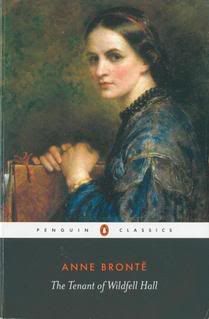
The Tenant of Wildfell Hall is the second and last novel written by Anne Bronte in her twenty nine years (1820 to 1849). Last month I read and posted on her first work, Agnes Grey.
The Tenant of Wildfell Hall is told in a very interesting way. It is a novel very rooted in its time and place. The book is divided into three sections and each is told from a different point of view and narrated in a different fashion. Part One is from the point of view of Gilbert, a well off farmer. A mysterious woman, a widow and her son, have moved into Wildfell Hall, a once grand mansion. Gilbert begins to court the widow, Helen Graham and loses interest in the woman his mother wanted him to marry. In a search for revenge, this woman begins to spread gossip about Helen. One needs to keep in mind that in the time and place of the novel a woman was not thought complete without a man and any single woman, widow or otherwise, above the age of twenty five or so was seen as a potential threat to the stability of the community and its morals. A friend of Gilbert's is also seemingly courting Helen. When Gilbert behaves in a jealous fashion, Helen gives Gilbert her diaries to read. The diary reveals her abusive marriage to Arthur Huntington. Helen begins the marriage completely in love. Over time Arthur seems to become bored with her company and prefers to spend his time with friends from his days prior to marriage. These friends lead him back into a life of heavy drinking and partying with women of dubious repute in the company of male friends. He becomes abusive to her and he tries to turn her son to his ways, teaching him to disrespect his mother and use improper language. In a move of extreme boldness for her day, Helen left Arthur. There some interesting twists and turns of the plot and throughout it all Helen behaves in a near saintly fashion, returning to her abusive husband to nurse him through a fatal disease.
Part 3 begins when Helen leaves Wildfell Hall. We see Anne has kept some secrets from us. The ending is much like the ending of Agnes Grey.
I liked several things about this book. I liked Anne Bronte's use of differing narrative modes for different sections of the book. I enjoyed the conversations in the book a lot. Wildfell Hall shows Anne was rapidly developing as an artist, compared with her first work. Wildfell Hall is one of the first novels showing a woman leaving an abusive husband. The abusive husband is a bit of a stereotype of the times (hence the name Huntington meaning he prefers the pleasure of the hunt to the company of his wife). You can see how deeply Anne felt alcohol was at the root of the problems in her marriage. She was very unhappy when her husband began to teach their son to drink. The novel is rooted in the time as there is no longer any great mysterious stigma that attached to a single woman with a child as there was in England in the 1840s. (Or perhaps one should say a single woman not of the poorer and majority class of people.) The world of women is a small one in the novels of Anne Bronte. She explores its limits very well.
I read Wildfell Hall in part because I have decided to read all of the novels of the Bronte Sisters. There are only seven of them and I like feeling closure on a reading project. As I was reading I could not help but wonder if almost everyone reads her works mainly because of who her ates were . ("Ate" is a tagalog word for "big sister" that conveys for me the familial relationship between Anne and her sisters. A young sister or brother will call their older sibling "Ate Jane" and it is meant to convey respect for an elder sister.) Wildfell Hall is worth reading on its own. Her work does not have the power, depth and beauty of the work of her ates but not much does. I really think anyone into the Brontes, the Victorian novel or 19th century women writers should read all of the Bronte novels.
Mel u
The Tenant of Wildfell Hall is told in a very interesting way. It is a novel very rooted in its time and place. The book is divided into three sections and each is told from a different point of view and narrated in a different fashion. Part One is from the point of view of Gilbert, a well off farmer. A mysterious woman, a widow and her son, have moved into Wildfell Hall, a once grand mansion. Gilbert begins to court the widow, Helen Graham and loses interest in the woman his mother wanted him to marry. In a search for revenge, this woman begins to spread gossip about Helen. One needs to keep in mind that in the time and place of the novel a woman was not thought complete without a man and any single woman, widow or otherwise, above the age of twenty five or so was seen as a potential threat to the stability of the community and its morals. A friend of Gilbert's is also seemingly courting Helen. When Gilbert behaves in a jealous fashion, Helen gives Gilbert her diaries to read. The diary reveals her abusive marriage to Arthur Huntington. Helen begins the marriage completely in love. Over time Arthur seems to become bored with her company and prefers to spend his time with friends from his days prior to marriage. These friends lead him back into a life of heavy drinking and partying with women of dubious repute in the company of male friends. He becomes abusive to her and he tries to turn her son to his ways, teaching him to disrespect his mother and use improper language. In a move of extreme boldness for her day, Helen left Arthur. There some interesting twists and turns of the plot and throughout it all Helen behaves in a near saintly fashion, returning to her abusive husband to nurse him through a fatal disease.
Part 3 begins when Helen leaves Wildfell Hall. We see Anne has kept some secrets from us. The ending is much like the ending of Agnes Grey.
I liked several things about this book. I liked Anne Bronte's use of differing narrative modes for different sections of the book. I enjoyed the conversations in the book a lot. Wildfell Hall shows Anne was rapidly developing as an artist, compared with her first work. Wildfell Hall is one of the first novels showing a woman leaving an abusive husband. The abusive husband is a bit of a stereotype of the times (hence the name Huntington meaning he prefers the pleasure of the hunt to the company of his wife). You can see how deeply Anne felt alcohol was at the root of the problems in her marriage. She was very unhappy when her husband began to teach their son to drink. The novel is rooted in the time as there is no longer any great mysterious stigma that attached to a single woman with a child as there was in England in the 1840s. (Or perhaps one should say a single woman not of the poorer and majority class of people.) The world of women is a small one in the novels of Anne Bronte. She explores its limits very well.
I read Wildfell Hall in part because I have decided to read all of the novels of the Bronte Sisters. There are only seven of them and I like feeling closure on a reading project. As I was reading I could not help but wonder if almost everyone reads her works mainly because of who her ates were . ("Ate" is a tagalog word for "big sister" that conveys for me the familial relationship between Anne and her sisters. A young sister or brother will call their older sibling "Ate Jane" and it is meant to convey respect for an elder sister.) Wildfell Hall is worth reading on its own. Her work does not have the power, depth and beauty of the work of her ates but not much does. I really think anyone into the Brontes, the Victorian novel or 19th century women writers should read all of the Bronte novels.
Mel u
