Showing posts with label Ancient Reads. Show all posts

Friday, October 13, 2023

The Girl from Andros - A Play first preformed in 186 BCE - by Terence - Translated with an Introduction and Notes by Peter Brown -2006


 The Girl from Andros is a Roman comedy play by Terence, which was adapted from the Greek play Andria by Menander. It was first performed in 166 BC, and was one of Terence's most popular plays.


The play tells the story of Pamphilus, a young man who is in love with Glycerium, a beautiful slave girl from Andros. Pamphilus's father, Simo, has arranged for him to marry Philumena, the daughter of a wealthy friend. Pamphilus is torn between his love for Glycerium and his duty to his family.


In the end, Pamphilus is able to marry Glycerium, after it is revealed that she is actually a free citizen. The play ends with Simo and Philumena reconciling, and Pamphilus and Glycerium living happily ever after.

"Terence (c. 195/185 – c. 159? BC), better known in English as Terence (/ˈtɛrəns/), was an African Roman playwright during the Roman Republic. His comedies were performed for the first time around 166–160 BC. Terentius Lucanus, a Roman senator, brought Terence to Rome as a slave, educated him and later on, impressed by his abilities, freed him. It is thought that Terence abruptly died, around the age of 25, likely in Greece or on his way back to Rome, due to shipwreck or disease. He was supposedly on his way to explore and find inspiration for his comedies.


Terence wrote six comedies, all of which are extant:


The Girl from Andros (Andria)

The Mother-in-Law (Hecyra)

The Self-Tormentor (Heautontimorumenos)

The Eunuch (Eunuchus)

Phormio (Phormio)

The Brothers (Adelphi)

Terence's comedies were adapted from Greek New Comedy, but he made a number of changes to his originals. His plays are more refined and less slapstick than those of his predecessor Plautus. Terence also focused more on character development and psychological realism." From Bard


Tuesday, June 6, 2023

Helen - by Euripides-First Preformed 412 B.C.E. Translated by Emily Wilson -This play is included in The Greek Plays: Sixteen Plays by Sophocles, Aeschylus and Euripides-Preface, general introduction, play introductions, and compilation - 2016 by Mary Lefkowitz and James Romm


 Helen - by Euripides-First Preformed 412 B.C.E. Translated by Emily Wilson -This play is included in The Greek Plays: Sixteen Plays by Sophocles, Aeschylus and Euripides-Preface, general introduction, play introductions, and compilation - 2016 by Mary Lefkowitz and James Romm


An Ancient Reads Work


Euripides-480 to 406 B.C.E 


Plays by Euripides Previously posted upon


Medea

Trojan Women

Hippolytus 

Electra

Bacchae 


Cast of Characters in Helen in Order of Appearance 


HELEN, wife of Menelaus 

TEUCER, a Greek hero from Salamis

 CHORUS of Greek maidens 

MENELAUS, king of Sparta 

THEONOË, priestess and sister of Theoclymenos 

THEOCLYMENUS, ruler of Egypt

 MESSENGER 

CASTOR and POLLUX, semidivine brothers of Helen (also known as the Dioscuri)SERVANT

 THEONOË, priestess and sister of THEOCLYMENUS


Setting: Helen takes place in front of the palace of Theoclymenos, ruler of Egypt.


"Helen by Euripides presents a very different account of the person of Helen depicted in the Iliad. Homer presented a faithless wife who abandons her much older husband because of an infatuation with a handsome young Trojan prince, Paris, visiting the court of her Macedonian husband, Menelaus, on a diplomatic mission. Her lack of decent morals and unfaithfulness ended up destroying Troy and costing 1000s of Greek lives.

Ever since Homer’s Iliad, Helen had been associated in the Greek mind with beauty, sexual allure, and a faithlessness and cunning born of these two qualities. To build a tragedy around such a woman—the polar opposite, in terms of stature, of Antigone or Medea— as Euripides did in 412 B.C. was a daring move, almost certain to produce a play that was not, in fact, tragic." From the introduction 


Euripides presents a totally different story. His Helen never went to Troy, never was unfaithful. Instead the Goddess Hera, jealous because she lost a beauty contest, created a spirit figure in Helen's and sent this to Troy.


The real Helen made it to Egypt. As I did not already know what was going to happen I found the plotting quite exciting.


EMILY WILSON is Associate Professor in Classical Studies at the University of Pennsylvania. Her work includes Mocked with Death: Tragic Overliving from Sophocles to Milton; The Death of Socrates: Hero, Villain, Chatterbox, Saint; Seneca: A Life; Seneca: Six Tragedies; and a new translation of the Odyssey.


Thursday, April 27, 2023

Hippolytus by Euripides- 428 B. C. E. - translated by Rachel Kitzinger- 2016- included in Sixteen Plays by Sophocles, Aeschylus and Euripides-Preface, general introduction, play introductions, and compilation copyright © 2016 by Mary Lefkowitz and James Romm


 Hippolytus by Euripides- 428 B. C. E. - translated by Rachel Kitzinger- 2016- included in Sixteen Plays by Sophocles, Aeschylus and Euripides-Preface, general introduction, play introductions, and compilation copyright © 2016 by Mary Lefkowitz and James Romm 


An Ancient Reads Project Work


Euripides:died 7 406 BC (aged approximately 74); Macedonia


Born: c. 480 BC; Salamis


CAST OF CHARACTERS (IN ORDER OF APPEARANCE) APHRODITE, goddess of sexual love; also known as Cypris HIPPOLYTUS, son of Theseus, the king of Athens, by an Amazon queen HIPPOLYTUS’ FELLOW HUNTERS, a group of slaves from his household OLD SLAVE, an attendant to Hippolytus 

CHORUS of young married women of Troezen 

NURSE, Phaedra’s personal attendant

 PHAEDRA, wife of Theseus; daughter of King Minos and Queen Pasiphae of Crete

 THESEUS, king of Athens

MESSENGER, an attendant of Hippolytus ARTEMIS, virgin goddess of the hunt, of wild things, and of childbirth


Wikipedia has a good summary of the plot and background of the play.


My reading and thinking is now shaped by my intense sorrow over the passing of my beloved wife last year. Tomorrow will be our 17th wedding anniversary.


"THESEUS: I long for the darkness below the earth, I long to die, to dwell in wretched darkness there, now I’ve lost your precious company." 


I felt a deep empathy with the words of Theseus concerning the death of his wife.

The attitude toward the competing Goddesses, APHRODITE and Artemis is that harm to humans is just "collateral damage".


By the time Seneca wrote a play based on this, entitled Phaedra, around 500 years later in 58 A.D., many in his elite audience no longer had a literal belief in these Gods but saw the story as a use of these figures to explain very destructive and irrational human behavior.

I have on my reading list Phèdre by Racine first preformed in 1677 in Paris.

The anthology pictured in this post is an excellent starting point in Greek Drama.


Mel Ulm


Thursday, February 2, 2023

Medea by Euripides 431 B.C. E. - translated by Rachel Kitzinger - 2016 This play is included in The Greek Plays: Sixteen Plays by Sophocles, Aeschylus and Euripides-Preface, general introduction, play introductions, and compilation copyright © 2016 by Mary Lefkowitz and James Romm


 Medea by Euripides- 431 B.C. E. - translated by Rachel Kitzinger - 2016 This play is included in The Greek Plays: Sixteen Plays by Sophocles, Aeschylus and Euripides-Preface, general introduction, play introductions, and compilation copyright © 2016 by Mary Lefkowitz and James Romm 


 Euripides- 480 to 406 BCE- Athens CAST OF CHARACTERS (IN ORDER OF APPEARANCE) NURSE, Medea’s personal attendant TUTOR, teacher and minder of Medea and Jason’s two sons MEDEA, member of the royal family of Colchis, on the Black Sea; granddaughter of the Sun-god; wife of Jason CHORUS of Corinthian women CREON, king of Corinth JASON, heir to the throne of Iolcus, living in exile in Corinth AEGEUS, king of Athens CHILDREN, Jason and Medea’s two sons MESSENGER, a slave in the royal house of Creon 


In Greek mythology, Medea was the granddaughter of the sun god Helios, and ran away from her father’s house to marry the hero Jason. Euripides re-sculpted her story in his play, adding the element that made her the Medea we know today – the woman who kills her own children to avenge her husband’s betrayal.


So the first  audience who saw Euripides’s play would have been in for something incredibly shocking, unfamiliar as they were with a Medea who kills her children for vengeance. When the play was first performed in an Athenian tragedy competition of 431 BC, it came in last place, and it’s often thought that this was because of the heroine’s dreadful actions. But regardless of the first audience’s response, the play quickly became a classic, and Medea’s infanticide supplanted all other versions of the story


The play takes place in front of Medea and Jason’s house in Corinth. Of the two entrances to the stage, one is understood to come from the royal palace where Creon and his daughter live, the other from the town and surrounding countryside. My main purpose here is to just keep a record of my reading. Wikipedia has a decent overall article on the play. YouTube has videos of Plays, an opera and a movie based on the play. Medea seeks revenge, she is known as a sourcer and a witch. The plot centers on Medea's, a former princess of the kingdom of Colchis, and the wife of Jason; she finds her position in the Greek world threatened as Jason leaves her for a Greek princess of Corinth. Medea takes vengeance on Jason by murdering his new wife as well as her own two sons, after which she escapes to Athens to start a new life. The depth of hatred felt by Medea is startling even when we know before we read the play what will happen. Like other Greek and Roman dramas I have recently read, the precarious nature of life, which can change in a moment at the whims of the Gods, is on center stage in Medea.


"Professor Kitzinger began teaching at Vassar in January, 1982. She taught courses in Greek and Latin literature, specializing in Greek tragedy, her field of research.She was involved in the development of the college course, Civilization in Question, which she taught for many years, often with Professor Mitch Miller from the Philosophy Department. In addition to articles on Sophokles, she published The Choruses of Sophokles’ Antigone and Philoktetes: A Dance of Words, translations of Sophokles’ “Oedipus at Colonus” and “Women of Trachis”; translations of Euripides’ “Medea,” “Hippolytus” and “Alcestis” in Greek Plays (Modern Library); she also edited with Michael Grant the three-volume Civilization of the Ancient Mediterranean. She directed a production of “Oedipus at Colonus” in collaboration with the Drama Department and gave frequent recitals of Greek poetry using the restored pronunciation of Ancient Greek. She sat on the Matthew Vassar Junior Chair of Greek and Latin Languages and Literature. Professor Kitzinger also worked in the administration in various roles: Advisor to the Junior Class, Director of Teaching Development and the Freshman Seminar; Associate Dean of the Faculty." From vassar.edu


I hope to soon read Seneca's Medea.


Sunday, January 22, 2023

Caeser:Life of a Colossus by Adrian Goldsworthy- 2006 - 583 Pages


 Caeser:Life of a Colossus by Adrian Goldsworthy- 2006 - 583 Pages


A captivating biography” of the great Roman general “puts Caesar’s war exploits on full display, along with his literary genius” and more (The New York Times)


"Tracing the extraordinary trajectory of the Julius Caesar’s life, Adrian Goldsworthy not only chronicles his accomplishments as charismatic orator, conquering general, and powerful dictator but also lesser-known chapters during which he was high priest of an exotic cult and captive of pirates, and rebel condemned by his own country. Goldsworthy also reveals much about Caesar’s intimate life, as husband and father, and as seducer not only of Cleopatra but also of the wives of his two main political rivals.


This landmark biography examines Caesar in all of these roles and places its subject firmly within the context of Roman society in the first century B.C. Goldsworthy realizes the full complexity of Caesar’s character and shows why his political and military leadership continues to resonate thousands of years later." From the publisher 


Having no expertise in Ancient Roman history, I am seeking books to increase my ability to place works of Roman Literature in a cultural and historical context that might deepen my understanding of these works. 


 Caeser is indeed one of the colossal figures not just of Roman history but of that of the World. Goldsworthy reminded me that his revamping of the Roman calender is still used today, with some minor modifications. Goldsworthy portrays Caeser as not cruel just for pleasure but ruthless when it suited his ambitions. His wars killed and enslaved vast numbers of people. Selling captured persons was a huge source of wealth.His conquests greatly enriched the Empire. He sponsored gladiatorial games and gave grain subsidies to ordinary Romans. He gave and took bribes as was normal.


Goldsworthy goes into copious detail concerning the tumultuous and dangerous political intriguing that was how Rome was run. Caeser had many affairs, had sex with slaves. Goldsworthy tells us what can be known about the relationship of Caeser and Cleopatra. Caeser could be merciful with opposition leaders if they agreed to be loyal. He could also let his soldiers sack a town, killing even children if a town resisted him too long. There is a lot about how the army worked. His soldiers were well rewarded and most were loyal to Caeser. He fought amongst along with them on occasion.


Of course the work goes into the conspiracy to kill Caeser.


"Adrian Goldsworthy was born in 1969. He was educated up to the age of sixteen at Westbourne House Preparatory School and Westbourne Boys College in Penarth, South Wales. He attended the Sixth Form at Stanwell Comprehensive School for his A-Levels. From there he went to St John's College, Oxford University and took a First in Ancient and Modern History. Remaining at St John's, he was awarded a D.Phil. in Literae Humaniores (Ancient History) in 1994. The topic of his thesis was 'The Roman Army as a fighting force, 100 BC-AD 200'. A modified version of this was subsequently published in the Oxford Monographs series under the title of The Roman Army at War, 100 BC - AD 200 (1996). This remains in print and is one of the best selling works in the series.


He was a Junior Research Fellow at Cardiff University for two years and subsequently taught part-time at King's College London and was an assistant professor on the University of Notre Dame's London programme for six years. He also did bits and pieces of teaching at other universities. He has lectured on a range of topics, including both Greek and (particularly) Roman History, but also taught a course on the military history of the Second World War at Notre Dame.


Teaching is tremendous fun, but writing is even more enjoyable and in the last few years he has given up teaching to write full time. Best of all this avoids the vast weight of administrative work now inevitable in any university post. It is still nice to give lectures and attend conferences, but only when time permits.


Just in case anybody is interested, he enjoys watching cricket (supporting Glamorgan in the first class game and England internationally), walking, and playing tennis - not terribly well, but with plenty of enthusiasm. He has recently started learning to ride and now wishes he had taken it up long ago.


Adrian Goldsworthy lives in South Wales." From adriangoldworthy.com


I have two more of his books on Roman history on my Kindle application, Augustus:First Emperor and Pax Romano: War, Peace and Conquest in the Roman World.


Mel Ulm


Monday, January 9, 2023

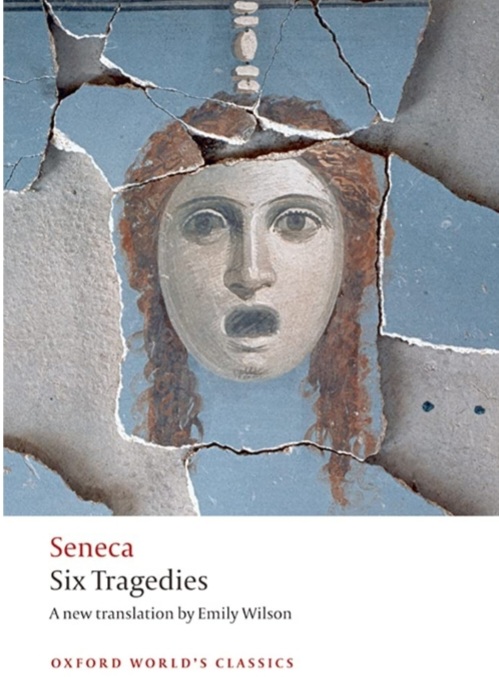
Trojan Women by Seneca - composed c. 54 A. D. - included in the Collection Seneca: Six Tradgedies- translated with an Introduction by Emily Wilson- 2010


 Born - 4 B. C. E. - Cordoba,Spain 


49 A. D. Appointed Advisor to Nero

Died 65 A. D. - ordered to commit suicide for his possible role in a conspiracy to murder Emperor Nero 

An Article from the Enclopedia Britanica has a detailed account of Seneca's involvement in Roman imperial politics 


DRAMATIS PERSONAE- in order of appearance 


 HECUBA, Queen of Troy TALTHYBIUS, Greek herald PYRRHUS, son of Achilles AGAMEMNON, Greek leader CALCHAS, Greek prophet ANDROMACHE, wife of Hector OLD MAN ASTYANAX, Andromache’s son ULYSSES, HELEN MESSENGER CHORUS [POLYXENA: silent part

 The action is set in the city of Troy, in the aftermath of the ten-year war. The Greeks—led by Ulysses and Agamemnon—have used the trick of the wooden horse to break the siege, invade the city, and defeat the inhabitants. The wealth of Troy is looted; the Trojan men are dead, including the great hero Hector, killed by Achilles; the Trojan Women enslaved, and will be taken home as servants and concubines by the various Greek soldiers. But before the Greek fleet can set sail, fate has decreed that two Trojan children must be killed: Astyanax, son of Hector and Andromache, must be thrown from the city walls; and Polyxena, daughter of Hecuba and Priam, the king and queen of Troy, must be given in ‘marriage’ to the dead Achilles, and then slaughtered. Seneca’s play plots the fulfilment of these terrible predictions.

In my post on his Pheadra I observed that contemporaries of Seneca were coming to see Rome as entering a period of decadence and decline.  Educated Romans were beginning to doubt the  Gods, even seeing them as fairy tales.

"CHORUS Is it true, or a myth to deceive the fearful, that spirits live on after bodies are buried, when the wife has laid her hand on the dead man’s eyes, and his last day has blocked out the sun and the mournful urn contains his ashes? Is it pointless to give our souls to death, since we, poor things, still have to keep on living? Or do we totally die, and does no part of us remain, when with a fleeting gasp...

. Hungry time and emptiness devour us.  Death is a single whole: it kills our body and does not spare the soul. The realm of Taenarus,* kingdom of cruel Hades, and the guard-dog Cerberus, fierce defender of the gate, are fictions, tall tales, empty fairy stories, myths, as close to truth as a bad dream. Do you want to know where you will be after death? Where the unborn are."

In Trojan Women the Greek Leaders are very much vilified, no Homeric Hero emerges unblemished

The women of Troy themselves do not know what the future holds for Ulysses and other Greek Leaders but the Chorus makes sure it is paramount in the mind of the audience.

There is no glory in war. Other women expressed extreme contempt for Helen.

I would suggest that those interested first read Euripides’s version of Trojan women.Emily Wilson is the College for Women Class of 1963 Term Professor in the Humanities, professor of Classical Studies, and graduate chair of the Program in Comparative Literature & Literary Theory at the University of Pennsylvania. Wilson attended Oxford University (Balliol College B.A. and Corpus Christi College M.Phil.) and Yale University (Ph.D.). In 2006, she was named a Fellow of the American Academy in Rome in Renaissance & Early Modern scholarship. In 2019 she was named a MacArthur Fellow, and in 2020 she was named a Guggenheim Fellow. She lives in Philadelphia with her three daughters, three cats, two rats, and one dog.


Follow Professor Wilson on Twitter @EmilyRCWilson. Professor Wilson frequently tweets about the Odyssey, translation, and her pets. From https://www.emilyrcwilson.com/


There are links to links to several articles by Wilson as well as several interviews on her website.

The next play by Seneca I will read is Thyestes.


Mel Ulm


Wednesday, January 4, 2023

Trojan Women by Euripides - first produced 415 B. C. E. - Translated by Emily Wilson 2016-This play is included in The Greek Plays: Sixteen Plays by Sophocles, Aeschylus and Euripides-Preface, general introduction, play introductions, and compilation copyright © 2016 by Mary Lefkowitz and James Romm


 Trojan Women by Euripides - first produced 415 B. C. E. - Translated by Emily Wilson -This play is included in The Greek Plays: Sixteen Plays by Sophocles, Aeschylus and Euripides-Preface, general introduction, play introductions, and compilation copyright © 2016 by Mary Lefkowitz and James Romm


Ancient Reads

The Trojan Women-A 1971 movie with Katherine Hepburn as Hecuba and Vanessa Redgrave as Andromache 


Translations of Euripides by Emily Wilson I have so far read 

Electra -420 B. C. E.

Trojan Women -415 B. C. E.


Trojan Women is the second translation of Euripides by Emily Wilson I have so far read

CAST OF CHARACTERS (IN ORDER OF APPEARANCE) POSEIDON, ATHENA, HECUBA, widow of Priam; queen of Troy, CHORUS of captured Trojan women, TALTHYBIUS, herald of the Greek army, CASSANDRA, Trojan prophetess; daughter of Hecuba and Priam, the late king of Troy ANDROMACHE, Trojan noblewoman; widow of the Trojan hero Hector, ASTYANAX, young son of Andromache by Hector MENELAUS, king of Sparta and co-leader of the Greek army HELEN, wife of Menelaus, whom she left for the Trojan prince Paris (the cause of the Trojan War)

"Homer’s Iliad was already some three hundred years old during the golden age of Athenian tragedy, but it remained the central literary text for the Greeks and colored all their thinking about war and loss. The downfall of the Trojans, made inevitable by the death" from the introduction by James Romm 

The coda of the Iliad consists of a long dirge for the fallen Hector, as his corpse is lamented by his sister, Cassandra, his widow, Andromache, his mother, Hecuba, and even his sister-in-law, Helen— widely considered the cause of the war. The center of the play is in the laments of these four women.

Trojan Women focuses on the horrible impact of the war on aristocratic Trojan women. An extreme denunciation of Helen is prominent. The capricious of the Gods is paramount.

There are translations of two more Plays of Euripides by Emily Wison, Bacchae and Helen, that I hope to read soon.

Mel Ulm 


Sunday, December 4, 2022

Birds by Aristophenes- A Comedy- first preformed 414 BCE- translated by Aaron Poochigian- 2021 - plus a new Project Begins, Ancient Readings


 Since the start of The Reading Life in July of 2009 I have employed Reading Life Projects to help me structure the blog. My first two projects were on Japanese Literature and Katherine Mansfield. I now have projects on Irish Short Stories, early Australian Literature among others. Projects also give blog visitors a sense of what can be found on The Reading Life. Once I begin a project it is permanent.


Today I am initiating The Ancient Readings Project encompassing Literature from Sumeria, Greece, India, China, Rome as well as historical narratives on this era.


As of now I have as potential works for the projects, six plays by Senaca, eleven comedies by Aristophenes, New translations of Gilgamesh, Ovid, The Illiad by Homer, Virgil's Aneid as well as plays by Sophocles, Euripides and Aeschylus. Hopefully I will be able to acquire modern translations of The Vedas and Buddhist Sutras. Perhaps portions of The Old Testament can be included. This is for me an ambitious project. (I am limited to works available as Kindle Editions)


"Not only was Aristophanes one of the greatest poets of antiquity but, in the words of Lempriere’s Classical Dictionary, “the greatest comic dramatist in world literature: by his side Molière seems dull and Shakespeare clownish.” - From New Translations of the Complete Plays by Paul Roche 


Aristophenes wrote 44 plays, as documented by Paul Roche, but only 11 survive still. Prior to today I have posted on two of his works. These are Lysistrata, his most famous work, and Women of the Assembly. Both these comedies have focus on the sex lives of Athenian women in very explicit language. Birds is very different.


The first work to be included going forward is Birds by Aristophenes.


Birds was first preformed in 414 BCE at Dionysius where it won second place. It is the longest of the 11 surviving works. Set in the wilderness outside of Athens, Pisthetaerus, an Athenian, persuades the birds in the area to form a great city in the sky, reclaiming their ancient place as Gods. 


Wikipedia has a decent plot summary so I will forgo that. I liked the satire of Athenian society, the way the birds were given personalities fitting their species. No doubt ornithologists would enjoy deciding which species are represented. Birds is a deep mockery of Greece's myth based religion.


I will next read his play Clouds.


Mel Ulm

Featured Post

Imperial Reckoning: The Untold Story of Britain’s Gulag in Kenya by Caroline Elkins - 2005 - 701 Pages

  Imperial Reckoning:     The Untold Story of Britain’s Gulag in Kenya by Caroline Elkins - 2005 - 701 Pages 2006 Pulitzer Prize Winner From...