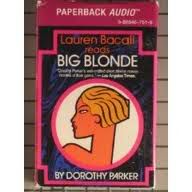
Showing posts with label Dorothy Parker. Show all posts

Thursday, September 15, 2011

Dorothy Parker's Picks for the Best American Short Stories of 1927

"The Killers" by Ernest Hemingway (1927, 5 pages)
"Another Wife"  by Sherwood Anderson (1927, 6 pages)
"The Short Story, Through a Couple of Ages" by Dorothy Parker (1927, 4 pages)

Today is day four of BBAW (Book Blogger  Appreciation Week).   Among the very most viewed posts on my blog (out of 750+) are those I have done on Dorothy Parker (1893 to 1967-USA).   All of  her stories are good and "Big Blond" is a work of genius (and also a warning!)   In addition to her stories and other literary works she wrote hundreds of short opinion articles for The New Yorker.   So in the spirit of community building and in honor of Dorothy Parker (who you know would have a great blog)  I am posting on what she says are the two best short stories of 1927.

"Another Wife"  by Sherwood Anderson

There is more to Sherwood Anderson (1876 to 1941-USA)  than his great collection of linked short stories, Winesburg, Ohio.   (I have included some background information on him in a prior post.)      "Another Wife" is told in the first person by a forty-eight year old physician.   It is kind of a strange story, nothing surprising about that.    We learn he is a widower.    His first wife and he came from poor families and this was part of their bond.   He talks quite a bit about how "plump" she was.   It is hard to see if he liked that or if it was a problem for him.  He has found a lady friend who comes to visit him at his house several times a month.   She is from a prosperous family and he talks over and over about how she is "plump" also and compares her size to that of his late wife.   As the story goes on a bit, we learn he is in fact married to this new woman.  At first I was confused but then I think he never mentioned it earlier as in his heart he does not really think she is his wife at all.   This is a very good story and Parker is to be commended for her excellent taste.

"The Killers" by Ernest Hemingway

Ernest Hemingway (1899 to 1961) is your all American iconic writer.    He won the Nobel Prize and wrote several of the most loved American novels like The Sun Also Rises and For Whom the Bell Tolls.   He is also very famous as a short story writer.   I think "The Killers" is one of his most famous and highest regarded short stories.  It sort of reminds me of something Quentin Taratino could make into a movie!    The story is set in a small restaurant.   The characters are the owner of the restaurant, the cook, two customers (the killers) and their intended victim.   It is almost all dialogue.  

As the story opens two men are in a diner.   They tell the owner they want to order the dinner special.   He tells them they are too early to get that and the men try to bait him into a conversation.   It is really well done and pretty scary in a way.   I will compress my summery a lot.   The two men have sawed off shot guns under their coats and the cook and the owner are very frightened.  The men tell them  they are at the diner as they know a man they are going to kill as a favor to a friend comes in everyday for the dinner.   I will leave the rest of the plot untold as it is the wonderful way Hemingway uses a minimum amount of dialogue to tell the story that makes it so great.   Of these two stories, I guess I would say this one is the best and for sure it is the most famous. 

You can read "Another Wife" Here 

You can read "The Killers" Here

You can read Parker's article Here

Mel u

Saturday, May 21, 2011

Dorothy Parker-Three Short Stories-

"Travelogue" (1928, 4 pages)
"The Last Tea" (1933, 5 pages)
"You Were Perfectly Fine" (1935, 4 pages)

From the Pen of Dorothy Parker
Three Smart Funny Stories

""It's a funny thing about me," she said. "It just makes me feel sort of sick to see a girl drink. It's just something in me, I guess. I don't mind a man so much, but it makes me feel perfectly terrible to see a girl get intoxicated. It's just the way I am, I suppose."- from "The Last Tea"


I have now read and very much enjoyed six short stories by Dorothy Parker (1893 to 1967-USA)  Parker may have been born in new Jersey but she was not a bridges and tunnels person and for sure not a Jersey Shores Girl.    She came to epitomize New York City , sophisticated, smart and witty, given to late nights and serious drinking and not above laughing at people who seem a bit backwards to her.    (There is a bit of background information on her in this post)

Of the five stories I have read (The exception being "Big Blond" which so far I see as her only truly great story) they all sort of follow a pattern.   Two people are talking to each other.   One of the people does most of the talking and they are the one who has the least of value to say.    That speaker could by an uncharitable person be described as babbling on while not hearing a thing the other person is saying.   

"Travelogue" is about a man who has just returned from a long trip to the Middle East and his female friend  who is very interested in hearing about it, or so it seems.   She asks such astute questions as "do they have Arabs there?".   She will ask the man a question and then immediately say what she thinks the answer must be.   She also tells the man what she things her husband (or boyfriend) would think the answer is.   Then she tells the man not to be surprised when he hears she has left on a long trip to the middle east herself!   The woman leaves the conversation thinking she has learned a lot about the middle east when in fact she learned nothing at all.

"You Were Perfectly Fine" fits the same pattern.   One person is talking on and on and you quickly learn they do not have very good listening skills.    Drinking plays a big role in the stories of Parker (as it did in her life) and this story is about a conversation between a husband and wife (or some sort of relationship) about how the man acted at a party the night before.    He fears he might have made a fool of himself due to heavy drinking (it sounds like they have had this conversation numerous times) and offended some of the people at the party.    The man asks the woman if he was out of line and she tells him over and over "You were perfectly fine" while describing his really rude and drunken actions.   What makes the story fun is the descriptions of the crazy behavior of the man followed by his wife telling him "You Were Perfectly Fine".

" The Last Tea" is set in a cafe where a man and a woman are keeping a date they made the night before at a party.    It is very much about drinking.     As I said before, drinking is very important in the stories of Parker.    Not drinking at all marks you out as a bore, too much a clown.    The story is about their conversations on their hangovers.  

All three of the stories can be read HERE.

Parker's attitude to other women is hard to set out in a brief space.   I can hear her and her female characters saying "all of my friends are men".  

All these stories are fun and easy to read.  

Mel u

Tuesday, April 26, 2011

"Big Blonde" by Dorothy Parker


"Big Blonde" 1929, 15 pages) by Dorothy Parker

The Best of Dorothy Parker?

"Big Blonde" is the third short story I have read by Dorothy Parker (1893 to 1967- USA.)    Prior to this I have read her "Arrangement in Black and White" and "A Telephone Call".      I  enjoyed both of these stories.   Both of these stories are about what seem like silly women whose lives revolve a bit to much about men.    Both are good smart stories.  When I started "Big Blond" (Wikipedia says it is her best known short story-it won the O'Henry Award in 1929 for the best short story of the year) I was expecting more of the same.     I was completely shocked and blown away by "Big Blond".    It was almost like finding out everybody's favorite partying sorority girl who could drink all the guys under the table can write a story to scare the world sober.

Imagine Virginia Woolf showing up on a late night talk show to swap jokes with Charlie Sheen or Elizabeth Bowen with an advise column in Seventeen Magazine.

"Big Blonde" is about Hazel Moore.  (Yes,  Dorothy Parker was a brunette.)   Here  is how she is described:

"Hazel Morse was a large, fair woman of the type that incites some men when they use the word “blonde” to click their tongues and wag their heads roguishly... In her twenties.. she had been employed as a model in a wholesale dress establishment—it was still the day of the big woman, and she was then prettily colored and erect and high-breasted. Her job was not onerous, and she met numbers of men and spent numbers of evenings with them, laughing at their jokes and telling them she loved their neckties. Men liked her, and she took it for granted that the liking of many men was a desirable thing. Popularity seemed to her to be worth all the work that had to be put into its achievement. Men liked you because you were fun, and when they liked you they took you out, and there you were. So, and successfully, she was fun. She was a good sport. Men liked a good sport."

Hazel meets and marries a man whose drinking and late night about town ways amused her.   It was not so funny after they got married.    He got bored with her and she with him.   He left her to move to Detroit and she did not much care.   He gave her enough money for a few months.   There was another big blond living in an apartment across the hall from her who had a lot of men friends and parties and Hazel soon had another admirer.  Then another and another and most all of them were married.   Hazel's job was to be "a good sport" and a big blond.   The story is set in a time when alcohol was illegal in America but only seemed to increase its hold on the people in Hazel's world.    

I do not want to tell any more of the plot of this story.    I think it is a brilliant work.   (I can see how readers who fit the physical description of Hazel might not be so thrilled with it!).     I did wonder as I read it if Parker's description of one of the characters as "a Jew" was a sign of prejudice or just a sign of times.   

If you have not yet read a Dorothy Parker story,I you might start with "A Telephone Call".   If you like that  then go on to "An Arrangement in Black and White" and then read the much better and deeper (and longer) "Big Blond".    I hope to read more of her stories soon.

You can read "Big Blond" HERE.


Thursday, April 14, 2011

"Arrangement in Black and White" by Dorothy Parker

  "Arrangement in Black and White" by Dorothy Parker  (1930, 5 pages)


In July of last year I read and posted on a short story by Dorothy Parker (1893 to 1967-New Jersey USA), "A Telephone Call"..      (There is some background information on Parker in that post).    I am really glad I decided to read another one today and I have no good reason for waiting so long.


"Arrangement in Black and White"  is a searing look at the racism in the heart of a well meaning  white woman who would have identified herself as a strong progressive in race relations.    The entire narrative of the story is in  the conversations of the woman to a friend of her husband.   The setting is at a party for a well known black musician.   The woman's husband refused to go to the party as he feels it is not right to socialize with blacks as equals.    The woman's attitude is a bit more complicated but in fact might be worse as at least the husband is not in bad faith with himself.    Here is a  good illustration of that as well as an excellent example of the prose style of Parker.


“I am,” she said. “I know I am. Poor Burton! Now, me, I don't feel that way at all. I haven't the slightest feeling about colored people. Why, I'm just crazy about some of them. They're just like children – just as easygoing, and always singing and laughing and everything. Aren't they the happiest things you ever saw in your life? Honestly, it makes me laugh just to hear them. Oh, I like them. I really do. Well, now, listen, I have this colored laundress, I've had her for years, and I'm devoted to her. She's a real character. And I want to tell you, I think of her as my friend. That's the way I think of her. As I say to Burton, 'Well, for heaven's sakes, we're all human beings!' Aren't we?”
Under the woman's patronizing attitude we find a vicious racist person whose sense of self worth comes from being able to look down on others do to their race.

"Arrangement in Black and White" is funny, wicked, and brilliant.   It is totally worth the few minutes it will take to read it.

You can read it online HERE.

I will be reading more of her stories this year.

Mel u


Monday, July 5, 2010

"A Telephone Call" by Dorothy Parker

"A Telephone Call"  by Dorothy Parker (1930, 5 pages)

Dorothy Parker (1893 to 1967, New Jersey, USA) is someone whose work I have wanted to sample for a while.    Parker achieved a lot in her life.    She was on the original board of directors of the New Yorker magazine upon its founding in 1925, she was a theater editor for Vanity Fair magazine, an editorial assistant on Vogue , wrote book reviews for Esquire Magazine and published over 300 short stories, articles, and poems in a wide range of American publications.   She also wrote screen plays for Hollywood and received two academy award nominations for best script, one for A Star is Born in 1937 and one for The Little Foxes in 1941.   Parker became an advocate for various organizations seeking social justice and as a result of this was blacklisted as a communist and found it difficult to work in Hollywood after that.    Parker had a tumultuous drama filled alcohol fueled personal life.    

I have wanted to read one of her short stories ever since I began reading short stories a few months ago.   I just found an example of her work on line for the first time yesterday.    Under the terms of American Copyright law (as I understand it) Parker's work should be protected until 2037 so I am assuming either the web page where I read this story got permission to reprint it or it slipped under the radar but that does explain why it is very hard to find any of her work online.    Of course not all countries have bound themselves  by these laws so there could be other reasons why this story is online.

"A Telephone Call" (1930, 5 pages) is the interior monologue of a woman waiting for a man she is infatuated with to call her as he had promised he would.     This story does a good job at capturing the anxiety of someone in this situation and conveying the emotions that can have sway during such a period.     I am glad I read this story to satisfy my curiosity but she is far inferior in talent to Mansfield, O'Conner, Chopin, and of course Woolf (based on my small sample of her work).    Mansfield and Woolf did not have to please editors and the public whereas Parker depended on the popularity of her work to make her living (she did very well at her peak).     Here is a sample of her style:


"I'll call you at five, darling." "Good-by, darling.,' He was busy, and he was in a hurry, and there were people around him, but he called me "darling" twice. That's mine, that's mine. I have that, even if I never see him again. Oh, but that's so little. That isn't enough. Nothing's enough, if I never see him again. Please let me see him again, God. Please, I want him so much. I want him so much. I'll be good, God. I will try to be better, I will, If you will let me see him again. If You will let him telephone me. Oh, let him telephone me now.
The story goes on for five pages just like this.    "A Telephone Call" is not high art and was not meant to be.   It was written to be in a magazine that catered to a sense of laughing at the fate of the unfortunate  between ads  for whiskey, cigarettes and expensive clothes and to be easy to read and follow for purchasers of the magazine.      Parker was a very big contributor to the New Yorker  and was known personally for her acerbic wit and we can see that in this story.     I am glad I got to sample her work.  

Final thoughts-you can read it for free in less than 5 minutes so I am glad I satisfied my curiosity and I laughed a bit-her work has some historical import in the development of the short story  as she did come to epitomize  a New Yorker style writer during the period the New Yorker came to be a great place to publish a short story.

you can read it online here


Mel u


Featured Post

Imperial Reckoning: The Untold Story of Britain’s Gulag in Kenya by Caroline Elkins - 2005 - 701 Pages

  Imperial Reckoning:     The Untold Story of Britain’s Gulag in Kenya by Caroline Elkins - 2005 - 701 Pages 2006 Pulitzer Prize Winner From...