Showing posts with label Chaim Grade. Show all posts

Monday, October 30, 2023

My Quarrel With Hersh Rasseyner - A Short Story by Chaim Grade- translated from the Yiddish by Ruth Wisse


My Quarrel With Hersh Rasseyner - A Short Story by Chaim Grade - 1952- translated from the Yiddish with an illuminating introduction by Ruth Wisse - 2020

https://mosaicmagazine.com/author/chaim-grade

Today's Story and the introduction can be read at the link above.


 "For nearly a thousand years, European Jews thought, spoke, argued, and lived out their lives in Yiddish. It was the language of an entire civilization, built on the foundations of educational institutions, voluntary associations, and communal organizations that over time became the central repository of modern Jewish culture. It was in Yiddish that European Jewry confronted modernity—confronted, that is, the rise of nationalism, Enlightenment liberalism, Communism, and its own twin impulses for religious reform and religious orthodoxy. That this civilization was brimming over with vitality into the 20th century can be seen by the fact that it managed to simultaneously nurse a decidedly secular literary tradition and cultivate institutions of traditional Jewish learning arguably unsurpassed by any other Jewish community at any time in Jewish history. That all came to an abrupt end with Hitler’s war on the Jews. The destruction of the 1930s and 1940s posed enormous questions, and spurred investigation and answer by those who survived it. Chaim Grade, one of the most extraordinary modern Yiddish writers, offers a very pointed answer to the Holocaust in his 1952 story “My Quarrel with Hersh Rasseyner.” True Jewish continuity, Grade seems to say, was not to be found merely in the physical survival of Jewish communities, but in the survival of the theological, intellectual, and moral arguments that have always characterized Jewish life. The Jewish people is structured by its contentions and disputes, and not even the risk of physical annihilation can silence the abiding claims of obligation and freedom that press upon every Jew, then and now. The story is a true masterpiece, one of the finest expressions of modern Jewish culture. Mosaic is pleased beyond measure to bring you Ruth R. Wisse’s rendering of the first unabridged English translation of the text, along with her sparkling interpretive and introductory essay." From the preface by Mosaic 

I quoted at some length from the preface as their account of the historical 
 importance of this work way surpasses my abilities and knowledge.

It relays a conversation of between 
Two now older Jewish men who survived the Holocaust, one in a Concentration Camp and one escaped to Russia. Both were raised and educated in Vilna in Lithuanian. They encountered each other two years after the war was over, on a bus in Paris. Each had assumed the other died during the Holocaust.   Both did lose all their families.

The man who was in a camp taught traditional teachings to a group of Jewish boys also imprisoned there. He was a very strong believer in the teachings of the Torah. The other man had lost much of his faith due to the Holocaust.  He reasoned how can we be the chosen people, how can we not hate the Germans. He is an established poet, read widely by  Europeans of a wide diversity.  He takes pride in this and takes his self worth from the praise of what the other man sees as the corruption of the world.

Each man is challenged by the other,  

Anyone who does not understand why understanding the meaning of the Holocaust obviously does not have any awareness of events in the Middle East now.

"“That is the outlook and the Musar path of ‘the old one,’ Reb Yosef Yoizl— may his merit be a shield for us—and thousands of Novaredok students steeped themselves in it day and night. We labored to make ourselves better, each of us filed and polished his own soul, with examiners gathering evidence of our improvement like pearls. But you laughed at us. Then came the German—may his name be blotted out—and murdered our sainted students. And now here we both stand before the devastated Community of Israel. But you face a khurbn of your own—the destruction of your faith in the world. That’s what hurts you and torments you, so you ask me: why weren’t the wise men of the Gentiles able to be good if they wanted to be good? And you find contradictions in what I said. But the contradiction you find is in yourself. You thought the world was striving to become better but you discovered that it was striving for our blood."

The conversation will require your full attention.

Chaim Grade Born in Vilna in 1910, Chaim Grade was a novelist and poet, known for such works as The Yeshiva. He settled in the Bronx following World War II, where he lived until his death in 1982.

Ruth R. Wisse Ruth R. Wisse is a research professor at Harvard and a distinguished senior fellow at the Tikvah Fund. Her most recent book is No Joke: Making Jewish Humor (2013, paperback 2015).



Saturday, December 12, 2020

My Quarrel with Hersh Rasseyner by Chaim Grade - first published in Yiddish in 1952 - Translated by Ruth Wisse December 2020 - published in Mosaic - First published in The 1952 in the Rosh Hashanah Issue of issue of the New York Jewish monthly Yidisher kemfer (“The Jewish Militant”)


My Quarrel with Hersh Rasseyner  by Chaim Grade -  first published in Yiddish in 1952 - Translated by Ruth Wisse December 2020 - published in Mosaic - First published in The 1952 in the Rosh Hashanah Issue of issue of the New York Jewish monthly Yidisher kemfer (“The Jewish Militant”)


My Quarrel with Hersh Rasseyner » Mosaic


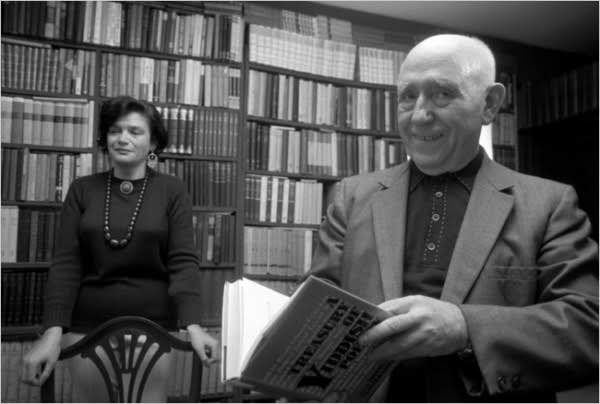
Chaim Grade,in the image above with his second wife, his first was murdered by Germans, Inna (née Heckler) Grade


Born April 4, 1910 in Vilna, Lituania 


1932 begins to write Short Stories in Yiddish


He spends WWII in Russia


1948-moves to New York City, where he will live from then on, after a couple of years in Paris


Dies April 26, 1982 in The Bronx, New York


Chaim Grade is considered one of the greatest of Yiddish writers.  He wrote plays, several novels considered Master works, learned treatises about how the Holocaust should be understood in Jewish tradition but I think it  his Short Stories and Novellas depicting life in Vilna, Lituania that are most now read.


Mayn krig mit hersh rasseyner” is situated in Paris where Grade briefly lived after the war. His first published work of prose, it appeared in the 1952 Rosh Hashanah issue of the  Jewish Militanf. 


In her introduction Professor Wisse says some scholars see the work as an essay on post Holocaust reactions by Jews debating the meaning of the Holocaust to surviving Jews.  Wisse classified it as a story as many Yiddish Short Stories are structured as two people, in most cases men, having an argument about how The Talmud dictates earthly events should be viewed.


There are three time and location segments in this work, Reading time is about one hour.   In 1937 two  friends debate Talmudic issues.  They were classmates at a yeshiva , a Talmudic school. Now seven years have gone by and one is now himself a teacher. They debate how different readings of the scriptures and commentaries would see worldly events.


“In 1937, I returned to Bialystok, seven years after I had been a student in the Novaredok Yeshiva of the Musarists, a movement that gives special importance to ethical and ascetic elements in Judaism. When I came back, I found many of my old school friends still there. A few even came to the literary evening when I spoke. Others visited me secretly; they did not want the head of the yeshiva to know. I could see on their unshaven faces that their poverty had brought them suffering and that the fire of their youthful zeal had slowly burned itself out. They continued to observe all the laws and customs meticulously, but the weariness of their spiritual struggles lay upon them. For years they had tried to tear the desire for pleasure out of their hearts, and now realized they had lost the war with themselves. They had not overcome the evil urge”


The two ex-Class mates meet again in 1939, in Novaredak.  The narrator,with same first name as Grade, is now a well know writer, his old Classmate, launches into a direct attack on him:


“Chaim Vilner, you will remain a cripple. You will be deformed for the rest of your life. You write godless verses and they pinch you on the cheek for it like a ḥeder child. To add to the blasphemy, you come to spread your godlessness in the very city where you once studied. Now they’re stuffing you with praise as they stuff a goose with grain, and spoil you like an only child! But later you’ll see, when you’ve begun to go to the school of those pork-eaters, oh, won’t they beat you! Oh, how they’ll whip you! Which of you isn’t hurt by criticism? Is there really one of you so self-confident that he doesn’t go around begging for some authority’s approval? Is any one of you prepared to publish his book anonymously? The main thing for you people is that your name should stand on the cover, at the very top!”


Of course Chaim counter attacks.


By far the longest segment takes place in Paris in 1948.  Chaim assumed his friend died in the Holocaust so he was totally shocked to spot him on a bus in Paris.  Hersh Rasseyner tells him how he survived in the camps.  While there he risked execution to teach young men scripture.


Chaim tells him how can you love a God that would allow send six million Jews to be murdered in the Holocaust.  They begin an extended  very learned passionate debate on this issue.


Professor Wisse says My Quarrel with Hersh Rasseyner  by Chaim Grade is the most profound treatment of Jewish theological and historical interpretations of the Holocaust ever written.


I am very grateful to Mosaic for placing the new translation and Professor Wisse’s essay online.  These are very valuable works.


Wednesday, October 3, 2018

A short story by Chaim Grade “Grandfathers and Grandchildren” - first appeared in January 1973 in The Forward


'


Chaim Grade,in the image above with his second wife, his first was murdered by Germans, Inna (née Heckler) Grade

Born April 4, 1910 in Vilna, Lituania 

1932 begins to write Short Stories in Yiddish

He spends WWII in Russia

1948-moves to New York City, where he will live from then on, after a couple of years in Paris

Dies April 26, 1982 in The Bronx, New York

Chaim Grade is considered one of the greatest of Yiddish writers.  He wrote plays, several novels considered Master works, learned treatises about how the Holocaust should be understood in Jewish tradition but I think it  his Short Stories and Novellas depicting life in Vilna, Lituania that are most now read.

He was a contributor to the Sunday Literary section of the NYC Yiddish Newspaper, The Forward.  Today’s story, some would classify it as a novella, was first published in Forward.  It is now translated for the first time ever by Curt Leviant and is included in a very valuable anthology, Have I Got a Story for You: More than a Century of stories from The Forward.  This is from the preface 

“ the Forward soon became associated with the most talented Yiddish writers of the day, from Sholem Asch and Avrom Reyzen in its early decades to Isaac Bashevis Singer and Chaim Grade in later ones. Under the leadership of Cahan and his successors, the newspaper became home to serialized novels and novellas, humor sketches and one-act plays, “high literature” and sensational potboilers. Often the paper would be running two or three novels at once, in addition to short fiction, belles-lettres, and poetry. For more than a century the Forward produced an immense trove of literature, most of which remained untapped—until now.”

“Grandfathers and Grandson” is set in Vilna between the wars, in the days when it was called “The Jeruseleum of Europe”, home of the highest regarded traditional schools.  The story begins with a lyrical description of Vilna in the Winter.  The story begins in a group of elderly men, the grandfathers.  In rapidly secularizing world they see their grandchildren being educated as if they were gentiles, with no grounding in the Torah.  They have been made to feel, by their children and their spouses, as if the  traditions that once they would have passed down are just to be trotted out on Holiday Holy Day Dinners.  One day a young Boy wanders into their gathering.  It turns out his deceased great grandfather was a highly revered Vilna Torah scholar.  Sadly the boy is getting only a secular education.  The grandfathers basically bribe him and soon his friends with food treats to let them teach boys Jewish tradition.  We see how both sides gain from this.

Grade does just a wonderful job with this story, taking his time creating the feel of Vilna, individuating the different personsalities of the grandfathers and the Boys.  Of course there is some drama, we meet mothers of some of the boys, we listen in as the men kvetch about their wives.  I found this a delightful story.

Vivo Institute Article on Chaim Grade

An interesting human interest story about Chaim Grade from The New York Jewish Week.


I want to read more of his work.  There are Kindle editions available but they are way over priced at $30.00 or more.  Nothing seems in print otherwise.


Featured Post

Imperial Reckoning: The Untold Story of Britain’s Gulag in Kenya by Caroline Elkins - 2005 - 701 Pages

  Imperial Reckoning:     The Untold Story of Britain’s Gulag in Kenya by Caroline Elkins - 2005 - 701 Pages 2006 Pulitzer Prize Winner From...