Showing posts with label Scotland. Show all posts

Saturday, December 13, 2014

Ivanhoe by Walter Scott (1820)

Ivanhoe -  Is it Anti or Philosemtic?  Are these just two sides of the same coin?


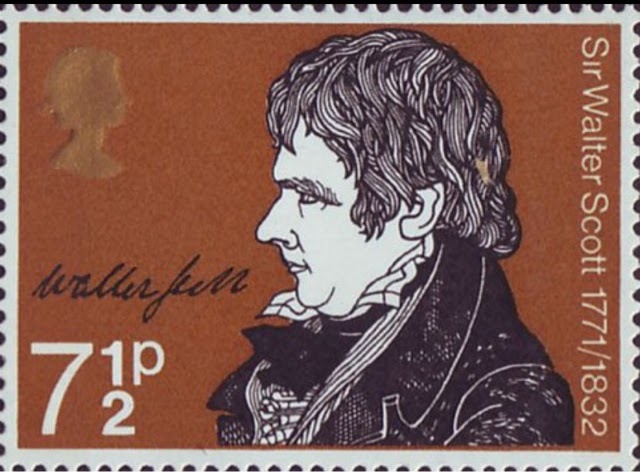
My immediate motivation for reading my first work by Sir Walter Scott (1711 -Edinburgh, Scotland to 1832) was to see his influence on Balzac and the historical novel.  In 1832 he was the world's most popular writer. 

I am very glad I took the time to read Ivanhoe.  I really liked parts of it a lot.  I guess flashing back to old movies I liked best the tournament of knights, the archery contest, the castle seige, the revelation of King Richard, the sense of the lingering conflicts between the ruling Normans and the Saxons and remembering all the old movies it brought to mind.  The book is set in England in the 12th century. 

As I read on I began to get very tired of and annoyed at the constant use of the word "Jew", 383 times in all, about once a page.  Jews are constantly described as being usurious and destroying the lives of  Christians   in pursuit of wealth.  All Jews are assumed by others to be rich and are considered to be adapts at all sorts of hidden "oriental lore".  All are assumed to be in league with others in their "tribe".  I began to feel like abandoning the book but then I thought  maybe Scott is trying to expose the attitudes of the English in the 12th century.  Still I thought why cannot Rebecca just be referred to as "a beautiful woman", why must she always be called a "Jewess"?  I did some quick research and found opinion divided but most said Scott was actually Philosemtic.  I admit this is a new to me expression but basically it means a predisposition to like anything or anyone considered Jewish.  People said, rightly, that the two main Jewish characters, Rebecca and her father, always act with complete nobility and goodness so this repudiates the claim that Ivanhoe supports anti-Semite values.  But let us think for a moment, imagine a novel which on hundreds of occasions dumped all Asians into the category of "sneaky, treacherous, inscrutable Orientals" then redeems itself by having two good Asians in the novel.  For sure Ivanhoe exemplifies Orientalizing, as used by Edward Said.  And I have said nothing about the way "Saracens" are described. 


Why cannot people just be complicated whole  entities? Is a commentator on American TV who makes a big show of his fondness for Bill Cosby to repudiate charges of racism proving he is not biased? 

I recently read an over all very good biography of C. K. Scott Moncireff (also from Edinburgh) in which the author explicitly states he showed great courage fighting in the trenches in W W I even though he was gay.

I know, for one example, Flannery O'Connor often uses gross racial terms to refer to African Americans (there is a disgusting line in Ivanhoe where a small group of African slaves are referred to as having "blubber lips") and this does not make her racist.  This is how people talked.  Howeveri, if she were to refer in amazement to how not all such persons are lazy, violent, ignorant, and shiftless, then we would see her differently.  


I think many will find the very flowery dialogue either tiresome or comic.  There are also very big issues with how women are valued only for their beauty.  I suspect the longer one scrutinized the values exemplified by Ivanhoe the worse it will look.  

Can great writer can be racist?.  Maybe bad in our, my eyes,values does not mean bad writing.  For sure Jane Eyre  has issues.  

Probably Ivanhoe should be read eventually by most literary autodidacts esoecially those seeking an understanding of the development of the novel.  

Feel free to respond to my claims.  Maybe in 1820 this was a daringly progressive book


Mel u


Thursday, March 27, 2014

The Prime of Miss Jean Brodie by Muriel Spark (1961)


This is my first time ever to read Muriel Spark's very famous novel, The Prime of Miss Jean Brodie.  I have seen the movie several times on cable so I knew the general plot line of a teacher at a private school  in pre-WW Two  Scotland, sympathetic to the Fascists in Italy and Hitler in the early years whose teaching methods were unconventional.  Every year she would select a few pupils as "her girls" and try to truly educate them.  To me part of the immense pleasure in reading this very insightful and at times hilarious novel was in seeing how Miss Brodie's girls perceived her and especially her relationships with two male teachers.  I think part of my enjoyment of this book arose from my having three daughters and wondering how they would react to Miss Brodie.  This is not a long book, the prose is a consistent delight, the satire is really well done and the characters are marvelously developed.  I am so glad I have at last read this book.

I was given a free review copy.


Mel u

Tuesday, December 10, 2013

The Big Music by Kirsty Gunn (2012, 496 pages)


I have read Kirsty Gunn's The Keepsake three times.  I have posted on it twice and hope to read it again in 2014.   I think it belongs in the Sontag category of "High Art".  The Big Music, twice as long as The Keepsake, is a very challenging, intricately constructed modernist tour de force set in the highlands of Scotland (where New Zealand born Gunn now lives).  There are excellent very insightful reviews of The Big Music in online editions of majors newspapers which I suggest interested buyers read.  

The central thing in the book, called "The Big Music", is Scottish bagpipe music.  If you know little or nothing about the history or the musical theory and methods of bagpipes, you certainly will after completing The Big Music.  Gunn's work is a deep meditation on the nature of music and through this that of art.  It is also a lesson in how to read a novel.

The novel is presented to us as if were a collection of material Gunn found relating to a famous family of bagpipers.  For generations they have composed music for bagpipes and instructed others advanced techniques of the instrument.  Gunn uses the material as if were the basis for an academic treatise.  Interspaced with personal notes from many members of the family are historical and theoretical notes about bagpipe playing.  

I read this book twice, once three months ago and once this week.   There are many wonderful sentences and paragraphs about loneliness and the Scottish Highlands.  The bagpipe is superbly equipped for expressing pain and loss.  It was played as troops went into battle and at the funerals of kings and presidents.    It's sound is like no other instrument.  

There is a lot of fascinating historical information in The Big Music.  

The Big Music is a very challenging book which should be read slowly and thoughtfully.  I hope to reread it in a year or two.  


Monday, November 4, 2013

"The Family House" by Elspath Davie 1972


In her obituary in The Telegraph Elspath Davie is described as a neglected master of the short story, little read anymore.  There are no book blog posts on her work other than the three prior ones I have done.  Who gets read, taught and bought is as much impacted by business and trendiness as it is by quality.  I have a posthumous collection of thirty nine of her stories, The Man Who Wanted to Smell Books and other Stories (2011).  I love having this collection but the editor did not include publication dates for the stories which I find a very bad but too common practice.  I do not know if it comes from laziness but I hope future editors will do a better job on anthologies.  I am going to read all these stories, I don't know if I will post on them all or not.  Part of me says why do posts I can predict nearly no one will read but you never know.   Long ago I wrote posts on Japanese WWII authors that had no mention on the net in English and they since have gotten steady but slow readership since then.  

Have you ever seen reality TV shows about hoarders, people who cannot bare to throw away anything?  "The Family House" is about a Scottish family of hoarders, not dysfunctional mental cases like we see on TV, but a perfectly respectable normally seeming   family of five, three brothers and two sisters.  They are adults, never married and childless.  The men work in offices,the sisters take care of the house, which being very old requires a lot of maintenance.  They inherited the house, quite big, from an aunt.  It has been in the family for generations.  The house is totally neat and organized but it is full of the stuff of generations. One day the oldest sister, we never learn much about the brothers, goes in the attic looking for something and hurts her foot when an old clock falls on it. She takes to her bed and refuses to get out even after the family doctor tells her she is fine.  She says she needs a rest from the burden of so much stuff.  (spoiler alert).  Her frustration starts an epic rush of fires in which old clothes and generations worth of letters are burned.  Soon the brothers are throwing lots of household items on the fire.  In one very funny scene, the sisters find three bread crumb brushes, never used in decades.  After debating on the need for three brushes to deal with bread crumbs, two go into the fire. The spell or power of the old house and generations of guilt are broken.  In  frenzy they sell of or send to the dump (the trash collectors go wild with joy when they contemplate the money they will make from what the family is throwing out) ninety percent of the things in the house.  In the event others may read this story, I will leave the denouement of the plot unrevealed.  

This is a very good story, the characters are not well developed but I think that to show how the house and their heritage prevented them from developing strong full personalities.  

Do you have a favorite short story writers that seems little read?  

(born March 1918 - died November 1995) - Kilmarnock, Scotland 

Elspeth Davie, née Dryer, was born in Kilmarnock in 1918. Her father was a Scottish minister; her mother was Canadian. Although she spent much of her childhood in England, she returned to Scotland to study at Edinburgh University and Art College. Rather than complete her degree, she trained as a teacher and taught art in Scotland and Northern Ireland. It was there that she met her husband, the philosopher George Elder Davie, whom she married in 1944.

She started writing stories for literature journals such as the Transatlantic Review, Cornhill and London Magazine, and her first novel,Providings, was published in 1965. Several other novels followed, but it was for her short stories that Davie was best known. Her anthologies included The SparkThe High Tide Talker, and The Night of Funny Hats.

In 1977 Elspie Davie won a Scottish Arts Council Award, and in the following year she won the Katherine Mansfield Prize. Her final collection, Death of a Doctor, was published in 1992. Her stories typically had ordinary settings into which extraordinary characters and events took place.

Elspeth Davie died in Edinburgh in 1995.


Saturday, October 26, 2013

"The First Year of My Life" by Muriel Spark A short story by the author of The Prime of Miss Jean Brodie


Muriel Spark

Muriel Spark (1918–2006) was a prolific Scottish novelist, short story writer, and poet whose darkly comedic voice made her one of the most distinctive writers of the twentieth century. Spark grew up in Edinburgh and worked as a department store secretary, writer for trade magazines, and literary editor before publishing her first novel in 1957. The Prime of Miss Jean Brodie (1961), considered her masterpiece, was made into a stage play, a TV series, and a film. Spark became a Dame of the British Empire in 1993.

It has been over four decades since in read The Prime of Miss Jean Brodie.  I have the plot pretty well still but maybe that comes from the movie.  Four decades is too long between reading the wonderful work of Ms. Spark.  This is a very interesting kind of one idea story.  It is the story, told from long ago memories, of what a baby experienced in the first year of their life.  The narrator says there is a theory, which she believes, that babies for the first year of their lives understand everything that is going on in the world they inhabit but once they get older they lose this ability.  This story is about the world the baby was born into in the year World War One began.  Spark does a brilliant job of letting us see the horrors of this year.  Just as expected I would, I really enjoyed this story.  I have access to one of her ghost stories and hope to read it soon. 


"Overweight" by Elspeth Davie 1980


"Overweight" is the third story by Elspeth Davie I have read and loved in the last few days. My research indicates that everyone who reads her work, loves it but sadly for them very few people do.  

(born March 1918 - died November 1995) - Kilmarnock, Scotland 

Elspeth Davie, née Dryer, was born in Kilmarnock in 1918. Her father was a Scottish minister; her mother was Canadian. Although she spent much of her childhood in England, she returned to Scotland to study at Edinburgh University and Art College. Rather than complete her degree, she trained as a teacher and taught art in Scotland and Northern Ireland. It was there that she met her husband, the philosopher George Elder Davie, whom she married in 1944.

She started writing stories for literature journals such as the Transatlantic Review, Cornhill and London Magazine, and her first novel,Providings, was published in 1965. Several other novels followed, but it was for her short stories that Davie was best known. Her anthologies included The SparkThe High Tide Talker, and The Night of Funny Hats.

In 1977 Elspie Davie won a Scottish Arts Council Award, and in the following year she won the Katherine Mansfield Prize. Her final collection, Death of a Doctor, was published in 1992. Her stories typically had ordinary settings into which extraordinary characters and events took place.

Elspeth Davie died in Edinburgh in 1995.

"Overweight", like the other two stories by Elspeth Davie I read this week, is a wonderful story.  It starts out as an airplane is getting ready to take off.  An announcement comes on, saying the plane is overweight.  They offer half off fare for a volunteer to get off and take the next flight.  The man who volunteers is almost painfully thin.  He wonders how his weight can impact such a giant machine.  As he wanders around waiting for his flight he begins to reflect on the weight of his life.  Much of the story is an extended metaphor on weight.  I really liked this story a lot.

For sure I will be reading more stories by Elspeth Davie.  If you have any experience with her please share it.  


Wednesday, October 23, 2013

"Change of Face" by Elspeth Davie, 1965


(born March 1918 - died November 1995) - Kilmarnock, Scotland 

Elspeth Davie, née Dryer, was born in Kilmarnock in 1918. Her father was a Scottish minister; her mother was Canadian. Although she spent much of her childhood in England, she returned to Scotland to study at Edinburgh University and Art College. Rather than complete her degree, she trained as a teacher and taught art in Scotland and Northern Ireland. It was there that she met her husband, the philosopher George Elder Davie, whom she married in 1944.

She started writing stories for literature journals such as the Transatlantic Review, Cornhill and London Magazine, and her first novel,Providings, was published in 1965. Several other novels followed, but it was for her short stories that Davie was best known. Her anthologies included The SparkThe High Tide Talker, and The Night of Funny Hats.

In 1977 Elspie Davie won a Scottish Arts Council Award, and in the following year she won the Katherine Mansfield Prize. Her final collection, Death of a Doctor, was published in 1992. Her stories typically had ordinary settings into which extraordinary characters and events took place.

Elspeth Davie died in Edinburgh in 1995.

Yesterday I posted on a story by Elspeth Davie, "The Choirmaster".  I was really amazed by this story, both by the style and the theme.  I have now read my second work by her "Change of Face", centering on a man who has a street stand where he draws in crayon portraits for  a pound. (About 70 pesos)
The story is so full of meaning and marvel I do not wish to summarize it.  It is a strange and deep story about how people see themselves, about a lonely old man whose portrait the artist cannot paint in crayons.  It is about chance encounters, the nature of art.  It is almost a work of magic.  

I have access to one more of her short stories, upon reading it I will probably begin reading her most famous collection of short stories, The Man Who Wanted to Smell Books and other Stories.  

Please share your experience with Ms. Davie with us.


Monday, October 21, 2013

"Choirmaster" by Elspeth Davie 1980


Elspeth Davie

(born March 1918 - died November 1995) - Kilmarnock, Scotland 

Elspeth Davie, née Dryer, was born in Kilmarnock in 1918. Her father was a Scottish minister; her mother was Canadian. Although she spent much of her childhood in England, she returned to Scotland to study at Edinburgh University and Art College. Rather than complete her degree, she trained as a teacher and taught art in Scotland and Northern Ireland. It was there that she met her husband, the philosopher George Elder Davie, whom she married in 1944.

She started writing stories for literature journals such as the Transatlantic Review, Cornhill and London Magazine, and her first novel,Providings, was published in 1965. Several other novels followed, but it was for her short stories that Davie was best known. Her anthologies included The SparkThe High Tide Talker, and The Night of Funny Hats.

In 1977 Elspie Davie won a Scottish Arts Council Award, and in the following year she won the Katherine Mansfield Prize. Her final collection, Death of a Doctor, was published in 1992. Her stories typically had ordinary settings into which extraordinary characters and events took place.

Elspeth Davie died in Edinburgh in 1995.

I was simply amazed by "The Choirmaster" by Elspeth Davie.  I admit I never heard of her prior to yesterday.  I found her in a wonderful anthology of short stories, The Story - Love, Loss, and the Lives of Women-100 Stories edited by Victoria Hislop.  There are stories by about 80 writers in the collection (some authors like Alice Munro and Yiyung Li have more than one story but who would complain about that) with concise introductions.  It is really the model of an anthology.  For about ten cents, four   Pesos, each you can read 100 stories and probably find lots of new to your authors you fall in love with like I have with Anne Kavan and Elspeth Davie.   

As far as I know there are no stories by Ms. Davie online.  There are two of her works in Hislop's anthology, which alone makes it worth buying.  "The Choirmaster" is a deep commentary on religion, on God.  I was really shocked by its power.  It deals directly with one of the hardest of Christian theological issues-if God is good and all powerful, why is the world full of evil and pain?  The greatest philosophers from Leibniz and Spinoza failed badly on this question.  The church will say only "have faith".  The story also deals with nature of history, the role of religion in history and much more.  It is beautifully written, almost overwhelming.  I see this story as high art in the terminology of Sontag. There is one more story by Ms. Davie in the anthology and if it is as good as this I will buy her most famous collection of short stories, The Man Who Wanted to Smell Books and other Stories and start a new reading project.


-


Featured Post

Imperial Reckoning: The Untold Story of Britain’s Gulag in Kenya by Caroline Elkins - 2005 - 701 Pages

  Imperial Reckoning:     The Untold Story of Britain’s Gulag in Kenya by Caroline Elkins - 2005 - 701 Pages 2006 Pulitzer Prize Winner From...