Showing posts with label Holocaust. Show all posts

Thursday, November 21, 2024

The Most Precious of Cargoes by Jean-Claude Grumberg - 2019 - Translated from French by Fred Wynne - 2020 - 60 pages


 The Most Precious of Cargoes by Jean-Claude Grumberg - 2019 - Translated from French by Fred Wynne - 2020 - 60 pages


Told in the manner of a fairy tale, Jean-Claude Grumberg's The Most Precious of Cargoes tells the story of a woman who wanted a child, and a child who needed a home. It is a tale that teaches us that even in the darkest, most violent times, there is reason to believe in people's capacity for kindness.

Once upon a time in an enormous forest lived a woodcutter and his wife. The woodcutter is very poor and a war rages around them, making it difficult for them to put food on the table. Yet every night, his wife prays for a child.

A Jewish father rides on a train holding twin babies. His wife no longer has enough milk to feed both children. In hopes of saving them both, he wraps his daughter in a shawl and throws her into the forest.

While foraging for food, the woodcutter’s wife finds a bundle, a baby girl wrapped in a shawl. Although she knows harbouring this baby could lead to her death, she takes the child home.

Set against the horrors of the Holocaust and told with a fairy tale-like lyricism, The Most Precious of Cargoes is a fable about family and redemption which reminds us that humanity can be found in the most inhumane of places.

I found work deeply captivating. The epilogue is just so wonderful.

"Jean-Claude Grumberg was born in 1939. He started out as an actor before writing his first play in 1968. Since then he has written more than forty scripts for the stage and film. He currently lives and works in his native France. He was inspired by the loss of his own father in a Nazi concentration camps to write The Most Precious of Cargoes. He lives in France." From Harper Row


Sunday, September 1, 2024

Refuge in Hell: How Berlin's Jewish Hospital Outlasted the Nazis by Daniel B. Silver - 2003


 Refuge in Hell: How Berlin's Jewish Hospital Outlasted the Nazis by Daniel B. Silver - 2003


This is essential reading for anyone with a serious interest in the Holocaust and the history of Jewish Life in Berlin.  Silver goes back to about 1350 when a restricted number of Jewish families were allowed to settle in Berkin, processing to periods when Jews were welcomed. By about 1940  over half of the economic productivity in Berkin was generated by the activity of Jews. (Silva goes into details on who was seen as a Jew by the Nazis and explains his own use of terminology.)  As German antisemitism grew worse some how a Jewish Hospital with almost all Jewish Doctors and staff survived, Some employees were saved by being married to Christians and for a while from being World War One Veterans.  They began to see family members deported to death camps.


The Germans actually sent Jewscto the hospital to be treated and once they recovered they sent them to death camps.  The hospital used to treat everyone.  If you could not pay you were welcomed.  Then they were told they could treat only Jews so they lost a large percentage of their paying customers.  Food rations were cut but still the hospital stayed open.


"Dan Silver, a lawyer and former general counsel to the CIA, tells the astonishing story of Berlin's Jewish Hospital during WWII. For decades before the Nazis seized power in Germany, the hospital had served Berlin's Jews as their principal medical resource. At the war's end, it was still functioning, delivering what medical care it could and sheltering a large percentage of the city's few remaining Jews. Silver asks how a Jewish institution, located in the capital city of a regime dedicated above all to obliterating the Jews, could possibly have survived. To answer this question, Silver has gathered the available documentary evidence and interviewed the handful of hospital staffers still alive. According to these sources, the institution's survival hinged on an amalgam of factors, including sheer, blind luck and bureaucratic infighting among Nazi organizations. As Silver explains, the Nazis' bizarre system for classifying persons of partly Jewish ancestry played a role as well, since some hospital personnel with mixed ancestry were not treated with the same implacable hostility as full Jews were. Silver acknowledges where gaps in the evidence make certainty impossible, as in assessing Dr. Walter Lustig, the hospital's chief during the war years. Lustig may have been a betrayer and collaborator, as some staffers think, or he may have manipulated the system as best he could to save at least some Jews from destruction. The balanced analysis of Dr. Lustig's record typifies the author's careful use of evidence throughout this absorbing book." From Amazon


Refuge in Hell: How Berlin's Jewish Hospital Outlasted the Nazis by Daniel B. Silver greatly expanded my knowledge of Holocaust and Jewish history.


Saturday, June 15, 2024

Milkweed by Jerry Spinelli - 2003- 240 Pages - Newberry Medalist


 Milkweed by Jerry Spinelli - 2003- 240 Pages - Newberry Medalist


I last read Milkweed in 2009.  I was delighted to find it available on Libby.

As I read it I remembered the persona of the young boy in Warsaw during the Nazi occupation,  the tone of the work, and the totally wonderful ending.  

"He's a boy called Jew. Gypsy. Stopthief. Runt. Happy. Fast. Filthy son of Abraham.

He's a boy who lives in the streets of Warsaw. He's a boy who steals food for himself and the other orphans. He's a boy who believes in bread, and mothers, and angels. He's a boy who wants to be a Nazi some day, with tall shiny jackboots and a gleaming Eagle hat of his own. Until the day that suddenly makes him change his mind. And when the trains come to empty the Jews from the ghetto of the damned, he's a boy who realizes it's safest of all to be nobody.

Newbery Medalist Jerry Spinelli takes us to one of the most devastating settings imaginable - Nazi-occupied Warsaw of World War II - and tells a tale of heartbreak, hope, and survival through the bright eyes of a young orphan" - from the Publisher Scolastic Press

I think this beautiful work about an incredibly ugly place and time will deeply move most readers, of any age.  We end up seeing the narrator as a grandfather.


Sunday, April 14, 2024

Stolen Words The Nazi Plunder of Jewish Books by Mark Glickman - 2016 - 344 Pages


 Stolen Words The Nazi Plunder of Jewish Books by Mark Glickman - 2016 - 344 Pages is a beautiful, brilliant book.  I offer my great thanks to Rabbi Glickman for sharing so much essential knowledge about Jewish traditions and the efforts of the Nazis to destroy Jewish Culture with us,

"Stolen Words is an epic story about the largest collection of Jewish books in the world—tens of millions of books that the Nazis looted from European Jewish families and institutions. Nazi soldiers and civilians emptied Jewish communal libraries, confiscated volumes from government collections, and stole from Jewish individuals, schools, and synagogues. Early in their regime the Nazis burned some books in spectacular bonfires, but most they saved, stashing the literary loot in castles, abandoned mine shafts, and warehouses throughout Europe. It was the largest and most extensive book-looting campaign in history.
 
After the war, Allied forces discovered these troves of stolen books but quickly found themselves facing a barrage of questions. How could the books be identified? Where should they go? Who had the authority to make such decisions? Eventually the military turned the books over to an organization of leading Jewish scholars called Jewish Cultural Reconstruction, Inc.—whose chairman was the acclaimed historian Salo Baron and whose on-the-ground director was the philosopher Hannah Arendt—with the charge of establishing restitution protocols.
 
Stolen Words is the story of how a free civilization decides what to do with the material remains of a world torn asunder, and how those remains connect survivors with their past. It is the story of Jews struggling to understand the new realities of their post-Holocaust world and of Western society’s gradual realization of the magnitude of devastation wrought by World War II. Most of all, it is the story of people —of Nazi leaders, ideologues, and Judaica experts; of Allied soldiers, scholars, and scoundrels; and of Jewish communities, librarians, and readers around the world."  From Nebraska University Press  - the Publisher 

Most people know the Nazis burned Jewish Books but my guess is few know that they stole millions of books from Jewish collections and individuals. Their purpose was to use them to document their fantasies about Jewish plots and to place the works in a planned museum of Jewish culture to be built  after a victory which never happened.

Glickman describes Germany as a country that respected the power of books.  That is why they were so concerned to capture Jewish Books. Likewise he details the great importance of studying the written word in Jewish History as well as the widespread love of books in Eastern European and Russian Jewish communities.

He takes us way back in Jewish and German history and ends up  with his experiences teaching in a summer camp for teenagers on Jewish culture 

Rabbi Mark Glickman has served at congregations in Ohio, Washington State, and Colorado. He is the author of Sacred Treasure—The Cairo Genizah: The Amazing Discoveries of Forgotten Jewish History in an Egyptian Synagogue Attic.


Monday, March 11, 2024

The Zone of Interest - Directed by Jonathan Glazer - Starring Christian Friedel as Rudolf Höss -'Sandra Hüller as Hedwig Höss - 2024 Academy Award Winner for Best International Picture and Best Sound Design


The Zone of Interest - Directed by Jonathan Glazer - Starring Christian Friedel as Rudolf Höss -'Sandra Hüller as Hedwig Höss - 2024 Academy Award Winner for Best International Picture and Best Sound Design 

One Hour 46 Minutes 

Available for Purchase on YouTube and Amazon Prime 

Among the numerous print reviews of The Zone of Interest I found that of the Los Angeles Times particularly perceptive.

https://www.latimes.com/entertainment-arts/movies/story/2023-12-14/the-zone-of-interest-review-jonathan-glazer-drama-auschwitz-holocaust-wwii


The film focuses on the Hosses as they strive to build a dream life for their family in a house in zone of interest next to the infamous Auschwitz concentration camp.  A wall separates their property from the camp.They have five children. Hoss is a dedicated father, reading stories to his children.

When the mother of Mrs Hoss visits she tells her daughter she has done very well. They have a beautiful garden, the household staff are a mixture of prisoners and Poles.  Hoss seems to be a Nazi for career purposes more than ideology,

We never see directly the horrors of Auschwitz but there are sounds of gun shots and screams.  The smoke from the ovens is always visible and the ashes of the murdered get into everything.  

. The Zone of Interest premiered at the 76th Cannes Film Festival on 19 May 2023 to acclaim, winning both the Grand Prix and FIPRESCI Prize, and was named one of the top-five international films of 2023 by the National Board of Review. It won three BAFTAs (including Film not in the English Language), two Academy Awards (Best International Feature and Best Sound), and three Golden Globe Awards.

In his acceptance speech at the Oscars the director Jonathan Glazer he hoped the film would make people think about the walls the set up to allow us to ignore  the Middle East War.


The Zone of Interest is High Art.  Along with Schindler's List and The Pianist it is essential viewing 


Sunday, March 10, 2024

The Pianist is a 2002 biographical Holocaust war drama film produced and directed by Roman Polanski, with a script by Ronald Harwood, and starring Adrien Brody


Available on YouTube 


The Pianist is a 2002 biographical Holocaust war drama film produced and directed by Roman Polanski, with a script by Ronald Harwood, and starring Adrien Brody


The Pianist is  based on the autobiography of the same name by Władysław Szpilman, a Polish-Jewish pianist who survived the Holocaust in Warsaw.  (2002) is a historical war drama film directed by Roman Polanski and based on the autobiography of the same name by Władysław Szpilman, a Polish-Jewish pianist who survived the Holocaust in Warsaw. 


The film stars Adrien Brody as Szpilman, and follows his life from the start of the German invasion of Poland in 1939 through his experiences in the Warsaw Ghetto and as a fugitive hiding in the ruins of the city.


The Pianist was critically acclaimed, winning the Palme d'Or at the 2002 Cannes Film Festival and three Academy Awards, including Best Director for Polanski, Best Adapted Screenplay for Ronald Harwood, and Best Actor for Brody. It is considered one of the greatest films ever made about the Holocaust.

I found The Pianist to be of great emotional power, exposing both the depths of evil and goodness.


Wednesday, December 13, 2023

Little Red Bird - A Short Story by Chava Rosenfarb- Included in In the Land of the Postscript: The Complete Short Stories of Chava Rosenfarb Translated and edited by Goldie Morgentaler


Little Red Bird - A Short Story by Chava Rosenfarb- Included in In the Land of the Postscript: The Complete Short Stories of Chava Rosenfarb Translated and edited by Goldie Morgentaler - 2023


Originally publidhed - “Royt feigele” (“Little Red Bird”). In Yiddish. Di goldene keyt 139 (1994)


I greatly admire Chava Rosenfarb both as a writer and as a person. She is among the eight authors included in the header picture for my blog.


"Little Red Bird" focuses on a woman whose husband and four year old daughter were murdered in a German concentration camp.  Her daughter was thrown into the crematorium while still living.  She meets a man, while living in a post World War Two displaced persons camp.


"Manya and Feivel met after the war in the displaced-persons camp of Feldafing in Bavaria. Both had been members of the Bundist youth organization in Poland; he in Kracow, she in Lodz. They had discovered each other during those confusing post-liberation days of hope and despair. Neither of them had any surviving family, so their need for closeness and intimacy with another human being was great."


Manya is frustrated because she is not able to get pregnant.


"They are both upset about the direction the postwar world has taken, about the fact that the sacrifice of millions has been in vain. But in Manya’s case, there lingers beneath the surface of her general sorrow over the fate of the world an additional, more intimate pain, which translates into a longing to have another child. "


Manya does something deeply immoral.  I really hope others will have the opportunity to read this profound story so I will say no more.


I do feel obligated to share a bit more of the powerful unflincing prose of this story.


"Manya is standing by the window, peering out at the snow. A little girl is playing in the street among the mounds of snow. The child is about five years old. She wears a red coat and a red hat, just like Little Red Ridinghood, the child the wolf tried to devour in the story by the Brothers Grimm. Manya’s child was in fact devoured by the wolf—a wolf who was, in a sense, a grandchild of the wolf in the Grimm brothers’ story. Manya’s child had been destroyed by the Germans when she was five years old. Her name had been Faygele, Little Bird. She too had had a red coat. When she wore the red coat her parents called her roit faygele, little red bird. Her parents delighted in the sight of Faygele wearing her red coat. The color suited her. It harmonized with the dark brown hair her mother would roll in tissue paper to form curls. The curls peeked out charmingly from underneath Faygele’s red hat. It did not occur to Faygele’s parents to associate the color red with the color of blood— Faygele’s blood."


CHAVA ROSENFARB (1923 - 2011)Prize-winning writer of fiction, poetry and drama, Chava Rosenfarb was born February 9, 1923 in Lodz, the industrial centre of Poland before the Second World War. She completed Jewish secular school and gymnasium in this community where several hundred thousand Jews lived —nearly half the population of the area. The Holocaust put an end to one of the richest centres of Judaism in all of Europe. Like many Jews of the city, Rosenfarb was incarcerated in the infamous Lodz ghetto. She survived there from 1940 to 1944, when she and her sister Henia became inmates of the concentration camps of Auschwitz, then Sasel and Bergen-Belsen. Even in the ghetto Rosenfarb wrote, and she hasn’t stopped since. Her first collection of ghetto poems, Di balade fun nekhtikn vald [The Ballad of Yesterday’s Forest] was published in London in 1947. After the liberation Rosenfarb moved to Belgium. She remained in Belgium until 1950, when she immigrated immigrated to Montreal. In Montreal, Rosenfarb obtained a diploma at the Jewish Teachers’ Seminary in 1954. Rosenfarb has produced a prolific body of writing, all of which speaks from her experience during the Holocaust. Her work has been translated into both Hebrew and English. Rosenfarb has been widely anthologized and has had her work appear in journals in Israel, England, the United States, Canada and Australia in Yiddish and in English and Hebrew translation. Among the many prizes awarded her work, she has received the I.J. Segal Prize (Montreal, 1993), the Sholom Aleichem Prize (Tel-Aviv, 1990) and the Niger Prize (Buenos Aires, 1972). She has travelled extensively, lecturing on Yiddish literature in Australia, Europe and South America as well as in Israel and the United States.


Mel Ulm 


Monday, October 30, 2023

My Quarrel With Hersh Rasseyner - A Short Story by Chaim Grade- translated from the Yiddish by Ruth Wisse


My Quarrel With Hersh Rasseyner - A Short Story by Chaim Grade - 1952- translated from the Yiddish with an illuminating introduction by Ruth Wisse - 2020

https://mosaicmagazine.com/author/chaim-grade

Today's Story and the introduction can be read at the link above.


 "For nearly a thousand years, European Jews thought, spoke, argued, and lived out their lives in Yiddish. It was the language of an entire civilization, built on the foundations of educational institutions, voluntary associations, and communal organizations that over time became the central repository of modern Jewish culture. It was in Yiddish that European Jewry confronted modernity—confronted, that is, the rise of nationalism, Enlightenment liberalism, Communism, and its own twin impulses for religious reform and religious orthodoxy. That this civilization was brimming over with vitality into the 20th century can be seen by the fact that it managed to simultaneously nurse a decidedly secular literary tradition and cultivate institutions of traditional Jewish learning arguably unsurpassed by any other Jewish community at any time in Jewish history. That all came to an abrupt end with Hitler’s war on the Jews. The destruction of the 1930s and 1940s posed enormous questions, and spurred investigation and answer by those who survived it. Chaim Grade, one of the most extraordinary modern Yiddish writers, offers a very pointed answer to the Holocaust in his 1952 story “My Quarrel with Hersh Rasseyner.” True Jewish continuity, Grade seems to say, was not to be found merely in the physical survival of Jewish communities, but in the survival of the theological, intellectual, and moral arguments that have always characterized Jewish life. The Jewish people is structured by its contentions and disputes, and not even the risk of physical annihilation can silence the abiding claims of obligation and freedom that press upon every Jew, then and now. The story is a true masterpiece, one of the finest expressions of modern Jewish culture. Mosaic is pleased beyond measure to bring you Ruth R. Wisse’s rendering of the first unabridged English translation of the text, along with her sparkling interpretive and introductory essay." From the preface by Mosaic 

I quoted at some length from the preface as their account of the historical 
 importance of this work way surpasses my abilities and knowledge.

It relays a conversation of between 
Two now older Jewish men who survived the Holocaust, one in a Concentration Camp and one escaped to Russia. Both were raised and educated in Vilna in Lithuanian. They encountered each other two years after the war was over, on a bus in Paris. Each had assumed the other died during the Holocaust.   Both did lose all their families.

The man who was in a camp taught traditional teachings to a group of Jewish boys also imprisoned there. He was a very strong believer in the teachings of the Torah. The other man had lost much of his faith due to the Holocaust.  He reasoned how can we be the chosen people, how can we not hate the Germans. He is an established poet, read widely by  Europeans of a wide diversity.  He takes pride in this and takes his self worth from the praise of what the other man sees as the corruption of the world.

Each man is challenged by the other,  

Anyone who does not understand why understanding the meaning of the Holocaust obviously does not have any awareness of events in the Middle East now.

"“That is the outlook and the Musar path of ‘the old one,’ Reb Yosef Yoizl— may his merit be a shield for us—and thousands of Novaredok students steeped themselves in it day and night. We labored to make ourselves better, each of us filed and polished his own soul, with examiners gathering evidence of our improvement like pearls. But you laughed at us. Then came the German—may his name be blotted out—and murdered our sainted students. And now here we both stand before the devastated Community of Israel. But you face a khurbn of your own—the destruction of your faith in the world. That’s what hurts you and torments you, so you ask me: why weren’t the wise men of the Gentiles able to be good if they wanted to be good? And you find contradictions in what I said. But the contradiction you find is in yourself. You thought the world was striving to become better but you discovered that it was striving for our blood."

The conversation will require your full attention.

Chaim Grade Born in Vilna in 1910, Chaim Grade was a novelist and poet, known for such works as The Yeshiva. He settled in the Bronx following World War II, where he lived until his death in 1982.

Ruth R. Wisse Ruth R. Wisse is a research professor at Harvard and a distinguished senior fellow at the Tikvah Fund. Her most recent book is No Joke: Making Jewish Humor (2013, paperback 2015).


Sunday, September 24, 2023

The Counterfeit Countess:' The Jewish Woman Who Rescued Thousands of Poles During the Holocaust by Elizabeth B. White and Joanna Silwa -2023-


"The astonishing story of Dr. Josephine Janina Mehlberg—a Jewish mathematician who saved thousands of lives in Nazi-occupied Poland by masquerading as a Polish aristocrat—drawing on Mehlberg’s own unpublished memoir.World War II and the Holocaust have given rise to many stories of resistance and rescue, but The Counterfeit Countess is unique. It tells the remarkable, unknown story of “Countess Janina Suchodolska,” a Jewish woman who rescued more than 10,000 Poles imprisoned by Poland’s Nazi occupiers. Mehlberg operated in Lublin, Poland, headquarters of Aktion Reinhard, the SS operation that murdered 1.7 million Jews in occupied Poland. Using the identity papers of a Polish aristocrat, she worked as a welfare official while also serving in the Polish resistance. With guile, cajolery, and steely persistence, the “Countess” persuaded SS officials to release thousands of Poles from the Majdanek concentration camp. She won permission to deliver food and medicine—even decorated Christmas trees—for thousands more of the camp’s prisoners. At the same time, she personally smuggled supplies and messages to resistance fighters imprisoned at Majdanek, where 63,000 Jews were murdered in gas chambers and shooting pits. Incredibly, she eluded detection, and ultimately survived the war and emigrated to the US. Drawing on the manuscript of Mehlberg’s own unpublished memoir, supplemented with prodigious research, Elizabeth White and Joanna Sliwa, professional historians and Holocaust experts, have uncovered the full story of this remarkable woman. They interweave Mehlberg’s sometimes harrowing personal testimony with broader historical narrative. Like The Light of DaysSchindler’s List, and Irena’s ChildrenThe Counterfeit Countess is an unforgettable account of inspiring courage in the face of unspeakable cruelty." From the publisher 
 

This is a very valuable addition to Holocaust History, especially as it relates to Poland.  Sometimes in thinking on the Holocaust one loses sight of the many people who Risked or lost their lives to help others.

I highly recommend this book to anyone interested in this period.

Friday, June 9, 2023

Wages of Destruction: The Making and Breaking of the Nazi Economy by Adam Tooze - 2008- 829 Pages


Wages of Destruction: The Making and Breaking of the Nazi Economy by Adam Tooze - 2008- 829 Pages


One of my core interests is the Holocaust. Of course this needs to be understood in terms of the places and the era in which it occurred, Germany and the territories it conquered during WW Two.


The Holocaust (1933–1945) was the systematic, state-sponsored persecution and murder of six million European Jews by the Nazi German regime and its allies and collaborators.The United States Holocaust Memorial Museum defines the years of the Holocaust as 1933–1945. The Holocaust era began in January 1933 when Adolf Hitler and the Nazi Party came to power in Germany. It ended in May 1945, when the Allied Powers defeated Nazi Germany in World War II. The Holocaust is also sometimes referred to as “the Shoah,” the Hebrew word for “catastrophe.” From The Website of The US Holocaust Museum 


Tooze's book goes into copious detail about how the economy in Nazi Germany was shaped by the goals and beliefs of Adolph Hitler and his supporters.


One of the platform ideas that helped make the Nazi party popular was their harsh criticism of the post WW One Versiles Treaty. The Treaty, among other things,prohibited Germany from rebuilding its military, imposed reparations and confiscated territory. The Nazis blamed the extreme decline in the German economy on the Treaty. They saw it as engineered by an international Jewish conspiracy. 


Tooze shows us how, with the full cooperation of wealthy German industrial concerns like I.G. Farben, BMW, Siemens, Damiler-Benz and others began a massive built up of the German Army and the airforce.


"The cultural crises of early twentieth-century Europe, the vacuum left by the secularizing tendencies of the late nineteenth century, the radicalizing horror of World War I, all demand attention from anyone seriously interested in plumbing the deeper motives of National Socialism. How else can we understand a regime that took as its central objective the destruction of European Jewry, an objective apparently devoid of all economic rationale, a project that, if it can be understood at all, seems to be intelligible only in terms of a violent theology of redemptive purifica tion?" From the book


Hitler wanted to expand Germany territory way into the east, basically killing the Jews and starving millions. The plan was to use this space to produce food for Germans.  


Tooze details the internal political developments within Germany. A top priority was to insure adequate food supply at home. Nazi leaders realised unless Germans had good diets they would not support the party.


In Hitler's mind the complete extermination of the Jews of Europe was always a top priority. At first he did not talk a lot about it but as Tooze illustrstes it was by early 1940 a dominant factor.


Tooze shows how concentration camps figured into the German economy as a cheap source of labor. The Holocaust was also explicitly viewed as eliminating people viewed as nonproductive, the old, ill, young children.


Russian prisoners of war up to 600,000 died from over work and starvation, as did millions in the Ukraine and Russia.


At first Jews were allowed to emigrate if they could pay huge fees. Jewish owned businesses were turned over to Germans.

Ultimately the German leadership knew they would probably be Defeated once America with its huge economic capability entered the war.


"This book is the first in sixty years to offer a truly critical account of the performance of the German war economy both under Speer and his predecessors and it casts stark new light on his role in sustaining the Third Reich to its bloody end. For it is only by re-examining the economic underpinnings of the Third Reich, by focusing on questions of land, food and labour that we can fully get to grips with the breathtaking process of cumulative radicalization that found its most extraordinary manifestation in the Holocaust. The first aim of this book, therefore, is to reposition economics at the centre of our understanding of Hitler’s regime, by providing an economic narrative that helps to make sense of and underpin the political histories produced over the last generation." From the book


 Tooze has produced a brilliant highly illuminating history.


Adam Tooze holds the Shelby Cullom Davis chair of History at Columbia University and serves as Director of the European Institute. In 2019, Foreign Policy Magazine named him one of the top Global Thinkers of the decade.


Mel Ulm


Wednesday, May 10, 2023

All The Frequent Troubles of Our Days-The True Story of the American Woman at the Heart of German Resistance to Hitler by Rebecca Donner - 2021 - 577 Pages


 Winner of the National Book Critics Circle Award for Biography 

Finalist for the Plutarch Award
A New York Times Notable Book for 2021 
Oprah Daily Best New Books of August
A New York Public Library Book of the Week
 
In this stunning literary achievement, Donner chronicles the extraordinary life and brutal death of her great-great-aunt Mildred Harnack, the American leader of one of the largest underground resistance groups in Germany during the Nazi Years.

Born and raised in Milwaukee, Mildred Harnack was twenty-six when she enrolled in a PhD program in Germany and witnessed the meteoric rise of the Nazi party. In 1932, she began holding secret meetings in her apartment—a small band of political activists that by 1940 had grown into the largest underground resistance group in Berlin. She recruited working-class Germans into the resistance, helped Jews escape, plotted acts of sabotage, and collaborated in writing leaflets that denounced Hitler and called for revolution. Her coconspirators circulated through Berlin under the cover of night, slipping the leaflets into mailboxes, public restrooms, phone booths. When the first shots of the Second World War were fired, she became a spy, couriering top-secret intelligence to the Allies. On the eve of her escape to Sweden, she was ambushed by the Gestapo. At a Nazi military court, a panel of five judges sentenced her to six years at a prison camp, but Hitler overruled the decision and ordered her execution. On February 16, 1943, she was strapped to a guillotine and beheaded.

Historians identify Mildred Harnack as the only American in the leadership of the German resistance, yet her remarkable story has remained almost unknown until now.

Harnack’s great-great-niece Rebecca Donner draws on her extensive archival research in Germany, Russia, England, and the U.S. as well as newly uncovered documents in her family archive to produce this astonishing work of narrative nonfiction. Fusing elements of biography, real-life political thriller, and scholarly detective story, Donner brilliantly interweaves letters, diary entries, notes smuggled out of a Berlin prison, survivors’ testimony, and a trove of declassified intelligence documents into a powerful, epic story, reconstructing the moral courage of an enigmatic woman nearly erased history.

As I read this marvelous work, I hoped so much Mildred Harnack's romances, her marriage and her career plans would not be destroyed by the Nazis. In her work as an anti-Nazi agent it was very hard to trust anyone. A neighbor might be a gestapo agent, a collaborator might, and one in fact turned in Mildred and many others, turn you in under fear of torture.  
Some in her circle did make it out of Germany.
We get a clear view of the increasing cruelty of life in Germany.

"Rebecca Donner is the author of the instant New York Times bestseller All the Frequent Troubles of Our Days, published by Little, Brown. All the Frequent Troubles of Our Days won the 2022 National Book Critics Circle Award for Biography, the 2022 PEN /Jacqueline Bograd Weld Award, the 2022 Chautauqua Prize, and was a finalist for the Los Angeles Times Book Prize, the Plutarch Award, and the Governor General’s Literary Award. All the Frequent Troubles of Our Days was also selected as a New York Times Critics’ Top Book of 2021, a New York Times Notable Book, and a New York Times Editors’ Choice, and was named one of the Best Books of 2021 by the Wall Street Journal, TIME Magazine, Publisher’s Weekly, and The Economist. 

Rebecca Donner is currently a Visiting Scholar at Oxford. In 2023-2024, she will be a Radcliffe Fellow at Harvard Radcliffe Institute." From rebeccadonner.com

Mel u


Tuesday, May 9, 2023

A Cat at Dachau - A Short Story by Elyse Hoffman - 2022- 47 Pages


 A Cat at Dachau - A Short Story by Elyse Hoffman - 2022- 47 Pages


Dachau, located in Upper Bavaria in Southern Germany was one of the first concentration camps established by the Nazis (March 22, 1933). Initially it housed political opponents but later it housed Jews and Roma. Prisoners were subjected to brutal treatment for minor violations of camp rules. Many of the guards were teenage boys. An estimated 40,000 died in Dachau. The camp was liberated on April 22, 1945 by forces from the American Army.

"Of course, SS training was effectively about making the cadets into loyal dogs that would bite and maul without hesitation or question. The aloof cat, ever watchful, ever independent, was anathema to the spirit of the Nazi movement. An SS man who acted like a cat, who carefully observed and escaped if things weren’t good, was a failure of an SS man."

Max, a teenage guard at Dachau,has no qualms about beating Jews, participating in mass tortures, he worships Hitler. He likes drinking after work with his buddies, misses his family and he loves cats.

One day a small, dirty starving cat wanders into Dacau. He is wearing a collar, he was once a pet. Max takes him to a veterinarian, paying for his care. 
He sees the cat has no fear or hatred of Jews. Max begins to think, what if the cat was loved by a Jew, cared for and pampered. Max wonders how could a Jew be kind and unselfish, this is against everything he has been taught.

In the story we get a feeling of what it was like to be a teenage guard. The cat wanders all over the camp, searching for someone.

This is a very moving story. I don't want to give away too much of the plot but I loved the ending.

"A Cat in Dachau" is a delightful story. Cat lovers will be enthralled by this story.

Elyse Hoffman is an award-winning author who strives to tell historical tales with new twists. She loves to meld WWII and Jewish history with fantasy, folklore, and the paranormal. She has written six works of Holocaust historical fiction: The Barracks of the Holocaust five-book series and The Book of Uriel. Elyse’s books are the way to go if you love history and want to read some unique stories." From ElyseHoffman.com

Mel Ulm


Friday, May 5, 2023

:Vilna, The End of the Road

Vilna, The End of the Road by Sarah Shimonovitz -2021- 158 Pages


The original manuscript of the book was written by the author in Yiddish and portions were published in newspaper in 1963. The Hebrew edition of the book was published in 1989. Edited and translated by Nathan Livneh from the Yiddish manuscript. This book is a translation of the Hebrew edition.

'Vilna, the End of the Road" is the story of the survival of a mother and daughter from a large Jewish family firmly established in Vilna, who, with the rest of the family, were also destined to be murdered and thrown into the pits at Ponar. The path of suffering began with the deportation of the Jews from their homes to the ghetto, and from there to the killing forest and the death camps. In the dead of the night, the writer boldly and with determination, jumps from the death train into the unknown, into the surrounding horror." From the Website of Jews from Vilna in Israel

From there, she started her long and tedious journey, often surrounded by deadly enemies. But she was determined to survive and reunite with her son and daughter. Time after time, she risked her life searching the forests for her beloved son, the lost partisan; thus, until the eve of the victory over Hitler, when she returns to Vilna, her city, in hope of finding her children. On her way back, alongside many armed Red Army convoys, she passed by Ponar, and remembers her loved ones, and the beloved martyrs of Vilna, sinking into melancholic reflections on the past.

This is not just the end of her personal journey. It is also the end of Jewish Vilna, the "Jerusalem of Lithuania," whose reputation had spread among the Jews the world over."

Vilna was in the years before Germany invaded called the Jerusalem of Lithuania, renowned for its high scholarship. (The military occupation of Lithuania by Nazi Germany lasted from the German invasion of the Soviet Union on June 22, 1941 to the end of the Battle of Memel on January 28, 1945.)
One of the lessons quickly learned by even casual students of the Holocaust is that the Christian citizens of countries conquered by the Germans joined in the killing of Jews with great joy and enthusiasm. In this memoir Christian Lithuanians saw getting Jews out of Vilna would give them an opportunity to steal their property and was also a way of sucking up to the Germans, who they greatly feared. There a few good Christian Lithuanians portrayed in Vilna, the End of the Road but very few. Many just liked killing Jews to whom they felt, rightly, inferior.

"For the Jews of Vilnius, the Germans brought with them the inferno itself, in all kinds of strange and different forms. And they deluged us every day, and in increasing quantities. All at once, we became completely defenseless people, or more precisely: mice in a trap. And if the Germans weren’t enough, auxiliary forces,gangs of murderers rose up, who thoroughly enjoyed serving as the “weapon bearers” of their German masters in the murdering of Jews. First in line, in the light of day, were the Lithuanian shooters. They called themselves the Ypatingas (Ypatingasis būrys; the special squad). They wanted to be more Nazi than the Nazis, and started catching Jews and shooting them on the street. Then they began to remove the Jews from their homes. They surrounded entire neighborhoods and quarters, and removed all of the men, supposedly to work, except that they were led to Ponary. “And none ever returned"
We see the level of fear rising rapidly. The Jews of Vilna knew the ultimate goal of the Germans was to kill all the Jews in the country.  The memoir does a marvellous job of letting us feel the horror.
Soon the author, a wife and mother from a well off family, is separated from her family and put on a train on the way to the camp. We know from so many memoirs the horror of the train. The author makes a daring and dangerous leap from the train. The portrayal of her efforts to survive we very exciting. She explains that she was able to pass as Christian. She pretended to be Russian. Some of the people who helped her talked about how glad they were the Germans were getting rid of the Jews.
She was elated when the Russians began to invade Lithuania.
The memoir closes with her return to Vilna where ultimately she is reunited with her daughter and she learns her son, who fought with the Partisans against the
Germans and her husband are both dead.
Christians who she had given her property before she left lie to her in a venal fashion when she asks for her property.

"We arrived in Israel in 1949 and the moment we had pretty much settled in, my mother began writing her memories. To this day, I can still remember her sitting day and night, writing and erasing and typing again, steadfastly and devotedly. What she wrote did not get published for decades. One copy went to Yad Vashem and portions were published in a Yiddish newspaper abroad. After her death, I decided to publish my mother’s memories. In honor of her extraordinary and regal personality. Her tragedy and the tragedy of the Jewish people from a personal standpoint – as they occurred. She wrote them down for her and for her family and for the next generations. It is also in memory of the Jewish Vilna that was destroyed and will never be the same again. Zuta Averbach-Shimonovitz Written by the author’s daughter in the Hebrew edition which she published in 1989."

Vilna, The End of the Road is included in The Kindle Unlimited Program

Mel Ulm


Wednesday, March 29, 2023

THE APPRENTICE OF BUCHENWALD THE TRUE STORY OF THE TEENAGE BOY WHO SABOTAGED HITLER’S WAR MACHINE by Oren Schneider- 2023 - 212 Pages


 THE APPRENTICE OF BUCHENWALD THE TRUE STORY OF THE TEENAGE BOY WHO SABOTAGED HITLER’S WAR MACHINE by Oren Schneider- 2023 - 212 Pages


Normally I read several works at a time, skipping from a novel, a nonfiction or a short story. I found THE APPRENTICE OF BUCHENWALD THE TRUE STORY OF THE TEENAGE BOY WHO SABOTAGED HITLER’S WAR MACHINE by Oren Schneider so completely compelling that I read it through without meandering.It is part memoir and part autobiography, written by the author, Oren Schneider, a detailed, beautifully written story about the author's grandfather’s experiences before, during and after the Holocaust. 

The first part of the book relates the story of Schneider’s Jewish grandfather’s elegant and affluent life in Slovenia prior to the Holocaust, the destruction of that life by local Hungarian Nazis and later German Nazis, the survival of Grandfather by his wits and talents and the reconstruction of his life in Israel after the war. The second part of the book is the story of the author, a then self-absorbed young man, who connects with his grandfather in a deeply emotional way during a trip to Europe with his grandfather and the concentration camp in which his grandfather was incarcerated. The grandfather reconnects with friends from the past. We learn how the family struggled to find a place to live after their liberation by the Americans,

The grandfather’s survival and that of his family depended on luck,his mechanical skills that made him useful to his captors and acts of kindness.Schneider’s grandfather sabotaged thousands of Mauser rifles in collaboration with Russian POW’s in the arms factory in which they all worked as slave laborers. There is a hint — unable to be confirmed — in the last section of the book, how the sabotage could have ironically boomeranged during Israel’s War of Independence.

Oren Schneider was born in Israel, a third generation to Holocaust survivors and seventh generation to farmers from the Galilee. He is an entrepreneur who enjoys music, cooking, travel, people and especially the combination of all four. He lives with his family in Brooklyn.


Friday, March 24, 2023

The Lost: A Search for Six of Six Million by Daniel Mendelsohn- 2006- 517 Pages


The Lost: A Search for Six of Six Million by Daniel Mendelsohn- 2006- 530 Pages 


The Lost begins as the story of a boy who grew up in a family haunted by the disappearance of six relatives during the Holocaust. He was initially motivated by a cache of letters written by his grandfather. His lost relatives were seemingly betrayed. From this he develops a powerful drive to find out how his Jewish ancestors died in the Ukraine during the Hololocost. Mendelsohn sets out to find the remaining eyewitnesses to his relatives' fates. That quest eventually takes him to a dozen countries on four continents and forces him to confront the wrenching discrepancies between the histories we live and the stories we tell. And it leads him, finally, back to the small Ukrainian town where his family's story began, and where the solution to a decades-old mystery awaits him.


The book is part memoirs of his growing up, his education as a classics scholar fluent in Greek, Latin, as well Yiddish and some Russian and Ukrainian. Interwoven with his journey are accounts of Medieval Cabbalist thought and accounts of the history of the murder of Jews by Germans and Ukrainians. Everyone he encountered said "The Ukrainians were the worst".  

He sought out those who might have known his relatives, all now at least in their eighties. Soon he learned that some contacts had moved to New York City, some Australia, others Stockholm and Israel. He often traveled with his siblings.

Some contacts were eager to talk to him, most insisted he share large meals.  

This is a work of deep scholarship both in its account of the Holocaust in Ukraine and of Mendelsohn's fairly extensive explications of Torah commentary as it might serve to illuminate the Holocaust. It is also a deeply personal account of how Mendelsohn's upbringing shaped him.

"Daniel Mendelsohn is an internationally bestselling author, critic, essayist, and translator. Born in New York City in 1960, he received degrees in Classics from the University of Virginia and Princeton. After completing his Ph.D. he moved to New York City, where he began freelance writing full time; since 1991 he has been a prolific contributor of essays, reviews, and articles to many publications, most frequently The New Yorker and The New York Review of Books. He has also been a contributing editor at Travel + Leisure and a columnist for The New York Times Book Review, Harper’s, and New York magazine, where he was the weekly book critic. In February 2019, he was named Editor-at-Large of the New York Review of Books and the Director of the Robert B. Silvers Foundation, a charitable trust that supports writers of nonfiction, essay, and criticism.

Mendelsohn’s books include An Odyssey: A Father, a Son, and an Epic (2017), named a Best Book of the Year by NPR, Newsday, Library Journal, The Christian Science Monitor, and Kirkus; The Lost: A Search for Six of Six Million (2006), which won the National Books Critics Circle Award and the National Jewish Book Award in the United States and the Prix Médicis in France; a memoir, The Elusive Embrace (1999), a Los Angeles Times Best Book of the Year; three collections of essays; a scholarly study of Greek tragedy, Gender and the City in Euripides’ Political Plays (2002), and a two-volume translation of the poetry of C. P. Cavafy (2009), which included the first English translation of the poet’s “Unfinished Poems.” His tenth book, Three Rings: A Tale of Exile, Narrative, and Fate, will be published in September 2020." From Daniel Mendelsohn.com


Mel Ulm


Sunday, April 3, 2022

Kl: A History of the Nazi Concentration Camps By Nikolaus Wachsmann - 2015 - 881 Pages


Kl: A History  of the Nazi Concentration  Camps

By Nikolaus Wachsmann - 2015 - 881 Pages


In March of 1933 an abandoned factory in Dachau surrounded by barbed wire held 233 prisoners. Wachsmann traces out in a very detailed  narrative the complex sequence of events leading up to the 22 majors camps and over 1000 satellite camps located in Germany and Nazi occupied Europe.  The camps were at heart of the Nazis program of terror and repression.  As war dragged on they became an important part of the German economy and war effort.


The camps were quite different from each other. Auschwitz, the biggest camp, was primarily a place to murder Jews.  Other sites were work camps where the SS had economic reasons to keep workers alive such as Dora where V2 rockets were made by slave labor.  Inmates with skills valuable to the Germans had a much better chance of surviving longer.  I fascinated to learn that there was a unit of about 200 inmates who counterfeited British currency.  They worked inside, had better food and had a much higher survival rate than inmates working outside.  


Wachsmann is the first historian to write a complete history of the camps.  He shows us how The camps were organized while vividly detailing horrors, the sadism, and the central role in murdering those Nazi ideology dictated were parasites, sub-human and enemies of the State.  We see how German doctors were among the most vicious of camp officials, giving lethel injections, performing barbaric experiments and selecting which of newly arriving inmates were at once sent to be killed.


Gas Chambers were phased in as the primary method of Killing because Germans found shoting 

 them traumatic.


Wachsmann shows us The Germans failed attempt to turn Russian  POWs into slaves laborers.  Most were judged to weak and about two million were murdered.  Only about two percent of Russian POWs survived to return home.


Almost everyone who worked at the camps very long stole things that were supposed to be used in war efforts.

There is a lot of information about the Command structure of the Camps.


As the war started to turn against the Germans, hard core anti-semites began to panic, fearing they would not suceed in Killing all of the Jews in the camps.  As portrayed by Wachsmann,most all Germans knew what was going on in camps and did not care much one way or the other.


There is much more in this book.  


“Nikolaus Wachsmann is Professor in Modern European History at Birkbeck, University of London.

He studied at the London School of Economics, the University of Cambridge and at Birkbeck, gaining his PhD in 2001. His comprehensive history of the Nazi camps KL, published in 2015, won the Wolfson History Prize, the Mark Lynton History Prize, and the Jewish Quarterly-Wingate literary prize. Nikolaus has a particular interest in public history and Holocaust education, and serves on the academic advisory boards of the UK Holocaust Memorial Foundation, as well as the concentration camp memorials Bergen-Belsen, Mauthausen, Sachsenhausen and Ravensbrück. He also curates a free educational website for students and teachers about the history of the Nazi camps.” From https://www.gresham.ac.uk/professors-and-speakers/nikolaus-wachsmann/


Mel Ulm


Monday, June 14, 2021

A Replacement Life-A Novel by Boris Fishman - 2014


A Replacement Life-A Novel by Boris Fishman - 2014


Website of Boris Fishman


Six weeks ago i first heard of Boris Fishman through Reading his illuminating essay on The Master and Margarita by Mikhail Bulgakov.


Two weeks ago I then read his introduction to a new collection of Short Stories by Anton Chekhov.  I checked Amazon and acquired his debut novel, A Reolacement Life. It is   set among Russian emigrates in New York


In the greater New York City area there are about 600,000 people of Russian descent with about 200,000 Russia Jews, living in areas like Brighton Beach, a part of Brooklyn.  Many Holocaust survivors moved there after World War Two as well as Russians impacted by war.  Flash Forward to 2013.  The German government is paying reperations to concentration camp and slave labor survivors.  There are strict guidelines and you have to make an application.  Just being Jewish and hurt by Germans is not enough.  Being hurt as a side effect of the war does not qualify you.  Depending on what you experienced you can get enough for a down payment on a nice House or to Help your kids.  


Salva is a young journalist, struggling to get recognized.  His grandfather is a Jewish Survivor of The war but he does not qualify for restitution.  So Salva creates a replacement life for him as a Survivor of a concentration camp.  The grandfather gets a nice check.  Soon he is writing replacement lives for others.  The more you suffered The more you get,  The stories have to have enough details to convince the Germans. The replacement lives are to me the best part of the novel.


There is a lot of drama among the immigrant community.  The conversations are very well done.  There is a romance and some sex.


I enjoyed this book a lot.  


The author’s website has a detailed bio.


Thursday, November 19, 2020

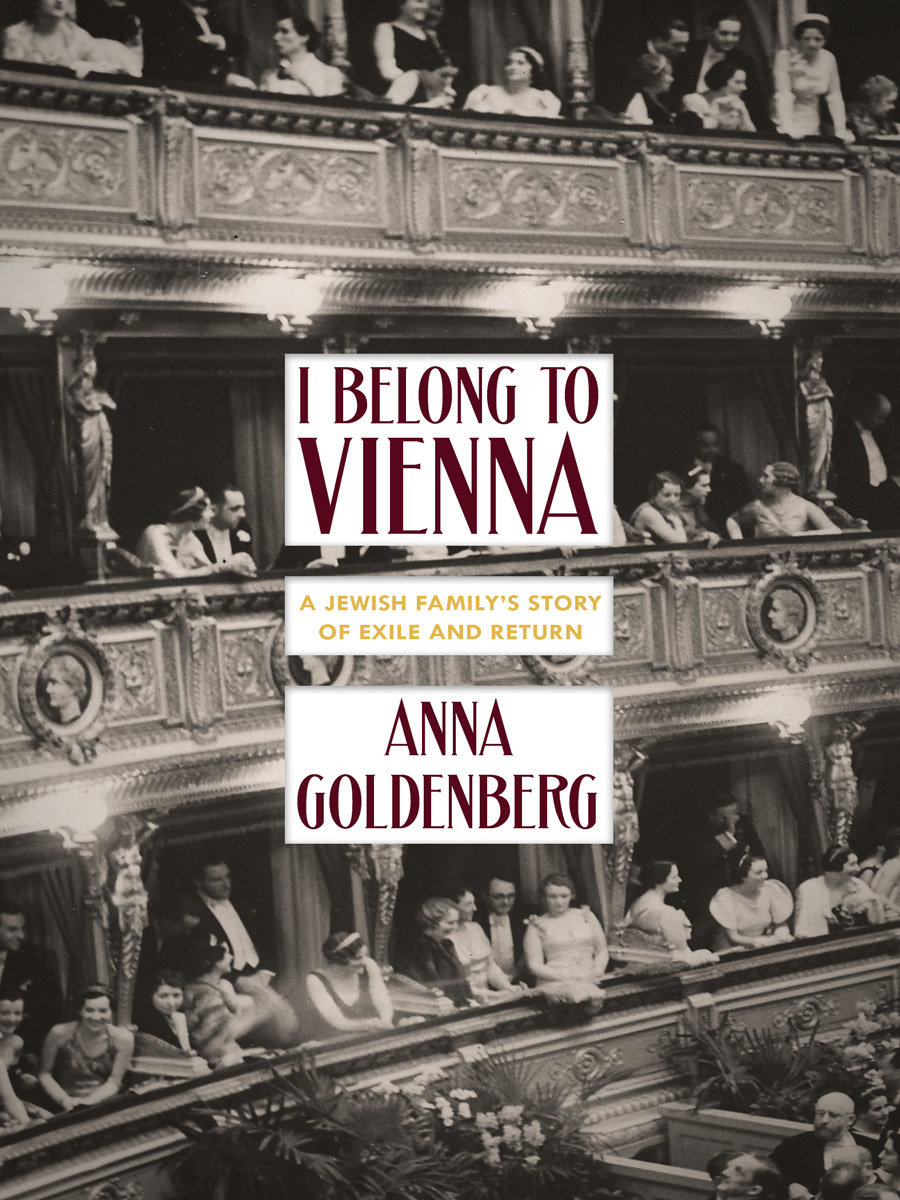
I Belong to Vienna: A Jewish Family’s Story of Exhile and Return by Anna Goldenberg - Translated from the German by Alta L. Price 2020


I Belong to Vienna:  A Jewish Family’s Story of Exhile and Return 

by Anna Goldenberg - Translated from the German by Alta L. Price 2020


First published in German in 2018 as Versteckte Jahre: Der Mann, der meinen Großvater rettete


There are quite a number of journey of discovery  memoirs by children and grandchildren of victims of the Holocaust.  I Belong to Vienna:  A Jewish Family’s Story of Exhile and Return by Anna Goldenberg is a very moving informative well narrated such work.


In Autumn of 1942 the author’s grandparents and one of her grandfathers were transported from Nazi controlled Vienna to the Theresienstadt Concentration Camp.  Their oldest grandchild Hans survives the war by hiding in an apartment in Vienna.  He does make it out to the municipal opera and library.  He comes to have a great passion for opera, one of the glories of the deep culture of Vienna even though he can buy only standing room tickets.  I smiled when I read about how he learned to reuse his tickets.  In America both he and his wife became doctors.


Both of her grandparents, but not her great grandparents, survived the war and moved to New York City.  Almost all surviving Austrian Jews wanted out of the country, once thought a safe haven during the Austro-Hungarian Empire, that totally turned on them.  It was not easy for a Jew to get out of Nazi controlled Vienna.  You had to give up almost everything you owned, secure a sponsor in America, and book passage.


The author was born in Vienna but moved to  in New York City in 2012 to study.  She feels driven to return, to trace her family’s time in Nazi Germany.  She tried to deal with the deep chasm of the magnificent past of Vienna and the barbaric city it became.  Goldenberg has given us a valuable addition to Holocaust studies.


From The Forward


“Absorbing … What distinguishes Goldenberg’s book from much of the vast library of Holocaust literature is its distance from the campaign to exterminate European Jewry. It is the story of a young woman’s attempt to make sense of history more than it is a direct evocation of the roundups, cattle cars, and gas chambers …  Will leave Americans fascinated by the cruelty and loyalty born in the city of Sigmund Freud, Gustav Mahler, and Anna Goldenberg.”

— The Forward


Anna Goldenberg is the author of I BELONG TO VIENNA. Born in 1989 in Vienna, she studied psychology at the University of Cambridge and journalism at Columbia University. Goldenberg worked at the Jewish newspaper The Forward in New York before returning to Vienna where she now writes as a journalist for various newspapers.


This work was published by New Vessal Press

newvessalpress.COM - a few minutes on their website Will likely add numerous works to your wish list.


Mel u


Featured Post

Imperial Reckoning: The Untold Story of Britain’s Gulag in Kenya by Caroline Elkins - 2005 - 701 Pages

  Imperial Reckoning:     The Untold Story of Britain’s Gulag in Kenya by Caroline Elkins - 2005 - 701 Pages 2006 Pulitzer Prize Winner From...