Showing posts with label Colson Whitehead. Show all posts

Monday, May 27, 2019

The Nickel Boys by Colson Whitehead - 2019


My Post on The Underground Railroad by Colson Whitehead


Anyone interested in learning more about the depth of racism in Florida society should read Nickel Boys. Set in a reform school in northern Florida,very near the   state capital, Tallahassee, during the 1960s.  At that time Florida was very much a segregated state in which it was taken for granted by those in power that African Americans were inferior to whites.  This was a matter of law not just custom.  

Our central character, Elwood is a straight A student with a scholarship to a black college awaiting him.  He lives with his grandmother.  One day long ago his parents just took off for California leaving him behind.  He hitched a ride with a black man in a New Plymouth.  It turns out the car was stolen and Elwood was sentenced to reform school as an accomplice.  Blacks and white students are in separate housing and don’t much mingle.  The “House masters” run the gamut from a few decent and fair to sexually abusive near sadists not above beating a boy to death.

The school has a system for allowing boys to advance in privileges and get released. Basically it boils down to being obedient and subservient.  The school is run in a very corrupt way, supplies meant for the boys are sold and the boys are rented out to do work on the houses of the richer people in the area.

Boys who act up are beaten with a leather whip in a special building, called The White House. Sometimes boys just disappear.  Elwood’s grandmother comes to see him, many of the families want nothing to do with the inmates.

Elwood tries to gain strength from the words of Martin Luther King, he becomes friends with another boy, one that looks on Elwood as totally naive 

Whitehead takes us way into the future and shows us what happened in later years to the boys.  Some did well, most did not, but all bore mental scars and were damaged by how they were treated at the school.


The Nickel Boys is Florida history, Florida before Disney World, the Latin influx.


I highly recommend this book.  Reading time is under four hours.  I think it would be a great book for Florida High schools.


Below is an extract from The Smithsonian Institute Magazine on The School.

“Many of the human remains found at the Arthur G. Dozier School for Boys, Florida’s first juvenile detention center for boys, were buried over a century ago. But questions about their identities—and what exactly happened at this notorious school—have remained alive throughout the center’s brutal history. Who is buried in the school’s many graves, and how did they die?
Now, thanks to a new reportby archaeologists and forensic anthropologists from the University of South Florida, some answers have finally emerged. NPR’s Laura Wagner writesthat an investigation of the Marianna, Florida institution, which only closed in 2011, has revealed scores of marked and unmarked graves and sets of remains. In the report, researchers discuss work that revealed 55 on-site graves and 51 sets of remains. Using the remains they did find on site, they made seven DNA identifications and 14 other presumptive matches.
The report is the final step in a four-year process of excavation and archaeological exploration at the school. The detention center opened in 1897 and was initially run by governor-appointed commissioners, but the governor and cabinet of Florida later took control. 
Its original mandate within Florida state statutes was to actas “not simply a place of correction, but a reform school, where the young offender of the law, separated from vicious associates, may receive careful physical, intellectual and moral training." The boys were to to be restored as honorable citizens that contribute to society.”

Read more: https://www.smithsonianmag.com/smart-news/archaeologists-finally-know-what-happened-brutal-reform-school-180957911/#hLhmoRTde0Z55Ypk.99


Colson Whitehead is the author of nine books of fiction and nonfiction, including The Underground Railroad, which was a number one New York Times bestseller and won the Pulitzer Prize and the National Book Award. A recipient of MacArthur and Guggenheim Fellowships, he lives in New York City.

Mel u
Oleander Bousweau 

Tuesday, June 12, 2018

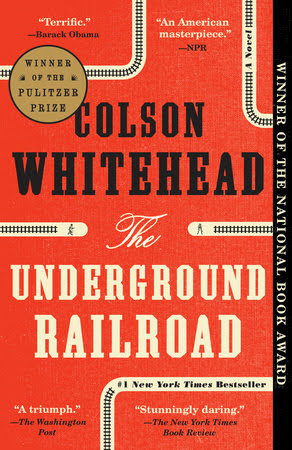
The Underground Railroad by Colson Whitehead- 2016


The Underground Railroad by Colson Whitehead won The 2016 Pulitzer Price, The National Book Award for fiction, and was selected by Oprah Winfrey for her book club. Like another recent wonderful novel by an American, Lincoln in the Bardo by George Saunders, it is set in America’s 19th century.  Slavery is central to The Underground Railroad, among the most poigant figures in Lincoln in The Bardo is a slave woman. (I suggest pairing these two novels with Kindred by Octavia Butler would be great for advanced English classes.)

Historically the Underground Railroad was an organization designed to help enslaved persons to make it to freedom.  Freedom for many meant disappearing into non-slave states in the north or Canada.  To slave owners escaping was theft, and was legally a crime.  Slave owners knew if one slave out of a hundred escaped, the others will get the urge to run.  Captured slaves were subject to terrible punishments, from whipping and branding up to death, often by lyncing. In one very vivid scene a captured slave is soaked in oil and set on fire.  All the other slaves were forced to watch the punishments.  In force at the time was 
“The Fugitive Slave Act” which made helping an escapee a crime.  

One of most despicable characters in the novel is a six foot six free black man, Ridgeway, who leads a band of slave catchers who track down people and return them, for a fee of course.

Slave women were subject to sexual abuse by their owners.  Slave women were expected to produce more slaves.  Central to the plot is Cora, an escaped woman.  She lived on a cotton plantation owned by two brothers.  Whitehead vividly depicts the terrible cruelty of slavery.

In the central conceit of The Underground Railroad, there is an actual railroad for escaping slaves, with trains, engineers, stations and hiding spots.   We meet very cruel people and very kind, of both races.

This is a very exciting book, we follow Cora on her escape and we fear for her.  


Author Bio

Colson Whitehead was born in 1969, and was raised in Manhattan.
After graduating from Harvard College, he started working at the Village Voice, where he wrote reviews of television, books, and music.
His first novel, The Intuitionist, concerned intrigue in the Department of Elevator Inspectors, and was a finalist for the PEN/Hemingway and a winner of the Quality Paperback Book Club's New Voices Award.
John Henry Days followed in 2001, an investigation of the steel-driving man of American folklore. It was a finalist for the National Book Critics Circle Award, the Los Angeles Times Fiction Award, and the Pulitzer Prize. The novel received the Young Lions Fiction Award and the Anisfield-Wolf Book Award
Sag Harbor, published in 2009, is a novel about teenagers hanging out in Sag Harbor, Long Island during the summer of 1985. It was a finalist for the PEN/Faulkner award and the Hurston/Wright Legacy Award.
Zone One (2011), about post-apocalyptic New York City, was a New York Times Bestseller.
The Noble Hustle: Poker, Beef Jerky & Death, a non-fiction account of the 2011 World Series of Poker, appreared in 2014.
The Underground Railroad, a novel, was published in the summer of 2016. It won the Pulitzer Prize, the National Book Award, the Carnegie Medal for Fiction, and was a #1 New York Times Bestseller.
Colson Whitehead's reviews, essays, and fiction have appeared in a number of publications, such as the New York Times, The New Yorker, New York Magazine, Harper's and Granta.
He has received a MacArthur Fellowship, A Guggenheim Fellowship, a Whiting Writers Award, the Dos Passos Prize, and a fellowship at the Cullman Center for Scholars and Writers.

He has taught at the University of Houston, Columbia University, Brooklyn College, Hunter College, New York University, Princeton University, Wesleyan University, and been a Writer-in-Residence at Vassar College, the University of Richmond, and the University of Wyoming.
The Colossus of New York is a book of essays about the city. It was published in 2003 and was a New York Times Notable Book of the Year.
Apex Hides the Hurt (2006) is a novel about a "nomenclature consultant" who gets an assignment to name a town, and was a recipient of the PEN/Oakland Award.  From colsonwhitehead.com


I highly recommend this book.  

Featured Post

Imperial Reckoning: The Untold Story of Britain’s Gulag in Kenya by Caroline Elkins - 2005 - 701 Pages

  Imperial Reckoning:     The Untold Story of Britain’s Gulag in Kenya by Caroline Elkins - 2005 - 701 Pages 2006 Pulitzer Prize Winner From...