Showing posts with label Edith Wharton. Show all posts

Sunday, July 26, 2020

Madame de Treymes - A Set in Paris Novella by Edith Wharton - 1907


Madame de Treymes - A Set in Paris Novella by Edith Wharton  - 1907


Edith Wharton was or maybe I can say is, The Grande Dame of American Literature. She published 15 novels, several novellas and eighty five Short Stories as well as travel books.

Born - January 24, 1862 - New York City - her father was very wealthy, descended from early Dutch elite families who received Land grants from The Crown. 

From 1866 to 1872 her family traveled in Europe, visiting Spain, Wharton became  in French, German and Italian.

Upon return to New York, she received no formal education, she begins to read in her father’s extensive library.

In 1881, The Family moves to Europe, her father soon dies.

1883 - Wharton’s mother moves to Paris and stays there until her death in 1901

April 29, 1885 Wharton Marries Edward Robbins, a wealthy man 12 years her senior who shared her love of Europe.  They divorced in 1913 after twenty eight years.  

Between 1886 and  1897, from February to June, she and her husband travel in Europe

1905 - Published The House of Mirth

1911 - Moves Permantly to Paris.  She becomes heavily involved in war work of various sorts.  Unlike most American expats, she never flees France.  She traveled to the front lines and sent reports back to Scribner’s Magazine.  April 18, 1916, the President of France appointed her Chevalier of the  Legion of Honour, the country’s highest award, for her war efforts


After the war, she bought an 18th century house ten miles outside of Paris.  For the rest of her life she would split her time between there and the French Rivera.


1920 - The Age of Innocence is published,
she will receive a Pulitzer Prize in 1921, the first woman to be so honored 

August 11, 1937 dies on her estate at Saint-Brice-sous-.


Like a number of the works of her friend Henry James, Madame de Treymas deals with the relationships of Americans living in Europe to the French. In this work the focus is on the relationship of an American woman, Fanny de Malrive to her French Marquis husband.  Her husband has committed adultery, she wants a divorce but under French law the husband will be allowed to keep the son to pass along the title. She has fallen in love with an American John Durham.  She wants to marry him and return to America, but does not want to lose her son.

Durham meets the sister of the Marquis, Madame Threymas.  She is secretive, very intelligent and herself involved in an illicit relationship.  She suggests to Durham that if he pays her lover’s gambling debts, she can arrange a divorce in which the Marquis gives up the child.  Durham is offended by this and refuses.

In the end Durham goes back to America alone.  The American characters seem more honorable than the French, the French more worldly.

This work is available free as an E book.


Friday, June 10, 2016

The Custom of the Country by Edith Wharton (1913, 302 pages)


Born 1867 in New York City, died 1937 in France

Author of The Age of Innocence, The House of Mirth among many other works


The Custom of the Country is the third novel by Edith Wharton I have so far read.  My favorite by far is The Age of Innocence followed by The House of Mirth.  

Udine Spragg, along with her family, the central figure in The Custom of the Country has just moved to New York City.  Her father made money in slightly shady Midwestern business deals.  Udine wants to marry into old New York money.  Her life takes many twists and turns.  She marries and remarries more than once.  There is a good plot summery on Wikipedia so I will just talk about my favorite aspects of the novel.

I really liked the descriptions of life among the rich in early 20th century Paris, of the ins and out of Parisian society.   I thought the treatment of Udine's relationship to her father somehow mirrored in her relative indifference to her own son.  I enjoyed the contrast of New York and Paris society.  Udine later in life married into a family of French aristocrats whose money is tied up in land and art.  Udine has a hard time adjusting to their ways and needs a life of constant excitement.  

I am glad I read this book.  I would say to those new to Wharton, her best known novels are first rate.  She has a legitimate claim to being the best female American novelist.

Mel u

Tuesday, February 24, 2015

The House of Mirth by Edith Wharton. (1905)


Edith Wharton is one of my favorite writers.  Her Age of Innocence was one of my first blogging subjects in September of 2009.  I later read and posted on her novella, Ethan Frome and a few of her short stories. (There is background information on her in my prior posts.)

I really enjoyed reading The House of Mirth inspite of it being a very sad and depressing book.  The star of the book is Lilly Bart, a beautiful young woman whose parents recently died.  She is left with a small income but lives largely from the  largess of a very wealthy aunt.  Much of the plot action centers on her matrimonial prospects and her various suiters.  She cannot maintain her high society status without  a wealthy husband but she cannot really find a man she wants to marry among her circle. 

There are great observations of the role of money in New York City society, at the opening of the 20th century.   The character of Lilly Bart is very finely articulated.  Maybe I did not read the novel carefully enough but I found the male characters less well done.  The prose is throughout exquiste.  

I guess I would suggest first read Age of Innocence then The House of Mirth.

What Wharton book should I next read?


Mel u

Thursday, February 14, 2013

"A Venetian Night's Entertainment" by Edith Wharton

"A Venetian Night's Entertainment" by Edith Wharton  (1912, 19 pages)


Last year I participated in the Venice in February Event 2012 hosted by  Snow Feathers and Dolce Bellezza through reading Henry James"s great short story set in Venice, "The Pupil".  I was glad to see they are once again hosting Venice in February for  2013.  Other works I have read set in Venice included two classics, Death in Venice by Thomas Mann and The Aspern Papers by Henry James.     These are both wonderful works and neither is  long.   Both are actually good picks for starter works by their authors.  If you need reading ideas you will find them on the blogs of the hosts for Venice in February 2013.

Edith Wharton (New York City, 1862 to 1937-there is background information in my prior posts on her work, I loved The Age of Innocence) is considered one of America's greatest writers.  I knew I wanted to participate again in Venice in February but I was not sure what to read.   I did a Google search on "short stories set in Venice" and was very happy to find a story by Edith Wharton set in Venice.

The plot is set in Venice in 1760.  A young American from Salem, Massachusetts  is getting ready to land there.  Up until WWII the English and Amricans looked upon Italy as an exotic land of strange delights, of course one of these delights was the beautiful women.  One of the reasons for the grand tour was to allow men to do things they might not be able or feel comfortable doing at home.   Our young traveler, Tony, is very excited as the ship pulls into Venice:

  It was a rare February day of the year 1760, and a young Tony, newly of age, and bound on the grand tour aboard the crack merchantman of old Bracknell's fleet, felt his heart leap up as the distant city trembled into shape. Venice! The name, since childhood, had been a magician's wand to him.

To Tony it as almost as if he is on another planet.  He comes from a totally homogenized society and he is amazed by what he finds in Venice.

For here, by their garb, were people of every nation on earth, Chinamen, Turks, Spaniards, and many more, mixed with a parti-coloured throng of gentry, lacqueys, chapmen, hucksters, and tall personages in parsons' gowns who stalked through the crowd with an air of mastery, a string of parasites at their heels. And all these people seemed to be diverting themselves hugely, chaffering with the hucksters, watching the antics of trained dogs and monkeys, distributing doles to maimed beggars or having their pockets picked by slippery-looking fellows in black -- the whole with such an air of ease and good-humour that one felt the cut-purses to be as much a part of the show as the tumbling acrobats and animals. 

Of course no trip to Venice would be complete without an adventure involving a beautiful woman of Nobel blood and Wharton does great job of drawing us into this.   He sees a beautiful young woman out for a stroll on the arm of an older man, one who looks "experienced" in the ways of the world.  There is a lot of interesting plot action and I do not want to spoil it but the woman, who speaks excellent language that she supposedly learned at the royal court in England where she lived for a while gives the man a letter which she says is to help  get out of terrible trouble and asks the man to please give it to the English Ambassador.   Soon he is confronted by the man who he saw with the young woman.  He is, of course, a count or some such, and is her father.   The trap is set:


 The Count met Tony's eye with a smile. "One of our Venetian beauties," said he; "the lovely Polixena Cador. She is thought to have the finest eyes in Venice."
     "She spoke English," stammered Tony.
     "Oh -- ah -- precisely: she learned the language at the Court of Saint James's, where her father, the Senator, was formerly accredited as Ambassador. She played as an infant with the royal princes of England."
     "And that was her father?"
     "Assuredly: young ladies of Donna Polixena's rank do not go abroad save with their parents or a duenna."


  She was betrothed to a very wealthy man so the two family fortunes could be united.   Sadly the man saw the woman give Tony the letter and now he has repudiated his relationship to her. He is one of the most powerful men in Venice.    Then Tony is seized by a gang of toughs and taken to the home of the woman and her guardian.   She tells him his life is now in great danger as he has dishonored two families.  He tells her you know we are innocent please tell them.  She says you do not understand our ways and I fear you may be killed.   When he tries to protest his innocence he is totally rebuffed:


 The Senator, at this, would have burst forth again; but the Count, stepping between, answered quickly: "His grievance against you is that you have been detected in secret correspondence with his daughter, the most noble Polixena Cador, the betrothed bride of this gentleman, the most illustrious Marquess Zanipolo --" and he waved a deferential hand at the frowning hidalgo of the cape and ruff.
     "Sir," said Tony, "if that is the extent of my offence, it lies with the young lady to set me free, since by her own avowal --" but here he stopped short, for, to his surprise, Polixena shot a terrified glance at him.
     "Sir," interposed the Count, "we are not accustomed in Venice to take shelter behind a lady's reputation."


  Then, if you think all is not what it seems, you are onto something.   I do not want to tell more of this plot of this very atmospheric and suspenseful story.

You can read "A Venetian Night's Entertainment" by Edith Wharton here

To me Venice In February is a great event and I think Ally and Dolce for hosting it.


Mel u

Tuesday, August 31, 2010

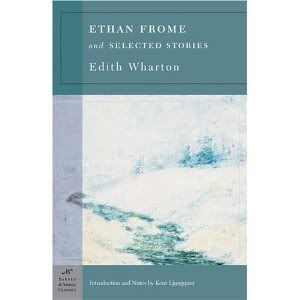
"Ethan Frome" by Edith Wharton

Ethan Frome by Edith Wharton (1911, 100 pages)

A little more than a year ago I read and posted on Edith Wharton's (1862 to 1937-New York City) Age of Innocence.    I was completely charmed  by this wonderful book.     I have had Ethan Frome on my  TBR list ever since I bought it about a year ago at an 80% off sale at Power Books in Trinoma Mall here in Manila.   The edition I have is by Barnes and Nobles and includes an introduction (read it after you read the story, if you read it at all), a chronology of the life and literary times of Wharton and four of her best short stories.    I am currently reading slowly through Ford Madox Ford's The March of Literature.   I checked for a reference to Edith Wharton in the book and found that Ford says Ethan Frome is the first work in which Wharton begins to step out of the shadow of "The Master" (Ford's expression for Henry James).   

There have been a lot of blog posts recently on this work.    Almost everyone likes it a lot.   I think also a lot of of people like the idea of a 100 page classic!    I will just write very briefly on this book.    I liked it.    I enjoyed seeing Wharton move outside her comfort zone,  the affluent society people that Age of Innocence is about to write about the working class people of New England.    She pulls it off well without a hint of condescension at all.    I found the story exciting and it kept my interest.    The characters were very well developed.    If asked I would say first read her master work, Age of Innocence, then House of Mirth.    Then if you like the first two works read Ethan Frome

Mel u

Monday, August 17, 2009

"Age of Innocence" by Edith Wharton-Reading as Deliberate High Culture Sunday Salon


My first reaction to a book as wonderfully written as The Age of Innocence is simply to let the words flow over me, to bask in the beauty of the language and to allow my sensibility to be controlled by beauty of the work. Some of the sentences in the book are so well crafted I reread them several times just for the sheer pleasure of doing so.

I think here the form of these sentences is part of the meaning. Age of Innocence tells us a lot about how one can live within the beauty of the written word, with no concern for its meaning. The lead male persona in the book,
Newland Archer, has a deep relationship with the books he reads and does retreat into them.

There are several themes one can mine in this book (and mind). It tells us a lot about the relationship of men and women, America to Europe, old culture to new, parents to children, passion to practicality. In accord with the theme of my blog, I will post a bit about what it tells us about the reading life of the characters of the book, how they use books to create culture, to see refuge, to create bonds and exclude others.

In the High Society of New York State late 19th century it was important to read the right books

"In an unclouded harmony of tastes and interests they cultivated ferns in Wardian cases, made macarame lace and wool embroidery on linen, collected American revolutionary glazed ware...they liked novels about people in society, whose motives and habits were more comprehensible, spoke severely of Dickens, who had never drawn a gentleman"

This displays the use of reading to reaffirm our beliefs, to read the books proper to our station in life.

Books can also be used as part of a mentoring relationship.

"the shy interest in books she was beginning to develop under his guidance".

Books are also physical property. One of the great pleasures of the Reading Centered Life for many of us is to get new books. Every week there are dozens or more blog posts about new books one has gotten in the mail.
Imagine how this feeling was magnified when the books had to cross the ocean on long voyages.

"That evening he unpacked his books from London. The box was full of things he had been waiting for impatiently.
a new volume of Herbert Spencer, another collection of Guy de Mauspassant's incomparable tales, and a novel called
Middlemarch ...he had declined three dinner invitations in favor of this feast: he turned the pages with the
sensuous joy of the book lover".

Every one seriously into The Reading Life can relate to how social obligations become a burden that gets in the way of our real life, our reading time.

"he built up within himself a kind of sancturary...little by little it became the scene of his real life, of his only rational activities, thither he brought the books he read, the ideas and feelings which nourished him...Outside of it he moved with a growing sense of unreality and insufficiency".

Newland Archer's books becomes more real to him them than what the world thinks is his life. Who among us that has done time in the corporate world or academia has not ended a long meeting lost in thought among the books we love, with no idea at the end what the meeting was about. (But we have learned to fake it.)

There is a lot more about the reading life, about how history books create what we think is history out of the mass of events that take place, and much more in Age of Innocence. To me personally, the deepest meaning is in the beauty of the words. Listen for a moment to this sentence and think about why Edith Wharton used the word
retailing" rather than retelling like very one else would:

"The queer cosmopolitian women, deep in complicated love-affairs which they appeared to feel the need of retailing to every one they meet, and the magnificent young officers and elderly dyed wits who were the objects of their confidences..."

Life recasts it self as a story, not as a newspaper article. The Europe created in the mind of Newland Archer (a first name worthy of Pynchon) is also a literary construct out of the books he cherishes.

I am embarked on two long term reading projects-the novels of Henry James and those of Edith Wharton. It will take me several years to complete this project. I hope in time, maybe after my one year blog anniversary in July 2010 to host a James/Wharton challenge. (I guess that would attract a rowdy crowd!!)


Reblog this post [with Zemanta]

Featured Post

Imperial Reckoning: The Untold Story of Britain’s Gulag in Kenya by Caroline Elkins - 2005 - 701 Pages

  Imperial Reckoning:     The Untold Story of Britain’s Gulag in Kenya by Caroline Elkins - 2005 - 701 Pages 2006 Pulitzer Prize Winner From...