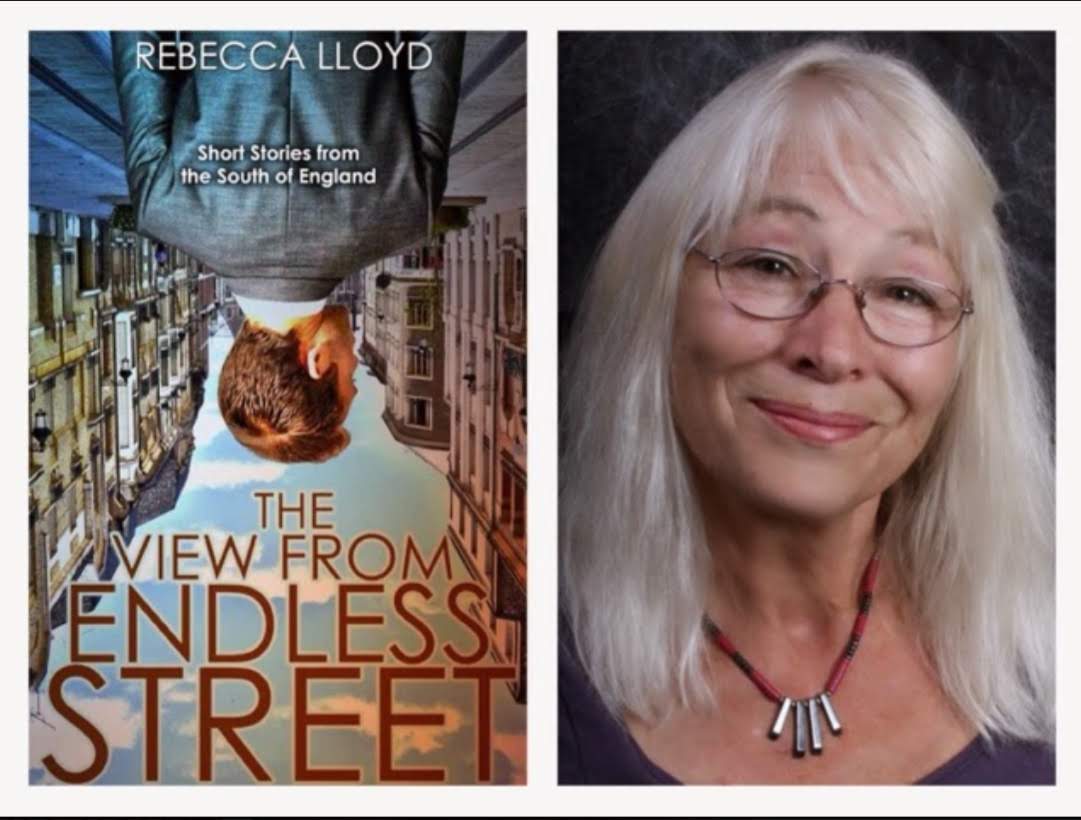
Not long ago I had the great pleasure and honor of reading and posting on a wonderful collection of short stories by Rebecca Lloyd, The View from Endless Street - Short Stories from the South of England. Here were my concluding remarks on the collection
1. Why did you set your stories in the south of England?
Although the stories in The View from Endless Street were all written either while I was living in London, or when I’d moved to Bristol, it was WiDo, the American publishers of the book who wanted to locate it geographically for the interest of their American readers. At first it was to be the South West of England I think, but as the majority of the stories were ‘London based’ I suggested being slightly vaguer and referring just to the south of the country.
2. as a holder of a Masters Degree in tropical diseases with much field experience, do you think Ebola is a very real threat world wide or is hysteria generating? How much of this do you attribute to racism?
. A disease with such high levels of contagion and ability to kill so fast is inevitably going to cause hysteria. However, I don’t think it’s going to spread world-wide unless the virus mutates into one that is airborne. [Although, droplets of saliva are expelled outwards when a person coughs, and that is a bodily fluid.]
The world’s richest biodiversity occurs in the tropics, so that countries such as Africa have a much greater number of different species than do colder northern countries. As parasites, viruses and other causes of human disease are part of this natural biodiversity, it stands to reason that there would be a greater number of different human diseases in the tropics, and the tropics include those countries sometimes called ‘third world.’ Back in the colonial days white ‘overseers’ who had imposed themselves onto different African communities – people such as missionaries and government officials – would often remark that ‘the African was a lazy fellow.’ What they could have been witnessing were people struggling with the effects of Schistosomiasis [Bilharzia] in which one female worm lays up to 300 eggs a day in the human body and eventually these can become lodged in the body tissues and block up the intestines. Then you are sick. Then you can’t work. Then, to the white man, you are a ‘lazy African.’ Round about 80 million people suffer from this disease today. So, what I’m leading up to is that you can look at the world’s diseases through a political lens. What I understood about Malaria was that it was the deaths of thousands of soldiers who contracted Malaria during the first world war that brought about serious work and funding to combat the disease.
However, as far as Ebola is concerned, while I think WHO might well have responded quicker when Medecins Sans Frontieres told them about the Ebola situation earlier on in the year, it wasn’t through any disinterest in the African origins of the disease so much as plain old incompetence… maybe one person or a group of people in that vast organisation who didn’t put things into action when they could’ve done. But who really knows?
3. Tell us a bit about your work in tropical medicine ? As a victim support worker? How did this impact your literary work?
. When I worked as a parasitologist what I was looking at and dealing with was the effects on human life of poverty, disease and superstition – the three most powerful obstacles to a good a fulfilled human life. My first degree was in Ecology and Anthropology, so you can see how those interests related to my later work in tropical diseases. When I came back from Africa and lived in East London I was already deeply engaged in fiction writing, and so I joined Victim Support as a volunteer so that I could keep on trying to understand human nature and all its diverse manifestations, both hideous and wonderful. [At the same time, I helped some people.] Now I work with asylum seekers and refugees, and so I continue to gain insights into human nature – all the funny, happy, beautiful things, as well as the tragic heart-breaking stuff. I consider it to be a huge privilege. All of this informs my writing, but in a kind of osmotic way; I just soak everything up and when I write, I’m not particularly conscious of how my brain works, or my emotions work to produce my stories. I feel every one of them, however.
4. What attracts you to moths? Why do you prefer them to butterflies?
. I love the names of moths as well as the moths themselves. The last story in The View from Endless Street is called ‘The Splendid Plan’ and it’s about a man who loved moths, but who was also in a deeply dysfunctional marriage in which he and his wife only communicate through post-it notes left around in their house. It’s a pretty strange story, but it was actually triggered by a tiny article I saw in a newspaper about this pair. I gave him moths as a hobby, because he needed one. The moths I love most are the hawk moths, breathtakingly powerful and wondrous creatures. It’s worth just taking a look at some of the popular names the Victorians gave to moths, because it can tell you a lot about the way they lived then and some of their preoccupations. Both I and Norman in ‘The Splendid Plan’ agree about that. I prefer moths to butterflies because they come in the night like a gift.
5. Tell us a bit about your writing routine please.
. My writing routine is pretty straightforward. I try to write every morning. I work in a room that’s just for my writing. It’s not very orderly, but it functions okay. I don’t play music while I work because I need all my brain to work with, and I need to listen to my own thoughts, or my own words spoken out aloud, and so music would be a distraction. It seems crazy to me to listen to music while you’re trying to write because I don’t see how you can pay proper attention to either. Although I don’t think I need solitude to write in. I could write notes or plans for stories in a noisy café if I had to, and block the noise out.
6. What advice would you give your eighteen year old self?
. This is a wonderful question, Mel. What would I say to my eighteen year old self? I’d have hugged her and told her not to despair, that she’d be free soon, that she was wasn’t going to be dominated all her life by other people, that whatever happened, no one owned her, or ever would.
7. " in the name of a humanism hypocritically turned champion of the reader’s rights. Classic criticism has never paid any attention to the reader; for it, the writer is the only person in literature. We are now beginning to let ourselves be fooled no longer by the arrogant antiphrastical recriminations of good society in favour of the very thing it sets aside, ignores, smothers, or destroys; we know that to give writing its future, it is necessary to overthrow the myth: the birth of the reader must be at the cost of the death of the Author."
What is your reaction to these very famous lines from "The Death of the Author" by Roland Barthes?
. Well, at one level, I think Roland should’ve gone out and done a bit of community work and tried to find a slightly healthier life! But being more serious, I have no expertise in classic criticism. It is possibly something that drifts into the lives of those writers who have taken Creative Writing degrees, or Eng. Lit. degrees maybe, so it’s a bit out of my range, as my academic work was in science. I don’t quite get what Barthes has written there. Isn’t the internet wonderful though? I was able to do a quick piece of research on ‘The death of the Author’, and found the following as Barthes main point in that discourse:- Barthes makes the point that the origin of a work may lie with the author, but its destination is with the reader. “…
I think this is true, but isn’t it also extremely obvious? Whatever the reader gets out of reading the stories in The View from Endless Street or Mercy is to some extent of their own making, and they, as much as I, must bring their imagination into play. So the business of story making involves both the speaker and the listener, or the writer and the reader.
8. D. UNCHARTED LIVES is a fascinating study by gay psychotherapist Stanley Siegel and straight Newsday columnist Ed Lowe Jr. The text is a mass analysis of how gay men develop through the eight male life passages from 'pre-emergence' to 'mentorin'’. The book is the result of numerous interviews and research. This data is balanced with Siegel's own dramatic mid-life coming out story.
When asked why such a seemingly disproportionate number of creative men are gay this was Siegel's response-
"I think that because gay men live in a society that is hostile to them, because they are oppressed, have few role models, and in most cases have no legal rights or institutions that support and honor us we became extraordinarily inventive in the ways we live our lives. The process of become gay, of accepting one's sexuality, is a process of living an extremely original life. The apparatus of a creative life begins early, when we feel we are different in some way but have no language to explain the difference. Young gay boys feel that almost always and consequently they often isolate themselves or are isolated by the outside world. Isolation presents a creative world. Sometimes in fantasy we deal with separation by becoming highly productive - drawing, writing, creating. Usually this stays with the person the rest of their life and is only enhanced by the challenges they meet later on."
My question is do you think he is onto something? Is the creativity of Gay men derivative from growing up without role models, from having to create a sense of self?
. I think he’s onto something here:- ‘The apparatus of a creative life begins early, when we feel we are different in some way but have no language to explain the difference.’ However, that experience is common to many different kinds of creative people, and their sexuality has nothing to do with it for the most part. Creative gay men are undoubtedly part of the ‘interstitial world’ that a lot of writers inhabit, but maybe Ed Lowe just ignored those gay men who weren’t creative, [along with the gay women he didn’t include at all]. But a strong sense of self is something I can relate to. If you do sense that you’re ‘unlike’ the people you should be like, I think your ‘group identity’ cannot thrive, and in my opinion, that’s a good thing, but your personal identity becomes strong, and that is an excellent thing.
9. "It is the habit of approaching works of art in order to interpret them that sustains the fancy that there really is such a thing as the content of a work of art" - from "Against Interpetation" by Susan Sontag
As a writer, how do you feel when people Interpet your work, attribute meaning to it?, see things in it you never thought about?
Who is your ideal reader?
. I’m always very happy for readers to interpret my work and see whatever they wish to in it as long as they are aware that it is their own interpretation. Recently someone who’d read ‘The River’ [the story in The View from Endless Street that won the Bristol Prize], said that the elderly man in it was obviously based on my grandfather. No, I said, it was not. It was based on YOUR grandfather. In other words it was any grandfather of any reader. My own real grandfather was nothing like the character I created in that story. That certainly is annoying, when people try to tell you what is in your own mind, rather than what is in theirs.
One of my ideal readers is someone who reads my books and is happy to write Amazon reviews about them. Another ideal reader is someone who has been so moved by something I wrote that they cried, or they laughed. And you’d be an ideal reader too, Mel, because you wrote movingly about my work.
10. It seems more and more writers have MAs in creative writing, some PhDs. Education is a great thing but is there a negative side to this, will it produce in few years a literary culture where lacking this degree will make it hard to get published?. Is it homogenizing writing styles? Will the day of the amateur writer who comes from nowhere and changes everything be over because of this? Does it give you pause to know the University of Iowa M A in writing scholarships for students from outside the USA, were for years funded by the C. I. A?
. I doubt that not having a creative writing degree will make it hard to be published in the future. My simile for that would be the difference between a window with no curtains and the same window with a set of … well look at the curtains in ‘The Egyptian Boat,’ the fourth story in The View from Endless Street. You see, whether you have or haven’t got a degree, you still have to develop the self-discipline to do the writing work and keep on doing it year after year in the first place, and to have the unshakable belief in the worth of your work – and many of us must do this writing work with no outside support, and sometimes even hostility from friends and family. That is the real life of the writer after they leave college, if they did go there in the first place.
But there is another element that plays into all of this that the publishing world and the literary world don’t talk about, and that is the degree to which plain luck is involved in whether you do or you don’t become a known writer who can live off the proceeds of their thoughts and words. Think of it like this:- at the same time as Rowlings was handing in her manuscripts to publishers, a thousand other Rowlings were doing the same thing, but she, bless her, hit lucky and the others, just as talented, did not. And they gave up. That might sound bleak but I think any new writers should regard the luck element as something that is on their side, as Violet in the fourth story, ‘Raptor’ does in The View from Endless Street.
Regarding the next part of your question, Mel, about writing styles becoming homogenized, I certainly have read some work from young writers that looked false and self-conscious and obviously a result of being in school. But if you go into ‘writing school’ unsure of your own inner identity and passions about the world, you may well ‘follow’ what your writing supervisor tells you, and again it’s down to luck whether you have a bad tutor or a good tutor who is honest and who guides you properly. But in the end, you’ve still got to do the writing work when you leave college as I said earlier, and frankly, you’re unlikely to succeed unless you can stand out from other writers, so you haven’t to be homogenized milk, you have to be warm milk falling in the pail under the cow.
So, I think in the end, that writers who come from nowhere and haven’t been to writing school will always be amongst us, and that’s a very good thing indeed.
You ask me does it gives me pause to know the University of Iowa MA in writing scholarships for students outside the USA was for years funded by the C.I.A. I find that a curious idea, but it doesn’t particularly frighten me. If I, in my hospital in Gonja in the mountains of Tanzania, had run out of HIV test kits and Playboy magazine offered to fund them for me, I’d take them. Fair enough, you’re talking about a situation of privilege and I’m talking about one of desperation. But I’d say that if the C.I.A. gave Iowa money with no strings attached, then good.
11. How important is your exposure to multiple cultures to your writing?
. Trying to understand different human cultures is very important to me, and was before I began writing, but how much it stimulates my creativity I wouldn’t know; I have no idea how my creativity actually works.
12. Where can we find you online?
. I am online at my website www.beccalloyd.org and at my professional writer’s page
https://www.facebook.com/pages/Rebecca-Lloyd-Writer/174742352684101?ref=hl
and on Twitter at https://twitter.com/rbeccalloyd .
13. Besides writing, what are some of your hobbies and interests?
. I do gardening sometimes and I’m good at painting rooms. I knit things, I walk, I swim, I cycle. Sometimes I cook, but for me cooking is a functional activity rather than an art form with food.
14. Can you please tell us something about your works in process?
. Well, I do have I works in progress, but since they are in progress, I’d be talking about unfinished things and that could be frustrating for me as teller and you as listener. But I can tell you about recent publications. At the same time as my short story collection The View from Endless Street was published by WiDo, I had another set of short stories published by Tartarus Press, and that collection is called Mercy. The story that the title of the book came from is about a man who loved a woman not only to distraction, but also to the extremes of creativity in that he became an expert at the art of what he thought was preservation, but was in fact, mummification. But of course, I’d like readers to buy this beautifully bound hardback book, rather than me talk about it however.
15. How did you begin writing?
. I began writing in Africa. Because people in my community trusted me, and told me a lot of fascinating things about life up there in the forest where I worked, I started writing my thoughts down, and then stories began to develop. There was only intermittent electricity up there, and we didn’t have telephones, or radios, or TV, or electric light, or anything like that. I just had paper and a pencil and I often wrote by candlelight.
16. How does the change of the seasons impact your creatively?
I don’t really know, the long winter can help to get me into a low mood, and I do feel triumphant if I get through the winter having been productive, but I couldn’t say for sure if there is any impact. Since I write dark materials, winter should be really quite inspiring.
17. What authors would you recommend to new writers? Who are some of your favorite writers?
. I think that we all have very different tastes and leanings, so I’d be disinclined to recommend books for other people to read unless I felt I knew them really well, and could guess what would interest them pretty accurately. The authors I personally regard as ‘classic’ and who I really like are Robert Aickman, Jane Bowles, and Walter De La Mare at the moment, and Tim Winton and Kevin Barry, [who I just discovered recently] are a couple of the contemporary writers I read.
18. Frank O'Connor in The Lonely Voice: A Study of the Short Story said short stories seem to be about marginalized people, the lonely, those with with little voice in society. Do you think he is on to something illuminating about the format? Why is there so much loneliness in the short story?
Marginalised people don’t have to be lonely, it’s more that they are singular and unique and therefore interesting. But of course there are lonely characters amongst them, and thinking about my two short story collections Mercy and The View from Endless Street, the character in the story ‘The Careless Hour’ definitely is lonely as he’s a Peeping Tom and they are lonely, aren’t they? But amongst the other 15 stories in Mercy, maybe only Marcia in ‘Lucky Cat’ is lonely, although come to think of it, all the characters in ‘Momentum’ are lonely! There are 20 stories in The View from Endless Street, and of the characters in those stories, I’d say about five are lonely. If Frank O’Connor is onto something here, my view would be that literary short stories often feature the lonely is because literary work is concerned with universal human conditions and dilemmas, and loneliness is one of the most dominating and yet at the same time most taboo of human conditions, and therefore the one most hidden away in societies. After death itself, loneliness is the most feared of human conditions, so there is much to write about and explore, isn’t there?
19. I sometimes wonder why such a disproportionate amount of the regarded as great literature of the world is written in the colder temperate zones rather than in the tropics. How big a factor do you think the Irish Weather is in shaping the literary output of its writers.? I cannot imagine The Brothers Karamazov being written on tropical island, for example.
This is a really interesting question, Mel … how geographical happenstance affects literary output. First of all, to be able to spend time writing is a great privilege, but one that is more easily carried out in relatively stable societies in which education is central. Many people living in the tropics are poor, there are a lot of diseases to deal with, and quite a few tropical countries are unstable with poor governments and weak educational standards, and crappy infrastructure, sanitation, housing and water. So while there might be other creative expressions that are very highly valued, the written word wouldn’t easily be one of them. As far as Ireland is concerned, I understand that it cherishes its writers in a way that we don’t in England, and that the Irish have a proper regard for the short story, again in a way that we don’t in England. I shouldn’t think rain and heavy skies has much to do with it though.
20. Many cultures are permeated with references to seemingly supernatural creatures, some kind some manavolent. Do you feel any sense of these entities in the world you look out on in your daily life or in your writings? Do you sense a continuity between the natural and supernatural worlds. Is a belief in the supernatural just escapism and wishful thinking? Is the believe in occult systems the refuge of the powerless?
I like the idea of supernatural creatures, but for me any creature is astonishing so I’m happy with the ones we’ve actually got. I’m interested in English folklore as well and in my writing I always mix up the fantastical with the mundane and realistic. I know that for other people in other cultures there is continuity between the natural and supernatural worlds; I had to work alongside very powerful witchcraft beliefs when I was in Africa and had some pretty interesting moments with some of our witches. But witchcraft belief itself is not escapism, but a traditional system of keeping societies under control. You ask is the belief in occult systems the refuge of the powerless. Well you could see it like that, but our five very intelligent male witches were both feared and relied upon by the rest of the villagers, so they were very important in our community and did harm and good in equal measure, I think. The fact is that if you are raised in a highly superstitious society and then you move on into a more rational one, you don’t lose your beliefs, but you don’t let too many people know about them either!
21. These are loaded question coming from me, but with the decline of print reviews, are book blogs becoming more important? Professional critics have denigrated book bloggers as reviewers without credentials,book bloggers have replied professional reviewers just don't like bloggers doing for free what they ask money for doing? Reviewers do it for money, bloggers for love. What is your reaction to this? Do you join book tours or send bulk mailings out asking for reviews?
I did organise an online blog tour for my two books this year. It took a great deal of organisation, as you have to be on one blog on a certain date and then move onto the next and so on. I couldn’t see the merit in doing it that way. I think it would’ve been just as good simply to pick out the same book review bloggers and ask if they’d read and review my stories when they had the time. I think online book promotion is important, but it’s also important to know when to shut up about your book, and some people find that hard! But yes, things have changed now and we have to go with the flow, within limits.
22. When you write do you picture an audience or do you just write?
I just write. I think a writer’s job is to picture the characters, not the audience or readers --- I mean how on earth is that possible anyway? They’d end up being just as fictional as the characters who inhabit my stories.
23. Do you ever experience creative "dry spells"? How do you get past them?
I have experienced a time once when nothing, but nothing, was coming out of my head, it was as if someone had stolen my imagination in the night. It shocked me profoundly; I felt that I’d lost my identity as a writer, and therefore, I’d lost most of me. During this time, I read stuff, talked with trusted people, tried to create a life for myself in which writing wasn’t involved, moaned a lot and bored myself to death. Eventually, I got back on track, and I’m so good at forgetting what has gone past, that I never think about that time anymore.
24. If someone says to you, "I prefer to live life, not just read about it " what is your reaction inside? (Besides cringing!)
. Well, that is one of the typical remarks made to writers by non-writers, but I can usually circumvent them by not having conversations about being a writer. If I do say I’m a writer and I sense a question coming, I tell them it’s not necessary for me to talk about it because I have a very visible online presence and so they can find out about me if they want. If I do get trapped by one of those jealous and snide little remarks, I laugh, and I leave.
25. Can you please share with us some recent movies you have seen and novels you have read and enjoyed?
If novels are a bit ordinary, which most of them are, I can usually read up to the last quarter of the book before I lose interest. If they’re longwinded and poorly structured, I’m more likely to stop reading them quickly and use them as props when hanging doors; paperbacks are just the right height to get the hinges lined up properly. If they are extraordinary, I can read to the end, I did read all the way to the end of Paul Bowles’ Sheltering Sky, and Emma Donoghue’s Room. But I can’t remember the last novel I read, let alone the last three. I read biographies and short stories for the most part. I do watch a lot of movies though. Recently I saw an Iranian film called Children of Heaven, directed by Majid Majidi and it was a really beauty.
26 . William Butler Yeats said in "The Literary Movement"-- "“The popular poetry of England celebrates her victories, but the popular poetry of Ireland remembers only defeats and defeated persons.” I see a similarity of this to the heroes of the Philippines. American heroes were all victors, they won wars and achieved independence. The national heroes of the Philippines were almost all ultimately failures, most executed by Spanish or American Rulers.. How has the fact Yeats is alluding too, assuming you agree, shaped Irish literature? In America it seems somehow the best short stories writers like Flannery O'Connor, Eudora Welty, and Carson McCullers, all writers admired by Irish authors, had their sensibilites shaped by the defeat of the south in the American Civil War. Feel free to apply this to your heritage.
I don’t have the knowledge to be able to answer a question about what shaped Irish literature, the only thing I can say is that just because W.B Yeats said something doesn’t make it true, if you read Ann Saddlemyer’s Becoming George, the life of Mrs W.B. Yeats,’ you’ll see more of what I mean. I too admire Flannery O'Connor, Eudora Welty, and Carson McCullers, but then most short story writers who care about the craft do recognise those three writers as significant. Someone might well have decided that their sensibilities were shaped by this that or the other, but how do we know this is actually true?
27. If you could live anywhere in the past for six months and be healthy and rich what would you pick?
Live anywhere in the past for six months? I’d like it to be in 1593, in Warboys in Cambridgeshire, the time that Philip C. Almond writes about in The Witches of Warboys. It would be so utterly fascinating, but you’d have to promise I’d be safe.
28. Amazon - as a reader I like it a lot- but is it a monster slowly taking down small publishers and independent book stores, controlling what books succeed? Is it bad for authors?
I have the same feelings about Amazon, I ordered an e-book tonight and was reading it within minutes and it cost me less than four pounds. But it is undoubtedly shaping what is happening to authors and dictating who gets read, and that is bad for us. I don’t think we can do anything about it though, and self-publishing has now come into the picture too, to make matters worse.
29. Are you open to internet contact with your readers or do you fear stalkers?
I’m open to Facebook or twitter contact with readers and I don’t particularly fear stalkers as they might be useful for writing material.
30. A while ago i read and posted on a long biography of Hart Crane, author of the Bridge-few read it hostile to them, because they are oppressed, have few role models, and in most cases have no legal rights or institutions that support and honor us we became extraordinarily inventive in the ways we live our lives. The process of become gay, of accepting one's sexuality, is a process of living an extremely original life. The apparatus of a creative life begins early, when we feel we are different in some way but have no language to explain the difference. Young gay boys feel that almost always and consequently they often isolate themselves or are isolated by the outside world. Isolation presents a creative world. Sometimes in fantasy we deal with separation by becoming highly productive - drawing, writing, creating. Usually this stays with the person the rest of their life and is only enhanced by the challenges they meet later on."
My question is do you think he is onto something? Is the creativity of Gay men derivative from growing up without role models, from having to create a sense of self?
. I think he’s onto something here:- ‘The apparatus of a creative life begins early, when we feel we are different in some way but have no language to explain the difference.’ However, that experience is common to many different kinds of creative people, and their sexuality has nothing to do with it for the most part. Creative gay men are undoubtedly part of the ‘interstitial world’ that a lot of writers inhabit, but maybe Ed Lowe just ignored those gay men who weren’t creative, [along with the gay women he didn’t include at all]. But a strong sense of self is something I can relate to. If you do sense that you’re ‘unlike’ the people you should be like, I think your ‘group identity’ cannot thrive, and in my opinion, that’s a good thing, but your personal identity becomes strong, and that is an excellent thing.
31. "It is the habit of approaching works of art in order to interpret them that sustains the fancy that there really is such a thing as the content of a work of art" - from "Against Interpetation" by Susan Sontag
As a writer, how do you feel when people Interpet your work, attribute meaning to it?, see things in it you never thought about?
Who is your ideal reader?
. I’m always very happy for readers to interpret my work and see whatever they wish to in it as long as they are aware that it is their own interpretation. Recently someone who’d read ‘The River’ [the story in The View from Endless Street that won the Bristol Prize], said that the elderly man in it was obviously based on my grandfather. No, I said, it was not. It was based on YOUR grandfather. In other words it was any grandfather of any reader. My own real grandfather was nothing like the character I created in that story. That certainly is annoying, when people try to tell you what is in your own mind, rather than what is in theirs.
One of my ideal readers is someone who reads my books and is happy to write Amazon reviews about them. Another ideal reader is someone who has been so moved by something I wrote that they cried, or they laughed. And you’d be an ideal reader too, Mel, because you wrote movingly about my work.
I’ve attended creative writing workshops as the tutor but never as a student. I taught myself to write. Workshops in my experience attract two thirds women and one third men on average. You can sometimes see in the faces of the students the dawning realisation that writing is something that demands serious commitment; a few drop out when that strikes home. But usually they are funny, energetic and interesting events, and I enjoy running them.
32. Do you think literary competitions are just money making rackets?
They can certainly look that way if they are not absolutely scrupulous in their rules and codes of conduct. For example, judges should be unpaid, and changed each year, because if the same people are judging year after year, the competition will become skewed in a particular direction; a particular kind of story will come to be favoured. Also, and even worse, a big literary competition that has thousands of entries and who charges everyone, says, £7.00 entry fee, will be receiving most of the money that keeps the competition afloat from would-be writers who don’t stand a chance against published or professional writers also entering. That is plain wicked. There should be a clear warning to the would-be writers about the fact that they will be in competition with professionals. Or and better still, one of the rules of entry would be that you either have to be someone who is published, [and not self-published, because that’s nothing], or you have to be an unpublished writer. Then at least that way, the playing field is even.
33. Not long ago I was sent several very hostile messages from Irish writers demanding to know why I had posted on the works of other writers and not them. Some suggested I had been influenced by some sort of shadowy group to ignore their work. I was informed there is a small elite group who decides who gets reviewed, published or receives grants and it was also suggested they had sent me negative feedback on writers I should ignore. What is mentally behind this? Is there anything like a Literary Mafia within your area.?
Yes, I’ve encountered this kind of thing in the writing world. It is driven by ambition, ego and insecurity, and however many writing niches or positions of ‘power’ the writer of this type achieves, he or she still has to produce the work, rather than just engaging in self-promotion, and if the work isn’t there, or isn’t good, then everything’s been for nothing anyway. I tend to regard my area as being both a physical and online space, and I’ve noticed what you’re talking about in both dimensions.
34. One of the characters in Savage Detectives by Roberto Bolano, set in Mexico city and centering on poets, says that the main reason poets, nearly all male in Bolano's book, read at work shops is to meet the way disproportional number of women who come to them in search of a tortured soul to nourish. is there truth in this? Why are attendees preponderantly female, or is that not true? Male writers, have you ever used the "troubled artist who feels too much" routine on women? Ladies, does this persona have an appeal to you?
. Mel, I don’t know about the lives and desires of non-writing women, so I can’t really answer this. I certainly couldn’t think of anything more parasitic or draining or harmful than getting hooked up with an egocentric male writer. I mean what would become of my own work that I love and value so much?
35. Tell us a bit about your non-academic non literary work experience please?
I have a first degree in Anthropology and Environmental biology and an MSc in medical parasitology. My early work life was in science; I was, for a longish time, an electron microscope technician working in brain research. When I moved away from science on coming back from Tanzania, I moved into community development work and held a string of different posts in East London. Over here in Bristol, I work with asylum seekers and refugees, and so I continue to be connected with community development along with some truly interesting and highly skilled colleagues that I’m proud to know and with some wonderful asylum seekers and refugees whom I’m honoured to know.
36. Who are some no longer living writers you admire?
Ezra Pound, Robert Aickman and Eudora Welty.
37. Quick pick questions
A. tablets or laptops or smart phones?
B. E readers or traditional books?
C. American Fast Food- love it, hate it, or once and a while?
D. Cats or dogs?
E. best city to inspire a writer- Paris, London, Dublin, or?
F. Walt Whitman or Willam Butler Yeats?
G. Roberto Bolano or Gabriel Cruz Marquez ?
K. Winter or Summer? Day or Night?
I. Would you rather witness opening night for Waiting for Godot, King Lear, Playboy of the Western World or Ubo Roi?
A. laptops. B. Traditional books. C. no feelings about this. D. Cats … can’t tolerate dogs. E. Dar-es-Salaam. F. Yeats. G. Marquez. K. Summer day. I. Can’t tolerate straight theatre, so would run from all.
38. How important is having readers to you?
Yes, readers are very important, and the ones who understand my work are precious to me.
39. From Paris Review Interview with Alberto Moravio in which he was asked to talk about the state of the Italian novel-
"That’s a pretty large question, isn’t it? But I’ll try to answer. I think one could say that Italy has had the novel, way back. When the bourgeois was really bourgeois, in the thirteenth and fourteenth centuries, narrative was fully developed (remember that all that painting was narrative too) but since the Counter-Reformation, Italian society doesn’t like to look at itself in a mirror. The main bulk of narrative literature is, after all, criticism in one form or another. In Italy when they say something is beautiful that’s the last word: Italians prefer beauty to truth. The art of the novel, too, is connected with the growth and development of the European bourgeoisie. Italy hasn’t yet achieved a modern bourgeoisie. Italy is really a very old country; in some ways it looks new because it’s so old. Culturally, now, it follows the rest of Europe: does what the others do, but later. Another thing—in our literary history, there are great writers—titans—but no middle-sized ones. Petrarch wrote in the fourteenth century, then for four centuries everybody imitated him. Boccaccio completely exhausted the possibilities of the Italian short story in the fourteenth century. Our golden centuries were then, our literary language existed then, had crystallized. England and France had their golden centuries much later. Take, for example, Dante. Dante wrote a pure Italian, is still perfectly understandable. But his contemporary Chaucer wrote in a developing tongue: today he must be practically translated for the modern reader. That’s why most modern Italian writers are not very Italian, and must look abroad for their masters: because their tradition is so far back there, is really medieval. In the last ten years, they’ve looked to America for their masters."
My question is designed to draw responses - it seems literary cultures are strongly impacted by continuity. The literary culture of American seems to have much more shallow roots, to assume a less cultured audience. Contrasting Indian literature, which has older roots than any other culture, it seems to really begin about 1920. The continuity of Indian literature was destroyed by the British rule and writers at first had to use English formats. So what is a very old culture, has a shallowly rooted literary tradition less than 100 years old. Something similar happened in Ireland which has a new literary culture on top of cut off old roots? Question is just react to this, is it nuts or onto something about the differences in literary culture.
I usually think in terms of good individual books from whatever country or culture they might come, rather than a ‘literary culture.’ But I don’t think it matters if a culture has a long history of producing the written word or not when it comes to what it might produce today or in the future – it’s not as if ‘writerliness’ from one generation rubs off on the next is it? It’s all happenstance, circumstance and education that create a secure place in which people can write. I should think it would be extremely easy to wipe out literary activities completely in, say, a country run by the Islamic State and at some level that is because writing is a luxury and nothing much more.
39. How important is social media for writers?
Social media is now absolutely unavoidable for writers, and while it might help in the development of a career at some levels, it might just as easily prevent some writers from producing their best work because of the time it demands and because of its triteness. I have a webpage because as a writer in 2014, I am expected to have one. However, while social media, FB and Twitter in particular, might be joyful experiences for extrovert personality types, more reticent introverted and intuitive people instinctively cringe from its brashness and invitation to narcissism. I spend about 35 hours a week online. I think small snippets of writing work posted online for people to read for free would be a good business idea if it resulted in more people buying your work or becoming interested in you, but how do you measure that?
40.. I think there is one sort of big difference between the reader and the writer. As you know, true reading is not passive but involves a creative process.
Readers do read within a tradition, seeing works as part of a great conversation, part of a hopefully ever deeper culture, writers see themselves as starting from ground zero, without a conscious relation to a tradition. Also readers or especially reviewers, I am not a reviewer- I just post stuff- put a limit on a writers work when they talk about it or find meaning in it, thus breaking the writes sense of pure creation. A writer might well truthfully say, "I just write", but you cannot really just read.
Is there a built in divide between writers and readers? Is this is what the resistance to interpretation is at least in part about?
. I wasn’t aware that there was a particular resistance to interpretation amongst writers; I rather think that depends on the individual, though. Earlier in this interview, I said that people are welcome to interpret my writing as they please as long as they are aware that it’s their interpretation and not necessarily what I think about the story. That’s fine because writing is a two way arrangement between writer and reader, and the reader brings his or her own response to the work and creates their own experience from the reading process.
I agree that readers might read consciously within a tradition, but a writer’s concern is getting their work finished, looking good, and out there, and doesn’t spend time contemplating how they fit into any tradition. But, I don’t sense any built in divides between readers and writers specifically, except the one that separates writers from the societies in which they live in general.
41. Is the notion that someone is a writer of "Women's" literature just one step above calling their work chic lit? Statistics show that women read much more fiction then men, why is this so? Is it patronizing to refer to a work as a great work of literature by a woman, a gay, a person of color as no one ever seems to say War and Peace is a great white men's work?
. I personally dislike all that divides writers from each other although I’ve heard reasonable arguments for why someone might want to promote… black and Asian women writers for example. As reasonable as the arguments are however, I am not convinced that such separations do anyone any good. I’m in favour of writers’ groups that include and do not exclude – I mean is a writer’s group really supposed to be like a golf club, or a gentlemen’s club? I also think that we should not be drawing attention to aspects of writers that they have no ability to change. If you are black and you are also a writer, you can change your writing, but not your skin colour, same for gender and desire orientation. Do we have bald men writers? If not, why not? The answer is because it’s irrelevant. Unfortunately, society’s compulsion to segment, categorise, rank and judge everything is a powerful as ever.
42. If you found out a favorite writer of yours had gross racial or religious prejuduces, would it turn you off to them?
I think it couldn’t help but affect me at some level, yet I’ve read many 20th Century writers who plainly did not like Jewish people, yet I have liked their writing. I suspect Robert Aickman might have been hideous to most women, yet I love his work. I think in the end it would depend on the level of bigotry and the importance or beauty of the writing work the bigots produced.
43. . Is the large number of pedagological professionals involved in literary reviewing a limiting thing, with the reviewers stuck at the intellectual, cultural and emotional level of their pupils? Does the need to "teach" literature force interpretations and paraphrasing as the standard modes to view literature? Or worst yet, political interpretations based on biographical data?
I’m not too familiar with the breed of literary reviewers you’ve got in mind here, so I’ve no idea how much influence they have. But if they were really able to influence what people read and what they thought about literature, hasn’t that now been taken out of their hands by Amazon? It seems to me that books come to the top of the pile these days much more by popular demand, otherwise how would 50 Shades of Grey have reached us? On teaching literature, I think it can probably deaden and flatten the individual imagination and aspiration, but not in all cases.
End
I offer my great thanks to Rebecca Lloyd for taking the time and effort to provide such interesting and insightful responses.
I hope to read much more of her work.