Showing posts with label George Eliot. Show all posts

Wednesday, January 17, 2018

Daniel Deronda - The Final Novel of Gerorge Eliot - 1876 - 752 pages


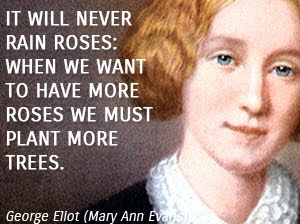
George Eliot

1819 to 1880, England

Since beginning my blog I have read and posted on these four of her seven novels:

Middlemarch-1871

Silas Marner-1861

The Mill on the Floss-1860

And her final novel, Daniel Deronda, 1876.

Middlemarch is seen by many as the greatest novel written by an author from England.  For sure it is among the greatest novels of all time.  

Daniel Deronda is not quite up to the level of Middlemarch, but then what is?  It is the only one of her novels set in contemporary to writing time.

It is a very serious challenging book.  As in the greatest literature, you will learn somethings about yourself from this book. It might take a while to get the characters straight in your mind but they will all fall in place.

The title character Daniel Deronda is the ward of a wealthy bachelor.  Everyone, including Daniel, assumes he is Sir Hugo’s child from a clandestine affair.  The other central character is a young woman, Gwendolyn who Daniel first meets at a casino in Germany.  Gwendolyn has just lost a lot of money at roulette, to which she seems abducted.  Their stories structure much of the novel.  

About a third way into the novel Daniel saves a young Jewish woman who is trying to drown herself in the Thames.  He takes her to the house of a wonderful family who shelter her.  In one of the very best segments of the novel we learn her terrible life story. 

Much of the novel is taken up with the question of the place of Jews in English society.  Daniel adopts as his teacher in Jewish culture a man dying of consumption. This man thinks Daniel, his heritage is at this point unknown, is Jewish but Daniel does not believe this.

There are some very interesting plot turns I will leave untold.  Exciting things happen, big revelations are made.

To those new to Eliot, by all means first read Middlemarch.  

I would like to read her other three novels, maybe I will read Adam Bead next.

Please share your experience with George Eliot with us

Mel u


Friday, October 30, 2015

The Mill on the Floss by George Eliot (1860)


George Eliot (1804 to 1886), UK) is universally acknowledged as one of the greatest of all novelists.  I have previously posted on her acknowledged by all masterwork Middlemarch and Silas Marner.

The Mill on the Floss entered my To be Read list in 1960 when I learned about it in The Lifetime Reading Plan by Clifton Fadiman.  I was motivated to at last read this incredibly powerful work when I read  in a biography of Constance Fenimore Woolson by Anne Boyd Rioux, Constance Fenimore Woolson Portrait of a Lady Novelist that The Mill on the Floss was a tremendous influence on Woolson. I saw the influence at once in the opening natural descriptions.   So a book added to my TBR list 55 years ago is now completed!


The central characters are Maggie and Tom Tulliver, brother and sister.  Their parents  own a mill on the river Floss.  Maggie is nine when we meet her, Tom maybe twelve.  The novel follows about fifteen or so years of their lives.  The characters of the siblings are brilliantly realized.  Like a mill stone crushes grain, life crushes Maggie and Tom, spiritually and physically.  There is not pity for the human condition in Mill on the Floss.  The frequent authorial observations on life put us in touch with a great intellect.

The feeling of children growing to maturity is truly powerful.  I actually gasped in delight after reading the chapter where Maggie, trying to run away from home, thought she had been captured by evil Gypsies.  Maybe the best thing in the book is the development of Maggie.
 

The final chapter was just overwhelmiingly, brutally harsh and shocking.     There is tremendous social commentary and satire in The Mill on the Floss.  

This is far from a "feel good novel".  It is a profound work of art with much to teach the willing reader.

I am hoping some will share their experiences with the five Eliot novels I have not yet read.  

Mel u

Tuesday, February 17, 2015

My Life in Middlemarch by Rebecca Mead (2014)


I first read Middlemarch October of last year.  My Life in Middlemarch by Rebecca Mead is a wonderful companion to this magnificent work.  Virginia Woolf  famously said that Middlemarch "was one of the few novels written for grown-up people".  Mead fascinatingly and insightfully explains what Woolf mean by using the term "grown-up" instead of adults.  I had never before pondered this matter and I found Mead's conjectures very convincing.  In her very important essay "Notes on Camp" Middlemarch is the only novel Susan Sontag  places in the category of "High Art".   One of the basic dictums of the reading life is that reading a great work of literature is a different experience as one advances in life.  I saw this so clearly when I recently reread King Lear for the first time since I got out of school decades ago.  Now I have three adult daughters of my own and I cannot help but relate the play to my relationships with them.


Everyone really into reading, Mead tells us, has one book that they hold to through their lives, reading it differently as the years go by. (Mine would be Gravity's Rainbow and if I had read it younger, maybe Proust's In Search of Lost Time.)   Middlemarch is Mead's book.  She kind of tells her own life through the ways her experience of Middlemarch changed as she read it over as she advanced from her late teenage years, through her first romance, jobs, education.  She also tells us a lot about the life of George Eliot, her romances, her work, and above all how she became George Eliot.  Mead lets us see the very deep,wisdom of Middlemarch.  Middlemarch is a book about marriage, among much else but it is not just about the matrimonial chase of Austin's world, it is about marriage in various stages.  

There is a lot to be learned about the social and business side of being a famous writer in Mead's book.  She takes us inside George Eliot's homes and walks the English countryside with us while talking about what was happening in her life during her various readings of Middlemarch.  She compares her own life, her relationships to those of the author and lets us see how the two cross illuminate. 

My Life in Middlemarch is truly a wonderful reading life book helping us see how great literature can expand our inner world and see deeper into life.  It also shows how reading a wonderful book is just a great experience how it can be a lifetime of revererbitation. 


My next Gerorge Eliot work will be her often called semi autobiographical work The Mill on the Floss and I look forward to benifiting from the many insights Mead offers in this early work.

Mead talks a lot about her husband in this book and somehow I think my having read his book on Stefan Zweig, Impossible Exile - Stefan Zweig at the End of the World by George Prochnik , made this part of Mead's book more meaningful for me.  

ABOUT REBECCA MEAD (from Rebeccamead.com


REBECCA MEAD is a staff writer for The New Yorker and the author of My Life in Middlemarch and One Perfect Day: The Selling of the American Wedding.  


Monday, October 6, 2014

Middlemarch A Study of a Provincial Town by George Eliot (1871 to 1872)

"What do I think of Middlemarch? asked the great American poet Emily Dickinson. "What do I think of glory?" And Virginia Woolf called it "The magnificent book, which with all its imperfections, is one of the few English books written for grown-up people". Many of what Woolf thought were imperfections are in fact strengths. It is possible to argue that Middlemarch is the greatest English novel."  A. S. Byatt


Middlemarch by Gerorge Eliot (1819 to 1880, England) is universally regarded as one of the greatest novels of all times, perhaps the pinnacle of the Victorian novel.  I am so glad to have at last read this magnificent work.   I recently learned that Eliot was among Proust's favorite English writers. In an article in The Guardian by A. S. Byatt she says that Eliot learned much from Balzac and I can see that.  I think it may help in understanding this novel to have been married for a longtime.  Book bloggers often talk about whether a book is part of the canon or not. ( I think the notion of a literary canon was first created by American professors at Columbia and Harvard but the meaning of the term has expanded way beyond that and has or was a subject of dispute among academics.). No one could deny Middlemarch a place near the top of the canon.   It is a must read classic for all literary autodidacts.  

I will just make a few random observations on the book (for homework help seekers, just go to Wikepedia and copy the whole article on Middlemarch and turn it in as your work).

I think it is important to see it as the full title would have us do, as a study of a small town in the Midlands of England in around 1830 to 1832.  It is a portrait of life in the imaginary town of Middlemarch.    It is intensely focused on marriages, the place of women in society, the importance of the clergy, and social structure. There are deep themes about the nature of love.  It  focuses on relatively affluent, upper middle class people, more on women than men   It does not rise to the highest levels of society like Proust and Zola and it does not take us into the lives of the very poor like Dickens or Hardy (meaning most people at the time) or the decadent rich.  There are no brothels or factories, no opera parties, no famous artists or courtesans. Eliot is a very close observer of a particular segment of society.    Balzac soars higher and sinks lower in his depictions of life.  There are didactic narrative  intrusions but if Tolstoy can do it so can Eliot.

It is an exciting book, you want to see what will happen next.  There are lots of minor characters and several plot lines.   

Please share your experience with Eliot with us.

My post on Silas Marner


I hope to read The Mill on the Floss in 2015.  Proust loved it.  


Monday, February 13, 2012

Silas Marner by George Eliiot

Silas Marner by George Eliot (1861, 210 pages)

Silas Marner is the first work of George Eliot (1819 to 1880-UK) I have ever read.   I picked it as my first Eliot because it is the shortest of her eight novels.   Her great masterwork is, of course, Middlemarch.  Based on my great liking for Silas Marner, I will be over the next few months be reading all of her novels in publication order.   (There is a good article on her life and career here.)

Silas Marner is a weaver.   He is wrongly accused of a crime and he leaves the town he grew up in.   He is a very hard working man, bothering no one.   He lives simply and frugally and manages to save a good bit of money for a working man.   He is robbed.   He then loses most of his interest in life but he goes on until he finds a dead woman in the snow who has left her baby daughter at Silas's door.

Lots going on here in terms of subplots involving two brothers but the girl who he raises sort of  humanizes the rough bachelor and turns into the greatest joy in his life.    I really liked it when the novel flashed ahead in part two sixteen years ahead in time so we could see how things will work out.

There are deep powerfully developed themes here.    Faith, hope, loyalty, faith in God, are among them.   Eliot is a very serious writer and this is a serious book.   It is not hard to read or ponderous, or at least it did not seem so to me.   I liked it so much that I will be reading all of her novels soon, I hope.

I know I have not spoken on other than to mention themes but maybe I will in subsequent posts on Eliot.   Her prose is majestic and her insights are brilliant and may shock a bit with their acuity.   Some might see her as heavy handed in pushing for the moral themes in her fiction and I can see that.   The plot of the two brother is not as strong as it might be but this is a gem of a novel by a a writer from the very center of the Canon of the English novel.

Please share your experience with Eliot with us.

Mel u


Featured Post

Imperial Reckoning: The Untold Story of Britain’s Gulag in Kenya by Caroline Elkins - 2005 - 701 Pages

  Imperial Reckoning:     The Untold Story of Britain’s Gulag in Kenya by Caroline Elkins - 2005 - 701 Pages 2006 Pulitzer Prize Winner From...