Showing posts with label Edgar Allan Poe. Show all posts

Monday, June 7, 2021

The Man of The Crowd - A Short Story by Edgar Allen Poe - 1840


 The Man of The Crowd - A Short Story by Edgar Allen Poe - 1840


 Born: January 19, 1809, Boston, Massachusetts 

Died: October 7, 1849,  Baltimore, Maryland 


Edgar Allan Poe was one of the forefathers of the modern Short Story


Having recently read Flâneuse: Women Walk the City in Paris, New York, Tokyo, Venice, and London by Lauren Elkin I was intrigued by her description of a story by Edgar Allan Poe, “The Man of The Crowd”, set in London.  


“I think of Edgar Allan Poe’s short story ‘The Man of the Crowd’ (1840), about an anonymous man, just another face in the crowd, but a particular kind of man, watching the world go by: the classic flâneur. Poe’s man has his interest piqued by a strange type, whom he follows all throughout the city, only to lose sight of him”


For sure this lesser known Poe story is worth ten minutes reading time.


After getting over an illness, the never named narrator is relaxing in a London cafe. Fascinated by the crowd, he begins to construct categories in which to place them.  He begins to focus on a decrepit looking man of about 65.  He is wearing ragged and fifty clothes that were once elegant and expensive.  He decides to follow the man as he walks through London, seemingly at first aimlessly.  Poe gives a marvelously rendered description of the different areas of London the man passes through.


Give yourself a treat, read this story.


Saturday, March 21, 2015

"A Tale of Jerusalem" by Edgar Allan Poe (1831, 4 pages)


By: Yitzchok Tendler

"It comes as no surprise that America’s writers and poets of the 19th century touched heavily on Biblical themes. They were, after all, overwhelmingly Christian. Far more surprising, and scarce, are instances of their references to Rabbinic Literature.

In this regard, a relatively obscure short story by Edgar Allen Poe, A Tale of Jerusalem, stands entirely in a league of its own. The breadth of familiarity with Rabbinic Literature and Temple protocol, the extent to which this narrative is so replete with abstruse Talmudic references, is, frankly, astounding. Poe goes far beyond mere Talmudic reference; he actually adopts its idiom and syntax, employing free use of Hebrew and Aramaic to color his characters."  From ThinkJudaism.com 


Since I began my blog in July 2009 I have read and posted on a few of Edgar Allan Poe's (1809 to 1849) sixty-nine short stories.   In almost every article or book I have read on the history of the modern short story Poe is treated as one of the originators of the form, especially the Gothic, horror and detective story.  This is as true not just for America but Ireland, Japan, and France. Poe defined a short story as a work that could be read in one sitting.  He lead a tumultuous way too brief life and there is much use of macabre, violent and disturbing images in his work.  

I decided to read one of his stories just on an impulse and I picked "A Tale of Jerusalem", because it was quite short and because the title kind of intrigued me, the same way it probably did readers The Philadelphia Saturday Courier where it was first published.   I was, though perhaps I should not have been, shocked by the apparent depth of Poe's knowledge of Jewish traditional literature and history exhibited in this story.  First I will briefly recapitulate the plot and then I will talk a bit about what my post read research revealed as I found it very interesting. 

The leaders of the temple have lowered down to the Romans a bucket with silver coins to pay for a sacrificial animal.  The Romans say they treat all the religions of their conquered nations the same.  As the leaders begin to pull up the basket they marvel at the weight, thinking the Romans have sent a great ram or fattened calf.  To their horrowing the animal is a hog, an animal repudiated by their religion.  There is a very big display of arcane lore in the story.  It seems Poe got his details from a very popular at the time four part novel, Tales of the Holy City by Horace Smith.

I hope to read through all the stories eventually.  

Mel u

Sunday, July 21, 2013

"The Purloined Letter" by Edgar Alan Poe (1844)


Edgar Allan Poe (1809 to 1849, Boston, USA) has as good a claim to be the grandfather of the modern  short story as anyone.   He never set foot in France but his stories helped shaped and initiate the modern French short story, just like they did the Japanese and Filipino short story.  He wrote lots of short stories.  "The Purloined Letter", along with "The Murder in the Rue Morgue" and "The Mystery of Marie Roget" are set in Paris and helped created the modern detective story.  The all focus on the adventures of a fictional French detective, C. Augusta Dupin, who Arthur Conan Doyle acknowledges as an inspiration for Sherlock Holmes, who used deductive reason and acute observation to solve crimes.  The Paris of Poe is not that of Zola, Balzac, or Proust.   It is the product of an incredibly rich imagination, a city of intrigue, decadence, elegance, wealth and corruption with sensual pleasures not to found in his Boston.   

"The Purloined Letter" is one of Poe's longest stories.  (I am slowly working my way through them.). As the story opens a police inspector friend of Dupin comes to visit him.   He has a case he cannot solve, one that has the potential to bring him a huge reward.   A letter in which a grand lady  compromises her integrity has been stolen.  The inspector thinks he knows who purloined it but inspite of exhaustive searches of his house and person he cannot find it.  He offers Dupin his share of the reward if he can find it as his superiors are putting a lot of pressure on him to find if.   Of course he does.   How he does it is terribly clever.  


The very real fun of this story is in hyper elegant prose of Poe and the imaginary Paris he created.  

All the French master writers read, some devoured, Poe.   

If you Google it, you can find this story online.

This is my third year as a participant in the Paris in July Reading Event hosted by Book Bath and Thyme for Tea.   I find this a very interesting and creative event of the sort that helps build the book blog community.  You will find  lots of reading ideas on the host blogs.

I having a very good time reading set in Paris short stories.  I hope shortly to read stories by Balzac and Zola.

Mel u


Tuesday, December 11, 2012

Edgar Alan Poe's First Short Story--"The Bargain Lost

"The Bargain Lost" by Edgar Alan Poe (1831, 12 pages)


A Reading Life Project


Who was the first modern short story writer, who first stepped out of the fables, parables and didactic tales to produce self-consciously artistic short stories?   In a recent very edifying book, The History of the Irish Short Story (post coming soon) by a Trinity University professor, Hester Ingram we are told it is  Edgar Alan Poe.  (1809 to 1849, Boston, Massachusetts, USA).   He certainly created the detective, the horror and the supernatural story.  

I have decided to read all sixty-nine of his short stories.  The total page count is shorter than a novel I am reading now, Bleak House.   I will read them in publication order and post on an occasional story.  I do not really like to read hundreds of pages of short stories by an author in one day.  I think it is a better idea to just read one or two a day at most.   In addition to simply reading individual short stories for pleasure and edification I am now trying to understand the art form and its development and I think these stories are a very important part of the history of the modern short story.  

"The Bargain Lost" reads very much like the other Edgar Alan Poe stories I have read.  I think readers of his more famous stories could probably guess that Poe wrote it.   Reading with the knowledge of the history of literature, we can see Poe working to find a narrative method  that goes beyond the "let me tell you a story" mode.  


The story is set in Italy, probably in the late 18th century.   It is about Pedro Garcia, a metaphysician whose mental qualifications are described as "Gigantic".    It is suggested that Kant derived his metaphysics from reading his work.  I enjoyed reading an account of his philosophical background, it was brilliant and exhibits a great deal of erudition.      Poe takes a great swipe at the novelists of the time in this story also.

He does make use of the "mysterious stranger" device to advance the narrative and present a crisis in the life of the man character.  The atmosphere of the story is pure Poe!

This story was also sometimes published with the title "The Bon-Bon".   It was first published in The Saturday Courier in Philadelphia on December 1, 1832.  

All of Poe's short stories can be read at the web page of the Edgar Alan Poe Society.

I really liked this story.  I look forward to seeing the changes and developments in the talent of Poe as I read the stories in the collection in order written.

What are your favorite Poe stories?

Do you think it is accurate to call him the first modern short story writer?


Mel u

Saturday, November 19, 2011

"Never Bet the Devil Your Head" by Edgar Allan Poe

"Never Bet the Devil Your Head" by Edgar Allan Poe (1841)


Poe takes a shot at the Transcendentalists

When I saw that  Jill of A Room of One's Own was hosting an event (Nov 15 to Dec 15) dedicated to exploring the work of Transcendentalists I was intrigued and knew I wanted to participate.   Transcendentalism refers to an intellectual movement began in the New England area of the United States in the 1830s.    Its most famous practitioners are Ralph Waldo Emerson and Henry David Thoreau.   It was a reactive set of doctrines in protest of the prevailing notions of the time.   It believed in the inherent goodness of man and in many cases was inspired by translations of  ancient India religious texts.  (Of course their understanding of the thoughts of the ancient texts is very much a clear case of Orientalizing.)  I have read and dearly loved the essays of Emerson but I would never try to "blog on" one of them.   They are just too densely written.  Reading Walden Pond was a powerful experience for me also.    Philosophically they have their underpinnings in German idealism as embodied in the work of Kant.  Walt Whitman was very influenced by the Transcendentalists.  I adore and have read Leaves of Grass numerous times but I do not see myself posting on it anytime soon and I think it is muddleheaded to treat him as a transcendentalist.   

 There is a kind of unworldly head in the clouds quality to some of the writings which offended and amused some of their contemporaries liked Edgar Allan Poe and Nathaniel Hawthorne.

Jill suggested we could also post on their work relating to the Transcendentalists and "Never Bet the Devil Your Head" by Edgar Allan Poe is close to a direct attack on the Transcendentalists.    

"Never Bet the Devil Your Head" (eight pages, 1841) is an unusual Poe short story.   It is not a detective story or a paranormal or horror story.   The story is told in the first person by a narrator who sounds like he could be the author talking.   He says his critics have accused him of not writing stories with proper "morals".   He mocks literary critics who seek a profound hidden meaning behind works of fiction.   (There is a Brahmic quality to many of the Transcendentalists as if they were in possession of elite knowledge that probably came across as vain to many.)  I have to quote a bit from the wonderful prose of Poe:

"These fellows demonstrate a hidden meaning in “The Antediluvians,” a parable in Powhatan,” new views in “Cock Robin,” and transcendentalism in “Hop O' My Thumb.” In short, it has been shown that no man can sit down to write without a very profound design. Thus to authors in general much trouble is spared. A novelist, for example, need have no care of his moral. It is there—that is to say, it is somewhere—and the moral and the critics can take care of themselves. When the proper time arrives, all that the gentleman intended, and all that he did not intend, will be brought to light, in the“Dial,” or the “Down-Easter,” together with all that he ought to have intended, and the rest that he clearly meant to intend:—so that it will all come very straight in the end."


The narrator begins to tell a story about his friend, Toby Dammit.   Toby likes to make hypothetical bets of the form of "I'll bet the Devil by Head" that it will rain today.   The narrator tries hard to break Toby of this habit but he cannot.   (The devil was very real in this time and place and not to be treated lightly).    They are out for a walk one day and they come to a covered bridge with a turnstile.   Toby says "I bet the devil by head I can jump over that turnstile."    Before the narrator can discourage him a mysterious old man comes out of the shadows and more or less goads Toby into the jump.  (spoiler alert).   Toby seems to easily jump over the turnstile but he is knocked backwards when he hits his head on something.     The narrator sees the old man running off with something in his hands.   It is Toby's head.   He had set up a sharp blade just at the point where Toby's neck would be as he jumped over the turnstile!   The narrator pays for his funeral and sends the bill to the Transcendentalists who he believes caused Toby to think he could transcend all obstacles with the power of his mind and taught him that there was no real evil in the world.   When the   Transcendentalists will not pay it, he has Toby dug up and sold for dog food.   (OK this is still Poe!)   

The narrator feels that Dammit may have been infected by the disease (Poe's word here) of Transcendentalism and because of this has lost his grip on reality.  

" Not so upon those of the unhappy Dammit, who offered to bet the Devil his head that I was hipped. He seemed to be in an unusual good humor. He was excessively lively—so much so that I entertained I know not what of uneasy suspicion. It is not impossible that he was affected with the transcendentals. I am not well enough versed, however, in the diagnosis of this disease to speak with decision upon the point; and unhappily there were none of my friends of the “Dial” present."

("The Dial" was a journal in which a number of the leading Transcendentalism published their works. )

You can read the story HERE .   "Never Bet the Devil Your Head" is a different not often anthologized Poe story.   For sure it is worth reading and it is a good example of "anti-transcendental" literature.

I really commend Jill for hosting this event and hope a lot of people will join in.   She has lots of good reading suggestions and background information on her great blog, A Room of One's Own.

Mel u

Monday, July 18, 2011

"The Murders in the Rue Morgue" by Edgar Allan Poe

"The Murders in the Rue Morgue" by Edgar Allan Poe (1841, 16 pages)


The First Detective Story

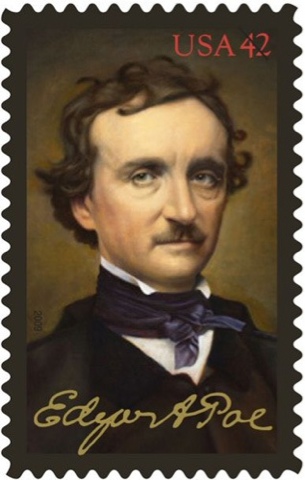
One of 46 USA Postage Stamps
Featuring an Author
Edgar Allan Poe on The Reading Life


Before CSI, Law and Order, and  Bones or Sherlock Holmes and Father Brown, there was "The Murders in the Rue Morgue" by Edgar Allan Poe.    "The Murders in the Rue Morgue" is considered the very first "detective story".    The influence of Poe (1809 to-1849 USA-there is background information on him in my three prior posts on his short stories) is just huge.    Numerous horror style movies have been made based on his stories.   His short stories are canon status works.   They are also a lot of fun to read.   All of his work can easily be found online.


"The Murders in the Rue Morgue" is about using deductive reasoning, acute observational skills and the willingness to follow the evidence to whatever conclusion, improbable as it may seem, it leads to.   Just like in the Sherlock Holme's stories,  the lead figure is a brilliant detective called into solve a crime that baffles the  authorities.   The story is narrated by a friend of the detective.   


As the story opens we are allowed to visualize  what those on the scene find when they come on the murder scene of an elderly woman and her adult daughter.   They lived as near recluses in a quiet Paris neighborhood.    The detective, Auguste Dupin, starts out by questioning the neighbors as well as the tradesmen in the area to try to find out about the life style of the two women.   Everyone says they are very quiet and had no visitors and no men in their lives.  The mother had her throat so badly slashed that her head is barely attached and the body of the daughter is found stuffed up the chimney.    It appears a very powerful maniac has committed the crime.   There is gold left behind in the house so it was not a robbery.   There also appears to be no way inside the house, there seems no evidence of a break in.    Everyone is baffled by this seemingly senseless and motiveless crime. 


Neighbors all report they heard wild screams in the house.   In a very funny scene a French man insists the  screams were in German, a Russian that they were in English and an Italian that the screams were made by someone speaking Romanian.  


Dupin, of course, comes up with the only logical solution for the crime by a process of elimination.    You can read this story in just a few minutes so I will not tell anymore of the plot.    


You can read this (and much more of Poe's work) HERE.


I think Poe had fun writing this story and I know I did reading it.   


Do you have a favorite Poe short story?


Mel u

Sunday, May 29, 2011

"The Black Cat" by Edgar Allan Poe

"The Black Cat" by Edgar Allan Poe (1843, 10 pages)


Stories About Cats Day-Part I


Edgar Allan Poe (1809 to 1849-Boston, Massachusetts, USA) is one of pioneers of the short story.    His work is part of the Gothic horror tradition and he is considered the creator of the detective story.   He is a tremendously influential author and all of his work is part of the canon.


I have previously posted on his  "The Masque of the Red Death" and "The. Tell Tale Heart.      Poe lived a short very troubled life (there is some background information on him in my prior posts).   His work shows a fixation on madness, death, drugs and alcohol.  


I have wanted to read more of Poe's short stories for some time.    Almost everyday I check East of the Web: Short Storiesn to see what is their short story of the day.    Yesterday it was Poe's "The Black Cat".   Given that I am a sucker for any work with "cat" in the title I decided I wanted  to read it.    


"The Black Cat" is a very scary story.   I ended up hating the central character in the story because of his cruelty to his cats.    Poe creates a powerful atmosphere of impending doom in the story.    He also makes reference to alcoholism as a disease.   I do not want to tell the plot of the story as that will spoil the fun for those who have not yet had the pleasure of reading "The  Black Cat".


"The Black Cat" is very knowing in its treatment of the mind set of a guilt ridden alcoholic.    The lead character, to me, was a very unsympathetic figure.    I did not see the surprise ending coming but I liked it a lot when I read it.   


The Short Stories of Poe are fundamental reads for any lover of the form. "The Black Cat" is perfectly written and kept me very interested throughout.


Mel u


Friday, January 21, 2011

"The Tell Tale Heart" by Edgar Alan Poe

"The Tell Tale Heart" by Edgar Alan Poe (1843, 5 pages)-Short Stories in The Life Time Reading Plan


Edgar Alan Poe (1809 to 1849-USA) would have been 202 years old on January 19.   Yesterday I was looking over the works listed in Clifton Fadiman's The Life Time Reading Plan (1960), a book that has meant a great deal to me for many years.    There are only four authors listed for their short stories, Franz Kafka, Nathaniel Hawthorne,  Ernest Hemingway and Edgar Alan Poe.   (Herman Melville's "Bartleby the Scriviner" is also listed and I completely agree with that.)  ( I think James Joyce, Anton Chehkov, Guy du Mauspassant, and Katherine Mansfield and maybe Gogol should be added to the list and I would be OK with the dropping of Hemingway.)      Fadiman says Poe pretty much created the  "horror story" and the "detective story" genre.   Many of the characters in his stories are right at the border between sanity and insanity.    He is very much a Gothic writer.

I have previously posted on Poe's "The Mask of the Red Death".   "The Tell Tale Heart" is on the surface a simpler tale.   The first person narrator and central character of the story knows he (might be a she for all we are told)  is perhaps losing his mind.    The central character is somehow being driven mad by an old man that he lives with who he thinks is somehow giving him a "vulture eye". He decided to save his sanity he must murder the old man.    He then dismembers the body of the old man and hides it under the floor boards of the house.   I do not want to give away more of the plot of this story as it is very well told and quite exciting.    Poe does a great job of making us see the world through the eyes of the  narrator.   It is beautifully written.  

"The Tale of the Tell Tale Heart" can be read online (all of his stories can be read online).    It is a fun story from a canon status writer.       In five minutes you can experience a classic short story.

Mel u


Monday, April 26, 2010

"The Masque of the Red Death" by Edgar Allan Poe


"The Masque of the Red Death" by Edgar Allan Poe (1842, ten pages, read via Dailylit.com)


Edgar Allan Poe (1809 to 1949) is considered one of the early masters of the Gothic horror story.   He was one of the very first American authors to write broadly in the short story genre.   Wikipedia says he was the first well known American writer to make his living from the sales of his work.   He  lead a trouble life that ended far to soon.

"The Masque of the Red Death" is set at the home of Prince Prospero, a converted abbey.   We are not given the time of the story but it feels like the 1500s to me in Italy.

As the story opens a terrible disease is ravaging the land ruled by Prince Prospero.     The language of the story is rich and opulent.   The story has a decadent feel to it.   Here is Poe's description of the Red Death, as the disease is called:

THE "Red Death" had long devastated the country. No pestilence had ever been so fatal, or so hideous. Blood was its Avatar and its seal -- the redness and the horror of blood. There were sharp pains, and sudden dizziness, and then profuse bleeding at the pores, with dissolution. The scarlet stains upon the body and especially upon the face of the victim, were the pest ban which shut him out from the aid and from the sympathy of his fellow-men. And the whole seizure, progress and termination of the disease, were the incidents of half an hour.
The Prince decides to try to avoid the red death.   He summons all the nobles and gentry of his princedom to a grand ball which is to be held in the seven rooms of his abbey.   It is a masked costumed ball.    The prince is completely indifferent to the sufferings of his people and just intends to wait out the end of the disease behind his walls and in his great luxury.   Here is Poe's description of the party (I see  a dream like quality to the feel of the party):

There was much of the beautiful, much of the wanton, much of the bizarre, something of the terrible, and not a little of that which might have excited disgust. To and fro in the seven chambers there stalked, in fact, a multitude of dreams. And these -- the dreams -- writhed in and about, taking hue from the rooms, and causing the wild music of the orchestra to seem as the echo of their steps. And, anon, there strikes the ebony clock which stands in the hall of the velvet.
 I won't tell any more of the plot.   Dailylit.com and other places like it make it easy for us to read short stories.   There are allegorical and philosophical interpretations that could be put on this brief tale concerning the nature of death etc.    To me the very real pleasure in this story is in the rich prose rather than the plot.   "The Masque of the Red Death" is a classic American short story well worth the few minutes it will take to read it.

Featured Post

Imperial Reckoning: The Untold Story of Britain’s Gulag in Kenya by Caroline Elkins - 2005 - 701 Pages

  Imperial Reckoning:     The Untold Story of Britain’s Gulag in Kenya by Caroline Elkins - 2005 - 701 Pages 2006 Pulitzer Prize Winner From...