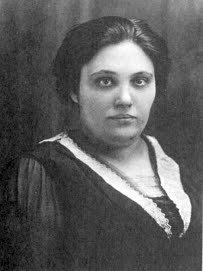
Old Woman with Young Dreams” by Yente Serdatsky was published in the Forverts on November 11, 1920, and was never reprinted. Translated from Yiddish in 2018 by Jessica Kirzane.

You may read the story here
It was published in 2018 in the Pakn Treger Translation Issue, a magazine of The Yiddish Book Center
Yiddish literature seems to me very appropriate for these times. Xenophobia is growing in the USA and Europe. All writers and most readers of Yiddish literature were fluent in at least three languages. Many left the lands of their ancestors for new very different places. They asked for no government help, worked very hard to educate their children and were very law abiding. Some survived horrible prejudice. The ancestors of Yiddish immigrants contributed greatly to their new countries. Yiddish writers survived the Holocaust. Chava Rosenfarb, her image is in my side bar, survived with her mother and sister four years in concentration camps. She moved to Montreal with her family, she was pregnant upon moving. She is one of the last surviving Yiddish writers. The experiences of the Yiddish writers I have been featuring for eight years makes me ashamed to complain about our lockdown.
Narrated by a flâneuse who observes the city and its people, like many of Serdatsky’s stories this one offers a picture of the day-to-day lives of immigrant women in New York City, their unfulfilled longings and small pleasure. The narrator of the story is an older woman, from Eastern Europe, she loves just strolling around NYC observing People.
The narrator is a writer. I really was booked by the opening paragraph. You can see the friendly conversational style of the story:
"A dignified mister, who’s more interested in my writing than in me as a person, says to me:
“Don’t you ever get weary of lowering yourself into the depths of human life to fish out the most interesting parts? It must be unpleasant to uncover and search the dark shadows of the human soul to find the bright sparks.
“You look upset, like you’re in a nightmare. Wake up! Now is the most beautiful time of year in New York. Take a stroll on the city streets, drink in everything up here on the surface, all that’s lighthearted and pleasant. See how light shimmers on the colorful dresses the rich ladies wear. See how golden rays glimmer on the blue rivers around New York, how they wrap around the tall buildings and stretch across the broad, wide, though crowded streets.”
You’re right, sir. I’ll take your advice. I’ll leave my heroines alone for a while and stop writing about them so much. They deserve a rest anyway. They may blunder through their dark corridors if I’m not here to help them find the way, but so be it. The street, in these bright days of autumn, is so dear to me. The colors are movingly rich. Nothing can get me down. I’ll go out, and I’ll see what’s out on the street!"
We follow her through the city, she walks and she takes the subway. She encounters interesting people. Some are other immigrants like her, some very different. This is a very moving scene where she encountered two women from her old home town:
"Do you see that big table, Bessie? If my sister and her family are going to stay with me, I’ll have to have that table.”
“So they’re really coming to you?”
“What do you think? I’d make them stay with strangers? We’ll get them situated. Just let them come in good health. I can’t wait to see her.”
“I’ll never see my sister again. Those hooligans murdered her.”
Their eyes grew teary as they remembered the land they’d left behind, where their relatives still suffer. The first woman philosophized, “You know, Bessie, it’s a strange world. Here we eat the best food, we wear wool and silk, and there? It’s a miracle to get even the humblest, oldest things. They’re almost afraid of something new. Did you see what joy they wrote in their letter? They kissed the pot, the sweaters, the socks . . . those old rags. Here we’d barely even look at such things.”
They both were silent as tears fell from their eyes. They forgot that they were standing on busy Grand Street, by the windows of a well-to-do furniture store, near a picture house where they sell tickets to the nightly showings. They hardly noticed the people looking at them. I also hardly noticed. The sadness enveloped all three of us as we remembered our home.
Bessie, who seemed to be a practical woman, was the first to gather herself. She wiped her face, laughed, and said, “Let’s go home, Esther. Soon it will be time for dinner.”
But Esther couldn’t calm herself so easily. She bowed her head. Her tears flowed as her chest heaved with sobs.
The other woman became impatient as she tried to console her friend. This is the first time I noticed she was a Litvak. She said samekhs instead of shins. “Shee here, don’t be shilly, Eshter. Don’t kill yourshelf over it. It’s Thurshday, and we need to buy food for Sabes. There’ll be plenty of fish, beef, and chicken. Your little Serke is probably already at home, and she musht be hungry!” "
For sure this delightful slice of immigrant life in NYC in 1920 is more than worth your time.

YENTE SERDATSKY (née Raybman, 1877–1962) was born in Aleksotas, near Kovno (Kaunas) in what is now Lithuania. Her childhood home was a gathering place for Yiddish writers, and she was acquainted from a young age with Yiddish literature. She married, had three children, ran a grocery store, and in 1905 left her family to pursue her writing in Warsaw, where she received encouragement from I. L. Peretz. In 1906 she and her family emigrated to the United States, eventually settling in New York City, where she ran a soup kitchen. She published short stories, sketches, and one-act plays in many Yiddish periodicals and was a regular contributor and eventually a contributing editor at the Forverts. In 1922 she left the Forverts and the literary scene, not publishing again until 1949–1955, when she contributed dozens of stories to the Nyu Yorker Vokhnblat. Her only book publication was her collected early writings, published in 1913.
JESSICA KIRZANE is an incoming lecturer in Yiddish at the University of Chicago. She holds a PhD in Yiddish studies from Columbia University. Kirzane is the managing/pedagogy editor of In geveb: A Journal of Yiddish Studies and was a 2017 translation fellow at the Yiddish Book Center.
Mel u