Showing posts with label Switzerland. Show all posts

Monday, November 4, 2019

Allmen and the Pink Diamond by Martin Suter - 2011 - translated from German 2019 by Stephen Morris


Allmen and the Pink Diamond by Martin Suter - 2011  - translated from German 2019 by Stephen Morris

During German Literature Month November, 2017 I read a very interesting novel by Martin Suter, The Last Weynfeldt.  

I am happy to begin my participation in German Literature Month 2019 with another novel by Suter, Allmen and the Pink Diamond.
Short, 203 pages it is a fast reading detective story.  It is part of a series of novels starring Johann Friedrich von Allmen and his Guatemalan butler Carlos.  Allmen is hired to retrieve a fabulously expensive pink diamond.  Perpetually strapped for cash, there is a huge fee involved if he recovers the gem.

Tracks lead to a grand Baltic beach resort.  Before then they stop in London and Zurich.. A mysterious Russian is the first suspect.  
 It was fun to vicariously indulge in the wonderful food served at the hotel and observe the other guests.  As befits a story set in an expensive hotel on the Baltic, there are semi-shaddy guests, ranging from the idol rich to international software pirates.  Of course there is a bit of mild sex.

I enjoyed reading this but..the characters could be better developed, some of the dialogue does not ring true. This might be a translation issue but an upper class Englishman talks like a character out of an Ali Gee skitt by Sasha Cohen.  I did enjoy the section on stock manipulations.  It ends happily )for Allman and Carlos.  I liked the ending.

I was kindly given a review copy of this novel.  I think the price is to high.  I would not suggest a friend pay $10.95 for this book.  I found
The Last Weynfeldt much more interesting.  


About Martin Suter


Martin Suter, born in Zurich in 1948, is a novelist, screenwriter and newspaper columnist. He has written a dozen novels, many of them best-sellers in Europe and translated into 32 languages. Suter lives with his family in Zurich.


Saturday, November 7, 2015

The Tanners by Robert Walser (1907, translated by Susan Bernofsky)

I am grateful to Max ü for the provision of an Amazon Gift I used to acquire this book.


I am estatic to once again be able to Participate in German Literature Month, elegantly and lovingly hosted by Lizzi's Literary Live and Beauty is a Sleeping Cat. This is my fourth year as a participant.   On the host blogs you will find the particularities of the event but the basic idea is to read literature first written in German (translated or not) and share your thoughts.  I began accumulating works for the event soon after the event ended last year and I began reading for it in mid-September.  


Works Read for G L V So Far

1.  Every Man Dies Alone by Hans Fallada. A brilliant recreation of life in Nazi Germany. 

2.  Ostend, Stefan Zweig, Joseph Roth and the Summer Before the End by Volker Weidermann. A fascinating social history 

3.  Buddenbrook Ths Decline of a Family by Thomas Mann.  Must reading 

4.  "The Governess" by Stefan Zweig

5.  Demian:  The Story of Emil Sinclair's Youth by Herman Hesse.  Read the major works first.


     Robert Walser 1878 to 1956, born in Bern, Switzerland 

Last year during GL IV I posted on a novel by Robert Walser, Jacob Von Gunten and his reflections on The Idiot by Fyodor Doestoesky.  I was inspired to reread The Idiot by his piece and I think this reading did significantly deepen  my understanding of the book.  I also read after GL IV closed Walser's "Kleist in Thun", a work which simply stunned me with the depth of feeling and beauty in the work. If a short story can reach the category of "High Art", this does. Additionally I have read a few of his many other short stories.

Anyone who has maintained a book blog for years, posting almost daily for years,  will know what I mean when I say I am doing this post just to keep going on.  Tommorow I will be better, I hope.

The Tanners is about five members of a family, the Tanners, there are four brothers, one is in a mental hospital and barely mentioned and a sister,   There is little traditional plot.  The primary focus is on Simon and his various jobs.   Part of the focus of the work of Walser is on  reflections on the meaningless of of most jobs.  There is a long segment  in which Simon talks about his work as a copiest, a very common office job in the days before copy machines and laser printers which perfectly captures the dynamics of office work, with its petty routines and little kings.  Copiests had to be educated men but they were performing totally meaningless work.  I was reminded of Melville's great short story, "Bartleby the Scrivener" as well as Gogol's foundational story  "The Overcoat" while reading this segment.  Tiny Tim's father was also a copiest!

The Tanners covers numerous jobs and periods of unemployment of Simon and his romances.  Much space is also devoted to the life of the sister.  


Simon is set off from his brothers, one is a sucessful business man, one an established artist and one is locked in a mental hospital.  It was impossible for me drive from the forefront of my consciousness the thought that Walser would spend the last twenty five years of his life so confined.  

I am very glad to have read this book.  It comes with an essay by W. G. Sebald.

I have two collections of Walser short stories and will be reading them all eventually, I hope.  

The book feels as if came directly from Walser's stream of consciousness.  

It is often said that Robert Walser was the favorite writer of Franz Kafka.  

Mel ü


Wednesday, December 10, 2014

Selected Stories by Robert Walser with a Preface by Susan Sontag and an afterword by Christopher Middleton (2012, 208 pages)

Stories and Feulilltetons by Robert Walser - Written from 1907 to 1929 -Translated by Christopher Middleton and others.


"Kleist in Thun" and the near novella length "The Walk" belong in the category of high art, as defined by Susan Sontag in her still very important essay, "Notes on Camp".  They are sublime works literature of almost transhuman beauty.  They are both included in Selected Stories Robert Walser along with a number of other mostly brief works of fiction with a few feuilletons.  I have posted previously on six of his short stories and one of his four novels, Jacob von Gunten.  I do not wish to generalize about his short stories and the zietgeist behind it (you can read the excellant essay by Sontag by downloading ten Kindle sample edition) but simply urge all lovers of the sublime to buy this collection so you can read it many times.

I see Walser's stories as at least worthy to stand next to Melville's "Barnaby the Scrivner" and Kenzeburo Oe's "When He Himself Shall Call My Name" as great tales of the Preterite of the Earth.


Mel u


Friday, November 28, 2014

"The Walk" by Robert Walser (1917)


"Since then I have slowly learned to grasp how everything is connected across space and time, the life of the Prussian writer Kleist with that of a Swiss author who claims to have worked as a clerk in a brewery in Thun, the echo of a pistol shot across the Wannsee with the view from a window of the Herisau asylum, Walser’s long walks with my own travels, dates of birth with dates of death, happiness with misfortune, natural history and the history of our industries, that of Heimat with that of exile. On all these paths Walser has been my constant companion. I only need to look up for a moment in my daily work to see him standing somewhere a little apart, the unmistakable figure of the solitary walker just pausing to take in the surroundings."  William Sebald


Works I have so far read for German Literature Month 2014


1.   Siddhartha by Hermann Hesse

2.   Gertrude by Hermann Hesse 

3.  "Diary of a School Boy" by Robert Walser (no post)

4.  Steppenwolf by Herman Hesse

5.  Burning Secret by Stefan Zweig 1925

6.  Life Goes On by Hans Keilson

7.  Comedy in a Minor Key by Hans Keilson

8.  "The Wall" by Jurek Becker

9.  "Romeo" by Jurek Becker

10.   "The Invisible City" by Jurek Becker.

11.  Wittgenstein's Nephew by Thomas Bernhard

12. "Dostoevsky's Idiot" by Robert Walser

13.  "French Newspapers" by Robert Wasler 

14.  Jakob the Lier by Jurek Becker

15.  The Trial by Franz Kafka 1915,

16.  "The Seamstress" by Rainer Maria Rilke  1894

17.  "The Experiement or the Victory of Children" by Unica Zürn 1950

18.  "The Star Above the Forest" by Stefan Zweig. 1924

19.  "Saint Cecilia or the Power of Music" by Heinrich von Kleist 1810

20.  Amok by Stefan Zweig 1923

21.  Concrete 1982

22.  "Kleist in Thun" by Robert Walser 1913

23.  "Incident at Lake Geneva" by Stefan Zweig (1924)

24.  "The Governess" by Stefan Zweig 1927

25.  "The Sandman" by E. T. A. Hoffmann 1817

26.  "The Secrets of the Princess of Kagran" by Ingeborg Bachmann 1971

27.  "Twilight" by Stefan Zweig 1928

28.   "The Lunatic" by Georg Heym 1913

29.    "Dissection" by Georg Heym 1913 - no post 

30.   "Blackbird" by Robert Musil

31.  "The Kiss" by Robert Walser 1914. - no post

32.  "The Suspect" by Jurek Becker. 1980,

33.  "A Favorite Family Story" by Jurek Becker 1982

34.  "Moonbeam Alley" by Stefan Zweig. 1928

35.  "Flower Days". By Robert Walser, 1911, no post.

36.  "Fantastic Night" by Stefan Zweig

37.   "The Walk" by Robert Walser. 1917

38.   The Flight Without End by Joseph Roth. No post.

When I attempted to post on Robert Walser's "Kleist in Thun" I found myself unable to do more than launch into a barely credible to those who have not experienced rhapsody on the story in which I said 
it belonged among the greatest of all art.  I now feel the same way about his longer work, "The Walk". 

Maybe in 2015 I will try to write a series of post on Walser, I have two of his collections of short stories.

William Sebald does a great job of explaining the wonder and power of Robert Walser in this article reprinted in The New Yorker.


                                Getting Ready for the closing Party for German Literature Month IV
                                                                      Hosted by Ruffington Bousweau

Mel von ü


Saturday, November 22, 2014

"Kleist in Thun" by Robert Walser (1913, translated by Christopher Middleton)

 Posts on Robert Walser

"Kleist in Thun" by Robert Walser is as powerful a short story as I have yet read.  
Mel u


"He wants to abandon himself to the entire catastrophe of being a poet:  the best thing for me is to be destroyed as quickly as possible"

"Kleist wants a brutal war, to fight in a battle, to himself he seems a miserable superfluous person"


There are still several days left in German Literature Month IV.  Lots of time left to participate. There are already over a hundred posts, reading through them is much like a fine class in German literature at a top academy.


The schedule and guidelines for participation are on the event webpage.  Just reading the  posts of all the other participants is tremendously informative. There is an interesting contest or two and some prizes to be won.  One of the tasks participants are charged with is reading a work first published in 2014 and this collection qualifies.  

I am very happy to be once again participating in German Literature Month, hosted by Caroline of Beauty is a Sleeping Cat and Lizzy of Lizzy's Literary Life.   Events like this are one of the great things about being part of the international book blog community.  I know there is a lot of work that goes into a month long event and I offer my thanks to Lizzy and Caroline


Works I have so far read for German Literature Month 2014


1.   Siddhartha by Hermann Hesse

2.   Gertrude by Hermann Hesse 

3.  "Diary of a School Boy" by Robert Walser (no post)

4.  Steppenwolf by Herman Hesse

5.  Burning Secret by Stefan Zweig 1925

6.  Life Goes On by Hans Keilson

7.  Comedy in a Minor Key by Hans Keilson

8.  "The Wall" by Jurek Becker

9.  "Romeo" by Jurek Becker

10.   "The Invisible City" by Jurek Becker.

11.  Wittgenstein's Nephew by Thomas Bernhard

12. "Dostoevsky's Idiot" by Robert Walser

13.  "French Newspapers" by Robert Wasler 

14.  Jakob the Lier by Jurek Becker

15.  The Trial by Franz Kafka 1915,

16.  "The Seamstress" by Rainer Maria Rilke  1894

17.  "The Experiement or the Victory of Children" by Unica Zürn 1950

18.  "The Star Above the Forest" by Stefan Zweig. 1924

19.  "Saint Cecilia or the Power of Music" by Heinrich von Kleist 1810

20.  Amok by Stefan Zweig 1923

21.  Concrete 1982

22.  "Kleist in Thun" by Robert Walser 1913

"The last paragraph with its excruciating modulation seals an account of mental ruin as good as anything I know in literature". - Susan Sontag

I have read Robert Walser's "Kleist in Thun" five times.  I will continue to read it over and over for the rest of my life.  It is high art, in the Sontagian categories, fully on a par with Middleton, the dramas of Aesylcus, Proust, and "The Dead".  I accept this sounds hyperbolic but I do not think many who have read it deeply will disagree.

The story weaves in and out of the consciousness of Heinrich von Kleist, the narrator and the evident persona of Walser.  Kleist has gone in retreat to a small hotel on an island in the River Aare in Thun located in the canon of Bern in Zwitgerland to write, to have peace, to be alone, to think, to be Kleist.

I do not feel now inclined to say more about  "Kleist in Thun".  I will post a few images of the area and a one of Kleist.


I hope to read and post my experiences with at least two more works by Robert Walser for GL IV.

Mel von ü


Saturday, June 21, 2014

Jacob Von Gunten by Robert Walser (1909, translated and introduced by Christopher Middleton, 1965)

I


Robert Walser (1878 to 1956, Switzerland) is a unique author.  I have previously read and posted on a few of his short stories and you can find some background on him in those posts.  Susan Sontag said that the basic theme of Walser was a refusal of obedience and the consequences of trying to be autonomous in increasingly controlling societies. Jacob Von Gunten is the first novel by Walser I have read.  The talent and discernment behind this work transcends my ability to describe.  It basically is the first person narrative of a young man, Jacob Von Gunten, going to school to learn to be a servant.  The school appears to do nothing other than try to impart an attitude of slavish obedience in their students.  Combined with a description of school activities and his interactions with students and teachers we also are presented a journal of the thoughts of Jacob.  You must wonder what unshown traumas could have pushed a young man of evident high intelligence to wish to be a servant with his whole life dictated by others.  There is a great depth of irony in this work.  I think this would be an exellant class room work for high school and college students.

  Kafka was an avid reader of Walser and I think you will become one also if you give him a try. 


Mel u

Thursday, November 14, 2013

"Response to a Request" by Robert Walser (1907) and "Walser's Voice" by Susan Sontag


From "Robert Walser Voice" by Susan Sontag

"The moral core of Walser's is the refusal of power, of domination."  Susan Sontag.


I am really glad I decided to once again participate in 
German Literature Month November 2013.  I thank Caroline and Lizzy for hosting this great reading event.


So far I have read and posted on these works, all but Kafka are new to me writers. 
The Tin Drum-by Gunther Grass
"The Judgement" by Franz Kafka
All Quiet on the Western Front by Erich Maria Remarque -very powerful war novel 
"A Letter from an Unknown Woman" by Stefan Zweig. 
The Death of the Adversary by Hans Klein - a work of genius
"The Job Application" by Robert Walser 
Chess Game by Stefan Zweig-I will read much more of his work
"The Battle of Sempach" by Robert Walser
I have also listed to podcasts of "Basta" and "Frau Wilkes" by Robert Walser
The March of Radetsky by Joseph Roth I hope to read all his work

Memoirs of an Anti-Semite by Gregor von Rezzori amazing work of art.

"Flypaper" by Robert Musil

"Mendel the Bibliophile" by Stefan Zweig - I totally love this story.

"The Dead are Silent" by Arthur Schnitzler an entertaining work from 1907

"There Will Be Action" by Heinrich Boll a very good short story by Nobel Prize Winner

German Literature Month is turning into a great voyage of discovery for me.  I am finding  one after the other new to me writer whose collected works I now want to read.  My reading is restricted to works available either online or as translated Kindle editions so that is what I mean when I say that.  Robert Walser is for sure now on my read everything he wrote list.  I was glad to see a preface by Susan Sontag, (say what you will  but they do not come much smarter than Sontag) included with The Walk and Other Stories by Robert Walser.  

I have already done several posts on short stories by Walser.  (You can read Sontag's essay and "Response to a Request" by downloading a sample of The Walk and Other Stories).  There is great sadness and loneliness in the stories of Walser.  There was a time when people compared Kafka to him, now it is the other way around.  Sontag and W. C. Sebald both verify this.  Sontag calls Walser "a kind, gentle tempered Beckett".  Walser's stories seem to me about the struggle to keep the self a life in a world where blind obedience is the norm.  By shrinking himself or his characters down to as little as possible he is saying "we can survive".  "Response to a Request"  (four pages) is a monologue by either an actor or a stage director. It starts out mild and closes on a mad scream.  The sheer violence and anger in this story overwhelmes us from the Walserian persona.  

This story was translated by Christopher Middleton who labored for many years to make Walser available in English.  


Thursday, November 7, 2013

Robert Walser Two Short Story Podcasts "Basta" and "Frau Wilke"


"To be alone: icy, iron terror, foretaste of the grave, forerunner of unpitying death. Oh, whoever has been himself alone can never find another’s loneliness strange."  From Frau Wilke by Robert Walser

I am happy to be once again participating in German Literature Month.
.  In the link below you will find lots of great reading ideas.  Caroline and Lizzy's only real rule is the work must be originally written in German.


The hosts are hoping this year to have an even balance of male to female authors as in prior years it had been very male author dominated. They have a schedule (but you are free to post on  any German work).  Here is the official announcement:

So far I have read and posted on these works, all but Kafka are new to me writers. 
The Tin Drum-by Gunther Grass
"The Judgement" by Franz Kafka
All Quiet on the Western Front by Erich Maria Remarque -very powerful war novel 
"A Letter from an Unknown Woman" by Stefan Zweig. 
The Death of the Adversary by Hans Klein - a work of genius
"The Job Application" by Robert Walser 
Chess Game by Stefan Zweig-I will read much more of his work
"The Battle of Sempach" by Robert Walser

I hope to read, among others
The Death of Virgil by Herman Broch
Austerlitz by W. G. Sebald

There are lots of decent places to listen to or download podcasts of short stories but only 
http://www.miettecast.com/ has the endorsement of The Reading Life.


Miette, whose work I have been following for years has exquisite literary taste and an incredible reading voice and style.  I was very happy to find, though not surprised, to find there were two podcasts of stories by Robert Walser.  (There are a number of other stories on her webpage that qualify for GL III)

My main purpose in this post is to let my readers and those participating in the event of Caroline and Lizzy know about this resource and to keep for myself a record of my encounters with the work of Robert Walser.  

"Basta" (1917) takes Miette six minutes to read.  Like the stories I have read it is about a man celebrating his ordinariness.  It is a marvelous story.  Now days people compare Walser to Kafka but there was a time when it was the other way around.  Cosmically it is easy to see this as mocking what many see as the near slavish will to obedience of the culture in which Walser lived.


"Frau Wilke" (reading time 12.5 minutes), translated by ChristopherbMiddleton, is a very beautiful poignant story centering on two very lonely people, Frau Wilke the land Lady of a rooming house and a poet,the narrator of the story who rents a room from her.  I listened to then read the story twice.  Frank O'Connor famously stated the short story at its best is about loneliness.   I know he probably never read Walser, but this story can stand with the best. 

"The Battle of Sempach" by Robert Walser (1908) includes full story in translation


I am happy to be once again participating in German Literature Month.
.  In the link below you will find lots of great reading ideas.  Caroline and Lizzy's only real rule is the work must be originally written in German.


The hosts are hoping this year to have an even balance of male to female authors as in prior years it had been very male author dominated. They have a schedule (but you are free to post on  any German work).  Here is the official announcement:

So far I have read and posted on these works, all but Kafka are new to me writers. 
The Tin Drum-by Gunther Grass
"The Judgement" by Franz Kafka
All Quiet on the Western Front by Erich Maria Remarque -very powerful war novel 
"A Letter from an Unknown Woman" by Stefan Zweig. 
The Death of the Adversary by Hans Klein - a work of genius
"The Job Application" by Robert Walser 
Chess Game by Stefan Zweig-I will read much more of his work
I hope to read, among others
The Death of Virgil by Herman Broch
Austerlitz by W. G. Sebald

Yesterday I read my first ever work by Robert Walser, one of Kafka's favorite writers, "The Job Application". I also posted this work. If it came out today it would be called flash fiction.  I fear I will feel a need to read much more of his work.  (I like to study pictures of writers when young and compare them to years later.)
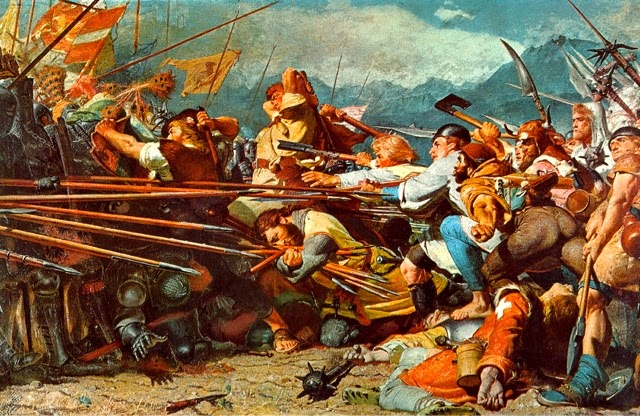
"The Battle of Sempach", another near flash fiction length work, is told in the first person by an Austrian foot soldier marching into a battle against the Swiss.  The date is July 9, 1386.  The Austrians are In a festive mood.  They see it just as a punitive battle against some rebellious vassals. To the Austrians it is a chance, they think, to show how brave they are, have some fun killing people and if they are lucky get in a rape for good measure. They are drinking wine and eating chicken as they march happily into battle.   There are very nice class distinction markers in the story I enjoyed.  People well read in Walzer say he often writes about the absurdity of blind obedience. I had an idea I needed to find out what happened at The Battle of Sempach so of course I Googled it.  I suggest if you read this story and your grasp of Austrian history in the 14th century is no better than mine, you do the same.  

"The Battle of Sempach" is a seering account of the absurdity of war, about the petty vanity and just plain stupidity behind most military conflicts. 
I read this story on Project Gutenberg which licenses its posting as long as credit is given. It was translated by Michael wood.  
"The Battle of Sempach"

By Robert Walser
One day, in the middle of high summer, a military expedition was advancing slowly down the dusty country road that led towards a district of Luzern. The bright, actually more than bright, sun dazzled down over swaying armour serving to cover human bodies, over prancing horses, over helmets and parts of faces, over equine heads and tails, over ornaments and plumes and stirrups as big as snowshoes. To the right and to the left of the shining military expedition spread out meadows with thousands of fruit trees in them up as far as hills that, looming up out of the blue-smelling, half-hazy distance, beckoned and had the same effect as light and carefully painted window dressing. It was before noon and the heat was already oppressive. It was a meadowy heat, a heat contained in grass, hay and dust, for thick clouds of dust were being thrown up that sometimes descended like a veil over parts and sections of the army. Sluggishly, ploddingly, carelessly the long cavalcade moved forward. Sometimes it looked like a shimmering and elongated snake, sometimes like a lizard of enormous girth, sometimes like a large piece of cloth, richly embroidered with figures and colourful shapes and ceremoniously trailed as with ladies, elderly and domineering ones as far as I'm concerned, accustomed to dragging trains behind them. In all this military might's method and way of doing things, in the stamping of feet and the clinking of weapons, in this rough and ready clatter lurked an "as far as I'm concerned" that was uniform, something impudent, full of confidence, something upsetting, slowly pushing to one side. All these knights were conversing, as far as their iron-clad mouths would allow them, in joyful verbal banter with each other. Peals of laughter rang out and this sound was admirably suited to the bright tones emitted by weapons and chains and golden belts. The morning sun still appeared to caress a good deal of brass and finer metal. The sounds of tin whistles flew sunward. Now and again one of the many footmen walking as if on stilts would tender to his mounted lord a delicate titbit, stuck on a silver fork, right up to his swaying saddle. Wine was drunk on the move, poultry consumed and nothing edible spat out, with an easy-going, carefree amiability, for this was no earnest war involving chivalry they were riding to, but more of a punitive expedition, a statutory rape, bloody, scornful, histrionic things. Everybody there thought so and everybody saw already the heap of cut-off heads that would redden the meadow. Among the leaders of the expedition was many a wonderful noble young man splendidly attired, sitting on horseback like a male angel flown down from a blue uncertain heaven. Many a one had taken off his helmet to make things more comfortable for himself and given it to an attendant to carry. By doing so he displayed to the air a peculiarly finely drawn face that was a mixture of innocence and exuberance. They were telling the latest jokes and discussing the most up-to-date stories of courtly women. The serious ones in their company they tolerated as best they could; it seemed today as if a pensive expression was deemed to be improper and unchivalrous. The hair of the young knights who had taken their helmets off, shone and smelt of oil and unguents and sweet-smelling water that they had poured on it as if it had been a matter of riding to visit a coquette to sing her charming love songs. Their hands, from which the iron gauntlets had been taken off, did not look like those of warriors, but manicured and pampered, slender and white like the hands of young girls.

Only one person in the wild procession was serious. Already his outward appearance, armour that was deep black broken up with tender gold, indicated how the person it covered thought. He was the noble Duke Leopold of Austria. This man did not speak a word and seemed completely lost in anxious thoughts. His face looked like that of a person who is being pestered by a fly that is impudently flying round his eye. This fly may well have been a presentiment that something bad was going to happen for a smile that was permanently both contemptuous and sad played over his mouth. He kept his head lowered. The whole world, however cheerful it looked, seemed to him to roll and thunder angrily. Or was it just the thunder of the trampling hooves of horses as the army was now passing over a wooden bridge that spanned the river Reuss? Nevertheless something foreshadowing misfortune hovered horribly around the duke's bodily form.

End of story

Robert Walser (1878–1956) was born into a German-speaking family in Biel, Switzerland. He left school at fourteen and led a wandering, precarious existence while writing his poems, novels, and vast numbers of the “prose pieces” that became his hallmark. In 1933 he was confined to a sanatorium, which marked the end of his writing career. Among Walser’s works available in English are Jakob von Gunten andBerlin Stories (available as NYRB Classics), The TannersMicroscriptsThe AssistantThe Robber,Masquerade and Other Stories, and Speaking to the Rose: Writings, 1912–1932. From The New York of Books.  

Please share your expereice with Robert Walser with us.


Wednesday, November 6, 2013

"The Job Application" by Robert Walser. 1907 A post which includes thefull story.

"

I would wish it on no one to be me.
Only I am capable of bearing myself.
To know so much, to have seen so much, and to say nothing. 
A late poem by Robert Walser


I am happy to be once again participating in German Literature Month.
.  In the link below you will find lots of great reading ideas.  Caroline and Lizzy's only real rule is the work must be originally written in German.


The hosts are hoping this year to have an even balance of male to female authors as in prior years it had been very male author dominated. They have a schedule (but you are free to post on  any German work).  Here is the official announcement:

So far I have read and posted on these works, all but Kafka are new to me writers. 
The Tin Drum-by Gunther Grass-often listed among 100 greatest 20th century novels.
"The Judgement" by Franz Kafka
All Quiet on the Western Front by Erich Maria Remarque -very powerful war novel 
"A Letter from an Unknown Woman" by Stefan Zweig. 
The Death of the Adversary by Hans Klein - a work of genius
Chess Game by Stefan  Zweig- a 100 page marvel

I hope to read, among others
The Death of Virgil by Herman Broch
Austerlitz by W. G. Sebald currently reading


Robert Walzer wrote over 1000 short stories.  In an article in The Guardian I read that Franz Kafka used to scan the newspapers and journals where Walzer's stories were published and would read them aloud to friends.  I don't have any reason to doubt this and I certainly hope Kafka and I shared in the enjoyment of "The Job Application".  Today the very brief work would be classified as flash fiction.  Amazon recommended I purchase a collection of his short stories.  I downloaded the sample and it had a good scholarly introduction but no stories.  Happily Harvard University had placed a story on one of their online journals, maybe left their for students to read.  No translator credit is given.  


Walzer's work is said to deal with one of the thought to be core German characteristics, the desire to be perceived as totally obedient to authority, be it a father, a boss, an kaiser or an emperor, a Sargent, or a Furher. "The Job Application", it can be read in under two minutes, is among other things, hilarious in its deadpan humor.  It is just what it says it is, a job application and as I read it I thought this is really the kind of worker governments and big corporations the world over want. 

I hope Robert Walzer would not mind and as Harvard gave no translator statement and claimed no copyright I am publishing the full story here.  Let us know how you like it. 


THE JOB APPLICATION by Robert Walzer 


I am a poor, young, unemployed person in the business field, my name is Wenzel, I am seeking a suitable position, and I take the liberty of asking you, nicely and politely, if perhaps in your airy, bright, amiable rooms such a position might be free. I know that your good firm is large, proud, old, and rich, thus I may yield to the pleasing supposition that a nice, easy, pretty little place would be available, into which, as into a kind of warm cubbyhole, I can slip. I am excellently suited, you should know, to occupy just such a modest haven, for my nature is altogether delicate, and I am essentially a quiet, polite, and dreamy child, who is made to feel cheerful by people thinking of him that he does not ask for much, and allowing him to take possession of a very, very small patch of existence, where he can be useful in his own way and thus feel at ease. A quiet, sweet, small place in the shade has always been the tender substance of all my dreams, and if now the illusions I have about you grow so intense as to make me hope that my dream, young and old, might be transformed into delicious, vivid reality, then you have, in me, the most zealous and most loyal servitor, who will take it as a matter of conscience to discharge precisely and punctually all his duties. Large and difficult tasks I cannot perform, and obligations of a far-ranging sort are too strenuous for my mind. I am not particularly clever, and first and foremost I do not like to strain my intelligence overmuch. I am a dreamer rather than a thinker, a zero rather than a force, dim rather than sharp. Assuredly there exists in your extensive institution, which I imagine to be overflowing with main and subsidiary functions and offices, work of the kind that one can do as in a dream? —I am, to put it frankly, a Chinese; that is to say, a person who deems everything small and modest to be beautiful and pleasing, and to whom all that is big and exacting is fearsome and horrid. I know only the need to feel at my ease, so that each day I can thank God for life’s boon, with all its blessings. The passion to go far in the world is unknown to me. Africa with its deserts is to me not more foreign. Well, so now you know what sort of a person I am. —I write, as you see, a graceful and fluent hand, and you need not imagine me to be entirely without intelligence. My mind is clear, but it refuses to grasp things that are many, or too many by far, shunning them. I am sincere and honest, and I am aware that this signifies precious little in the world in which we live, so I shall be waiting, esteemed gentlemen, to see what it will be your pleasure to reply to your respectful servant, positively drowning in obedience.

End of story


Robert Walser (1878–1956) was born into a German-speaking family in Biel, Switzerland. He left school at fourteen and led a wandering, precarious existence while writing his poems, novels, and vast numbers of the “prose pieces” that became his hallmark. In 1933 he was confined to a sanatorium, which marked the end of his writing career. Among Walser’s works available in English are Jakob von Gunten andBerlin Stories (available as NYRB Classics), The TannersMicroscriptsThe AssistantThe Robber,Masquerade and Other Stories, and Speaking to the Rose: Writings, 1912–1932. From The New York of Books.  

The next of his works I will read, I hope, is another short story, "The Battle of Sempach" 
I have a feeling I will read more by him.  


Featured Post

Imperial Reckoning: The Untold Story of Britain’s Gulag in Kenya by Caroline Elkins - 2005 - 701 Pages

  Imperial Reckoning:     The Untold Story of Britain’s Gulag in Kenya by Caroline Elkins - 2005 - 701 Pages 2006 Pulitzer Prize Winner From...