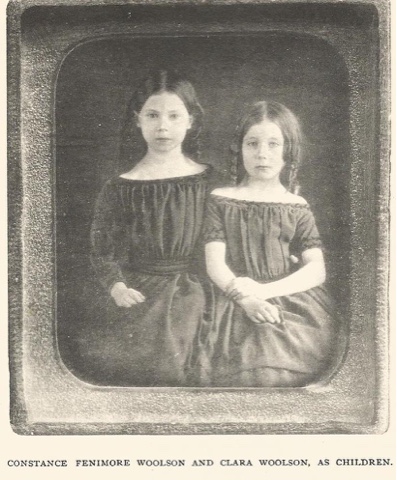
Showing posts with label Constance Fenimore Woolson. Show all posts

Saturday, January 16, 2016

"Miss Grief" and Other Stories Constance Fenimore Woolson edited by Anne Boyd Rioux with a Forward by Colm Toibin (Forthcoming February 2016)


Contains a good short bio and a list of her works.


Any day I discover a new to me writer whose first work I read makes me want to read all their work is not an entirely bad day.   My most recent "discoveries" are Iréne Némirovsky and Clarice Lispector.  After reading  "Miss Grief" I am close to adding Constance Fenimore Woolson (1840 to 1894, USA, her grand uncle was James Fenimore Cooper) to my read all I can list.

Drawing on the very insightful historically informed introduction of Rioux, Woolson was born in 1840 in Cleveland, Ohio and died in 1894 from a fall from a third story window in Venice, Italy.  She wrote five novels, the post popular was Anne what way out sold at the time Henry Jame's Portrait of a Lady.  James and Woolson were friends, both Toibin and Woolson talk about the influence of James and their relationship.  Woolson never married, having lost a man she loved to another woman in her younger days.  She was raised in a cultured enviorment, encouraged to read Dickens, and, as Rioux tells us, and I saw it clearly in Anne, was very influenced by Eliot.  

Her writing live can be roughly divided into three periods.  From around 1870 to 1875 she wrote stories centering on the American Great Lakes region, where she grew up.  From late 1875 to 1879, she and her mother spent much time in the American south and her stories center in this region.  When her mother died she moved to Europe, spending most of her time in Italy.  It is here she developed her relationship with James.  

Woolson, in her life very popular, quickly faded to obscurity where she still largely lingers.  I hope so much Rioux's collection and her biography (I will post on it soon, after I reread it) revitalize her readership.  I did a book blog search and found very few posts on her but mine.  


When I saw a collection of her short stories offered to reviewers on Edelweiss I decided to request it largely because Colm Toibin contributed the foreword. I based this on my love for his novel on Henry James, The Master.    I was embarrassed as I read the foreword and introduction to learn she was at one time one of America's best selling authors,as  I had never heard of her.   I learned she faded from public view and was only currently mentioned by and large because of her long term friendship with Henry James.  James lived for a while in a villa Woolson rented in Florence.  Toibin and Anne Boyd Rioux make a lot of interesting observations about the use James might have made of their relationship in Portrait of a Lady and a few of his short stories.  The fioreward and introduction are really well done.

The anthology of her short stories is truly  a first rate production.  Every story is  introduced  and full details on the publication history of the stories is provided.  (One of my bet literary peeves centers on collections of short anthologies that do not include first publication data.)

I will talk in enough detail on the stories to give readers a sense of the great range of her talents. 

I strongly endorse this collection to all lovers of the short story and urge all teachers of American literature to add Woolson to the ciriculum.  

"Miss Grief" is set in Florence.  An older slightly impoverished looking woman begins making daily visits to the home of a very sucessful American writer.  He thinks she is probably an antique dealer or collector. He keeps avoiding her, having his butler tell her he is not in.  Finally he relents and it turns out she has written something  she wants him to read.  He reluctantly agrees and she insists she will come back in a few days for his reactions.  He sees lots of faults with the work but he is deeply impressed by the sheer depth of her creation. When she returns he tells her of changes she should make in the work.  He tells her if she follows his suggestions, he will submit it to his editor for possible publication.  She adamantly refuses to his great surprise.   She begins, in the company of what he takes to be her maid, to visit regularly.  He reads more of her work and is amazed.  He tries himself to rewrite her work but he finds he cannot change it without the work falling apart.

I will leave the close unspoiled.  It is very interesting, sad and moving.

Part of the power of the story is in the very brilliant    way the relationship between Miss Grief, which is actually a mispronouncing of her name, and the male author is depicted.  Of course as I read it I found it hard not to see the writer as Henry James.

"The Florentine Experiment"

Woolson's short stories are set, with one exception in this anthology, either in the American Great Lakes region where she grew up, in the American south, or in Italy where she spent the last years of her life, as Rioux elegantly details in her wonderful introduction.


"The Floretine Experiment, first  appeared in Harper's Magazine in 1880'and was included in the collection Dorothy and other Italian Stories and is included in this collection. 

I think Riioux has captured this story in her introduction:

"It also reflects Woolson’s interest in James’s writing, for in it she consciously set out to write the type of story at which he was considered to excel—the society tale in which the talk is more important than the plot and in which, she felt, manner was placed above matter."

It does reflect the great talent of Woolson to be able to write a story like this as well as others like "Solomon", "Miss Grief" and "Saint Claire Flats" which are complete unique in style.  The dialogue is very good and the backdrop of art saturated Florence is well utilized.

"St. Claire Flats"

This might be my favorite of her stories.

"Saint Claire Flats" is set in a very marshy area of the Saint Claire Lake area near Detroit, Michigan.


Flats are a very marshy, normally with water not deep enough for big boats.  They are, or in those days were ideal habitats for very abundant fish and birds.  They were often visited by sports fisherman and duck hunters.

The story centers in part on two men from Cleveland come to the flats to fish.


The story starts out marvelously with very beautiful nearly lyrical descriptions of the rushes, the birds and the water.  I really felt and wished I was there.  There is talkof a canal that will be built that will greatly damage the flats, destroying the habitat.  The work is in a powerful way the story of the destruction of the American natural environment for the sake of commerce and money.    The men need to leave the big paddle boat, Woolson describes the boat trip perfectly, as well as Mark Twain.  

Compressing a good bit, the two fishermen are directed to a small island in the flats where they are told they can be boarded while fishing and hunting the area.  The opening of the story is beautiful but nothing prepared me be taken by Woolson deeply into a very dark strain of American culture through the words spoken by the man and wife who live on the island.  This story alone makes buying Miss Grief and Other Stories necessary.  It would, I think, make a wonderful class room story in American schools.  I think in order to really "get" this story you need an understanding of the American concept of Manifest Destiny and an overview of the westward expansion of the country from the Atlantic coast. You also would benefit from an understanding of the part chiliastic religious thought played in American society in the period in frontier areas.

Like the other stories I have read, there are two sets of people in the story, "tourists" from main stream society and near outcasts, stranger seeming people into whose world they temporarily intrude.  I thought for a good while as to whether or not to try to tell the "plot" and I decided not to do so.  

I will instead quote a few of the remarks made by the man on the island, a visionary who feels he is in direct contact with God.  I will say the depiction of the relationship of the couple is just so deep, so complex as to be a great wonder of American literature.  

"“What seek ye here?” continued the shadow. “Rest!” replied Raymond. “Hunting and fishing!” I added. “Ye will find more than rest,” said the voice, ignoring me altogether (I am often ignored in this way),—“more than rest, if ye stay long enough, and learn of the hidden treasures. Are you willing to seek for them?” “Certainly!” said Raymond. “Where shall we dig?” “I speak not of earthly digging, young man. Will you give me the charge of your souls?”  Spoken by the husband as they enter the house on the marsh island.

"“I am not Mrs.; I am called Roxana,” replied the woman, busying herself at the hearth. “Ah, you are then the sister of Waiting Samuel, I presume?” “No, I am his wife, fast enough; we were married by the minister twenty years ago. But that was before Samuel had seen any visions.” “Does he see visions?” “Yes, almost every day.” “Do you see them, also?” “O no; I’m not like Samuel. He has great gifts, Samuel has! The visions told us to come here; we used to live away down in Maine.” “Indeed! That was a long journey!” “Yes! And we didn’t come straight either. We’d get to one place and stop, and I’d think we were going to stay, and just get things comfortable, when Samuel would see another vision, and we’d have to start on. We wandered in that way two or three years, but at last we got here, and something in the Flats seemed to suit the spirits, and they let us stay.” The story of how Roxanna and Samuels got to the flats where they work hard but have a good life. 


There is an incredible description of a meal Roxana serves her guests.  You will love it.


"“Do you believe in these visions, madam?” asked Raymond, as we left the table, and seated ourselves in front of the dying fire. “Yes,” said Roxana; emphasis was unnecessary,—of course she believed. “How often do they come?” “Almost every day there is a spiritual presence, but it does not always speak. They come and hold long conversations in the winter, when there is nothing else to do; that, I think, is very kind of them, for in the summer Samuel can fish, and his time is more occupied. There were fishermen in the Bible, you know; it is a holy calling.” “Does Samuel ever go over to the mainland?” “No, he never leaves the Flats. I do all the business; take over the fish, and buy the supplies. I bought all our cattle,” said Roxana, with pride. “I poled them away over here on a raft, one by one, when they were little things.” “Where do you pasture them?” “Here, on the island; there are only a few acres, to be sure; but I can cut boat-loads of the best feed within a stone’s throw. If we only had a little more solid ground! But this island is almost the only solid piece in the Flats.”

The narrator returns to the flats many years later.   The close of the story is mysterious heartbreaking.  Roxana and Samuel will remain with those who give this story the respect it deserves for a very long time.  

This story is a great work of art 

"Soloman"

"Soloman" is a heartbreakingly sad story about a man who never found his way as an artist, living his life out doing the terrible drudgery of working as a coal miner in Ohio for a community of German immigrants.  I am sensing a theme in Woolson of Protestant versus Catholic cultures but it is way too early in my venture into the oeuvre of Woolson to talk about this. In this story she also, just like  in  "Sister Saint Claire" deploys  visiting tourists, in this story to the Zoar community of Germans. In a sense even in "Miss Grief" Woolson employs at the least cultural tourists. 

 It helps a lot to understand this story if you know a bit about the back story of Zoar, Ohio.  (Woolson's stories are great motivators to learn new things, a big pleasure for me.)


The community was founded by Germans in 1817 seeking freedom to practice their religion. By 1877, having kept the architectural styling of a German village from the early 19th century, it had become an attraction for curious visitors from Cleveland and elsewhere in the vicinity. There were hotels and business and such catering to visitors.  The community still exists (per their very well done webpage they have about 200 residents still living in the old ways) and is designated as an American Historical Place of Importance.  Below is a picture, I think, of the hotel where the toursists ladies from Cleveland stayed when they visited Zoar.  You can book a room on the town webpage! 


Below is an image of residents of Zoar at harvest time at about the time of the story.


To compress the action of the story, which I don't desire to trivialize by retelling the plot, the tourist ladies go to the home of a man who works for the Zoar community,in their coal mine , and his wife.  They discover many paintings the man has done over the years of his wife.  He tried for a long time to make a living as an artist but failed.  You can see his spirit is nearly broken by the overwhelming sadness  and emptiness of his life.

  The relationship of man and wife is strained, odd and very hard for me to articulate.  Sometimes it seems the wife has contempt for her husband for his failure as an artist and sometimes I felt a great love.  A dog plays a central role. The artist says little but is very gratified when the ladies ask to see all his work.  In the many paintings they sense an untaught passion and a raw artistic power that nearly overpowers the one tourist lady who has studied art.  

Happy endings are, it seems so far, in short supply in the stories of Woolson and I was almost moved to tears by the deadly close of "Soloman".  This is a story that will haunt and deeply impact anyone who wanted to be an artist, a writer but gave it up  and knows in her or his twilight years that with a few simple changes what  they could have been but now understands  they never will materialize what they could have been. It is partially about the sadness of learning what you should have been to late in life, to knowing your spirit is too broken now to really matter.

The prose style of Woolson is really unique.  

"Rodman the Keeper"

Roman the Keeper" is a truly great short story.

As I learned in Rioux's introduction to the story, it is set in a Union (Northen States) Civil War cemetrary like the one in Salisbury, North Carolina.  Emotions still ran very deep in the defeated South against northerners.  Rodman was a soldier for the North in the war.  He advanced to the rank of Colonel and suffered serious wounds.   During the war he lost his fiancé, his family and afterwards his money.  He accepted a job as the keeper, manager, of the cemetrary as he wanted solitude and he somehow sought atonement for the massive war deaths.  Woolson does a just wonderful job of slowly bringing Rodman to greater and greater realization.

The area is isolated.  Rodman stops at the well at a nearby house, he thinks it is abandoned and is shocked to find a sick man there.  He was a confederate soldier and they bond over their common experiences.   He sees the man has only the simplest foods so he brings him dinner.  Compressing a lot, he meets the man's only living relative, his younger female cousin.  There is a lot of real depth and brilliance in the depictions of the characters.  I don't want to give away too much.  Some very politically correct readers may rankle at how ex-slaves are portrayed in the story but those were the ways of the times.

"Sister Saint Luke"


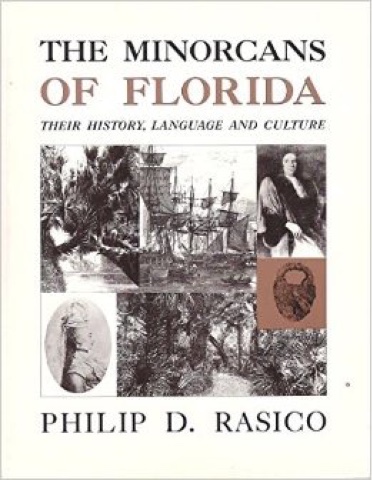
There are five people in the story.  Keith and Carrington are two friends who have come together from the north to enjoy the wildness of the area and get away from the cold, tourists.  The other characters include Pedro, a descendent so of the Minorcan colonists who had come long ago in a group of 1300 or so from Greece, as indentured servants,  I Goggled the Minorcans and was fascinated to learn some very interesting Florida history.  I admit I was impressed that pre-Internet Woolson knew this aspect of local history.  To me this shows the real respect Woolson has for her subjects.  Never in this story do I feel the what could have been made backwoods Florida characters treated in a fashion that tries to reduce their full humanity.  We also meet Melvyna, she came from the north to be a private duty nurse and stay there when her patient died.  She ended up marrying Pedro.  I really liked the depiction of their marriage.  They live on Pelican Island and keep the lighthouse there.  Keith and Carrington are staying there a while and they also meet an ex-nun, Sister St Luke who also stays there.


Melvyna is a strong self reliant woman living in a place where you have to know how to take care of your self and your family.  She and Pedro have a good, it seems, relationship.  Buried in the storyline is no doubt a commentary on the differences of the attitudes toward life of Catholic Pedro, his name is no accident, and  Protestant Mevyna of tough "Yankee" stock.  Sister Saint Luke is an interesting person, it seems somehow she was left at a nunnery at an early age and put out once she became an adult.  She is a bit child like, longing to return to the security of the nunnery.  The characters of Keith and Carrington are not quite as well developed but from their actions and words we get to know them.  They are both decent men.

There are beautiful descriptions of the area.  There is a powerful storm.  The description of the flock of 100s of Pelicans makes me so wish I could time travel to see it.  


Exciting things happen toward the close of the story which I will leave for others to enjoy discovering as I very much did.

I really enjoyed reading this story.  I have a special interest in Florida history and that made the story resonate greatly with me.  

In her very well done introduction to Miss Grief and other Stories Anne Boyd Rioux mentions two other set in Florida short stories and I hope to read them both very soon.  

There is a lot of depth in this story, issues about cultural contrast buried in a passing remark.  It is also flat out a lot of fun to read.

"In Sloane Street"

"In Sloane Street", her only story set in England is described by Toibin as a work showing her skill at writing a story closely observing emotions in a small setting in the manner of Henry James.  He says it is her best story in the collection.  I found the characters discussion of art and the work of George Eliof fascinating.  

This anthology should be studied by anyone contemplating editing a volume of short stories.  Rioux deeply knows Woolson, works from an academic background and helped me understand not such Woolson but the business side of American literary life.  

I have added Woolson to my read all I can list.  Woolson is an amazingly versatile writer. I thank Rioux for introducing me to her. 

I strongly endorse this book for all lovers of the short story, maybe especially Americanx.  I hope teachers will add her work to the ciriculum and suggest all librarians acquire this work.

Rioux does not belong in the shadow of Henry James and I hope Rioux's books help her reemerge.  These stories are tremendously enjoyable and exemplfy short story art at a very high level. 

I will soon, I hope be doing a Q and A Session with Rioux and will post on her biography of Woolson, also forthcoming in February. 
 

I hope later in the year to do post sort of comparing her to other writers whose work I love, Iréne Nemirovsky and Clarice Lispector.

Anne Boyd Rioux is a professor at the University of New Orleans and the author of Constance Fenimore Woolson: The Portrait of a Lady Novelist, forthcoming from W. W. Norton.


Mel u


Sunday, December 27, 2015

"The Front Yard" - A Short Story by Constance Fenimore Woolson (1895)


I began 2015 having never heard of Constance Fenimore Woolson.  I end the year with her securely in my list of favorite writers.  I have so far read about fifteen of her wonderful short stories  and her highest regarded novel, Anne.  (There is background information on her in my prior posts.)  

"The Front Yard" is a terribly sad near heartbreaking story set in the hills of Tuscany about a woman from New England who marries an Italian man eighteen years  her junior.  She felt sorry for the man because he lead her to believe he as all alone in the world.  When for the first time she goes to live in his house she discovers he has eight children from a wife who died a year ago, a nasty as can be mother and a reprobate uncle living with him.  She is expected to be the care giver for them.  Soon her husband dies and instead of moving on she is driven by a sense of duty to stay on, using her little money to feed the totally ungrateful near abusuve mother and her step children.  Her money gives out and she takes a menial job working sometimes fourteen hours a day.  The years go by, the woman ages and her mother in law gets crueler, the children more demanding.  Her dream is to remove a shed from her front yard, allowing a nice view.  

To me the cruelest moment in the story was when one of the step daughters tells her she needs money for a wedding gown.  She has found a rich husband. The woman gives her moneyfrom her very small savings and then says she will need herself a dress to go to the wedding.  The daughter tells her she is not invited because the step daughter feels she will not be comfortable among higher class people.  In fact she is embarrassed by her step mother.

This is a story many step parents will appreciate.  It is full of pain and rings of the truth.

In January or early February I hope to do a Q and A session with Anne Boyd Rioux.  Her magnificent biography of Woolson and her anthology of Woolson stories will be out in February, 2016.


At some point next year  I am hoping to do a joint post on Woolson, Clarice Lispector, and Iréne Nemirovsky. 


Mel u


Saturday, November 28, 2015

Anne by Constance Fenimore Woolson. 1882


"Anne was an ambitious first novel. It is an engrossing book, carrying readers along on a sea of absorbing observations and then sweeping them up in scenes of intense emotion. Its great originality is to be found in what many saw as her thoroughly American heroine and her loving tribute to Mackinac Island in the opening chapters, which many readers (including Henry James) felt was the novel’s strongest section."   From Constance Fenimore Woolson Portrait of a Lady Novelist by Anne Boyd Rioux

A couple of months ago I had never heard of Constance Fenimore Woolson (1840 to 1894, an American novelist, short story writer, travel author and poet).  Now I consider her a great writer. I am so glad to have found her and I thank Anne Boyd Rioux for this discovery.  There are no book blog posts but mine on Woolson which tells me she is virtually unknown.  I hope the two books of Anne Boyd Rioux being published in February of next year (you can pre-order on Amazon) will restore her reputation.  She is at least as good a writer as Edith Wharton, who I greatly admire.  For sure her range is wider than Wharton.  


One day I was looking at the new books for review on Edelweiss and I saw a biography of Woolson and a collection of her short stories, both by Anne Boyd Rioux.  I saw the collection of short stories had a preface by Colm Toibin whose opinion I greatly respect
and I also love a good literary biography sp I requested and was kindly given review copies of both books.  I first read the preface by Toibin which placed her in cultural context and sketched out her connection to Henry James.  The short story collection is called Miss Grief and Other Stories by Constance Fenimore Woolson (James Fenimore Cooper was her great uncle) so I decided to read the title story first.

 Rioux has provide very interesting short introductions to each story so I knew it was set in Florence (Woolson spent a lot of time there) and many see the story as Woolson drawing on her relationship to Henry James.  I loved the story and there are now posts on about twenty of her short stories on The Reading Life some by Ambrosia, mostly the set in Italy stories, and some by myself.  I am posting on the set in America short stories. All of the stories are wonderful works and some can stand with the best of all short stories.  In her excellent biography Rioux explains how Woolson fell from fashion and out of the American literary curriculum. 


Other than through reading Woolson all i know about her comes from the books of Rioux.  Next year I will post on her biography and Rioux has kindly agreed to due a Q and A session on The Reading Life.  

Anne at nearly six hundred pages is a long novel.  It can be taken as a coming of age story of a young American woman.  Rioux talled in her biography about how strongly Woolson was influenced by George Eliot, especially by The Mill on the Floss.  I had been planning to read this novel for about fifty years so I decided to read it before I read Anne.  The influence is strong, I saw it right away in the descriptions of nature in the opening chapter of Anne.  Anne was serialized for eighteen months in the very prestigious at the time Harper's Magazine.  In the opening chapter Woolson does a just wonderful job describing the atmosphere on Mackinac Island.


The plot line begins maybe about 1855, a few years before the American Civil War, which will play a big part in the story.  In those days Mackinaw Island was kind of a primitive place, lots of Indians still lived there.  (One could pull apart how Woolson portraits Indians in the opening section and twist it into something negative but in a deeper vein I think that is mean spirited and shows shallow reading.)
Anne's father is a physician, working for the army.  Anne's mother died and her father remained a woman who was of French and Indian Ancestory.  With her he had two sons and a another daughter.  This wife died also and Anne is kind of the head of the family now, her father is to a degree in his own world, withdrawn from the pain. 

 In the first chapter I bet Harper's readers felt they were in for a wild ride with so many plot lines left open.  In America in the1850s where your ancestors were from was very important, you were not just American but seen as German, English, French and so on American. Each nationality was seen  as having certain characteristics, for example Woolson in other works treets Germans as very hard working and thrifty, the French as pleasure lovers.  As we see in the great Victorian novels, extended family, partially because of the early deaths of the period, play an important part in the plot of Anne.  There is a domineering wealthy  spinster Aunt with a slightly mysterious past that plays a big role in the life of Anne that could come right out of a work by Balzac or Dickens.  

I am not inclined to retell the plot.  I will just talk a bit about some of the things I really like about the novel and some slight reservations I have.  

The novel has three, maybe three and a half segments.  The first part, Henry James says the best and it is wonderful, is set during her late childhood and early adult years on Maginaw Island.  She falls in love with a local man and he becomes her finance.  Then to begin the next section a wealthy spinster aunt living in New York State, offers to sponser her in college for women teachers and suppprt the family back on the island until Anne graduates.  This is kind of standard melodrama of the period though Woolson does it very well.  The college scenes are interesting and I saw the world of Anne expanding and her mind growing.   Of course there has to be at least one romance and there are two men interested in her.  One suitor is highly endorsed by her Aunt, wealthy family background.  As things get complicated Anne refuses the marriage proposal saying she was engaged, then, leaving out a lot of exciting action, remember every magazine segment had to end leaving readers wanting badly to know what will  happen next, Anne learns her fiancé has married her younger half sister!  Now she is free to marry and much drama ensues.  The aunt goes nuts when Anne refuses to marry the man she picks out for her.

The civil war breaks out and Anne and some lady friends of hers from school, volunteer as nurses, we are now in phase three of the story.  Now things get complicated and a bit weird.  I will leave it untold other than to say Anne turns into a murder mystery solving detective and saves a man from hanging.  

To me the weakness in Anne is in her romantic interests. I don't find the romantic leads very convincing.   I was glad things ended well for Anne.

There are numerous great minor characters, I loved the French cook, I would have liked to have seen more time devoted to the half sister but maybe this needed another novel.   The natural descriptions are very well done.  The great aunt is wonderful,
but her own romantic past and how it impacted the story made me groan at first but then I accepted it.  

Next year I hope to do a post sort of talking about the similarities and differences between Woolson and two literary ladies I have fallen for this year, Iréne Nemirovsky and Clarice Lispector.

I hope to read all of Woolson's novel, only five I  think, and as many of her short stories as I can download in Kindle editions, I am guessing thirty.  

To all into the 19th century American novel, give Anne a try.  

I bet this would be an excellent class room book for honors sections.

Mel u


Sunday, November 8, 2015

"A Florentine Experiment". A Short Story by Constance Fenimore Woolson (1880, included in Miss Grief and other Stories edited and introduced by Anne Boyd Rioux, Forthcoming February, 2016)

A post by Ambrosia Boussweau, European Correspodent of The Reading Life


"The Floretine Experiment, forest appeared in Harper's Magazine in 1880'and was included in the collection Dorothy and other Italian Stories and will be in the excellent collection edited by Anne Boyd Rioux, Miss Grief and other Stories  Constance Fenimore Woolson.

I think Riioux has captured this story in her introduction:

"It also reflects Woolson’s interest in James’s writing, for in it she consciously set out to write the type of story at which he was considered to excel—the society tale in which the talk is more important than the plot and in which, she felt, manner was placed above matter."

It does reflect the great talent of Woolson to be able to write a story like this as well as others like "Solomon", "Miss Grief" and "Saint Claire Flats".  The dialogue is very good and the backdrop of art saturated Florence is well utilized.

Ambrosia Boussweau 


Thursday, October 29, 2015

"At the Chateau of Corrine" A Short Story by Constance Fenimore Woolson, included in Dorothy and other Italian Stories, 1896, first published in Harper's Magazine, October, 1887)

A post by Ambrosia Boussweau, European Correspondent of The Reading Life

Contains a good short bio and a list of her works.


"At the Chateau of Corrine" takes place on the shores of a large lake, called by the Swiss Lake Geneva and Lake Leman by the French.  The action centers on the visitors to a chateau on the lake.  Last November Mel posted on an excellent short story by Stefan Zweig "An Incident on Laks Geneva".  These two,stories, Zweig's was written about 1930, would make an excellent reading pair.  I could not help but wonder what Constance would have thought of the very cultured, worldly and wealthy Zweig.


"At the Chateau of Corrine" displays the extreme versatility and authorial skill possessed by Constance.  It is very different in prose style from stories, set in America, like "St. Claire Flats", "Solomon", "In Cotton Country" or "Felipe".  "At the Chateau of Corrine" contains no strange or marginalized personas, no isolates from crumbling aristocracies, no obvious mythological overlays. The persons are educated, socially adapt, and affluent.   It almost feels like Constance is saying, "let me show these Europeans just how refined an American girl could be when she put her mind to it".  Many famous writers like Byron, Voltaire, Charles Gibbon and, she will play an important part in the story, Madame de Staël. 

I like the opening lines.  Those who have read the American set stories will feel at once a marked difference.

"On the shores of Lake Leman there are many villas. For several centuries the vine-clad banks have been a favorite resting-place for visitors from many nations. English, French, Germans, Austrians, Poles, and Russians are found in the circle of strangers whose gardens fringe the lake northward from Geneva, eastward from Lausanne, and southward from Vevey, Clarens, and Montreux. Not long ago an American joined this circle. The American was a lady named Winthrop. Mrs. Winthrop's villa was not one of the larger residences. It was an old-fashioned square mansion, half Swiss, half French, ending in a high-peaked roof, which came slanting sharply down over several narrowed half-stories..... 
Mrs. Winthrop had taken possession of the villa in May, and it was now late in August; Lake Leman therefore had enjoyed her society for three long months. Through all this time, in the old lake's estimation, and notwithstanding the English, French, Germans,  Austrians, Poles, and Russians, many of them titled, who were also upon its banks, the American lady remained an interesting presence. And not in the opinion of the old lake only, but in that also of other observers, less fluid and impersonal. Mrs. Winthrop was much admired. Miolans had entertained numerous guests during the summer; to-day, however, it held only the bona fide members of the family—namely, Mrs. Winthrop, her cousin Sylvia, and Mr. H. Walpole, Miss Sylvia's cousin. Mr. H. Walpole was always called "Cousin Walpole" by Sylvia, who took comfort in the name, her own (a grief to her) being neither more nor less than Pitcher. "Sylvia Pitcher" was not impressive, but "H. Walpole" could shine for two. If people supposed that H. stood for Horace, why, that was their own affair."

Ok I loved the Horace Walpole reference.  The very real fun of the story is seeing the interaction of Mrs Withrop and her family with the other residents on the lake.  One member of the family is an aspiring author and she is pursued by a wealthy youngish bachelor.  The lake has enjoyed as residents some of the great writers of the European tradition.   Madame de Staël stayed in a chateau on the lake and was visited by many illustrious figures.  Mrs. Withrop and her family are very taken with tne connection to Madame de Staël.  There are lots of interesting conversations.  Byron wrote Childe Harold on the lake and this attracts poets, one of whom plays a big part in the story.


Perhaps tne grand theme of the story concerns whether a woman can be both a committed writer and a wife.


I wish I was able to attend the presentation of Anne Boyd Rioux.  I hope the publication of her two Woolson books in February of next year will introduce Constance to readers all over the world.  

Mel and I have begun her novel Anne.  I will continue on with her European short stories.

Several of Woolson's works, including Dorothy and other Italian Stories can be downloaded for free on Amazon.  There are also two E books for sale that suggest they are the complete works of Woolson.  They are not at all complete and should not be purchased. 


Ambrosia Boussweau 


Monday, October 26, 2015

"Bro." A Short Story by Constance Fenimore Woolson (1880, included in Rodman the Keeper Southern Sketches)


Ambrosia Boussweau, European Correspodent of The Reading Life, looks at "Bro." And other stories of Constance Fenimore Woolson in the light of Frank O'Connor's ideas on the short story.


Contains a good short bio and a list of her works.


I have been reading along with Mel the short stories of Constance Fenimore  Woolson 
 (born 1840 in New Hampshire, died 1894 in Venice, Italy).  I have also read Constance Fenimore Woolson Portrait of a Lady Novelist by Anne Boyd Rioux, a wonderful book, a true labor of love.  

The only book worth reading on the short story is The Lonely Voice A Study of the Short Story by a great Irish practitioner of the craft, Frank O'Connor. I want to look at Woolson's "Bro." and  other of her stories to see if they can be read in accord with the ideas of  O'Connor who had three interrelated theses about the nature of the short story.   One was that short stories are about marginalized  people on the fringes of society with no one to speak for them.  Secondly he felt short stories can often be seen as literary studies of loneliness.  Third he saw the central characters in short stories as symbolic representations of mythic or religious figures.  He devotes much of the opening chapter of his book to Gogol's "The Overcoat".  He devotes  chapters to Guy de Maupassant, Ivan Turgenev, Issac Babel, Mary Levin, and Katherine Mansfield.   Some of his observations are quirky but they are always interesting.


"Bro." Is set on an island.  Our title character "Bro" ferries  himself and others to the island.  He thus evokes the figure of the ferryman in myths from ancient Egypt up to medieval legends of ferrymen.  He is an isolate and works in a mill. He also invents mechanical devices.  He lacks conventional social skills.  He takes his meals with and is very close to the family that owns the mill.  He has long been in love with their daughter.  He is kind of a man beast figure.  One day the grandson of a family friend returns to the island after a years long absence.  Clearly he symbolizes the return of the prodigal son and can stand for a miriad of wandering figures.    Soon he and the young woman are in love.  He wants to marry her but he also wants to go back to Europe but he does not have the funds to take her along, or maybe that is an excuse.  Now he is the wanderer, the stranger, who steals the virgin daughter.  The grandson is not an evil person, just not a saint.  He sends some inventions Bro has made to a patent attorney he knows who ends up selling the idea for a screw for $10,000, a huge fortune at the time.  Bro then, through a proxy keeping himself anonymous, offers to buy some waste land on the island from the grandson for $10,000.   He knows now the grandson can marry the woman and take her away.  He then embarks on a program of development for the land that will make the woman want to come back.  It is also the story of the creation of civilization from the efforts of an isolate strange figure, a mechanical creator and a creator of living space out of the sate who asks for nothing for himself.  We have here also a version of the legend of Orpheus and Eurydice, with Europe as the upper world and the backwoods island as the underworld.  

River islands play a part in two other Woolson stories we have read so far, "Sister Saint Luke" and "Soloman".  There are lots of legends and myths centering on river islands in central and Eastern European mythology.  The story "Soloman" screams out yes I fit the O'Connor pattern.  The figure of the failed artist resonates to more cultures than we can find space enough to explore.  "Saint Claire Flats"  is perhaps the most evocative story, it is partially about the myth of America but it goes deep to the roots of culture and the spread of civilization. 

We will next be reading the "Italian Stories" of Woolson.  The Boussweau family has a long connection with Venice, establishing trading routes to Indian.  The family maintains a residence on the Grand Canal.


Ambrosia Boussweau 

Thursday, October 22, 2015

"Old Gardiston" - A Short Story by Constance Fenimore Woolson (1880, in Rodman the Keeper Southern Sketches)


"It was the only way they knew. Cousin Copeland lived only in the past, Gardis in the present; and indeed the future, so anxiously considered always by the busy, restless Northern mind, has never been lifted into the place of supreme importance at the South."   From "Old Gardiston"

"She possessed  traditions in decay but still standing. And since there was no new criterion to sustain all those vague and grandiose hopes, the weighty tradition still held. Tradition of what? Of nothing, if you had to pry. The only argument in its favor was the fact that the inhabitants were backed by a long lineage, which, though plebeian, was enough to grant them a certain pose of dignity. She thought, all wrapped" - Clarice Lispector


Having read ten short stories my Constance Fenimore Woolson I am beginning to see why I like her work so much.  Each  of her stories, varying in length (I E read so a direct comparison to book page lengths is inexact) from twenty five to fifty pages creates a complete self contained world with its own values, history, physical enviorment and interesting people, especially focused on women. The stories seem to focus on cultures in decline from old aristocracy and have buried deep within them contrasts of Northern and Southern Values.  This dichotomy may at first jump out in the stories in Rodman the Keeper Southern Sketches as just an American matter but it goes way back in European history to at least the working out of the social consequences of the rise of the reformation  in Northern Europe and probably much further back.    I was thinking yesterday that her stories remind me of those of Alice Munro who creates so much of life in her works.

Woolson, I am struggling with what to call her, felt deeply tne impact the defeat of the Southern States in the American Civil War (1861 to 1865) had on the old planter castes, the owners of the great plantations, the former aristocrats.  (For a visual flash to Scarlett O'Hara struggling to keep her home and family intact after the defeat). "Old Gardiston" is set, I think, somewhere in the Carolinas in a once grand now in ruins plantation house named "Old Gardiston". The family ownership goes back maybe two hundred years.  It is just shortly after the end of the war, maybe 1867.  There are still northern troops occupying the territory.  Living in the house are Gardis Duke, a young woman, her cousin Copeland, a bachelor in late middles ages.  Gardis is educated as a woman of an aristocratic family in a Jane Austin novel would be, Copeland spends all his time researching old family history.  There are also two former slaves still working for them.  One day two Union officers, regarded as pure villains by the  planter caste, advise Gardis that the troops they command will camp on the plantation.  Even though Gardis is assured by the very gentlemanly acting officers that they will in no way be harmed by this she is agast almost catching the vapors (ok, I could not resist that).

The plot action gets very interesting.  The officers are given an obligatory by customs dinner invitation and they are both quite charming, single and taken with Gardis.   Gardis and Copeland are supported by the rent they receive from a warehouse they own in town.  The plot is so intriguing I will not tell anymore, just make a few observations.  It is exciting and dramatic and kept me very involved.

In terms of romantic actions, the  story is a throw back to the Georgian era where men fell at once in love with a woman based on her looks and knowing little about her, decide they must marry her no matter what.  It is total love at first sight.  The use of this in this story strains credibility and but maybe Woolson felt her readers and magazine editors would want a romance with some intrigue so she threw one, actually two into the plot.

The characters are very interesting, the picture of the old south being despoiled by venal opportunists is brilliant.  

I was startled by this paragraph, describing Cousin Copeland's efforts to find a job.

"Reaching the town at last, he walked past the stores several times and looked timidly within; he thought perhaps some one would see him, and come out. But no one came; and at last he ventured into a clothing-store, through a grove of ticketed coats and suspended trousers. The proprietor of the establishment, a Northern Hebrew whose venture had not paid very well, heard his modest request, and asked what he could do. "I can write," said Cousin Copeland, with quiet pride; and in answer to a sign he climbed up on a tall stool and proceeded to cover half a sheet of paper in his best style. As he could not for the moment think of anything else, he wrote out several paragraphs from the last family document. "Richard, the fourth of the name, a descendant on the maternal side from the most respected and valorous family--" "Oh, we don't care for that kind of writing; it's old-fashioned," said Mr. Ottenheimer, throwing down the paper, and waving the applicant toward the door with his fat hand. "I don't want my books frescoed."

This gives me pause.  

I owe my discovery of the short stories of Woolson, which I regard as world class literary treasures, to Anne Boyd Rioux.  I hope the Febuary 29, 2016 publication of her two wonderful books will bring Woolson back into fashion.  


Much of Woolson work, her total oevere is not real huge, can be downloaded at Manybooks.org.

I have easy access to eight more Woolson stories and hope to read them soon.

I love her prose. 

Mel u


Tuesday, October 20, 2015

"Miss Elisabetha" a short story by Constance Fenimore Woolson (1880, included in Rodman the Keeper Southern Sketches)


Constance Fenimore Woolson spent a lot of time in Florida, mostly in the Saint Augustine area.  (Saint Augustine was the first colonial town in what is now the United States, established by the Spanish.)

Three of her short stories are set in Florida.  In every story a descendent of Minorcan colonists plays an important part.  Thinking I am perhaps not the only one whose knowledge of Minorcans is very low I am taking the liberty of sharing this information from Ancestory.com.


The Minorcans in Florida

The Peace of Paris in 1763 gave Florida to the British.  When the British entered Florida they found it depopulated.  To promote settlement the Proclamation of 1763 offered easy terms to prospective settlers who desired land grants.  A Scottish physician, Dr. Andrew Turnbull, siezed this opportunity.  Realizing that citizens from the British Isles might have difficulty with the heat and humidity in Florida he resolved to use Greeks, who were accustomed to such conditions and knew how to cultivate olives, cotton, madder, and tobacco, as settlers.  He had experience with the Greeks as his wife was Greek.  He received large grants of land near the Ponce de Leon Inlet (near present day Daytona).  His plans called for 500 Greek settles to cultivate crops that would thrive in the Florida climate.  He called his colony New Smyrna after the birth place of his wife.

Turnbull arrived at the port of Mahón on Minorca in June 1767.  This was the perfect base for his operations.  The island was owned by the British and the harbor of the port Mahón was deep and well sheltered.  His original intention was to go to Greece to enlist immigrants, but he postponed his trip and instead went to Leghorn, Italy where he heard there were some Italians willing to immigrate to British East Florida.  The Italians who signed on with Turnbull, all male, were transported to Minorca.  In July Turnbull departed for the Levant.  While he was on his voyage, his agents found a number of Greeks on the island of Corsica who were willing to join his venture.  His recruiting efforts in Greece were much more difficult.  Eventually about 200 Greeks from among the peoples of Mani in the Peloponnesos, and a handful of Greeks from a variety of other locations were recruited.  Turnbull returned to Mahón in February only to find that many of the Itallians had married Minorcan women.  An additional group of about one thousand Minorcans persuaded Dr. Turnbull to accept them as colonists.  On 17 April 1768 Turnbull left Minorca with eight ships carrying 1403 colonists, almost three times more than his original plan.  End quote

Woolson was clearly fascinated by the Minorcan descendants still in the area.  I think it is part of a dicta you of Protestant versus Catholic, Northern European versus Southern and one must acknowledge lighter skinned people versus darker.  I am just a Woolsonian neophyte and I am speculating by foisting this on her but it seems hard not to see it.  

"Miss Elizabetha" takes place in the 1870s in rural North East Florida.  Miss Elizabetha came down long ago from the north and never left.  She has a small farm where she grows a lot of her needs.  To earn cash she weaves palmetto leaves into baskets and such for the tourist trade.


She has a ward, a boy of Spanish ancestory.  Her life revolves around him, she is home schooling him and is focusing on his ability as a singer.  Miss Elizabetha also gives piano lessons to supplement her income.  The boy is gifted musically.  One day he tells Miss Elizabetha he heard an incredibly beautiful woman singing on the beach, almost an angel.  Compressing a lot, the woman is a world famous opera singer and she wants to take the boy and educate him musically.  She finds there is no legal tie of the boy and Miss Elizabetha and says she will just take him but Miss Elizabetha holds strong.  The woman leaves but prophecies another will come and take the boy.  It happens in a way I never expected, nor did Miss Elizabetha. 

To her dismay she finds the boy is involved romantically with a fourteen year old Minorcan girl.  A darkly beautiful girl from a family of no education, no accomplishment who breeds on and on.  The plot gets very interesting now and I will leave it untold.  

This story perfectly plays into the dichotomies I spoke of at the start  of my post.  It would be a great work for class room discision, I think. 

Like much of her work, it seems, a death is central to the meaning of the story.


Much of the work of Woolson can be downloaded from manybooks.org.


,
Forthcoming February 29, 2016.  This book is the very model of a perfectly done one author short story anthology.  

I will next read two more of her set in the American South short stories and I will then move with her to Italy.


Mel u


Featured Post

Imperial Reckoning: The Untold Story of Britain’s Gulag in Kenya by Caroline Elkins - 2005 - 701 Pages

  Imperial Reckoning:     The Untold Story of Britain’s Gulag in Kenya by Caroline Elkins - 2005 - 701 Pages 2006 Pulitzer Prize Winner From...