Showing posts with label Urdu. Show all posts
Friday, March 13, 2020
River of Fire by Qurratulain Hyder - 1998 - Translated from Urdu by the author.
The Masterwork of Modern Urdu Fiction.
Urdu is a living language which, according to estimates, is spoken by close to 100 million people around the world. It is the official language of Pakistan, a status which it shares with English. It is also spoken and understood in parts of India, Bangladesh, Nepal, the Middle East, and many other countries around the world where Pakistani communities have settled.
Qurratulain Hyder’s River of Fire is considered by all the greatest work of the modern Urdu novel.
Chronicling twenty five hundred years of life in India we are presented with a profound and sweeping collage of princes, paupers,philosophers and many points in between. Prior to completing this I read and loved two of her translated from Urdu short stories. Both short stories are historic fictions.
I am very glad I took the time to read River of Fire.
My mind is not totally focused right now so I will share with you the quote from TLS on Amazon
“Qurratulain Hyder’s River of Fire encompasses the fates of four recurring characters over two and a half millennia. These characters become crisscrossed and strangely inseparable over different eras, forming and reforming their relationships in romance and war, in possession and dispossession. River of Fire interweaves parables, legends, dreams, diaries, and letters, forming a rich tapestry of history and human emotions and redefining Indian identity. But above all, it’s a unique pleasure to read Hyder’s singular prose style: “Lyrical and witty, occasionally idiosyncratic, it is always alluring and allusive: Flora Annie Steel and E. M. Forster encounter classical Urdu poets; Eliot and Virginia Woolf meet Faiz Ahmed Faiz” (The Times Literary Supplement).
I endorse this book for those wish to expand their knowledge of Indian literature
Saturday, August 17, 2019
“Of Fists and Rubs" - A Short Story by Ismat Chughtai - Translation of "Mutthi Maalish," from Urdu (Lahore: Naya Idara, 1967). Translation copyright 2010 by Muhammad Umar Memon.
Translation of "Mutthi Maalish," from Urdu (Lahore: Naya Idara, 1967). Translation copyright 2010 by Muhammad Umar Memon.
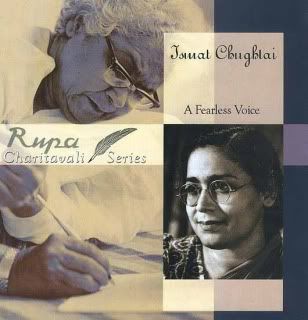
Ismat Chughtai
August 15, 1915 - Buduan, India
October 24, 1991 - Mumbai, India
It has been sevrn years since I posted on a story by Ismat Chughtai, time is getting away ftom me. One of my priorities this month, as part of my limited participation in womenintranslationmonth# is to share with my readers translations of a few stories originally written in Urdu. Ismat Chughtai is considered a pioneer writer on issues concerning the lives of Urdu women.
(Urdu is spoken by close to 100 million people around the world. It is the official language of Pakistan, a status which it shares with English. It is also spoken and understood in parts of India, Bangladesh, Nepal, the Middle East, and many other countries around the world where Pakistani communities have settled. -
from the BBC)
“Of Fists and Rubs” contains very disturbing descriptions of abortions preformed on women from the poorest elements of Indian Society, women with no access to any form of medical care. I say this first as it is graphic enough to be disturbing.
As the story opens a woman is waiting in a long line to cast her vote:
"Bai, O Bai! How are you?” The woman wrapped in a dirty-looking kashta bared her filthy, yellow teeth and grabbed my hand.
“Oh, it’s you, Ganga Bai . . .”
“No, Ratti Bai. Ganga Bai was the other one. She died, poor woman.”
“What a pity! Poor woman . . .” And my mind zoomed back five years. “Rubs or fists?” I asked.
"Rubs,” Ratti Bai winked. “I kept telling her not to, but why would she listen, the blasted woman. Who are you voting for, Bai?”
Of course I wondered what rubs or fists might refer to, evidently a common expression.
The woman, of a higher caste than Ratti, first encountered her and Ganga Bai, when she was in the hospital giving birth. Both worked there, doing the lowest of jobs beneath that of nurses. The two women seem to hate each other. Each calls the other a slut and a whore. Each wait on the woman and lose no change to tear each other down. The woman finds out both want to go home to their villages. Both are married to abusive men, normal for them. Both work on the side as near prostitutes. One of the occupational hazards is pregnancy.
Now we learn the meaning of "rubs or fists". They refer to alternative methods of back street abortions.
"Rubs” work perfectly during early pregnancy—like a doctor, absolutely first-class. The Bai makes the woman lie down flat on the floor, then holding herself with a rope suspended from the ceiling or to a club, she stands on the woman’s stomach and works it with her feet real well, until the “operation” is performed. Or she makes the woman stand against the wall and after combing her own hair she ties it tightly into a topknot. Then, after dousing it with a fistful of mustard oil, she bangs it against the woman’s legs like a ram. Certain young women used to hard labor don’t respond to this. Then it’s time for “fists.” After dipping her unscrubbed hands with their grimy nails in oil, she just pulls the throbbing life from the womb.
Most of the time the operation goes off without a hitch on the very first assault. If the performing Bai happens to be a novice, sometimes one of the hands is broken off, or the neck comes out dangling, or even a part of the woman’s own body that needed to stay inside spills out.
Not too many die from the “rubs,” but the woman generally falls prey to all kinds of disease. Different parts of her body swell up. Permanent wounds@ form and never heal, and if her time’s up, she dies. “Fists” are used sparingly, only when everything else fails. Those who survive aren’t able to walk. Some drag on for a few years and then croak."
We learn a lot about the lives of the two women, both in the hospital at work and back home in the village. Debt bondage has caused many small farmers to no longer be able to support their families. Their wives go to the big city where caste discrimination, sexual abuse and often an early death await them.
This is a very powerful story.
“Ismat Chughtai (Urdu: عصمتچغتائی) (August 1915 – 24 October 1991) was an eminent Urdu writer, known for her indomitable spirit and a fierce feminist ideology. She is considered the grand dame of Urdu fiction, Along with Rashid Jahan, Wajeda Tabassum and Qurratulain Hyder, Ismat’s work stands for the birth of a revolutionary feminist politics and aesthetics in twentieth century Urdu literature. She explored feminine sexuality, middle-class gentility, and other evolving conflicts in the modern Muslim world. Her outspoken and controversial style of writing made her the passionate voice for the unheard, and she has become an inspiration for the younger generation of writers, readers and intellectuals.” From Goodreads
Mel u
Thursday, August 15, 2019
Laajwanti by Rajinder Singh Bedi (1956) - translated from Urdu by Muhammad Umar Memon
A post in observation of Indian Independence Day
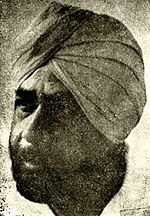
Rajinder Singh Bedi.
September 1, 1915 Sialkot, Punjab, British India
October 12, 1984 Mumbai, India
He had a prolific and successful career as a script writer in movies and was widely admired for his novels and short stories
From Words Without Borders
"Rajinder Singh Bedi was born in Sialkot in 1915. He first worked as a clerk in the postal department; later he joined the Lahore office of All India Radio and wrote many successful plays, having meanwhile established himself as a highly nuanced fiction writer with the publication of Daana-o-Daam, his first collection of short stories. On Partition he moved to India. After working for a short period as Station Director for Radio Kashmir, he joined the Mumbai film industry producing and writing scripts for a number of successful films. His Urdu novel Ek Chaadar Maili Si, translated into English as I Take This Woman, received the Sahitya Akademi Award in 1965. Bedi, who died in 1984, is regarded as the second most prominent Urdu fiction writer after Sa’adat Hasan Manto."
Midnight August 15, 1947 bells rang all over the Indian Subcontinent celebrating the end of 190 years of British Rule. In order to try to accommodate the Muslim and Hindi citizens, the largest groups, the country was partitioned into West and East Pakistan, meant to be Muslim, and India. This final act by the English, in a long vicious history of exploration, lead to an estimated two million deaths and fourteen million refugees. No accommodations were made for other segments such as the Sikhs. Hundreds of thousands of women were raped by men of the other religion. In the culture of the time, a raped woman should kill herself. In any case, few married men would continue with them. In part this should be seen as an excuse by young men to let out their hatred. Eventually decent people on both sides began to try to convince everyone that raped and kidnapped women should be accepted back by their families. The partition lead to one of the largest mass migrations in history. (The Bangaldesh War of 1971, extimates of deaths are as high as two million can be clearly traced back to the Partition.) Women who lived close to the borders were very much in danger of rape and kidnapping. Our story today deals how a married couple deal with this.
(From Stanford University, a good brief introduction to the Partition
Muhammad Umar Memon, recognized as a leading authority on Urdu literature, in his invaluable introduction to The Greatest Urdu Short Stories, tells us that Lajwanti by Rajinder Singh Bedi (1956) is one of the best literary accounts of the Partition. (He acknowledges that Saadat Hasan Manto must be given priority in this area. I have previously posted upon his work.)
As the story opens a committee has been formed designed to get people to accept back in the community women who had been raped or kidnapped by Muslims. Conventional morality requires suicide to preserve honor.
"There was one programme, though, which seemed to have escaped notice. It concerned the rehabilitation of abducted women. Its rallying cry was ‘Rehabilitate them in your hearts!’ It was bitterly opposed by Narain Bawa’s temple and the conservatives who lived in and around it."
We learn that Laajwanti was a kidnapped wife.
"Early in the morning when Babu Sundar Lal and his companions Rasaloo and Neki Ram used to make their rounds through the streets singing in unison, Touch the leaves of the laajwanti,/ they curl and wither away! Sundar Lal’s voice would fade. Walking along in silence he would think about Laajwanti—who knows where she might be? In what condition? What would she be thinking of him? Would she ever come back?—and his feet would falter on the cobblestone pavement."
During their marriage he was abusive to her. A true man was expected to beat his wife on occasion. No beatings was seen as a lack of love for his wife and a lack of masculinity. Her husband says if she ever returns he will open his heart to her. An exchange of women between border areas begins. At first the Hindus complain only old ugly women are being returned, some are refused.
A friend tells her husband that he has seen Laajawanti on a truck of returned women. When they are united her husband begins at first to wonder why she seems healthy and happy.
Conservative clerics cited passages from the Ramayana which support the idea that returned women should be rejected by their husbands, sons and even fathers.
When they are united her husband acts strange to her. He no longer beats her. He sees her as a holy woman, she thinks he no longer loves her.
Just a simple story about two ordinary people whose lives were ruined by the Partition.
You can watch a video of the story, in English with Hindi subtitles, at the link below
Oleander Bousweau
Friday, August 9, 2019
Beyond the Fog - A Short Story by Qurratulain Hyder -A Translation of "Kohr ke Peeche," from Qurratulain Hyder Ki Muntakhab Kahaaniyan (Delhi: National Book Trust, 1995). Translation copyright 2010 by Muhammad Umar Memon. - from Urdu
1927 - Aligarh, India
2007 - Noida, India
In August I will for the second year participate in Women in Transition Month, began six years ago as a book blog event. It is now observed by publishers and book stores all over the world along with book bloggers. Without meaning to, over my ten years of blogging I have very happily read and posted on probably hundreds of short stories by women which have been translated into English. Where possible I will focus on stories that can be read online,as can today’s story.
In 2018 I did not participate, Here are my concluding remarks for Women in Translation 2017
"I ended up reading works from nine different Indian languages, two in languages spoken in Uganda, three works by contemporary Japanese writers, one of my great literary loves. I read two stories focusing on same sex relationships, one in Italy, one in Croatia. I read two works by authors from Poland, the great Clarice Lispector represented the Portuguese language. Additionally I read stories by authors from Finland, one of two Science Fiction stories, one about an Indonesian household helper in Hong Kong. I traveled through rural Argentina up into Paraguay with Marianna Enriquez. Goli Taraghi, from Iran and translated from Persian, will join my read all I can list. She left Tehran in 1980. Her work and her life history reminds me a bit of Mavis Gallant. Kundanika Kundanika's "Red Glow of the New Moon" is as beautiful and moving s story of the Reading Life as i have ever read.
All of these stories together take up at most 600 pages. I read each one at least twice, I researched the background of the authors and in some cases the language in which they originally wrote. Often reading one of these stories closely enough to let it sink into my consciousness was all I could read in a day.”
I hope this year to post on several short stories by translated from Urdu short stories by women.
(Urdu is a living language which, according to estimates, is spoken by close to 100 million people around the world. It is the official language of Pakistan, a status which it shares with English. It is also spoken and understood in parts of India, Bangladesh, Nepal, the Middle East, and many other countries around the world where Pakistani communities have settled.
The Urdu community in the UK numbers about four hundred thousand speakers.- from the BBC)
Qurratulain Hyder’s River of Fire is considered by all the greatest work of the modern Urdu novel. A few days ago several of those I follow on Twittef highly recommended this novel, chronicling twenty five hundred years of life in India. I added this book to my Amazon wish list. Based on his wonderful today's short "Beyond the Fog" was I will hopefully read it soon.
Beyond the Fog begins in a rooming house in Moussourie, in the Uttarakhand district of India, where Urdu is the main language. The rooming house is owned by an English woman:
"Hers is a second-class “Europeans Only” facility where run-of-the-mill English, poor white missionaries, or fair-skinned Eurasians come to stay. With her keen, hawk-like sight, Miss Richmond can immediately see who has what percentage of English blood. If an Anglo-Indian with even the slightest trace of sallow shows up, she has Katto tell him that all the rooms are taken".
Katto, from the area, has worked for her for a long time.
Every day a poor man, Fazi Masih, who looks like an unemployed sweeper, a Dalit occupation, stays on a bridge holding a young blond girl. He is Katto's older brother. The father was a drummer in the British army, a private, staying in the house for a while. When he is called back to India he says he is not much of a writer but he will try to correspond. After he leaves Miss Richmind she tells everyone he was a Colonel in the British Army.
I love these lines, I can hear Miss Richmond in them:
"Miss Richmond also indulged in absurd fancies and theatrics now. And very much like her kind, ordinary middle-class English ladies, she was a perfect snob. She cooked up quite a story about the little girl to tell to the erstwhile residents of the guesthouse. “Her father, Colonel Arthur Bolton, was lost in action on the Berlin front. Poor Arthur . . . ” she would say heaving a deep sigh while serving a guest their breakfast. “Poor Arthur was my first cousin. Before coming to India he married the daughter of some Irish lord. Both of them were stationed at the Peshawar garrison. Soon after Arthur left for the front, poor Bridget died giving birth to the girl in the military hospital. Arthur had given my address as ‘next of kin’ so the Red Cross sent the girl to me"
She accepts the child and takes care of her. Time goes on and they never hear from Arthur Balton. Catherine at 15 has grown into a besuty. Following the advice of a guest from Australia who tells her a girl of mixed blood will not find a decent husband in India, they relocate to Sydney, the guest house bring sold.
Catherine becomes very beautiful with lots of boyfriends. By the time Catherine turns 18, Miss Richmond dies.
Hyder comprsses so much about post colonial S. E. Asia. Catherine goes through a lot, from being a movie actress in Singapore, a high class prostitute in Hong Kong until she marries a forty year old man of Dutch and Indonesia ancestry. She assumes a Muslim names when they move to Jakarta. So much happens, the man robs her of her jewelery and leaves. She becomes an fashion model and would you believe there is a brief article about her father being Colonel Bolton and her mother an India woman from Moussourie. It says she has moved back home. It gets published in a London magazine and Arthur Bolton sees it.
The ending brings us full circle. I really enjoyed this story, twenty years, several cultures and countries in a few delightful pages.
The story made me think of Candide.
Qurratulain Hyder (1928–2007) was one of the leading writers of Urdu fiction in India. A prose stylist of rare accomplishment, she wrote in both Urdu and English, and her books have been translated into all Indian languages. She was awarded the Bharatiya Gnapinth, India’s highest literary award, in 1989. New Directions Press
Monday, April 25, 2011
Rajinder Singh Bedi- "Lajwanti"-A Great Urdu Short Story
NOTE ADDED AUGUST 13, 2015
Recently there has been a huge number of page views of this post from Bangalore. Please let me know if this story is a school assignment and please leave any comments on the story on my post you might have.
"Lajanti" by Rajinder Singh Bedi (6 pages, 1960-translator unknown)
Lajawanti's husband is at first overcome with joy when one day she was among the returned women. Lajawanti used to routinely beat his wife for the smallest matters. He asked if the man she spent longs months with while abducted beat her. She says no. Then the husband begins to wonder why she looks better and healthier than before she was abducted. Maybe she was happier with the other man. He promises never to beat her again and he keeps his word. He never criticizes her like he used to. They never fight over anything. At first she is very happy. Then she realizes why this has happened.
You can read this story HERE
Indian short stories are a new chapter in my reading life. I have already found links to 100s of what seem like very worth reading short stories.
If you have any experience with South Asian short stories, please leave a comment.
Mel u
Recently there has been a huge number of page views of this post from Bangalore. Please let me know if this story is a school assignment and please leave any comments on the story on my post you might have.
"Lajanti" by Rajinder Singh Bedi (6 pages, 1960-translator unknown)
A Story About the Plight of Women Abducted During
the 1947 Partition of India
Rajinder Singh Bedi is considered the second best, Saadat Hasan Manto is the highest regarded, Urdu short story writer. Like Manto, his best known work centers on the immense human cost of the of the 1947 Partition of India into Pakistan and India. Much the worst of this holocaust (death tolls range from 1/2 a million on up to 2 million) was felt by the women as men of diverse groups took their revenge by raping and abducting women of other groups. Hundreds of thousands of Hindu women were abducted by Muslin and vice-versa. Many of the women killed themselves from shame. (You can find some background information on this here.)
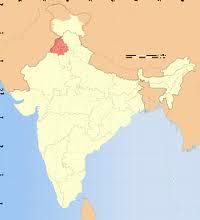
Bedi (1915 to 1984) was born in Punjab region of Pakistan and moved to India at the time of the Partition.
He was educated in Urdu. In his early working career he was a postal clerk. Later on he got a job at All India Radio. It was there he began his writing career. From here he moved to script writing for Bollywood movies and then into directing. It will be for his 72 short stories that he is remembered.
"Lajawanti" is about a once happily married couple. Then in the riots that resulted in the Partition of India (the effects were at their very worse in the Punjab region where the story is set and where Bedi grew up) the wife Lajawanto was kidnapped. It is also a story about human cruelty. Not just the cruelty of the abductors but of the husbands and family of the abducted women.
As the story opens we see Lajawanti expects to be beaten. It is part of the marriage custom and it almost seems a wife regards a husband who never beats her as "unmanly". Then she is abducted and taken over the border. Years go by and her husband tries to get along with his life. In time Pakistan and India authorities begin to arrange for the swapping of abducted women. A truck load of Hindu women would be exchanged for a truck load of Muslim women. There were lots of problems and quarrels over this. Sometimes men of one side managing the exchange would complain that all they are getting back is "useless old and middle aged women". The real cruelty to the women in many cases came when they returned.
There were some people who refused to have anything to do with the abducted women who cam back "couldn't they have killed themselves? Why didn't they take poison and preserve their virtue and their honour? Why didn't they Jump into a well? They are cowards, they clung to life...."
Hundreds of thousands of women had in fact killed themselves rather than be dishonoured...how could the dead know what courage it needed to face the cold, hostile world of the living in a hard-hearted world in which husbands refused to acknowledged their wives. And some of these women would think sadly of their names and the joyful meanings they had..."suhagwanti..of marital bliss" or they would turn to a younger brother and say "Oi Bihari, my own little darling brother, when you were a baby I looked after you as if you were my own son."
Lajawanti's husband is at first overcome with joy when one day she was among the returned women. Lajawanti used to routinely beat his wife for the smallest matters. He asked if the man she spent longs months with while abducted beat her. She says no. Then the husband begins to wonder why she looks better and healthier than before she was abducted. Maybe she was happier with the other man. He promises never to beat her again and he keeps his word. He never criticizes her like he used to. They never fight over anything. At first she is very happy. Then she realizes why this has happened.
"Lajwanti" depicts a world where women have totally internalized the idea that they are little more than property. Imagine the horror of being abducted, taken to another country and being raped over and over for perhaps years. When you at last return to your home country, you are totd that your failure to kill yourself has brought great shame on your family and in many cases are driven from your old home.Many days passed in this way. Suspicion took the place of Joy: not because Sunder Lal had resumed ill-treating her but because he was treating her too well. Lajo never expected him to be so considerate. She wanted him to be the same old Sunder Lal with whom she quarrelled over a carrot and who appeased her with a radish. Now there was no chance of a quarrel. Sunder Lal made her feel like something fragile, like glass which would splinter at the slightest touch. Lajo took to gazing at herself in the mirror. Arid in the end she could no longer recognise the Lajo she had known. She had been rehabilitated but not accepted. Sunder Lal did not want eyes to see her tears nor ears to hear her wailing.
You can read this story HERE
Indian short stories are a new chapter in my reading life. I have already found links to 100s of what seem like very worth reading short stories.
If you have any experience with South Asian short stories, please leave a comment.
Mel u
Saturday, April 23, 2011
Ismat Chughtai عصمت چغتائی-"The Quilt"-Greatest Female Urdu Short Story Writer
"The Quilt" (aka "Lihaf" 10 pages, 1944, translated from Urdu by M. Asaduddin) by Ismat Chughtai عصمت چغتائی
Ismat Chughtai (1915 to 1991-Pardesh, India) was born into a very traditional and conservative Muslim family. Chughta earned two
degrees in spite of her own families opposition to education for women.
Most of the female, and nearly all of the male authors of the time of the writing of "The Quilt"-1944-advocated only the very slowest changes to the social order as it regarded the rights of women. Chughtai was seen at the time as a radical advocate of women's rights. For example, she opposed the requirement of the veil for Muslim women and advocated equal educational rights for women. Her writings have been banned as too radical in some countries.
"The Quilt" is an amazing and shocking story for the time and place it was written. It is about a lesbian relationship set in a time when this could result in stoning to death. It is told in the first person by a young woman who was given in married by arrangement while she was at most fifteen or so (normal practice at the time) to a much older wealthy man. Her family expects her to get pregnant soon and fatten up while living a life of forced leisure in the female section of the house. The young woman soon finds out her husband prefers the company of beautiful young men.
The shocking conclusion in the story is slowly and artfully built up to. I do not want to give away any more of the plot of the story. (There is a link to read it online at the end of the post.)
Chughtai was tried for obscenity for this story and found innocent. Even though no words are used in the story that could not be in a children's story, "The Quilt" does have a lot of erotic power. It is a story about the
effects of long time neglect and loneliness.
Chughtai and her husband were friends with the most highly regarded Urdu short story writer Mulk Anand (I have already posted on two of his stories.)
You can read "The Quilt" online HERE
Urdu short stories are a completely new chapter in my reading life. I am very open to guidance suggestions or corrections.
I will soon post on the greatest 20th century Punjabi woman writer (many would say best period) Amrita Pritam. I will read and post on three of her best known short stories soon, I hope.
Mel u
A Ground Breaking Story by Greatest Female Urdu Short Story Writer
Ismat Chughtai (1915 to 1991-Pardesh, India) was born into a very traditional and conservative Muslim family. Chughta earned two
degrees in spite of her own families opposition to education for women.
Most of the female, and nearly all of the male authors of the time of the writing of "The Quilt"-1944-advocated only the very slowest changes to the social order as it regarded the rights of women. Chughtai was seen at the time as a radical advocate of women's rights. For example, she opposed the requirement of the veil for Muslim women and advocated equal educational rights for women. Her writings have been banned as too radical in some countries.
"The Quilt" is an amazing and shocking story for the time and place it was written. It is about a lesbian relationship set in a time when this could result in stoning to death. It is told in the first person by a young woman who was given in married by arrangement while she was at most fifteen or so (normal practice at the time) to a much older wealthy man. Her family expects her to get pregnant soon and fatten up while living a life of forced leisure in the female section of the house. The young woman soon finds out her husband prefers the company of beautiful young men.
The shocking conclusion in the story is slowly and artfully built up to. I do not want to give away any more of the plot of the story. (There is a link to read it online at the end of the post.)
Chughtai was tried for obscenity for this story and found innocent. Even though no words are used in the story that could not be in a children's story, "The Quilt" does have a lot of erotic power. It is a story about the
effects of long time neglect and loneliness.
Chughtai and her husband were friends with the most highly regarded Urdu short story writer Mulk Anand (I have already posted on two of his stories.)
You can read "The Quilt" online HERE
Urdu short stories are a completely new chapter in my reading life. I am very open to guidance suggestions or corrections.
I will soon post on the greatest 20th century Punjabi woman writer (many would say best period) Amrita Pritam. I will read and post on three of her best known short stories soon, I hope.
Mel u
Subscribe to:
Posts (Atom)
Featured Post
Imperial Reckoning: The Untold Story of Britain’s Gulag in Kenya by Caroline Elkins - 2005 - 701 Pages
Imperial Reckoning: The Untold Story of Britain’s Gulag in Kenya by Caroline Elkins - 2005 - 701 Pages 2006 Pulitzer Prize Winner From...
-
Book Blogger Appreciation Week Sept 13 to Sept 17-2010-Giveaway- Katherine Wish by Linda Lappin Leave a comment to win! Open to all f...
-
Nothing Can Destroy the Faith and Strength of the people of the Philippines -Mel u, November 10, 2013- comments welcome. "How My B...
-
The Reading Life Guide to Getting Started in the Indian Short Story One of my reading hopes for this year is to read a large number of the s...