Showing posts with label Voltaire. Show all posts

Thursday, February 27, 2020

Zadig ou la Destinée (Zadig, or The Book of Fate; 1747) By Voltaire


An Autodidactic Corner Work

November 11, 1694 - Paris

Candide. 1758

May 30, 1778 - Paris

Voltaire played a very important part in my development as a reader.  In 1960, I was thirteen, I acquired a copy of a book that still shapes my reading life, The Lifetime Reading Plan by Clifton Fadiman.  I don’t recall how this came into my hands but it was like a revelation to me of something no one had ever told me before.  I had been an avid reader since about six.  I had no internet to guide me, no adults to lead me.  I just read at random mostly from the school library.  Now I was told by Fadiman that some literary works are immortal classics to nourish you for a lifetime,some books are great, that reading can enrich your life.

I began to read one of his selections, Candide, guided by Fadiman’s  short note.  

I saw somehow there was a wisdom in this book way beyond my years and the things I was told by adults.  Fadiman explained to me that Voltaire was “the uncrowned king of intellectual Europe,the most destructive of the sappers of the foundations of the old Regime destroyed by the French Revolution.”  I knew nothing about what this meant but I hoped  one day I would.  I am sure I had never before read a work not originally written in English and for sure not one written in the 18th century.

In his article on Candide, Fadiman also included Zadig in his Life Time List.

Still being guided by Fadiman i at last have read Zadig.  

Tales of exploration of exotic places were very much in fashion in 18th century France and England.  Zadig is very much in this category.

Zadig is set in ancient Babylon.  Zadig, a philodopher, decides to embark on a journey in search of wisdom, similar to that of Candide.  All sorts of terrible things happen to him. Then through great luck he continues his journey.  He goes from esteemed philosopher, to slave, to advisor to a Sultan, to being condemned as a heretic back to a receiving counsel from an Angel.

This is a more complicated plot than that of Candide.  There are interesting philosophical debates.  I am glad I read this.  To others, all on their own quest for wisdom, should read Candide.  Zadig is harder to get into, maybe the central character is less emphatic and their is no love interest or Pangloss.  That being said, it is worth The ninety or so minutes it will require.

Wikepedia has a good article on Voltaire 


Thursday, December 12, 2019

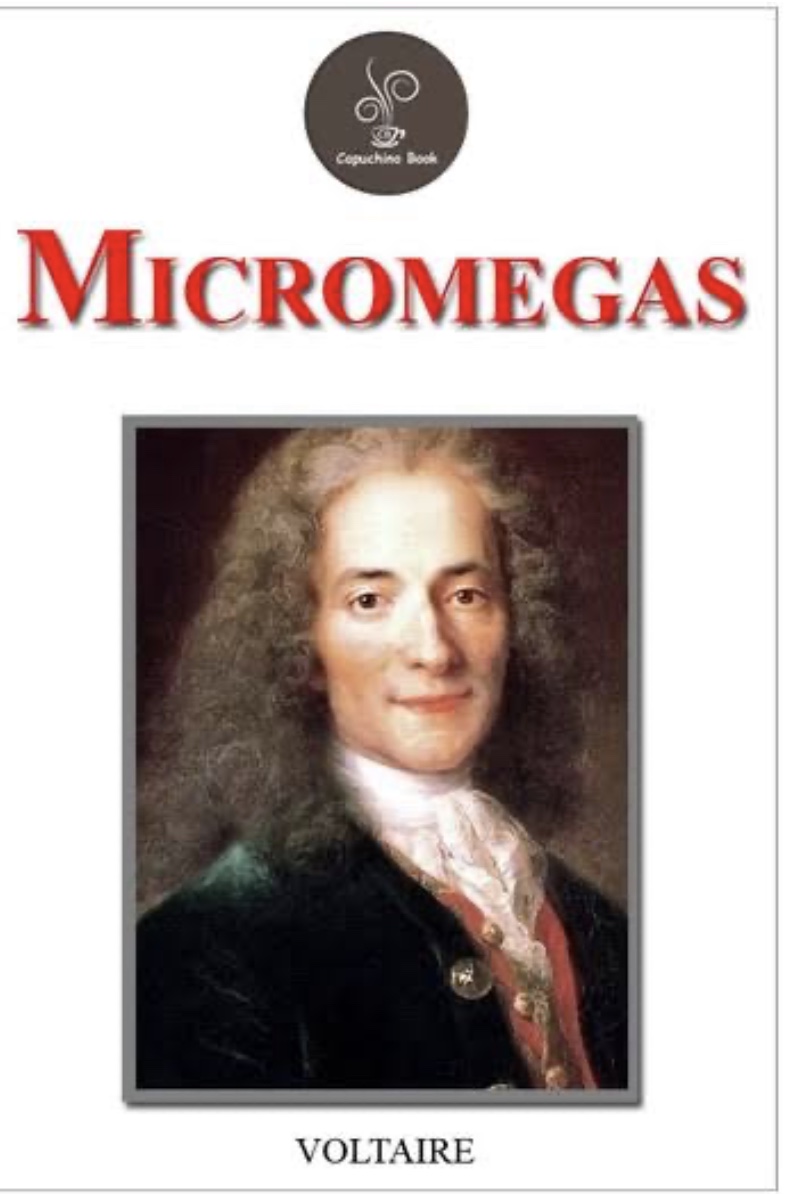
Micromégas - A Short Story by Voltaire - 1752 - An Early Work of Science Fiction


November 11, 1694 - Paris

May 30, 1778 - Paris

Last month I read and posted on a work of great fame as well as personal importance to me, Candide by Voltaire. I first read this work in 1964, lead by a reference to it in The Lifetime Reading Plan by Clifton Fadiman.  Candide was my first read of a classic and before I read Fadiman's wonderful guide I never knew there was such a thing!  I reread Fadiman's section on Voltaire.  In addition to Candide, he suggests Letters to the English and two works that are close to short stories in format, Zadig, which I read long ago and will reread next month and today's work Micromégas.

In a time when the world was being transformed by global exploration, stories of travels to strange lands were popular in 17th century Europe.  Educated people were captiva by storied of people encountered by exploration parties, living so very differently than Europeans.  Gulliver's Travels, 1726, is a famous example.  Fadiman suggests Micromégas may have been inspired by that work but I don't know if Voltaire read that or just knew of it second hand.  

Micromégas, just a few pages, is about a fantastically large being from another world.  It is structured as a conversation between a being from Saturn and  Micromegas. Voltaire knew Saturn had a ring and five then discovered moons. We learn that Micromegas will 
live over a million years and is about 100,000 Kilometers tall.  
He tells the academic from Saturn he has met beings that live 100 million years and have many times the 72 senses of a being from Saturn. Of course the life spans of humans are puny in comparison and we have only five senses.  Underlying this is the no doubt completely unacceptable to the clerics of France notion that God created many worlds much better than Earth.

Micromégas is a fun fast read.

Mel u


Friday, November 29, 2019

Candide by Voltaire - January, 1759 - translated from French by Philip Littrel


"All that is very well," answered Candide, "but let us cultivate our garden."

An Autodidactic Corner Work

November 11, 1694 - Paris

May 30, 1778 - Paris

Candide played a very important part in my development as a reader.  In 1960, I was thirteen, I acquired a copy of a book that still shapes my reading life, The Lifetime Reading Plan by Clifton Fadiman.  I don’t recall how this came into my hands but it was like a revelation to me of something no one had ever told me before.  I had been an avid reader since about six.  I had no internet to guide me, no adults to lead me.  I just read at random mostly from the school library.  Now I was told by Fadiman that some literary works are immortal classics to nourish you for a lifetime,some books are great, that reading can enrich your life.

I began to read one of his selections, Candide, guided by his short note.  A lot of the items on the list were very long and sounded scary when Fadiman said I might have to read seriously for a long time before I could appreciate them. 

I saw somehow there was a wisdom in this book way beyond my years and the things I was told by adults.  Fadiman explained to me that Voltaire was “the uncrowned king of intellectual Europe,the most destructive of the sappers of the foundations of the old Regime destroyed by the French Revolution.”  I knew nothing about what this meant but I hoped  one day I would.  I am sure I had never before read a work not originally written in English and for sure not one written in the 18th century.  Something amazing and terrible happened in every short chapter.  Lots of sex followed by the pox (what was that Pangloss, Candide’s teacher was doing in the bushes with a servant girl).

Adults are horrible monsters, only Candide and his lady love are innocent.  He travels all over the world, everywhere weird things happen, people thought murdered reappear. There is a cool chapter I bet Voltaire loved writing trashing literary critics.  Who can argue with this council Candide was given.

“A million regimented assassins, from one extremity of Europe to the other, get their bread by disciplined depredation and murder, for want of more honest employment. Even in those cities which seem to enjoy peace, and where the arts flourish, the inhabitants are devoured by more envy, care, and uneasiness than are experienced by a besieged town. Secret griefs are more cruel than public calamities. In a word I have seen so much, and experienced so much that I am a Manichean."

Of course I must have wondered in 1960 what in the world a Manichaean was and why they were despised by the church.  Speaking of which the Catholic Church from the Pope on down comes in for some serious trashing as do Muslim clerics.

Candide has thousands of spin offs, maybe Don Quixote is lurking.

There are references to current events such as an Earthquake in Lisbon.


All this in a work I could read in under three hours. I have read it several more times but not since I began my blog July 7, 2009. 
I was pleased it all came back to me. I wanted Voltaire on The Reading Life.

I knew after encountering Voltaire all works are not equal.  A vast world opened up to me, one I am still journeying as I can.

  My thanks to Monsieur Voltaire and Mr. Clifton Fadiman.  

Mel u


Monday, October 8, 2012

Candide by Voltaire

Candide by Voltaire (1759)


Voltaire (1694 to 1778, Paris, France) was a towering figure of the age of reason and the French Enlightenment.   He was a very famous person, not just a writer with a huge body of work.  He wrote in a time when an intellectual took it as their goal to know everything and for his time he came as close to anyone I can imagine.   The only one of his works that is still read, in the English only world at least, is his ultra-famous travel novella, Candide or Optimism.  

I think I first read Candide when I was about 13 or so, too many decades ago.   I think it is the perfect age to first read Candide.   I have read it several times since then and once listened to a tape of it on a long car ride.  I just finished it again yesterday.   I sometimes think to  the scene in the journals of James Boswell where Boswell went to visit Voltaire.    Boswell basically forced himself in and Voltaire did all he could to get the conversation over with as soon as possible.

I recently read Don Quixote and Candide is clearly in its debt.   I really am not inclined to tell the plot of this book.   Every commentary says it is a satirical attack on the philosophical notion, often attributed to Leibniz, that we live in the best of all possible worlds.   This is true but it trivializes the meaning and wonder of Candide.  

I decided not to attempt a blog post on Candide other than to say it is must reading for everyone on a life time plan to read the classics.   It is also fun.  I mean who would think a great classic of the French Enlightenment would have a hilarious chapter about  women in tears when their monkey lovers are shot?

There is a very good article by Julian Barnes that explains the historical background of Candide, the process of its translation into English and gives an account some point to ponder as we read it.

You can read Barnes' essay here

You can easily find and download this work in English or French.

Mel u
The Reading Life
@thereadinglife

Featured Post

Imperial Reckoning: The Untold Story of Britain’s Gulag in Kenya by Caroline Elkins - 2005 - 701 Pages

  Imperial Reckoning:     The Untold Story of Britain’s Gulag in Kenya by Caroline Elkins - 2005 - 701 Pages 2006 Pulitzer Prize Winner From...