Showing posts with label Arthur Schnitzler. Show all posts

Tuesday, November 28, 2017

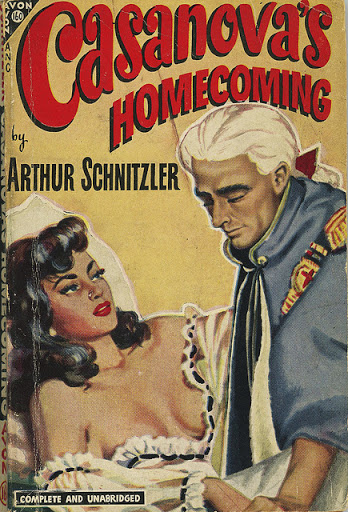
Casanova’s Homecoming by Arthur Schnitzler-1918


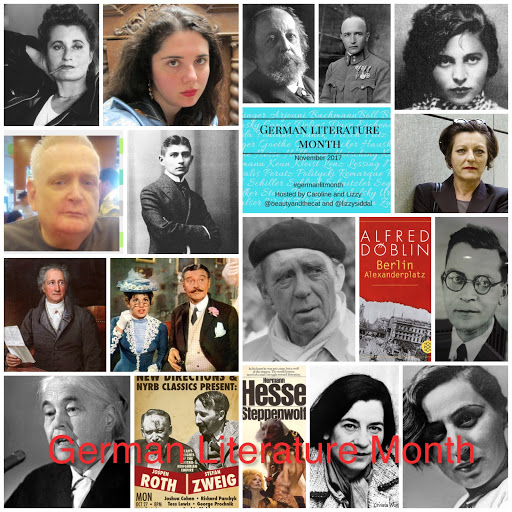
German Literature Month, November, 2017 on The Reading Life

  1. “You’d Have Larvae Too” by Nora Wagener, 2016
  2. Vertigo by W. G. Sebald, 1990
  3. The Last Weynfeldt by Martin Suter, 2006
  4. “An Earthquake in Chile” by Heinrich Von Kleist, 1809
  5. Who is Martha? by Marjana Gaponenko, 2012
  6. “The Legal Haziness of Marriage” by Olga Grjasnowa, 2015
  7. “Aladdin, COB” by Isabelle Lehn, 2015
  8. “The Last Bell” by Johannes Urzidil, 1968
  9. The Rings of Saturn by W. G. Sebald, 1995
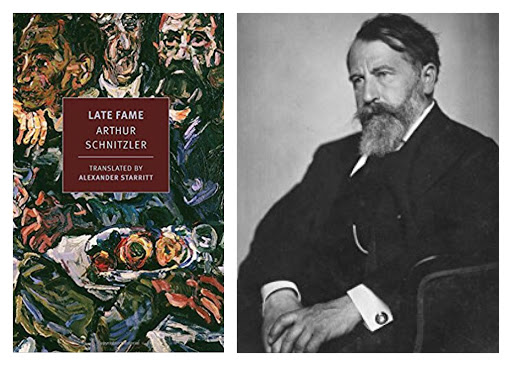
  10. Late Fame by Arthur Schnitzler, written 1892, published 2016
  11. Blood Brothers by Ernst Haffner, 1933
  12. Berlin Alexanderplatz by Alfred Döblin, 1929
  13. Confessions of a Murderer by Joseph Roth, 1936
  14.   “Compulsion” by Stefan Zweig,  1929
  15. “Borderlands”by Johannes Urzidil, 1956 (no post)
  16. “A School Boy’s Diary” by Robert Walser, 1910 (no post
  17. Austerlitz by W. G. Sebald, 2001, Second Reading 
  18. “The Duchess of Albanera” by Johannes Urzidil, 1965
  19. Gigli by Irmgard Keun, 1931
  20. Gay Berlin -Birth of a Modern Identity by Robert Beachy, 2014 *
  21. “Ernst in Civilian Clothes” by Mavis Gallant, 1963 *
  22. “Germans at Meat” by Katherine Mansfield, 1908 *
  23. Casanova’s Homecoming by Arthur Schnitzler, 1918

Items with an * are my English language supplements to German Literature Month

Casanova’s Homecoming is a sad work, in more ways than one.  When we meet Casanova the man once considered Europe’s greatest lover, seducer of duchesses and their dishwashers, with an encyclopaedic knowledge of the brothels of the continent, who considered it ok to seduce, near rape young girls (sounds like an American senator) and justify it by paying them afterwards is long past his physical prime at fifty three, much of his money gone.  He still has a voracious sexual appetite and uses every trick he knows to get women in bed.  Sometimes he pays as little as he can, sometimes he pays way more than required.  Sometimes he charms them, seems all the same to him.

His big goal in life is to go back to his old home Venice.  He needs official help as he was once in prison there.  By sheer luck he meets an old friend of his who owes him a great debt.  When Casanova has money he is generous. The man helps him, Casanova years ago seduced and paid both the man’s now wife and his mother.   The man has contacts that can help Casanova be allowed back in Venice and a cute thirteen year old daughter....

This book was probably shocking in 1918.  It can be read in under two hours and I feel it is worth that.  You can download an E book for free.  Schnitzler’s Late Fame is a better work and Casanova in Bolzano by Sandor Marai (1940) is a much better literary treatment of Casanova.


ARTHUR SCHNITZLER (1862-1931) was so central a figure in Viennese literary life in the first decades of the 20th century that the great cultural historian Peter Gay titled his book on the development of bourgeois culture between the Battle of Waterloo and World War I, Schnitzler’s Century.
A Jewish doctor born to a Jewish doctor in the largely Jewish Leopoldstadt quarter of Vienna (a plaque marking his birthplace, a short walk from the Prater, can be seen if you crane your neck on Praterstrasse), his true love was writing. Schnitzler was hugely successful as a playwright by his thirties; his most famous work, Reigen (La Ronde), was first performed in 1897.
His writings, biting portraits of Hapsburg society that were frank in their sexuality, made him both a star and a scandal. - from Jewishcurrents.org

We hope to post on about ten more works by Arthur Schnitzler by the end of 2018.   

Avant Bousweau
The Reading Life


Tuesday, November 14, 2017

Late Fame by Arthur Schnitzler- written in early 1890s, first published in 2016, translated from German by Alexander Starritt, 2016.


A Very Good Video on Arthur Schnitzler and Vienna - Friom the Getty Institute


Late Fame was written around 1892. Schnitzler’s publisher wanted to initially serialise it in eight episodes in a literary journal.  Schnitzler did not want this and the work was put in a drawer.  It was recently found in his archives.  It was published for the the  first time by The New York Review of Books, translated by Alexander Starritt in 2016.

Schnitzler is one of the leading literary chroniclers of Fin-de-Siécke Vienna.

As  Late Fame opens Eduard Sayberger, a fifty year old bachelor is returning home from his job at a government office.  He has been working there over thirty years.  As he enters his apartment he is surprised when his housekeeper tells him a young man is waiting to see him.  He is even more surprised when the man says “Are you the poet Eduard Sayberger who wrote The Wanderings?”  Sayberger, very shocked, asks  the young man how he knows of this book he wrote forty years ago.  He says he found it in a used book store in Vienna, read it and was so moved by the beautiful poetry that he felt compelled to seek him out.  He tells Sayberger he is part of a poetry group, everyone his read now The Wanderings, they want badly to meet him.  

Compressing a bit, Sayberger ends up at the cafe where the poets meet.  He is gratified to be appreciated, he had almost forgotten his times as a poet in his routine of work and eating with friends. Schnitzler charmingly satirises the pretentious of those in the group.  Slowly he begins to resume the identity of a poet.  His new friends ask him how can he stand being a civil servant, he in fact was happy with his life, at least up until he met the young poets.

The ending is interesting.  We see how all of this has impacted Sayberger.

I enjoyed this book and hope to read more of Schnitzler’s work.  I last read him in November, 2013 for German Literature Month.

I offer my great thanks to The New York York Review of Books for providing me with a review copy of Late Fame


A renowned Austrian writer and dramatist, Arthur Schnitzler (1862–1931) chronicled turn-of-the-century Vienna. He was famous for his frank treatment of sexual and psychological themes as well as his outspoken stance against anti-Semitism. His works were called "Jewish filth" by Adolf Hitler and were banned by the Nazis in Austria and Germany. 

Schnitzler's masterful stories and plays impressed Sigmund Freud (who famously called him his "double") and were admired by his contemporaries Thomas Mann and Henrik Ibsen. His writing continues to inspire creative artists; Tom Stoppard adapted several works by Schnitzler, and Stanley Kubrick based the film Eyes Wide Shut (1999) on Schnitzler's 1926 novella Dream Story.  - from The Getty Institute 


Mel u


Tuesday, November 12, 2013

"THE DEAD ARE SILENT By Arthur Schnitzler" 1907


I am really glad I decided to once again participate in 


So far I have read and posted on these works, all but Kafka are new to me writers. 
The Tin Drum-by Gunther Grass
"The Judgement" by Franz Kafka
All Quiet on the Western Front by Erich Maria Remarque -very powerful war novel 
"A Letter from an Unknown Woman" by Stefan Zweig. 
The Death of the Adversary by Hans Klein - a work of genius
"The Job Application" by Robert Walser 
Chess Game by Stefan Zweig-I will read much more of his work
"The Battle of Sempach" by Robert Walser
I have also listed to podcasts of "Basta" and "Frau Wilkes" by Robert Walser
The March of Radetsky by Joseph Roth I hope to read all his work

Memoirs of an Anti-Semite by Gregor von Rezzori amazing work of art.

"Flypaper" by Robert Musil

"Mendel the Bibliophile" by Stefan Zweig - I totally love this story.

"The Dead are Silent" by Arthur Schnitzler (Amazon has a free kindle edition of this 14 page story) was another first look at a new
to me writer.   It felt like a story Guy de Maupassant might have written on a day when he was writing 
fast formula slightly risqué for the times stories.  It was very much worth reading.  It is told by a 
married woman who has been committing adultery for a long time.  It has a very dramatic event.  While 
on a carriage ride with her lover, the carriage hits something and they are both thrown out of the carriage.  She is covered with mud and she fears her lover is dead.  Her first impulse is to flee  before 
the police arrive.  She worries her husband will somehow find out about her long term adultery.  The 
ending is interesting.

A doctor himself and close friend of Sigmund Freud, Arthur Schnitzler was one of the most important playwrights and novelists of early 20th-century Austrian literature. From Good Reads.


Featured Post

Imperial Reckoning: The Untold Story of Britain’s Gulag in Kenya by Caroline Elkins - 2005 - 701 Pages

  Imperial Reckoning:     The Untold Story of Britain’s Gulag in Kenya by Caroline Elkins - 2005 - 701 Pages 2006 Pulitzer Prize Winner From...