Showing posts with label R K Narayan. Show all posts

Monday, January 8, 2018

“The Cat Within” - A Short Story by R. K. Narayan. With a Link to The Malgudi Days TV Episode Based on the Story


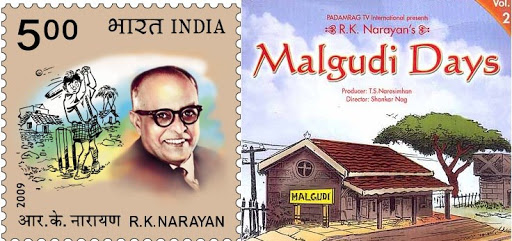
R. K. Narayan (born 1906 in Chennai, India, died 2001) is one of my favourite writers.  I have read and posted on all his novels and several of his short stories.  Most of his work is set in the community of his creation, Malgudi. India.


Jhumpa Lahari in her introduction to the collection of his short stories she edited, Malgudi Days includes him among the best short story writers of the last century.  I love his prose style.  Lately I have been reading a number of short stories by Sholom Aleicham set in small towns in Eastern Europe.  If you like Sholom Aleichman you will like Narayan, and vice versa.  Both create universality in their small towns.  

My main purpose in this post is to make sure my readers know that 54 episodes of the TV series based on Narayan’s short stories can be viewed on YouTube.  First initiated in 1986 and restarted in 2004, there are 54 episodes, each about 25 minutes.  It looks like about 20 are in English, the rest in Hindi.  On YouTube just search “Malgudi Days, English” to find those episodes.  “The Cat Within” is in English.  It does a great job of bringing the story to life.


As the story opens a landlord hears a terrible sound in his storage building.  One of his tenants is a well known exorcist so he calls him for help.  The portrayal of the story is really perfect.  The clothes and the set design are really well done.  

If you can I suggest you first read the story then watch the video.  If you do not have access to the story, the TV program is a lot of fun.  It follows the storyline very closely.

Please share your experience with Narayan with us.  

Mel u


Saturday, June 1, 2013

The Dark Room by R. K. Narayan (1938, 128 pages)

The Dark Room
by R. K. Narayan ( 1906 to 2004 Delhi) is an amazing look at a marriage in late Raj India.  The family is in comfortable surroundings with servants and three children.  The husband is the manager of a life insurance sales office.  He is a petty tyrant at home verbally abusive to his wife and sometimes children.  It is a time and place in which wifely subservience was a cultural given.  The father is not a monster, just selfish and unfeeling.  A crisis arises when an attractive female saleswoman comes to work for the husband.

This may not be among Narayan's most read books and I would not suggest one start in his work here but it is very much worth reading and might be one of the best accounts of Indian family life as seen in tremendous empathy to women ever written.   

I have a few Narayan novels still to read and I will be sad once I have read them all.

Mel u

Thursday, May 30, 2013

The Guide by R. K. Narayan (1958)

N
R. K. Narayan (1906 to 2004) is one of my favorite writers.  I love his short stories and novels, most of them set in the imaginary South Indian community of Malgudi.  I find his prose style an addictive delight, his characterizations brilliant and the plot action of his work always keeps me wanting to see what will happen next. 

The Guide is his consensus best novel.  Of the eight I have so far read, I agree with this.   The Guide is the longest of his novels and really is a rich wonderful work.  David Gorda has provided a very interesting introduction to the Penguin edition in which he points out a very marked difference in the work of Narayan to most other well known Indian novelists.  Most modern Indian novels focus on the dark turmoil, the teeming slums, the terrible corruption found in the Indian mega-cities.  They are eager to show us the ugly side of Indian life.    Narayan instead focuses on simple family issues, daily life, food, making a living, being Hindi, married life (Narayan in just a few lines can bring the dynamics of a marriage to life), and relationships between people.  One if the common elements found in much of his work is how differing perceptions of the same thing can greatly impact relationships.   As one reads more in his work we come to see how the community of Malguidi works. 

 The central character is a shop keeper in a rail road station who doubles as a guide for tourists.  He knows all the various points of interest and is an expert on sizing people up in terms of how much money they will spend.   There are lots of twists and turns in the plot.  He somehow gets a reputation as a wise swami and begins to cultivate the appearance and manner of a guru who can solve all problems.   Then one fatal day a man interested in cave paintings and his classical dancer wife hire him as their guide.  He soon becomes indispensable to the man while starting an affair with his wife.  The novel goes deeply into the culture of dancing women, on the one hand a highly respected profession but many, especially house wives, regard them almost on the level of "public women".  I do not want to tell too much of the plot but we see the guide go from poverty, to riches and back again.   

The Guide truly is a great novel.  I am currently reading the author's 1938 work The Dark Room and hope to post on it soon.   

Mel u

Saturday, September 1, 2012

"Mother and Son" by R. K. Narayan

"Mother and Son" by R. K. Narayan (1956, 8 pages)

Short Stories of the Indian Subcontinent
A Reading Life Project


I am very pleased  that The Reading Life was recently recommended by The Economic Times of India,the leading financial daily of The Subcontinent.   


There is no literary culture with roots older than that of India.   I will always admire Edmund Burke for telling the English that they had no right to govern a region whose culture is much older than theirs. .       Some of the writers featured  will be internationally famous, such as Salmon Rushdie, Saadat Manto,  and R. K. Narayan but most of the writers I post on will be authors on whom there are no prior book blog posts.    There are numerous books and academic conferences devoted to exploring the colonial experiences of India and Ireland and I will look at these stories partially as post colonial literature.   My main purpose here is just to open myself up to a lot more new to me writers and in this case most will be new to anyone outside of serious literary circles in the region. I am hoping in a small way to create networks of readers worldwide.    Where I can I will provide links to the stories I post on but this will not always be possible.


My blog owes a lot to R. K. Narayan (1906 to 2001).   My posts on his work have drawn more readers to my blog than those on any of the other authors I have posted on.   I was very proud when The Economic Times of India, the leading financial daily newspaper of the Subcontinent recommended my posts on Narayan to its one million plus readers.    Jhumpa Lahiri in her introduction to Malgudi Days ranks him among the greatest of all short story writers.   I totally agree with this.   Historically he is probably the first writer from India, writing in English, to have a large international readership.

It has been since November of last year that I read a work of Narayan, way to long.   Plus there is no way I could do a project on short stories of the Indian Subcontinent without including several of his works.

"Mother and Son" is a simple story anybody from anywhere can relate well to.    For sure devotees of the Irish short story will like this story.  (In his book on the short story, The Lonely Voice, Frank O'Connor, writing in 1962, said the Indian short story writers were very close to surpassing the Irish and he had to have meant Narayan.)   There are only two center stage characters, a widow and her late teen age son.  Like his counterparts world wide, the son does not want to listen to any parental advise and for sure he does not want to be pushed into a marriage with his cousin, which his mother is constantly trying to do.   She finally gets exasperated and tells him he either agrees to marry the cousin (she is buck toothed) or she will have no more to do with him.   The son has finally had it, he does not want to get married even though his mother keeps saying motherly things like "who will cook for you after I am dead".   The mother is a bit dominating and she knows it.   One day the son does not come home and the mother is beside herself.  Finally she goes all over the town until she finds her son sleeping outside.   She tells him come home and he follows her, inside she is so glad he is safe and he is so thrilled to be going home but on the way they strike up the same conversation again.  

This is a totally believable universal story about the love between a mother and her teenage son.   Like all of Narayan's work, it is beautifully written.   If you look in some of my other posts on Narayan, you will find links to his stories.   In some countries his stories are under copyright so make your own judgement.  I read it in Jhumpa Lahiri's edition of Malgudi Days, which has thirty stories from various periods of his life, including works not previously anthologized.  

You can also see TV shows based on his stories on You Tube.

I have three of his novels I have not yet read  (I have read five of them) and will read them, I hope, pretty soon.  

Mel U

Saturday, December 24, 2011

"Trail of the Green Blazer" by R. K. Narayan

Pickpockets in Malgudi?


V"Trail of the Green Blazer" (1956, ten pages) by R. K. Narayan was originally published in The Hindu, where many of his other short stories were first published.   As was to be expected, the publication imposed some directives as to the length of his short stories, most come out to ten or fifteen pages.    Any shorter and subscribers might feel shortchanged, much longer and they might lose interest.   Most all of the subscribers read English as a second language.    It was latter included as the second story in his collection Lawley Road and other Stories and has now been included in an expanded collection of his short stories

Watch this and 39 other classic episodes!
The more works I read set in the fictional community of Malgudi India (said to be in South India-some may know the name from the old TV series based on the stories), the more I like it for the brilliant way Narayan makes the characters in the story so real for us and lets see how the customs and commerce of the town shapes the lives of the people who live in it.   There are lots of good, hardworking men and women in Malgudi but that is not all there is.   I admit I was shocked to learn in Man-Eater of Malgudi that the town has a lot of what were euphemistically referred to as "Public Women".

People are always warned about the pickpockets that work the big markets, blending into the crowd while they stalk their prey, carefully watching them as they try to discretely pat their wallet to make sure it is still there not knowing they have just given too much information to someone.    "Trail of the Green Blazer" is about the work and life of a professional pickpocket.   He tries to dress so as to blend into the crowd, he wants to be as bland and nondescript as possible.   We share his elation when a wallet contains enough to live on for a month and share his  annoyance when it only has a few coins.   We also learn about the market for stolen fountain pens, something he almost feels is a waste of his time.   He has been in trouble for this before so now he tells his wife the money he brings home is from his commissions.    She never stops to think what that might be or maybe she just does not want to think about it too much.    Narayan does a great job depicting with just a few lines the dynamics within a marriage.   Even a pickpocket has a wife he must answer to.  Anyway he steals the man's wallet and (this is a bit of a plot giveaway) something prompts him to return the wallet (keeping the money of course).   He gets caught trying to slip the wallet back into the green blazer.   The man grabs his arm and holds him until the police come.   A crowd gathers and everybody has a great laugh when he says he was trying to put the wallet back.   He ends up doing 18 months in jail.   He changes a bit when he gets out and the story proposes an interesting lesson in morality.
.
"Trail of the Green Blazer" is another really good Narayan story, I do not think there is probably a bad one!

Mel u


Featured Post

Imperial Reckoning: The Untold Story of Britain’s Gulag in Kenya by Caroline Elkins - 2005 - 701 Pages

  Imperial Reckoning:     The Untold Story of Britain’s Gulag in Kenya by Caroline Elkins - 2005 - 701 Pages 2006 Pulitzer Prize Winner From...