Showing posts with label Argentina. Show all posts

Sunday, February 24, 2019

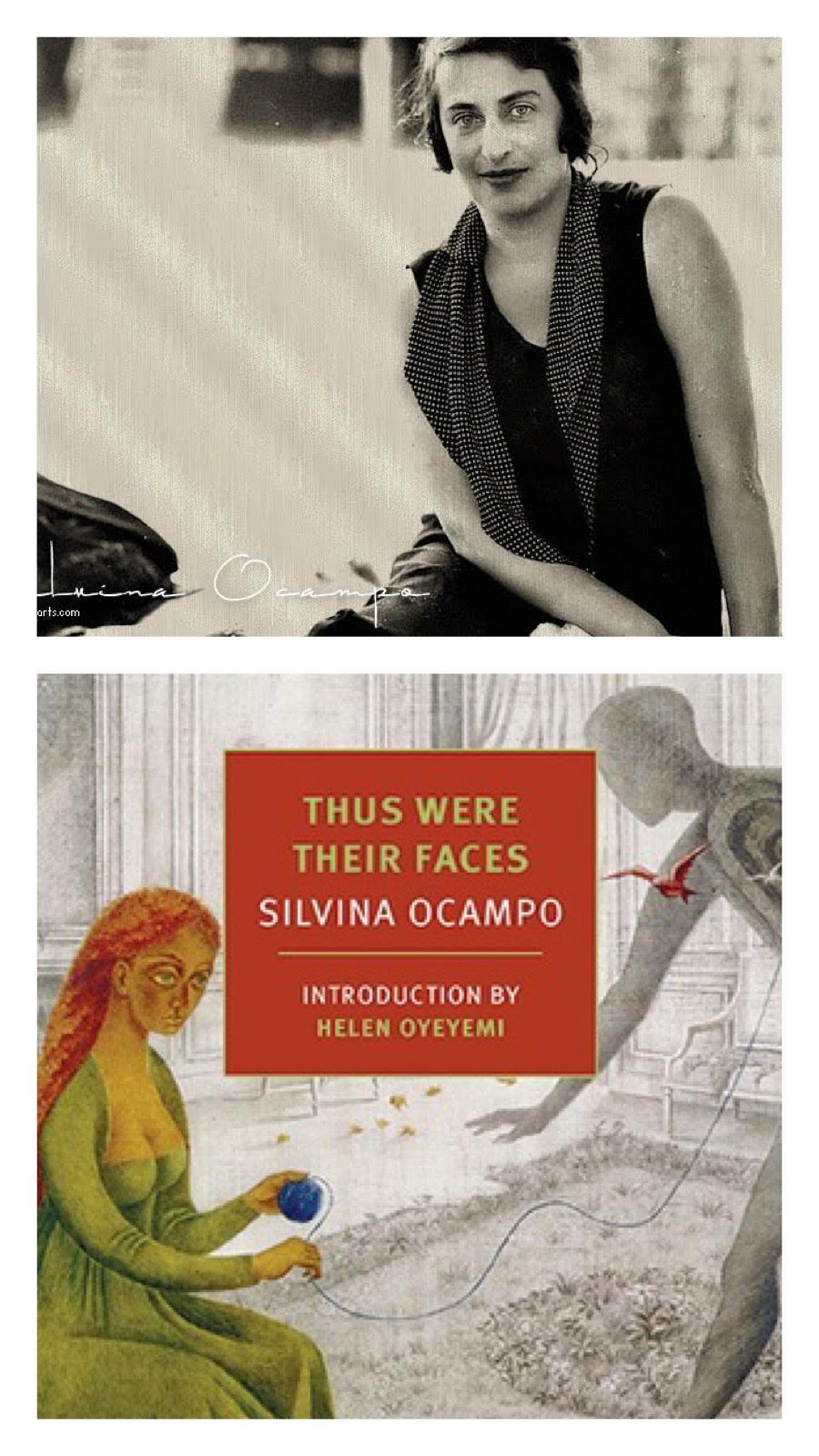
The House Made of Sugar: a short story by Silvina Ocampo, from the collection Thus Were Their Faces | NYRB Classics


The House Made of Sugar: a short story by Silvina Ocampo, from the collection Thus Were Their Faces | NYRB Classics - 2015

1903 to 1993, born and died in Buenas Aires

Today's story is included in Thus Were Their Faces and can be read online at the link above.

My main purpose in this posting is to provide interested readers a link to the lead story in The New York Review of Books 2015 collection of short stories by the marvelous Argentinian writer Silvina Ocampo.  Readers of Lenora Carrington will see strong affinities, both began as visual artists with works influenced by Surrealism.

A husband and wife, recently married, are the focus of "The House of Sugar".  The wife has an unusual superstition, she refuses to live in a house or apartment anyone else had ever inhabited.  She thinks the spirits of such persons will take over her life.  The husband cannot find such a never before lived in place in his price range.  So he lies to his wife and tells her a house, one that looks like it is made from sugar, fits her wishes.  There is, of course, trouble coming.  The house comes with a phone and they must keep the same number as the prior occupants.  Things get very interesting when a caller insisted to speak with an old resident, Viola.  Gradually the lives of the couple seem to take on, just as the wife feared, elements of the other couple.  Things get exciting when we find out Viola is cheating on her husband who shows up at the house, he had moved out leaving Viola there.  When he meets the husband, he assumes, he is his wife's lover.

A fun story.


THUS WERE THEIR FACES
SELECTED STORIES
by Silvina Ocampo, introduction by Helen Oyeyemi, a new translation from the Spanish by Daniel Balderston, preface by Jorge Luis Borges


From the NYRB website

Silvina Ocampo (1903–1993) was born to an old and prosperous family in Buenos Aires, the youngest of six sisters. After studying painting with Giorgio de Chirico and Fernand Léger in Paris, she returned to her native city—she would live there for the rest of her life—and devoted herself to writing. Her eldest sister, Victoria, was the founder of the seminal modernist journal and publishing house Sur, which championed the work of Jorge Luis Borges and Adolfo Bioy Casares, and in 1940 Bioy Casares and Silvina Ocampo were married. The first of Ocampo’s seven collections of stories, Viaje olvidado (Forgotten Journey), appeared in 1937; the first of her seven volumes of poems, Enumeración de la patria (Enumeration of My Country) in 1942. She was also a prolific translator —of Dickinson, Poe, Melville, and Swedenborg—and wrote plays and tales for children. The writer and filmmaker Edgardo Cozarinsky once wrote, “For decades, Silvina Ocampo was the best kept secret of Argentine letters.” Silvina Ocampo: Selected Poems is published by NYRB/Poets.

Oleander Bousseau


Wednesday, November 7, 2018

"The Intoxicated Years" - A Short Story by Mariana Enríquez . 2017 from. her collection Things We Lost in the Fire- translated from the Spanish by Megan McDowell


Gateway to Mariana Enríquez on The Reading Life


You may read “The Intoxicated Years” here


Very Perceptive post from The Kenyon Review on Things We Lost in the Fire


“I realized she had slept with him. Andrea smelled different, and sometimes she looked at us with contempt and fake smiles. I told her she was a traitor. I reminded her of Celina, a girl from our school a little older than us who had died after her fourth abortion, bleeding out in the street as she tried to get to the hospital. Abortion was illegal and the women who performed them sometimes just threw the girls into the street afterwards. There were dogs in the clinics, they said the animals ate the fetuses so they wouldn’t leave any traces behind. She looked at us angrily and said she didn’t care if she died. We left her crying in the plaza.”  

Recently i did a Google search on “The best short story collections of 2017".  Of course the list is just the opinion of the maker, or maybe something they were paid to write.  I found on the list Things We Lost in the Fire by Mariana Enriquez.   I read one of her stories (see the link above) and wanted to enter further into her vision of the mean streets of Argentina.

"The Intoxicated Years" (see the link above) begins in 1989 with three late teenage girls learning to use cocaine.  Enriquez makes you wish for a razor.  

We skip to 1994.  The friends have moved onto acid.  We are their as they are splitting a tab.  One of them now has a boyfriend who is with them.  Lots goes on with them in this session.  The descriptions are marvelous.

I hope  to read more of her work, eventually her entire collection.


Tuesday, August 22, 2017

"Spiderweb" - A Short Story by Mariana (from The New Yorker, 2016, translated from Spanish by Megan McDowell)


The New Yorker, December 29, 2016


Information on Women in Translation Month - August, 2017


Short stories I have read so far for Women In Translation Month - August, 2017

  1. "Happy New Year" by Ajaat Cour - Translated from Punjabi
  2. "The Floating Forest" by Natsuo Kirino- Translated from Japanese
  3. " A Home Near the Sea" by Kamala Das - Translated from Malayalam
  4. "Maria" by Dacia Maraini- Translated from Italian
  5. "Zletka" by Maja Hrgovic - Translated from Croatian
  6. "Arshingar" by Jharna Raham - Translated from Bengali
  7. "Tsipke" by Salomea Perl - Translated from Yiddish
  8. "Mother" by Urmilaw Pawar - Translated from Marathi
  9. "My Creator, My Creation" by Tiina Raevaara - Translated from Finnish
  10. "Cast Offs" by Wajida Tabassum - Translated from Urdu
  11. It's All Up to You" by Slywia Chutnik - Translated from Polish
  12. "Covert Joy" by Clarice Lispector- Translated from Portuguese 
  13. "The Daughter, The Wife, and the Mother" by Arupa Kilita - Translated from Assam
  14. "Red Glow of the New Moon" by Kundanika Kapadia - translated from Gujarati
  15. "Breaking Point" by Usha Mahajan- translated from Hindu
  16. "The Gentleman Thief" by Goli Taraghi - translated from Persian
  17. "Spider Web" by Mariana Enriguez- translated from Spanish

Mariana Enriquez, from Buenos Aires, is a leading Argentinian short story writer.  Today's story "Spiderweb" was published, in translation in the December 19, 2016 of The New Yorker (for now you can read it for free on their website, link above).  Publication in The New Yorker has sustained and started many literary careers.

The narrator of "Spiderweb" is a young recently married woman, living in Buenos Aires.  Her aunt and uncle have never met her husband and they have asked her to bring her husband to their house, up near the northern border close to Paraguay and Brazil, a very rugged place for a young woman from a very sophisticated city like Buenos Aires.

Enriquez does a wonderful job of setting the stage in these opening line:

"In February I went to visit my aunt and uncle in Corrientes, because I was tired of their reproaches: “You got married and we haven’t even met your husband! How is that possible? You’re hiding him from us.”
“No,” I’d say, laughing, over the phone. “How could I be hiding him? I’d love for you to meet him—we’ll come soon.”
But they were right: I was hiding him.
My aunt and my uncle were the custodians of the memory of my mother, their favorite sister, who was killed in a stupid accident when I was seventeen. During the first months of mourning, they offered to have me come live with them in the north; I said no. They came to visit me often. They gave me money, called me every day. My cousins stayed to keep me company on weekends. But I still felt abandoned, and because of that solitude I fell in love too quickly, I got married impetuously, and now I was living with Juan Martín, who irritated and bored me."

Her husband boasts to her relatives about his business success and denigrates the province in which they live as underdeveloped.  In a private conversation she tells her aunt that her husband repulses her.  She hates having sex with him.  Her cousin Natalie joins them, she is single but has a wealthy boyfriend.  Her husband doesn't like Natalie. The narrator thinks she is very beautiful.  Natalie proposes a three hundred kilometer road trip to a market town in Paraguay where she buys exquisite lace for resale back home.  The road trip is very exciting, it has a Wild West kind of feel, Paraguay feels edgy and dangerous.  Seeing the interaction of the two cousins was wonderful, great dialogue.


There are exciting developments on the Way Home that I will leave untold.   Enriquez made me feel I was along for the ride.

I greatly enjoyed this story and hope to read more stories by Mariana Enriquez.

Mariana Enriquez is a writer and editor based in Buenos Aires, where she contributes to a number of newspapers and literary journals, both fiction and nonfiction- from the website of Penguin Random House Books.

Mel u 


Sunday, January 13, 2013

"The Library of Babel"by Jorge Luis Borges-Project 196- Argentina

"The Library of Babel"by Jorge Luis Borges (1941, 4 pages)


Project 196
Argentina

Country 22 of 196
Juan Luis Borges

Argentina is home to one of the greatest of 20th century short story writers, Juan Luis Borges (1899 to 1886).   Among his very large literary output are a great many short stories often with a parable like feel.  One of the most famous is the very interesting philosophical fable, "The Library of Babel".  The "plot" of the story is the narrator's account of the structure of the universe which he sees as a vast set of interlocking hexagonal rooms, each of which contains four walls of bookshelves.  The majority of the books in the universe are just gibberish, random collections of letters and punctuation marks.   However, the library also contains not only every book that was ever written but everyone that could be written.   The library contains all possible information needed by humanity, but much of it is in unknown languages.   The library becomes subject to many diverse interpretations,  some think there is a "library man" who knows the catalog of all the books and there are various cults looking for him.  

There are a lot of philosophical and occult themes in this very densely written story.  I think anyone who takes the time to read it with any care will be stimulated and puzzled and quite possibly delighted.   It is also a satire on grandiose philosophical schemes so like much of Borges work, it is self referential.   


Saturday, October 20, 2012

"Funes, the Memorious" by Juan Luis Borges

"Funes, the Memorious" by Juan Luis Borges  (1968, 8 pages, translated by James Irby)


Juan Luis Borges (1899 to 1986-Argentina) is best known for his fables and short stories as well as his essays.   He is one of the dominant figures in Latin  American literature.   I was very happy to see that included in Object Lessons:  The Paris Review Presents Art of  the Short Story edited by Lorin and Sadie Stein, 2012, was a short story by Borges.   I have read his work before but it has been several decades.   Each of the stories in the collection has a brief introduction by a well established short story writer.  Borges' story is introduced by Aleksandar Hemon, author of three short story collections and The Lazarus Project, a 2008 National Book Critics Circle Award finalist.

Set in the middle of the 19th century in Buenos Aires, the story centers on a man with incredible mental capacities, a man who wants to know everything.    There are strong connections for many people, myself included, between a compulsive love (that is the wrong word but will let it go for now) for the reading life and a compulsion to know as much as you possibly can.  As illustrated in the story, these compulsions are at least as isolating as they are connecting.

As Hemnon says in his great introduction, the work of Borges "belongs to the tradition of literature with cosmic ambition:  the Bible, The Iliad, The Divine Comedy, Ulysses..works that strive to convey complete universes, containing everything".   In order for this to work, human language has to be able to articulate all  knowledge.   The vision in this story and the other works in the tradition us that you cannot really conceptualize humanity without literature.

Funes, the central character in the novel cannot forget anything.  He can pull up the number of leaves on a tree he saw 25 years ago.   The story focuses on the attempt of the narrator of the story to tell of the life if Funes, a near impossible task as his very project transcends human limitation.  This is a beautiful fable.   It has a lot to tell us about the reading life.

Mel u
The Reading Life


Monday, May 17, 2010

"The Spirit of Emulation" by Fernando Sorrentino

"The Spirit of Emulation" by Fernando Sorrentino (6 pages, 1972, translated from the Spanish by Thomas Meehan)

Fernando Sorrentino (1942-Buenos Aires) is a well known Argentine writer of short stories and children's books.   He has six collections of short stories published in Argentina and his works have been translated into numerous languages.   I must admit last week I had never heard of him.    I am getting into reading short stories after a lifetime avoidance of them (I like to sort of escape into the world of the books I read and short stories up until recently just sort of left me hanging).  Most of my reading of short stories  is of works that are on line.    There are 1000s of short stories on line that  you can read for free.   A lot of them are older stories in the public domain but there are some very good web pages that feature stories by known contemporary writers.   One web page I discovered recently Short Stories at East of the Web has a lot of contemporary and classic short stories on line.    One of the features I like on the web page is that every day they spotlight a new story.   Yesterday it was "The Spirit of Emulation" by Fernando Sorrenttino.   I decided to read it and I am glad I did.

To be an Argentine short story writer is to be in the shadow of Jorge Borges (1899 to 1986).   You are either a disciple or in rebellion against him.   This is just a fact of literary live  life.    Fernando Sorrentino seems firmly a follower, at least in this story.    Borges wrote many stories in a seemingly realistic mode which ask us to accept an absurd premise or the  acceptance of the bending of the rules of common sense or science.   Many are broadly satirical of the faults and vanities of mankind.

"The Spirit of Emulation" is narrated in the first person by a man living in a modern high rise apartment in a comfortable part of Buenes Aires.    The residents of the apartment complex are all into competing with each other and striving to at least emulate and hopefully surpass any material possessions others in the building have.     The narrator is a perfectly normal person.   His only quirk is that he has a pet spider.  One day a neighbor drops by and sees the spider.   Here is the result this one little incident begins to produce:

The next day he came by to show me the scorpion he had just bought. In the hallway, the maid of the people who live in 7-D overheard our dialogue on the life, habits and feeding of spiders, scorpions and ticks. That very afternoon her employers acquired a crab. 


then, for a week, there was nothing new of note. Until one evening when I happened to be on the elevator with one of the neighbor women on the third floor: a languid, young blond with one of those vacant stares in her eyes. She was carrying a big, yellow purse, the zipper of which was partially broken: every little while, through one of the breaks, there would poke out the tiny head of a golden yellow lizard.
Soon one of his neighbors acquires an ant bear only to be outdone a few days later by a neighbor who takes delivery of an American brown bear.    The man's wife then begins to be completely humiliated by the pets of her neighbors and tells the man he must do something soon or she will leave him because of this shame he has brought on her by his failure to provide her with her basic needs.   He borrows all the money he can and buys a beautiful leopard.   All is well with him for a while until he and his wife observe one of their neighbors walking a jaguar down the hall.    The man deeply loves his wife and to keep her happy he sells everything he owns and buys a giant anaconda.   For a few days he is the hero is the building.   Then all conventions break down:

My anaconda boa broke every dike, it destroyed every sense of moderation, it brought down the most respected conventions. In all the apartments there now multiplied lions, tigers, gorillas, crocodiles ... Some even had black panthers, those panthers they don't even have in the municipal zoo. The whole building resounded with roaring, howling and chattering. We spent the nights awake; it was impossible to sleep. The intermingled odors of felines, quadrumanes, reptiles and ruminants turned the atmosphere unbreathable. Huge trucks brought tons of meat, fish and vegetables. Life in the building on Paraguay street became a little dangerous. 
The ending of the story is very well done and completely believable once we give ourselves over to the logic of magic realism.   I will leave the ending as a surprise for anyone who takes a few minutes to read this story.  Sorrentino did a very good job creating a believable narrator.   You really felt like you were inside the apartment building as you were reading the story.   It is a funny story that gently mocks the vanity of man without being mean spirited.  


Mel u

Featured Post

Imperial Reckoning: The Untold Story of Britain’s Gulag in Kenya by Caroline Elkins - 2005 - 701 Pages

  Imperial Reckoning:     The Untold Story of Britain’s Gulag in Kenya by Caroline Elkins - 2005 - 701 Pages 2006 Pulitzer Prize Winner From...