Showing posts with label JL14. Show all posts

Monday, February 8, 2021

Under Reconstruction- A Short Story by Oagi Mori - 1910 - translated from the Japanese by Ian Morris - 1965


 UNDER RECONSTRUCTION - A short story by Ōgai Mori - first published 1910 - translated from the Japanese by Ivan  Morris 1962


The Japanese Literature Challenge 14 - Hosted by Dolce Bellezza 

January 1 to March 31. Japanese Literature Challenge 14


My prior posts for JL14 2021


  1. “Peony Lanterns” a Short Story by Aoko Matsuda - translated from the Japanese by Polly Barton -2020 - a delightful story you can read online. Linked to traditional stories of Ghosts
  2. Before The Coffee Gets Cold by TOSHIKAZU KAWAGUCHI -2020- an international bestseller
  3. The Memory Police by Yoko Ogawa - 1998
  4. The Lady Killer by Masako Togawa - 1968
  5. The Convenience Store Woman by Sayaka Murata - 2016 - cult favorite.


UNDER RECONSTRUCTION - A short story by Ōgai Mori - first published 1910 - translated from the Japanese by Ivan  Morris 1962


“Under Reconstruction” is included in Twenty-Five Stories by

Japan’s Leading Writers Edited by Ivan Morris With a new foreword

by Seiji Lippit - 2019 with Translations by Ivan Morris, Edward Seidensticker, George Saitō and Geoffrey Sargent


Ogai Mori (1862 to 1922) was born into a privileged family in the southern Japan.   His family had long had the been by right of inheritance physicians to the daimyo (a feudal samurai lord) of the region.    As the oldest son of the family, Mori as expected graduated from Medical School.   In his younger days he studied Confucian texts to supplement his schooling and insure a grounding in the classics.    After graduation he enrolled in the Japanese Imperial Army.   The army sent him to Germany to pursue advanced medical training and while there he developed a passion for European literature.     Upon return to Japan he was given a high ranking position in the army medical corps.   While pursuing his military career he started at his own expense a literary journal in the pages of which Japanese literary criticism first began.   In time he  was promoted to the position of Surgeon General of the Japanese Imperial Army.   While in the army he served in Manchuria and Taiwan during periods of combat.   As a hobby he pursued his writings, the most famous of which is The Wild Geese.


In 2010 during JL3, i read a fascinating novel by Ogai Mori, Vita

Sexualis, published in 1909.  It is considered an autobiographical novel of the sexual development of Mori.   It was considered so daring at the time that it was banned three weeks after its initial publication and Mori drew an official reprimand from his military superiors.   The book is narrated as if one writer was presenting the manuscript of a second one.


Now after 11 years I was delighted to find the lead story in a very good collection of Japanese Short Stories (listed above) was by Ogai Mori.


One of themes of Japanese literature in opening decades of the 20th century was on the delitorious impact of contact with western Society on society.  Often this was developed through a depiction of the relationship of a Japanese man with a European woman.  The man in this story has set up a luncheon meeting with a German woman he had a relationship with while living in Berlin, at the hotel restuarant.


“Finally he caught sight of a small signboard with the inscription written horizontally in the Western style: “Seiyoken Hotel.” The front of the building facing the canal was covered with scaffolding.”
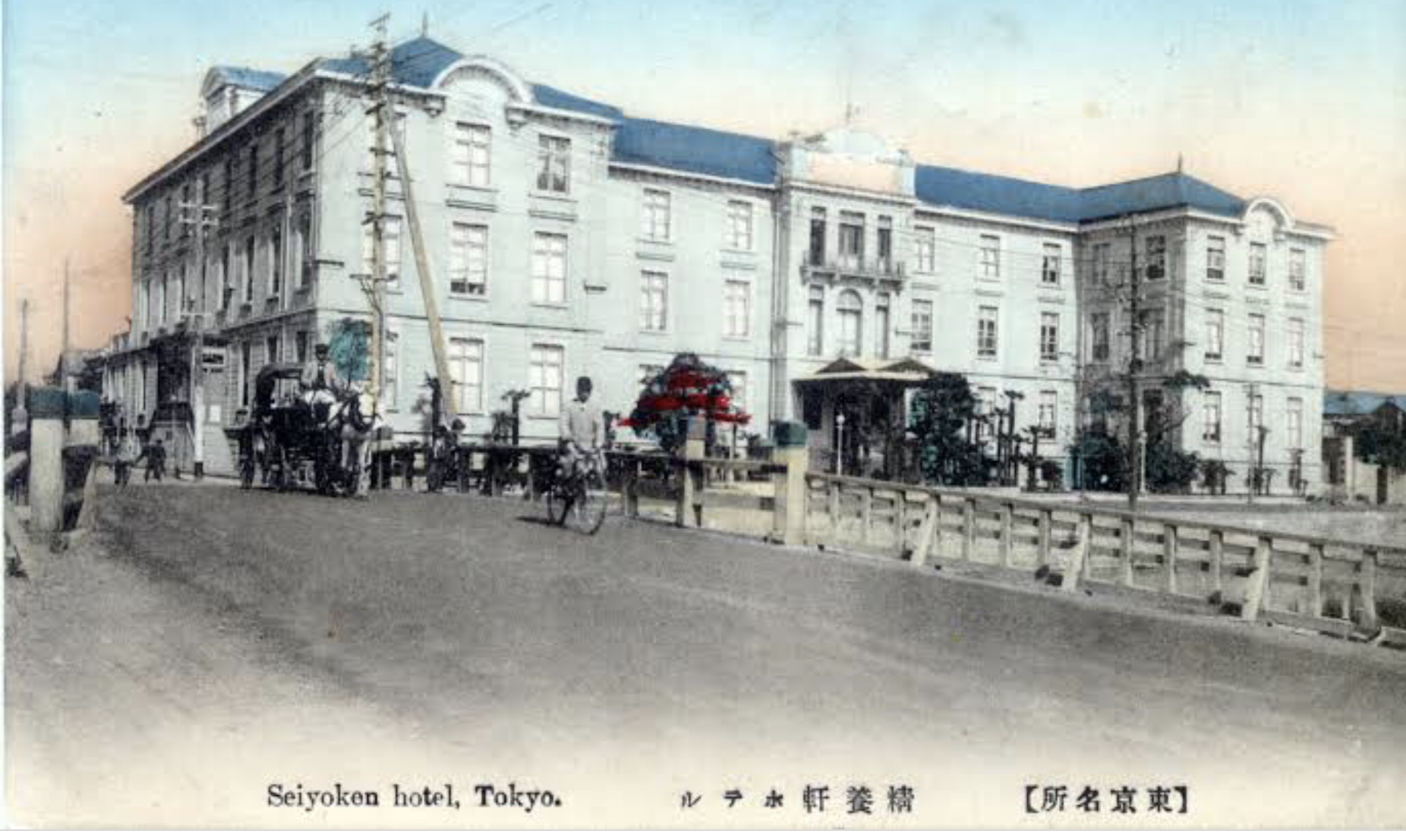


He is surprised to see they have adapted the western custom of keeping their shoes on while dining.  He has made a reservation and is taken to a large room without  customers.  He hears sounds of renovations.


The woman before coming to Tokyo had been working as singer in Vladivostok.


““Oh, that explains it. The place does give one rather an unsettled feeling. Not that I’m a particularly calm sort of person at best.” “When did you arrive in Japan?” “The day before yesterday. And then yesterday I happened to see you on the street.” “And why did you come?” “Well, you see, I’ve been in Vladivostok since the end of last year.” “I suppose you’ve been singing in that hotel there, whatever it’s called.” “Yes.” “You obviously weren’t alone. Were you with a company?”


Japan had just won the Sino-Russian war so there is submerged meaning here.


The elegant dinner is very enjoyable to vicariously experience.  We see the German woman as somewhat adrift, perhaps headed to America.


Wednesday, February 3, 2021

The Convenience Store Woman by Sayaka Murata - 2016 - translated from the Japanese by Ginny Tapley Takemori - 2018 - 160 pages


The Convenience Store Woman by Sayaka Murata - 2016 - translated from the Japanese by Ginny Tapley Takemori - 2018 - 160 pages 


The Japanese Literature Challenge 14 - Hosted by Dolce Bellezza 

January 1 to March 31. Japanese Literature Challenge 14


My prior posts for JL14 2021


  1. “Peony Lanterns” a Short Story by Aoko Matsuda - translated from the Japanese by Polly Barton -2020 - a delightful story you can read online. Linked to traditional stories of Ghosts
  2. Before The Coffee Gets Cold by TOSHIKAZU KAWAGUCHI -2020- an international bestseller
  3. The Memory Police by Yoko Ogawa - 1998
  4. The Lady Killer by Masako Togawa - 1968


The Convenience Story Woman has sold over a million copies in Japan.  It has a cult like following of devoted readers, myself now included, trying to unravel the meaning of the central character Keiko Furukura.  Keiko starting working at a Tokyo convenience store at 18, we meet her at age 36 still working in the same convenience store. A job in a convenience store is not considered one for college students needing extra money, job hoppers, and people needing temporary work.  It is not a socially acceptable permanent position in contemporary Japanese society.


Kieko was a strange child.  Once other kids in her elementary school were fighting.  The teacher yelled stop but they would not so Keiko hit one on the head with a shovel.  When asked why she did that she said she was stopping the fight.  Of course her parents were distressed.


Keiko totally submerges are identity into being a “convenience store woman”, living only to fulfill that position.  Years went by, coworkers and managers came and went but Kieko stayed.  Nothing ever changes in her life, no boy friends, and her only close relationship is with her sister.  People ask her why she sticks in a low income dead end part time job, her sister tells her to say she has a health issue when people ask. We see the employees come and go, get a look at the work flow in the store.  People do wonder why she has never married, expected of Japanese women.  


Then a strange man begins to work at the store.  In a remarkable series of events he quits his job and moves in with Kieko, who supports him.  Her family and friends are happy she seems to have a relationship, maybe it will lead to marriage.  But no, it is a weird sexless relationship. The man repeatedly tells her she is so drab an unattractive he could not climax with her as needed to produce a child.  The man is verbally abusing and is clearly taking advantage of her.  Then Kieko after 18 years quits her job.  Even the store manager who relies on her loyalty congratulated her, thinking she was finally moving toward a normal life.


I will let you discover what happens next.


This novel was tremendous fun to read.  Some compare Kieko to characters out of Kafka and Gogol.  To me she belongs with the “little people” in the fiction of Robert Walser.


She has written nine other novels. One was recently translated and it seems the others are in process.  I will read as many as I can.


Sayaka Murata (in Japanese, 村田 沙耶香) is one of the most exciting up-and-coming writers in Japan today. She herself still works part time in a convenience store, which gave her the inspiration to write Convenience Store Woman (Conbini Ningen). She debuted in 2003 with Junyu (Breastfeeding), which won the Gunzo Prize for new writers. In 2009 she won the Noma Prize for New Writers with Gin iro no uta (Silver Song), and in 2013 the Mishima Yukio Prize for Shiro-oro no machi no, sono hone no taion no (Of Bones, of Body Heat, of Whitening City). Convenience Store Woman won the 2016 Akutagawa Award. Murata has two short stories published in English (both translated by Ginny Tapley Takemori): "Lover on the Breeze" (Ruptured Fiction(s) of the Earthquake, Waseda Bungaku, 2011) and "A Clean Marriage" (Granta 127: Japan, 2014). - from Goodreads


Thursday, January 28, 2021

THE LADY KILLER by Masako Togawa - 1963- Translated from The Japanese by Simon Grove - 1986


THE LADY KILLER by Masako Togawa - 1963- Translated from The Japanese by Simon Grove - 1986


The Japanese Literature Challenge 14 - Hosted by Dolce Bellezza 

January 1 to March 31. Japanese Literature Challenge 14


My prior posts for JL14 2021


  1. “Peony Lanterns” a Short Story by Aoko Matsuda - translated from the Japanese by Polly Barton -2020 - a delightful story you can read online. Linked to traditional stories of Ghosts
  2. Before The Coffee Gets Cold by TOSHIKAZU KAWAGUCHI -2020- an international bestseller
  3. The Memory Police by Yoko Ogawa - 1998


In 2019 during JL112 I read a very interesting mystery novel by Masako Togawa, The Master Key. I greatly enjoyed it and was very grateful to Pushkin Press for giving me a DCR of another of her works, The Lady Killer, also centered on a murder mystery.


Like The Master Key, the mystery in The Lady Killer  is so well done that I did not see the  ending coming but when it arrived everything fell into place.  


The novel opens with what we think is an extract of a diary by man who seduces and then kills by strangulation women he picks up using false personas of various sorts.  The diary is called The Hunts Man’s Journal.  As the plot proceeds we see the man has no memory of Killing The women but he does recall having sex  with them.  When he learns of the deaths he begins to fear he might be a murderer.  The man is married but lives outside of Tokyo and see his wife, with whom he no longer has sex, just when he files home on weekends.  He begins to try to hide his activities and also fears someone may be trying to frame him for the four murders of women recorded in The Huntsman’s Journal.


There is very strong medical evidence linking him to the murders.  He has a very rare blood type found in only about one in a thousand Japanese and this is found on the Ginger nails of the victims or can be traced through semen.  On the basis of this, his insbility to give an

alibi  and some circumstantial evidence he is arrested for murder,  convcted and is sentenced to death.  


His wife’s father is quite rich so he hires a private detective to try to prove he is not the killer.  There is a sininster woman with a prominent mole on her nose who seems linked the victims.  We are taken on a journey through the lives the lonely vulnerable women who wind up murder victims.  The detective is convinced the man has been set up in an elaborate plot.


The unraveling of frame up is just so inventive.  


I enjoyed this book a lot.  The Kindle edition is value priced now at $1.95


Bio Data from Puskin Publishing


In 2016, beloved Japanese crime writer and LGBT activist Masako Togawa sadly passed away. We’re delighted to be able to bring you her prizewinning debut novel The Master Key, originally published in 1962, as the latest in the Pushkin Vertigo crime series.


Masako went on to publish over 30 books and was described by the Times Literary Supplement as “The P.D. James of Japan.” She was as gregarious as she was talented, finding success in many different careers over the course of her rich and varied life. Here are some of her highlights:

Singer/songwriter: She made her singing debut in the well-known nightclub ‘Gin-Pari’ in 1954. Music and performing remained a big part of her life and she released several records including “Lost Love” in 1975 and “Bon Voyage” with her son Nero in 2015.


Club owner: In 1967, she decided to turn her sister’s coffee shop into a live music hall, calling it Aoi Heya, or “Blue Room.” The intimate 150-person venue in Tokyo’s vibrant Shibuya district hosted artists and composers, simultaneously serving as a Chanson club and a lesbian night club.

LGBT icon: After years of encouraging LGBT artists at Aoi Heya, she came out as bisexual on television in 1999. In 2002, she was one of the first Japanese television personalities to take an active role in the Tokyo Lesbian and Gay Parade.


Actress: From 1969 to 1974, she played the lead character in a television show called Playgirl about a mystery writer who creates an all-female detective agency specialising in white collar crimes. She also starred in a film The Hunter’s Diary (1964), an adaptation of several stories she had co-written.

Music teacher: In 2012, she started teaching Chanson classes, calling the programme the “Blue Room Grand Cabaret.” They proved highly popular, taking place on the first and third Wednesdays of each month and broadcast via web channel “Scatch TV”.


Sunday, January 17, 2021

The memory police by Yoko Ogawa- 1994- translated fom the Japanese by Stephen Snyder - 2019


The memory police by Yoko Ogawa- 1994- translated fom the Japanese by Stephen Snyder - 2019


The Japanese Literature Challenge 14 - Hosted by Dolce Bellezza 

January 1 to March 31. Japanese Literature Challenge 14


My prior posts for JL14 2021


  1. “Peony Lanterns” a Short Story by Aoko Matsuda - translated from the Japanese by Polly Barton -2020 - a delightful story you can read online. Linked to traditional stories of Ghosts
  2. Before The Coffee Gets Cold by TOSHIKAZU KAWAGUCHI -2020- an international bestseller


My first encounter with Yoko Ogawa was during Jl3 in March of 2010.

As of now I have posted on two additional novels by Ogawa, Hotel Iris and her most famous work The Housekeeper and The Professor as well as eight shorter works.  Like Memory Police, The Housekeeper and The Professor are centered on the consequences of memory failure.  The Housekeeper and The Professor is a realistic mode work about a man whose short time memory only extends back one day.  The Memory Police is a dystopic s/f work about a culture wide mandated memory lose.  Things people do not remember disappear.


The Memory Police takes place on an unnamed island where things are disappearing, starting with hats, ribbons  birds and roses.  Most people have no memory left of the disappered things, those who do are dealt with by the memory police.  The Menory Police are a Gestapo like organization.  The narrator is a novelist.  Her editor is being sought by The memory Police so she decides to hide him.  Gradually more and more things begin to disappear including human body parts.  Things get stranger as the plot  proceeds.


I found Tbe Memory Police very interesting.  We never have a clear idea of why this is happening, just a few speculative notions.


About the Author Yoko Ogawa’s fiction has appeared in The New Yorker, A Public Space, Granta, and Zoetrope: All-Story. Since 1988 she has published more than twenty works of fiction and nonfiction and has won every major Japanese literary award. She lives in Hyogo.


I Will next read for JL14 a noir novel THE LADY KILLER by Masako Togawa Translated by Simon Grove, first published in 1963.


Saturday, January 9, 2021

Before the Coffee Gets Cold by Toshikazu Kawaguchi - Translated from Japanese by Geoffrey Trousselot - 2020 - 227 Pages


 Before the Coffee Gets Cold by Toshikazu Kawaguchi - Translated from Japanese by Geoffrey Trousselot - 2020 - 227 Pages


The Japanese Literature Challenge 14 - Hosted by Dolce Bellezza 

January 1 to March 31. Japanese Literature Challenge 14


My prior posts for JL14 2021


  1. “Peony Lanterns” a Short Story by Aoko Matsuda - translated from the Japanese by Polly Barton -2020 - a delightful story you can read online. Linked to traditional stories of Ghosts


I love Japanese literature.  I have Dolce Bellezza to thank for expanding my Reading World.


Before the Coffee Gets Cold by Toshikazu Kawaguchi is a best seller in Japan with over a million sold.  Like “Peony Lanterns” it has supernatural elements.  (Maybe one day literary historians will determine that during the pandemic people turned to escapist other worldly fiction to withdraw into themselves.)


Before The Coffee Gets Cold was fun to read, taking up a pleasant evening with a Reading time of under four hours.  The plot action takes place in a famous coffee shop in contemporary  Tokyo.  Urban legend has it that this café is a portal from which one can time travel, as long as you follow the rules.  


You can only time travel from one particular chair in the cafe, nothing you might do on your travels will change the future, you may only encounter someone who has also visited the café and you must be back before your coffee gets cold otherwise you will turn into a ghost.


There are four chapters each showing us experiences of time travelors.

The characters are very well developed as is feeling for the shop. 


In the first episode a woman wants to find out why a man she loved abandoned her to take a job in America.  In second section a woman wants to receive a never mailed letter from her husband who has lost his memory to Alzheimer's.  In third a woman  wants to meet her sister, killed in an auto accident hoping to resolve bitterness between them over responsibilities to their parents.  As the father of three daughters I have wished sometimes I could travel in to a future when I am gone to see How our girls are doing.  In the final most moving episode to me, a woman is pregnant.  Her doctor has told her if she gives birth probably child, a girl, Will survive but she might not.  She asks to meet her daughter as a Young woman.  She knows she well may never see her.


There are fun asides about a ghost who sits in the special chair most of the time, descriptions of attire and café food that add a lot to the pleasure of Before The Coffee Gets Cold.


TOSHIKAZU KAWAGUCHI was born in Osaka, Japan, in 1971. He has produced, directed and written for the theatrical group Sonic Snail. As a playwright, his works include COUPLE, Sunset Song and family time. His play Before the Coffee Gets Cold won the grand prize at the Suginami Drama Festival. This is his debut as an author. Before the Coffee Gets Cold has become an international bestseller and has been adapted for the screen in Japan.


Wednesday, January 6, 2021

Peony Lanterns - A Short Story by Aoko Matsuda - translated from The Japanese by Polly Barton - 2020


“Peony Lanterns” a Short Story by Aoko Matsuda - translated from the Japanese by Polly Barton -2020 - My Plans for The Japanese Literature 14 Challenge 


Electric Litarature has placed this story online, accompanied by an introduction by Carmen Maria Machado


The Japanese Literature Challenge 14 - Hosted by Dolce Bellezza 

January 1 to March 31. Japanese Literature Challenge 14


In these pandemic times we may not be able to visit Japan in person  but through JL14 you can make many virtual trips.


This will be the 12th time I have participated in The Japanese Literature Challenge.  I first joined in July 2009, just as I started The Reading Life. From this start, never having read any Japanese literature, I

went  read hundreds of works, adding numerous writers to my “read all I can” list.  I came to see that the post World War Two Japanese novel is a World Class Cultural treasure of a very high order.  


My plans so far for JL14 includes these novels


  1. Before The Coffee Gets Cold by TOSHIKAZU KAWAGUCHI
  2. A Single Swallow by Zhang Lin
  3. Life for Sale by Yukio Mishima
  4. Star by Yukio Mishima
  5. The Frolic of The Beasts by Yukio Mishima (all these of The Mishima works are newly translated)


I also have added to my wish list three novels by Osamu Dazai as well as Breasts and Eggs by Mieko Kawakami.  There are also a lot of stories i have not yet read in The Penquin Book of Japanese Short Stories.


Today I am starting my participation in JL14 with a really fun story by s writer new to me Aoko Matsuda, “Peony Lanterns”.  In her introduction Carmen Maria Macado says it is a modern retelling of a classic Japanese Ghost Story in which a man is visited every night by what he thinks is a beautiful woman.  In fact she is a ghost embodied as a decayed corpse.


The central character has recently lost his sales job in a corporate reshuffle.  His spirit is low as he sits home supported by his wife.  Of course he finds this humiliating.  One day two women knock on his door, they are selling peony lanterns.  Against his better judgement he lets them come inside.  One is in her fifties, fhe other mid thirties.  Both are well dressed and attractive.  I do not want to give away the very intriquing  plot of this story but the longer the women stay, the stranger they seem.  The ending was a lot of fun.


About the Author - from Electric Literature 


Aoko Matsuda is a writer and translator. In 2013, her debut book, Stackable, was nominated for the Yukio Mishima Prize and the Noma Literary New Face Prize. Her novella, The Girl Who Is Getting Married, was published by Strangers Press in the U.K. in 2016. In 2019, her short story “The Woman Dies” was short-listed for a Shirley Jackson Award. She has translated work by Karen Russell, Amelia Gray, and Carmen Maria Machado into Japanese.


Mel u


Featured Post

Imperial Reckoning: The Untold Story of Britain’s Gulag in Kenya by Caroline Elkins - 2005 - 701 Pages

  Imperial Reckoning:     The Untold Story of Britain’s Gulag in Kenya by Caroline Elkins - 2005 - 701 Pages 2006 Pulitzer Prize Winner From...