Showing posts with label Canada. Show all posts

Tuesday, November 2, 2021

Oryx and Crake by Margaret Atwood - 2003 - 468 Pages


Oryx and Crake by Margaret Atwood - 2003 - 468 Pages 


Margaret Atwood Month- hosted by Buried in Print. November 2021


I am happy to once again participate in Margaret Atwood Month.


Some might find this book a little much.    Some might find it a little silly.  Some people are going to stop reading this book well before midpoint.    I think you have to enjoy post apocalyptic fiction and be happy to read a book and enjoy the beauty of the language without stressing too much over whether or not you have clear cognitive understanding of the plot action.     I really enjoyed the book for the skill with which Atwood constructed an alternative future earth.     The language of the book is very creative and imaginative.    There are lots of new earth creatures running around, lots of dangers and maybe a delight or two. If  Vienna sausages  made of soy beans that have been in the can twenty years after the expiration date sound like a great treat to you then you will be at home in the world of this novel.    One advice I would give new entrants into this world is to forget about having a pet dog!.    


Oryx and Crake is part one of a planned trilogy.    The Year of the Flood (2009) is part two and part three has yet, as far as I know, to be written.   There is no sense of a cliff-hanger at the end of Oryz and Crake.     What the books have in common is that they are set in the same alternative future.   I have a copy of The Year of the Flood and hope to read it soon.    If you are looking for a first Atwood, then I would say read The Handmaid's Tale.  If you like that a lot and you like speculative fiction (meaning fiction set in a world based on Earth but altered somehow) then give Oryx  and Crake a shot.    


Tuesday, August 10, 2021

“The Return” - A Short Story by Alistair MacLeod - 1971- included in The Collected Stories of Alistair MacLeod


“The Return” - A Short Story by Alistair MacLeod - 1971- included in The Collected Stories of Alistair MacLeod


Join in iwith Buried in Print for A read along through The Short Stories of Alistair MacLeod. 


Schedule for the Alistair MacLeod Read along


My post on his story, “The Boat”


For almost four years i read along with Buried in Print through The Short Stories of Mavis Gallant. I was able to read and post on about half of her two hundred or so stories.  It was a great Reading Life experience which also gave me a sense of accomplishment.  Plus it was a lot of fun to folllow along with Buried in Print. Now we begin a new read along on a writer new to me, Alistair MacLeod. This Will be my fourth  post on his work.


Alastair MacLeod


July 26, 1936 - North Battleford, Canada


April 20, 2014 - Windsor, Canada


As the story opens Alex, age ten when it happens, is on his way back to Cape Breton with his parents.  Cape Breton was then a rough place to live, with most men working as fishermen, a dangerous occupation. Residents looked down on outsiders who come as tourists to see the beautiful coast. His father left the family home there a long time ago to become an attorney in Montreal.His in laws paid for his schooling. The mother regards Cape Breton people with contempt,seeing them as drunken and uneducated.  We can see her angst in this:


“When we are seated on the new train I see that my mother is very angry. “Ten years,” she snaps at my father, “ten years I’ve raised this child in the city of Montreal and he has never seen an adult drink liquor out of a bottle, nor heard that kind of language. We have not been here five minutes and that is the first thing he sees and hears.” She is on the verge of tears.”


Of course now her husband is dreading the face to face encounters when he arrives.


For an affluent woman from Montreal Cape Breton seems like a very squalid place.


We are quick to see the bad blood between father and oldest son:


““You have been a long time coming home,” he says to my father. “If you had come through that door as often as I’ve thought of you, I’d’ve replaced the hinges a good many times.” “I know, I’ve tried, I’ve wanted to, but it’s different in Montreal, you know.”  


The father picks up his attack:


““Yes, I guess so. I just never figured it would be like this. It seems so far away and we get old so quickly and a man always feels a certain way about his oldest son. I guess in some ways it is a good thing that we do not all go to school. I could never see myself being owned by my woman’s family.” “Please don’t start that already,” says my father a little angrily. “I am not owned by anybody and you know it. I am a lawyer and I am in partnership with another lawyer who just happens to be my father-in-law. That’s all.” “Yes, that’s all,” says my grandfather and gives me another sip from his glass. “Well, to change the subject, is this the only one you have after being married eleven years?”


The Young man is taken out by his cousins.  He is exposed to things way rougher than Life in Montréal.  To me this seemed almost like his Grandfather’s revenge on his son.  The older man works as a miner,hard dangerous work at 76.


To me this is the grandfather’s revenge 


““And did you have a good day today, Alex?” asks my grandfather as we stop before his locker. And then unexpectedly and before I can reply he places his two big hands on either side of my head and turns it back and forth very powerfully upon my shoulders. I can feel the pressure of his calloused fingers squeezing hard against my cheeks and pressing my ears into my head and I can feel the fine, fine, coal dust which I know is covering my face and I can taste it from his thumbs which are close against my lips. It is not gritty as I had expected but is more like smoke than sand and almost like my mother’s powder. And now he presses my face into his waist and holds me there for a long, long time with my nose bent over against the blackened buckle of his belt. Unable to see or hear or feel or taste or smell anything that is not black; holding me there engulfed and drowning in blackness until I am unable to breathe. And my father is saying from a great distance: “What are you doing? Let him go! He’ll suffocate.” And then the big hands come away from my ears and my father’s voice is louder and he sounds like my mother. Now I am so black that I am almost afraid to move and the two men are standing over me looking into one another’s eyes. “Oh, well,” says my grandfather turning reluctantly toward his locker and beginning to open his shirt.”


To me this seems shameful and cruel, hurting the grandson for revenge.


MacLeod brought out well the emotions of the different parties. The grandson is clearly confused.  


Mel u


Sunday, March 17, 2019

Up North - A Short Story by Mavis Gallant -first published November 21, 1959 in The New Yorker -included in Home Truths


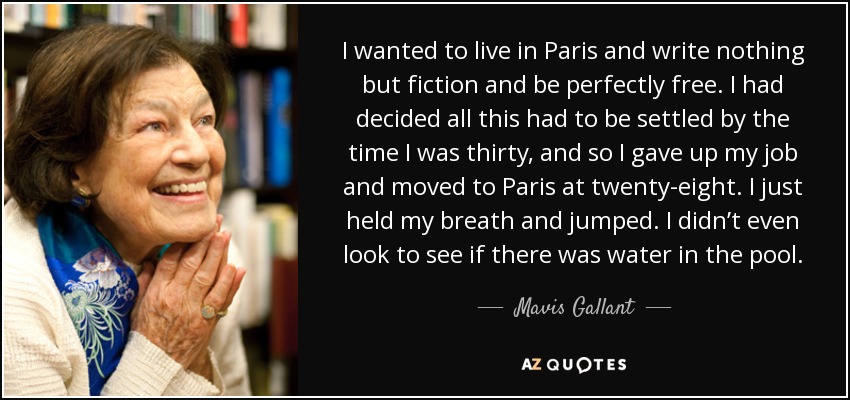
"A short story is what you see when you look out of the window."
Mavis Gallant

April 11, 1922 - Montreal

1950 - moves to Paris

September 1, 1951- publishes, in The New Yorker, her first short story.  She would publish 116 stories in The New Yorker. 

February 18, 2014 - passes away in her beloved Paris

Katherine Mansfield set a number of her short stories on trains, with women talking to men they never met, opening up to a stranger they knew they would never see again.  "Up North" is such a story.  Set around 1946 or so, when Gallant must've been dreaming about leaving Canada, the woman is the English war bride of a Canadian soldier, she is with her son who barely remembers his father.  They are headed  Abitibi, in northern Quebec to join her husband who drives a bull doxer for an aluminum company.  We never learn how she came to marry a Canadian soldier or anything at all about her life in England.  Gallant is a master at using small details to illuminate the past and see into the future:

"He looked all at once ridiculous and dishonored in his cheap English clothes –the little jacket, the Tweedledum cap on his head. He outdistanced his clothes; he was better than they were. But he was rushing on this train into an existence where his clothes would be too good for him."

The woman hates the train berth.  She begins a conversation with a man sitting near her and her son.  We learn her husband is a laborer.  Her son has never heard anyone speak French and in an intriguing aspect of the story mistakes a group of Frenchmen for elves.  Her son asks the man if he has ever seen a ghost.  No he has not but where the boy is going he will find lots of Indians, who do see ghosts.

I think in Quebec in 1946 the expression "up North" was more than just a location,it means an almost wild west kind of place far from civilization in Montreal, and light years from London. If the woman thought the train was shabby wait until she gets to Abitibi and takes up the life of a mining camp wife.

We leave the story worrying for the future of the woman but more so her son.  His father seems a bit of a brute.

We also wonder about the future of the man on the train.

Do you have some favorite set on a train short stories?

Mel u


Sunday, February 10, 2019

The Montreal Shtetl- Making Home After the Holocaust by Zelda Abramson and John Lynch - 2018


The Montreal Shtetl- Making Home After the Holocaust by Zelda Abramson and John Lynch

Growth of Jewish Population of Montreal

1941 - 63,000

1951 - 80,000

1958 - 100,000

The Montreal Shtetl- Making Home After the Holocaust by Zelda Abramson and John Lynch is a groundbreaking essential work, both for content and methodology.  It is a study of the immigration of Eastern European Jews into Montreal and their integration into Canadian society, after the Holocaust.  Most arrived with very little money, normally speaking Yiddish, Hungarian or Russia but little English.  Unlike early waves of immigration in which a man would come first, establish himself and then bring over his family, post Holocaust immigrants often came as families.  The Montreal Shtetl- Making Home After the Holocaust focuses on immigration from 1947 to 1954.

Immigrants first priorities were a place to live and a job.  The lucky ones had family or contact already in Canada to help them.  The other were helped by various government and private organizations.  The authors go into detail about Canadian immigration laws of the period.  Workers were especially needed in the garment trade and those with skills in this area found work right away, mostly initially as paid by pieces completed factory workers.  There was no day care so where there were children normally the wife stayed home.  It was normal for men to bring work home, often to be helped by his wife.  The immigrants were very hard working, very family oriented and wanted very much  be a success. (Ten years after arriving success meant owning a house in a decent area, kids in good schools, food anxiety long gone, often owning a business or being in managerial positions.)

Just like in Israel, Holocaust survivors were often viewed by Canadian English speaking Jews as suspect.  It was wondered how they survived.  The authors show how new arrivals, mostly Hungarian Jews, sometimes also but not always speaking Yiddish, stuck together.  In part this was because Holocaust survivors could often only closely bond with other survivors.  Third generation Canadian Jew looked down on new arrivals as ignorant and though they helped them they were not warmly welcomed.  Many immigrants were in fact highly educated, having had professional positions and wealth before they lost it all.  It was sad to learn that an immigrant with a degree in engineering would find his first Canadian landlord explaining what a light switch was for.  There were lots of quick marriages in the immigrant community. Many had lost their spouses in the Holocaust.  Education of children, who quickly became translators for their family, was a very top priority.  It was interesting to see that parents might speak Hungarian or Yiddish to each other and friends but insisted their children speak only “The King’s English”.


The heart of The Montreal Shtetl- Making Home After the Holocaust is in the numerous fascinating interviews with the immigrants.  The authors explain the methodology behind the interviews.  Most interviewed were seventy plus.
The interviews are in three sections.  The first section is devoted to experiences before they arrived and how the arranged passage to Canada.  There were set quotas as to how many Jews could be admitted.  Canada was more liberal than the USA at the time.  Many immigrants applied to the USA, Canada, Australia and South Africa, just wanting to put Europe way behind them.

Section two of the interviews deals with settling in Canada.  The authors studied the records of Jewish Social Agencies of the period.  Immigrants got some cash aid, help with rent and counseling.  Some at once found housing and a job, others struggled.  

The last section of interviews takes us on into their full integration into Canadian society, their children were professionals and their grandchildren in medical or law school.  Most, but not all of course, did very well.  We follow them from rooming houses to nice houses in exclusive areas.  Most immigrants did socialize mostly with other immigrants and we do see there was a lingering anti immigrant feeling, nearly as bad among prior immigrants as English or French speakers.

The Montreal Shtetl- Making Home After the Holocaust by Zelda Abramson and John Lynch should be read by anyone interested in immigration, Canadian history or post Holocaust Jewish experiences.  This is a wonderful book. I liked everything about it! The interviews were a joy to read.

In conjunction with this book, I suggest reading World of Our Fathers: The Journey of the East European Jews to America and the Life They Found and Made by Irving Howe.

I highly recommend everyone visit the website of Between the Lines Books, a forty year old Montreal based publishing company.


“Between the Lines books presents new ideas and challenge readers to rethink the world around them. Our authors offer analysis of historical events and contemporary issues not often found in the mainstream. We specialize in informative, non-fiction books on politics and public policy, social issues, Canadian and world history, international development, gender and sexuality, critical race issues, culture, adult and popular education, labour and work, environment, technology, and media.” - from the publisher 

Zelda Abramson is an associate professor of sociology at Acadia University. Her areas of teaching and research include methodology, health, and family. As a public sociologist, she strives to combine academic research with social activism. Zelda grew up in Montreal as a child of Holocaust survivors.

I was initially drawn to this book through my admiration for Chava Rosenfarb, whose image is in my blog side bar.  After spending four years in Auschwitz and then Bergen-Belsen, five years waiting for a Canadian visa in Paris, she and her husband,also a survivor, moved to Montreal.  Already a renown author, she was met with a reception by Yiddish writers.  She wrote stories related to Holocaust survivors in Montreal as well as many other great works.  The Montreal Shtetl- Making Home After the Holocaust by Zelda Abramson and John Lynch helped me understand her works more.

I salute Between the Pages for publishing The Montreal Shtetl- Making Home After the Holocaust by Zelda Abramson and John Lynch and give my great thanks to the authors.

Mel u


Friday, October 6, 2017

Polish (Ed) Poland Rooted in Canadian Fiction edited by Kasia Jaronczyk and Malgortza Nowaczyk, 2017)


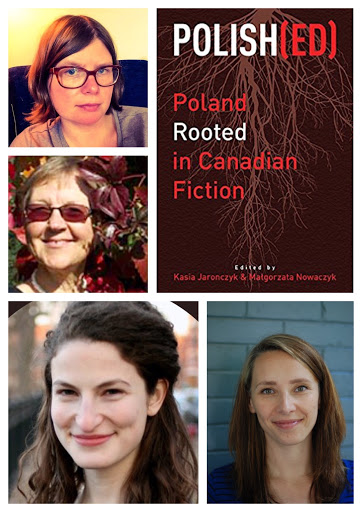
In The collage are, from The TOP left, Kaisa Jaronczyk, then Anna Milduchawsks, Zoe Greenberg, and at the right Anna Mioduchowska


I just finished reading a brand new collection of short stories ,Polish (Ed) Poland Rooted in Canada, edited by Kasia Jaronczyk and Malgortza Nowaczyk.  All of the stories deal with the Immigration of persons from Poland to Canada.
.

This is the first Polish diaspora collection published in Canada.  There are twelve stories, about an equal mix of men and women.  Some of The writers settled in The big cities, others in rural areas.  All struggled with a new language, some are great successes, others struggle to get by.

“We have found a wonderful community of writers who, although they write in different styles and on different subjects, support each other and are proud to represent Poland on the Canadian literary map. We have received an astonishing number of submissions, many more that we were able to accept. In the process we have discovered emerging and established Canadian authors Edited by Kasia Jaronczyk and Małgorzata Nowaczyk [xi] who include being Polish as part of their identity.”  From The introduction

I will post briefly on four of the stories, each one giving the reader a perspective about life experiences of Polish immigrants to Canada.

Iceburg” by Aga Maksimowska at first seems to have nothing to do with being an immigrant.   The woman this story centers on is not at all obviously an immigrant, her language gives nothing away, her appearance neither does.  Sometimes an immigrant can only be at once recognized by a countrymen, PR in this case by another woman from Poland.  The central character is having an Affair with a married man.  When he is hurt, the attending nurse at the hospital at first refuses her access then everything changed when the nurse realized they were both Polish.

“I say my name and she shoots me a look of recognition and glances down at her nametag, her own first name full of consonants. She smiles and tells me the Bruns are on the seventh floor, in Imaging. Why do I only now think of how strange it is that Dianne never changed her last name back? Olivier would say that’s because Milosevic is a mouthful, and that he’s been convicted of war crimes. And I would agree that it would be unfortunate to share a surname with a genocidal maniac.”

The two women have a link that bonds them, in a last names difficult to others


Aga Maksimowska emigrated from Poland in 1988. She studied Journalism at Ryerson University and Education at the University of Toronto. In 2010, she completed a Master of Fine Arts degree in Creative Writing at the University of Guelph. Her debut novel, GIANT (Pedlar Press) was a Toronto Book Award finalist and a CBC Readers' Choice Top 5 book in 2012. Aga's short fiction and nonfiction has been published in print and online in Canada and Australia, most notably in Rhubarb Magazine, Soliloquies Anthology, The Globe and Mail, and Kurungabaa. She lives in Toronto with her husband and two daughters, where she is teaching high-school English and working on her second novel.. from the author’s webpage


“A Temporary Pinprick” by Anna Mioduchowska centers on a woman, Ziutta, now fiftysix, who immigrated from Warsaw to Hudson Bay Canada twenty years ago, during a time unrest.  Friends advised her the Canadian winters were harsher than the Polish so she had made before she left, paying a bribe to get the fleece, a very warm jacket.  She is still wearing it today.  We are not told a lot about her life in Canada, she has a Family and works long hours in a garmet factory.  She wonders why everything is “on her”.  Her life is very well comveyed.  We sense her struggle.


Anna Mioduchowska, born in Poland, came to Canada in 1961 and has lived in the lovely city of Edmonton ever since. She started writing stories about 12 years ago.  Active in Edmonton's literary community from the moment she began writing, she is completing a two-year stint as President of the Stroll of Poets Society.
She has a B.A. (1969) and a B.Ed. (1979) from the University of Alberta. She received a Diplome de Langue et Lettres Françaises from d'Universite d'Aix-Marseille in 1970. Course work towards an MA in Comparative Literature, University of Alberta 


“The God of Baby Birds”  by Zoe C. Greenberg is set in Beilsk, Poland, is the story of the friendship of two young girls during the early 1960s, when the country is dominated by the People’s Workers Party.  Their fathers are engineers on the same project.  One of the girls is Jewish and in the anti-Semitic climate of the times this puts a cloud over the families relationship to each other.  There is one side benefit to being Jewish.  The party has ordered all Jews out of the country, hence only Jewish engineers can get visas to Canada.  There is a very interesting surprise as the story closes, I will leave it untold.  The relationship between the two girls was very subtly done, especially showing how anti-Semitism impacted their relationship. 

Poet and actor Zoe C. Greenberg’s experimental films have been shown in New York, Dublin, and St. Petersburg. She lives in Montreal with her husband, a painter, and their son.


“Lessons in Translation” by Kasia Jaroncsyk is perhaps my favourite story in the collection.  It begins, I think, in 1945 when the Communist Party comes to power in Poland.  The narrator, a  late teenage woman,  of the story lives with her affluent family.  Her fsther’s textile Family is seized by soldiers, their servants steal anything of value.  The Family, used to a life of comfort, is sent to labor in Siberia.  The narrator works for a Russian Family in exchange for Russian lessons.  From Siberia she and her parents are taken Tanganyika, now The Congo.  She learns Swahili, has a mixed race Child and ultimately from there moves to Canada, she does not want her Child kidnapped by his father.  In Canada she becomes a government interpertator, translating between Canadian officials and new immigrants.  She alsa reflects in a very interesting way about the meaning of the act of translation.


Kasia came to Canada from Poland in 1992 in her teens. She now lives in Guelph, Ontario, Canada with her husband, two children and two cats.
She has published poetry, short stories, and reviews in The Bristol Prize Anthology, The Prairie Journal, Room, Carousel Magazine, The Nashwaak Review, and Postscripts to Darkness. Her work won first place in the Eden Mills Contest in 2010; second place in the GritLit Hamilton festival in 2015; and was longlisted for the CBC Radio Short Story contest in 2010. She has co-edited an anthology of Polish-Canadian short stories (Guernica Editions, forthcoming 2017), and has written a collection of short stories, Lemons (Mansfield Press, forthcoming 2017).
She is currently working on a novel that features the art world, manipulative muses, controlling doctors, psychiatric photography and hysteria.

This is a very worth reading  collection.  I strongly endorse it to all Canadian libraries.  

Mel u


Sunday, August 13, 2017

The Ladies' Lending Library by Janice Kulyk Keefer (2007, 355 pages)


Ladies' Lending Library by Janice Kulyk is set in 1963, amongst first and second Generation Ukrainian emigrants to Canada, at their summer homes on a beach about six hours from Toronto, where the husbands of the families in the story work.  Sometime ago an enterprising Ukrainian real estate agent bought a stretch of beach land, on Lake Huron.  He then sold lots to members of the Toronto Ukrainian community, who built summer houses where the wives and children would go for eight weeks in the summer.  Being able to afford this meant you were a success in Canada.  We see the struggles of the first generation to fit in and raise their families while their kids have little sense of being anything but Canadian.

One of the mothers lives in a mansion with servants, the other women work very hard doing laundry, cooking watching over their developing teenage daughters.  Their husbands come on week ends.  They pretty much have repair jobs on the houses every weekend.  In 1963 the movie Cleopatra starting Elizabeth Taylor and Richard Burton had just been released.  Everybody, especially the girls, is very into the off screen Romance of the stars.  The girls are obsessed with Elizabeth Taylor's breasts.  In one hilarious scene they conspire to see nude a girl with very large breasts, when that does not quite work out, they steal her bra and take turns trying it on.  

The teenagers are pretty much totally Canadian, their parents try to hang on to their Ukrainian heritage.  In one side plot we learn the tragic story of a sister who had to be left behind in the Ukraine.  After an eight year gap, she rejoined her family in the Ukraine.  There is also the daughter of a family friend, being kept away from the big city as she is growing up way to fast, at sixteen they fear she will disrupt the community.  In a very sad scene, when she loses her virginity, she thinks she can prevent pregnancy by washing up with coke a cola.  

I really enjoyed the narrative methods of Keefer, keeping multiple interacted story lines going.  The characters are very well developed.  We get an excellent feeling for the generational gaps between first and second generation emigrants.  The title of the book comes from the books the ladies read and exchange. The prose is beautiful, the characters are interesting and well individuated.  

I very much enjoyed The Ladies' Lending Library.  This is my first venture into her work and I am certainly interested in reading more of her work

JANICE KULYK KEEFER is a bestselling Canadian author widely admired for her novels, short story collections, poetry, and nonfiction. She has been twice nominated for the Governor General’s Award and is a recipient of the Marian Engel Award, the Canadian Authors Association Award for Poetry, two first prizes from the CBC Radio Literary Competition, and several National Magazine Awards. The Ladies’ Lending Library is her fifth novel to date and the first to be published in the United States in more than fifteen years. She lives in Toronto.

Mel u

Monday, August 25, 2014

"The Bear Came Over The Mountain by Alice Munro ( December 27, 1999 inThe New Yorker)


When Alice Munro won The Nobel Price short story lovers world wide felt gratified to see the genre recognized.  Alice Munro has published 139 short stories and one novel, most set in her native rural Ontario.    I was kindly recently give an advance review copy of her forthcoming collection of twenty five short stories published from 1995 to 2014,  Family Furnishings.  It is a generous collection, well over five hundred pages.  

"The Bear Came Over the Mountain" was originally published in The New Yorker.  It is set in rural Ontario and centers on a retired college professor and his wife.  My main purpose in this post is to keep a record of my reading of this excellent story and to share with my readers a link to the story. 

Many have rightly said that Alice Munro can do more with thirty pages than most other authors can do with three hundred.   This is very true of "The Bear Comes Over The Mountain".  One day the professor finds his wife wandering around outside, she does not recognize him.  He has to choice but to place her in a facility.  Much of the story takes place on his visits.  She and a man their have formed a very close bond. ,He talks to the nurses their and they say these things happen but they pass.  The husband thinks back on the decades of their marriage.  We see the impact on changing habits on college life.  In time he meets the wife of the man his wife is bonded with.  She tells him not to be concerned on sex as her husband is not capable. The insights into both marriages are very moving.  The ending of the story was very satisfying. 

This is a very much worth your time story which you can read here


Mel u


Sunday, August 3, 2014

"The Hired Girl" by Alice Munro (April 11, 1994, The New Yorker,reprinted in Family Furnishings, 2014)


When Alice Munro won The Nobel Price short story lovers world wide felt gratified to see the genre recognized.  Alice Munro has published 139 short stories and one novel, most set in her native rural Ontario.    I was kindly recently give an advance review copy of her forthcoming collection of twenty five short stories published from 1995 to 2014,  Family Furnishings.  It is a generous collection, well over five hundred pages.  I have read only a few stories by Alice Munro, I find it takes me a while to absorb one of her stories.   In two or three good reading days I could easily read most five hundred page novels.  I think reading all of the stories in Family Furnishings back to back would be a much more challenging task.  I actually think one of the reasons many say they do they don't like short stories is that they require more mental energy to read, with any depth.  To read a Munro short story requires and will reward your fullest powers.  The gift of this collection will provide me a way to read more of her work.  

The story is narrated by a young woman, seventeen, from rural Ontario.  She talks enough about her family to let us see they are very hard working, used to be better off than they are now.  They once had a "hired girl" but now they don't. We get a really good sense of her life from her descriptions of the various hired girls that worked for her family. The woman is off school for the summer so her mother finds her a job as a live in "hired girl" for a family who owns their own private island. 

When the girl get to the island, owned by a couple, the woman owner tells her that the name of the island "Nausicaa" comes from Shakespeare. The girl knows it is actually a reference from The Odyssey but she is smart enough to keep quiet on that.  When I heard that my feelings for the young woman deepened.  There is just so much in this shorter than normal Munro work.  We see a lot of what happens on the island, including a shocking revelation at the close of the story, one that took me totally by surprise.  Munro is brilliant in her subtle use of class markers.  In one very revealing moment the girl says where she is from it is considered OK for girls to stay in school, most will become teachers, but the masculinity of a boy who stays too long in school is suspect.  Being too smart is not really an approved thing for anyone.  

In one super interesting touch, the girl notices the woman reading Seven Gothic Tales. The woman notices the girl reading it and she tells her the book makes no sense to her.  We are never told it was written by Isak Dinesen.  The girl is fascinated by it.  

There just is an amazing amount of life in the beautiful prose of "The Hired Girl".  I have left out a lot. 

Please share your favorite Munro stories with us.

Would you do a nonstop reading of this collection?

Mel u

Friday, February 21, 2014

"In Italy" by Mavis Gallant (February 25, 1956 in The New Yorker, five pages)


There has been a great outcry of appreciation for the work and admiration for the life of Mavis Gallant (born Montreal August 11, 1922, died February 18, Paris) since her passing a few days ago in her beloved Paris.  She published 116 short stories in The New Yorker.  I have previously posted on her very first published short story, "Madeline's Birthday".   The New Yorker has very kindly made one of her short stories and selections from her diary available for all to read. 

"In Italy" in just five wonderful pages luminously brings to life decades of family dynamics.  There are four people directly or indirectly in the story.  One is a man in his fifties, Henry,at least who has married a woman about the age of his twenty five year old daughter.  In addition to the daughter we meet her husband.  As the story opens, brilliantly I felt, the older man makes in a jocular tone a shocking announcement

"“The joke of it is,” Henry kept saying, “the joke is that there’s nothing to leave, nothing at all. No money. Not in any direction. I used up most of the capital year ago. What’s left will nicely do my lifetime.”

Beaming, expectant, he waited for his wife to share the joke. Stella didn’t think it as funny as all that. It was a fine thing to be told, at this stage, that there was no money, that your innocent little child sleeping upstairs had nothing to look forward to but a lifetime of work. She had just been bathing the innocent child. Usually, her evening task consisted only of kissing it good night, for the Mannings were fortunate in their Italian servants, who were efficient, loyal, and cheap."


The power in this story is in seeing how the young wife and his daughter react to this news.  The wife was not a shameless gold digger but she is shocked to see her child will not receive an inheritance.  Her step daughter, her age, turns on her and both realize untoward things about themselves.  I don't want to tell to much about this story other than to say I loved it.  I really hope to read more and would like to read all of her stories.


You can read "In Italy" here


http://www.newyorker.com/archive/1956/02/25/1956_02_25_032_TNY_CARDS_000254275


Mel u

Saturday, October 26, 2013

Mavis Gallant's first published short story - "Madeline's Birthday" in The New Yorker, September 1, 1951


Two days ago I read my very first short story by Mavis Gallant (Canada, 1922), "Rue de Lille".  Yesterday I downloaded a sample of Early and Uncollected Stories of Mavis Gallant edited and introduced by Jhumpa Lahari.  Lahari's introduction was totally illuminating and her deep appreciation of the stories of Ms. Gallant shines through.  Gallant has published about 100 stories in The New Yorker.  "Madeline's Birthday", September 1, 1951 was the very first published story of Gallant. It is kindly included in the sample edition.  Lahari tells us it that it contains the basic elements that would emerge in Gallant's  work over the next five decades.   It is the story of the events on Madeline's seventeenth birthday.  I am not inclined here to tell the plot.  It is about half-functioning families, loneliness under comfortable conditions, people on their own before they are ready.  

I have access to two more of her stories and will read them soon.  I can see myself reading a lot of her work.

Please share your experience with Mavis Gallant with us.


Friday, October 25, 2013

"Rue de Lille" by Mavis Gallant (1985)


Mavis Gallant was born in Montreal and worked as a journalist at the Montreal Standard before moving to Europe to devote herself to writing fiction. After traveling extensively she settled in Paris, where she still resides. She is the recipient of the 2002 Rea Award for the Short Story and the 2004 PEN/Nabokov Award for lifetime achievement. New York Review Books Classics has published two previous collections of Gallant’s stories, Paris Stories, selected and introduced by Michael Ondaatje (2002), and Varieties of Exile, selected and introduced by Russell Banks (2003). (From The New York Review of Books)

I feel a great sense of frustration almost despair when I think of all the wonderful writers I will die never having read or even worse never having heard about.  Ai least now Mavis Gallant will not be among them.  "Rue de Lille", from her 1985 collection of twelve set in Paris short stories, Overhead in a Balloon (first published in The New Yorker as were many of her stories, throws us right into the lives of a married couple, the wife sixty, the husband a bit older.  The husband finds his wife dead on the floor of their apartment, it looks like she died trying to retrieve a five franc coin that had rolled under a cabinet.   She was a translator of popular American novels into French, he was a Stendhal scholar and the host of a literary radio program in Paris.  Gallant takes us deeply into their marriage in just a few pages.   We sense the great void that will come into the life of the husband.  I think the contrast between the wife's work as a translator of American pop fiction and the husband's on classic French literature is brilliant.    For sure I will read more of Ms. Gallant's work soon.  


Featured Post

Imperial Reckoning: The Untold Story of Britain’s Gulag in Kenya by Caroline Elkins - 2005 - 701 Pages

  Imperial Reckoning:     The Untold Story of Britain’s Gulag in Kenya by Caroline Elkins - 2005 - 701 Pages 2006 Pulitzer Prize Winner From...