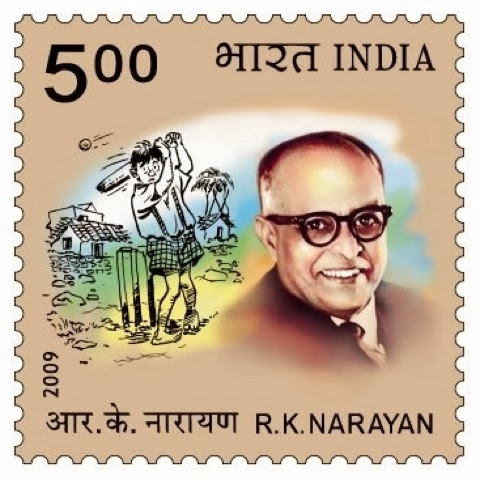
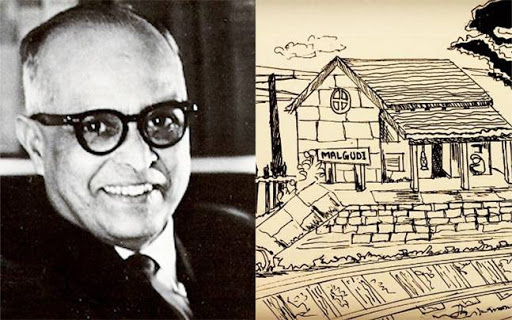
Years ago I stumbled on a short story by the great Indian writer, R. K. Narayan. I fell in love with his beautiful prose and his gentle wisdom. I have so far read and posted on all of his novels and a number of his short stories. I am happy to know there are still a good number of his short stories I have not yet had the great pleasure of reading. Jhumpa Lahiri in her introduction to an anthology of his short stories she edited, Malgudi Days, said he was one of the great short story writers of the 20th century. Much of his work is set in a fictional city lovingly brought to life in his oeuvre, Malgudi. Malgudi is considered to be a South Indian town. I think my favorite of his novels is A Tiger for Malgudi. For sure Narayan
should have gotten the Nobel Prize.
Today I am very honored to be allowed to share with my readers a very insightful essay by Meera Ekkanath in which she elegantly expresses her thoughts on R. K. Narayan and his city of Malgudi.
Bio of Meera Ekkanath Klein, author of My Mother's Kitchen: A Novel with Recipes

Award-winning author, Meera Ekkanath Klein, deftly weaves her love of cooking and story-telling into an irresistible tale. My Mother’s Kitchen: A novel with recipes (2014, Homebound Publications) was selected as a Winner in the 2015 International Book Awards in the Multi-Cultural Fiction category. The book was also selected as Finalist in the 2015 National Indie Excellence Book Awards and in 2015 Beverly Hills International Book Awards, both in the Multi-Cultural Fiction category. She was one of 40 authors at the celebrated 2015 Authors on the Move fundraiser for the Sacramento Library Foundation dinner and auction. She was featured on Capital Public Radio on April 2, 2015 and interviewed by host Beth Ruyak. She has participated in the Local Author Festival at the Sacramento Library and will be a presenter at the Great Valley Book Fest in October. She will also make presentations at the Woodland Friends of the Library annual meeting in June and at the Greenhaven/Pocket area Library in July. A former newspaper reporter and columnist, Klein, honed her writing skills in a busy newsroom. She mastered the art of Indian cooking in her own mother’s kitchen in the beautiful Blue Mountains or Nilgiris of south India. Klein currently lives in northern California and is completing a sequel to My Mother’s Kitchen, as well as a YA book based on Indian legends and mythology.

All Roads lead to Malgudi…and home!
By Meera Ekkanath Klein
At 15 I was an established anglophile in my literary tastes. I immersed myself in authors like G.K. Chesterton, C.S. Lewis, Charles Dickens, Emily Bronte, Jane Austen and William Wordsworth, to name but a few. What made this unusual was that I was a teenager living in the beautiful Nilgiris or the Blue Mountains of south India in the late 1970s.
So naturally my writing reflected my reading. In one essay I described the gentle rolling hills of Yorkshire and the sweet English breeze in a seaside town. My wise English teacher suggested that I write about what I knew. Write about what you see every day, she suggested. But who would want to read about the egg seller at our market or the dhobi (washer men and woman) village?
Try reading this book, she said, thrusting a copy of The Vendor of Sweets at me. The book was by some gentleman named R.K. Narayan. But he’s Indian, I protested. Try it, she urged me.
So reluctantly I opened the book and started reading. Soon I was immersed in the village life of Malgudi, a fictional place in south India. In this village I would meet all kinds of characters and some even reminded me of my own cousins and family. Malgudi was familiar and exotic at the same time. Mr. Narayan’s writings opened the door to a whole new world, one that was just outside my front door.
The writing was simple, direct and unassuming. I can still remember how much sense the writing made to my teenage self. Even the egg seller would find a role in Mr. Narayan’s story, I remember thinking. As a teenager who distained all things “old,” the story about Jagan, a vendor of sweets, was timeless and relevant. I could relate to the contrast and struggles between Jagan and his son Mali. Even though I was an obedient daughter, I could feel the constraints of my life and I desperately wanted to break free, but didn’t have a clue how to do it. The Vendor of Sweets embodied my life to some extent and that ageless struggle between young and old.
Like Mali in The Vendor of Sweets, I would eventually find my way to America. I would go on to read other Indian writers but Mr. Narayan’s writings resonated with me on a very deep level. So it isn’t surprising that decades and decades later I would create a fictional hilltop town of Mahagiri in my own writing.
Realism is tempered with decency and goodness in my fake town. I wanted readers to feel safe and secure in the confines of Mahagiri, just as I felt when I stepped into the streets of Malgudi all those years ago. I wanted readers to enter Mahagiri and feel a sense of homecoming—a place to put up their feet and stay awhile, perhaps with a cup of cardamom tea. Maybe we can’t go home in real life but we can in our imagination. So welcome to Mahagiri and Malgudi!
THE END
I offer my great thanks to Meera for her wonderful guest post.
You can enter the serene world of Mahagiri in award-winning author Meera Ekkanath Klein’s debut novel, My Mother’s Kitchen: A novel with recipes. Find out more at: http://meeraklein.com/
I will be doing a post on her wonderful novel, and maybe I will get very bold and try a few recipes, soon.
Mel u

 .
.