Showing posts with label Franz Kafka. Show all posts

Wednesday, November 29, 2017

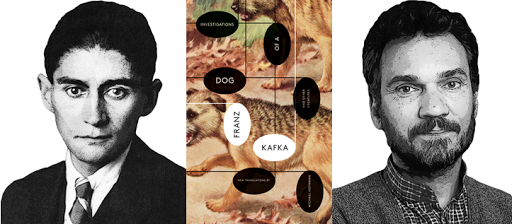
“Investigations of a Dog” - A Short Story by Franz Kafka - 1922 - translated by Michael Hoffman - 2016


German Literature Month, November, 2017 on The Reading Life


  1. “You’d Have Larvae Too” by Nora Wagener, 2016
  2. Vertigo by W. G. Sebald, 1990
  3. The Last Weynfeldt by Martin Suter, 2006
  4. “An Earthquake in Chile” by Heinrich Von Kleist, 1809
  5. Who is Martha? by Marjana Gaponenko, 2012
  6. “The Legal Haziness of Marriage” by Olga Grjasnowa, 2015
  7. “Aladdin, COB” by Isabelle Lehn, 2015
  8. “The Last Bell” by Johannes Urzidil, 1968
  9. The Rings of Saturn by W. G. Sebald, 1995
  10. Late Fame by Arthur Schnitzler, written 1892, published 2016
  11. Blood Brothers by Ernst Haffner, 1933
  12. Berlin Alexanderplatz by Alfred Döblin, 1929
  13. Confessions of a Murderer by Joseph Roth, 1936
  14.   “Compulsion” by Stefan Zweig,  1929
  15. “Borderlands”by Johannes Urzidil, 1956 (no post)
  16. “A School Boy’s Diary” by Robert Walser, 1910 (no post
  17. Austerlitz by W. G. Sebald, 2001, Second Reading 
  18. “The Duchess of Albanera” by Johannes Urzidil, 1965


  1. Gigli by Irmgard Keun, 1931
  2. Gay Berlin -Birth of a Modern Identity by Robert Beachy, 2014 *
  3. “Ernst in Civilian Clothes” by Mavis Gallant, 1963 *
  4. “Germans at Meat” by Katherine Mansfield, 1908 *
  5. Casanova’s Homecoming by Arthur Schnitzler, 1918
  6. “Investigations of a Dog” by Franz Kafka, 1922

Items with an * are my English language supplements to German Literature Month
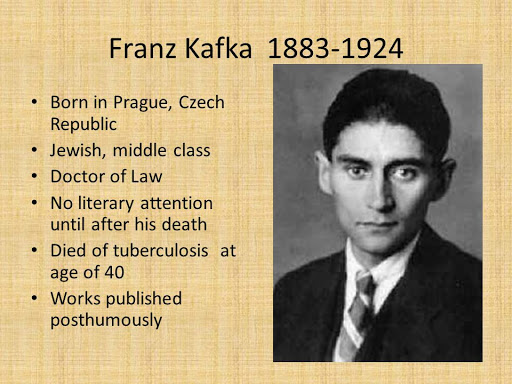


This will be our last post for this year’s German Literature Month, other than the closing post.  I first read Kafka about fifty years ago.  I read his short story “The Hunger Artist”, I can partially recall the plot.  This was, I am pretty sure, the first piece of translated into English German fiction I had yet read.  I have since I began The Reading Life read or reread most of his major works.  I was delighted to be recently given a collection of  Kafka short stories, new translated by the multi-award winning Michael Hoffmsn containing lots of new to me works.  

“Investigations of a Dog”, the title story of the collection was a lot of fun.  I do think many people almost take Kafka’s work  too much as an obscure to all but a tiny elite master text.  People allow themselves to be intimidated.  Much of his work is funny and can be enjoyed by anyone with an open mind.  In this story, a long interior monologue by a middle aged smaller than average dog, we are treated to interesting observations on science, religion, government, relationships and much more as the Dog tries to figure out the meaning of life.  Of course food is at the  center  of his life. Everything is very convincingly done from the dog’s point of view.  There are deep levels of meaning in the  story, I think, a commentary on Society but it can be read just for the fun of accepting a dog’s thinking.

Euphemia B. Rodsengraz
The Reading Life 


Monday, December 7, 2015

The Castle by Franz Kafka. (1926)


November last year I read as part of my participation in German Literature Month Franz's Kafka's The Trial which I found greatly intriguing.  Over my blogging history I have read most of his major works of short fiction.  I did not complete his unfinished novel The Castle in time for German Literature  Month this year.  It was probably me but I did not really find The Castle interesting as The Trial.  The Trial was also unfinished but the plot line was complete where that of The Castle was not. 

I am not much  inclined to repeat the plot.  The main purpose of this post is just to journalize my reading experience.  Like The Trial it can be seen as a commentary on dealing with beauracrats, and above all the absurdity of modern life.  One aspect of  Kafka most of those new to his work will be surprised to discover is how funny he can be.  

The Castle has gone through several published versions. It was put together for publication by the executor of Kafka's estate Max Bohr. 

For homework help seekers, Wikepedia has a good article.

I am glad I have at last read this book. 


Mel u

Monday, November 17, 2014

The Trial by Franz Kafka (written in 1915, first published in 1924)


Request for interpretation of one episode in The Trial - In one chapter K is going to visit the official court painter.  As he goes up the steps of the building where the painter lives, he is accosted by a band of girls 13 or so years old.  K describes them as "already degenerate" and they seem to want to have sex with him.  They are aggressive, the most so has a hunchback.  How do symbolic readings of Kafka see this?


The schedule and guidelines for participation are on the event webpage.  Just reading the  posts of all the other participants is tremendously informative. There is an interesting contest or two and some prizes to be won.  One of the tasks participants are charged with is reading a work first published in 2014 and this collection qualifies.  

I am very happy to be once again participating in German Literature Month, hosted by Caroline of Beauty is a Sleeping Cat and Lizzy of Lizzy's Literary Life.   Events like this are one of the great things about being part of the international book blog community.  I know there is a lot of work that goes into a month long event and I offer my thanks to Lizzy and Caroline


Works I have so far read for German Literature Month 2014

1.   Siddhartha by Hermann Hesse

2.   Gertrude by Hermann Hesse 

3.  "Diary of a School Boy" by Robert Walser (no post)

4.  Steppenwolf by Herman Hesse

5.  Burning Secret by Stefan Zweig

6.  Life Goes On by Hans Keilson

7.  Comedy in a Minor Key by Hans Keilson

8.  "The Wall" by Jurek Becker

9.  "Romeo" by Jurek Becker

10.   "The Invisible City" by Jurek Becker.
Is
11.  Wittgenstein's Nephew by Thomas Bernhard

12. "Dostoevsky's Idiot" by Robert Walser

13.  "French Newspapers" by Robert Wasler 

14.  Jakob the Lier by Jurek Becker

15.  The Trial by Franz Kafka 

The Trial by Franz Kafka (1883 to 1924) is uncontroversiallly one of the most influential literary works of the 20th century.  No German language writer after him has had anywhere near the influence of Kafka.  Since I began blogging I have read his most famous short fiction, I think my favorite is "The Penal Colony", but this is my first reading of one of his two novels.  Both were incomplete but the story line in The Trial is brought to a conclusion.

As I read on in The Trial I was on high alert, trying to understand what I knew was a key, almost holy literry text, looking peer into the depths of the work.  At every turn I asked myself what does that mean?  I knew parts of the symbological heritage comes from medieval Jewish tradition and Eastern European literature but it is a very original book. Of course it is read and mentioned in classes throughout the world (by pedagogical professionals who most likely have not read it) as a commentary on the absurdities of modern life.  Anyone trying to deal with a government office in The Philippines will directly relate to the endless labyrinth of lines and procedures combined with a hidden from view power structure that can solve all your problems in an instant if only you know or bribe the right people. 

The Trial was funnier than I thought it would be, it has strong comic elements.  There are strange at times sexual elements in the plot.   K, for example, has a long standing date with a hooker every week.  And then once again, what are those young teenage girls doing in the hallway?  Why is the man in the closet who is going to whip the first two policemen who arrested K dressed like a stereotype figure in a gay bar costume party?  There is almost a lesbian scene, maybe.  Plus I liked a lot the office politics in the sections set at the big Prague bank where K has an important job.  The court room scenes are beyond brilliance. 

With Ulysses, Proust and "The Waste Land", The Trial is a central text.  It is also a lot of fun to read. Don't be nervous about or scared to read this book.   

I hope to reread this in 2015 as well as read initially The Castle.  There is also an edition of The Complete Short Stories of Franz Kafka that has been on my Amazon wish list for a longtime.


Thursday, September 19, 2013

" A Report to an Academy" by Franz Kafka (1917)


Recently I read a very interesting article by Tessa Hadley, author of Married Love (a highly regarded collection of short stories)  in the Manchester Guardian in which she listed ten of her favorite short stories.   The first story she mentioned was "The Dead" by James Joyce followed by Anton Chekhov's devastating "Ward Six" about life in a late Czarist era mental hospital.  Most of the stories I have read.   One I had not was "A Report to an Academy" by Franz Kafka.   

I have posted on several of Kafka's works.   No one would say they are light reads by any standard.   The major short stories of Kafka are must readings for anyone seeking to understand modern literary, especially European,  sensibilities.  Given a full focus and respect, his works are immensely rewarding.   

I hope you will read this story (it is about five pages and a translation is in the pubic domain) so I will just post briefly on it more to help me recall it in the future.   The story is told in a very elegant and sophisticated fashion by an ape, speaking to an academy of highly learned members about his conversion from wild ape to a "civilized" one.  We learn of his horrific capture in the jungle and his caged shipboard return to Europe.   We learn of the process where he became less ape like and more human.  We sense deeply buried his self loathing.   Underlying the story is a deep contempt for what passes for humanity.   

Mel u


Thursday, August 22, 2013

"A Hunger Artist" by Franz Kafka (1922)


On a very rainy  day in Manila, up to a meter in three days in parts of the metro area, I decided I would reread a Kafka short story I still partially recalled from decades ago, when I saw it was the story of the day on a web page I follow.   I wondered what kind of story Kafka would have written in reaction to Prague being simultaneously hit by a typhoon and monsoon that flooded eighty percent of the city.  Kafka is one of the great Icons of European literature.  His name has become an adjective used by people who have never read his work in description of literature far inferior to that produced by Kafka.

I have posted on a two of Kafka's short stories, "The Prison Colony" and "Metamorphoses".  "The Hunger Artist" is shorter, maybe six pages, than either of these stories.  There are so many things one could say about this story.  One can read it as a eulogy to the decline of European culture, a commentary on the nature of art, the absurdity of vanity, and I am sure others have discerned readings I have not fathomed.  The ending is terribly sad about a life swept out like garbage.  Is the hunger artist a fool or a saint, decide for your self.  This story would be a decent first Kafka.


You can easily find this story online. 


Mel u


Featured Post

Imperial Reckoning: The Untold Story of Britain’s Gulag in Kenya by Caroline Elkins - 2005 - 701 Pages

  Imperial Reckoning:     The Untold Story of Britain’s Gulag in Kenya by Caroline Elkins - 2005 - 701 Pages 2006 Pulitzer Prize Winner From...