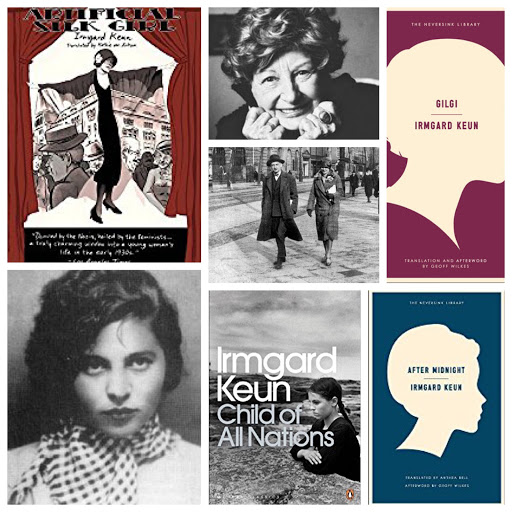
Showing posts with label Irmgard Keun. Show all posts

Sunday, November 26, 2017

Gilgi by Irmgard Keun - 1931 - Translated from German by Geoff Wilkes -2016


Works I Have So Far Read for German Literature Month, November, 2017

  1. “You’d Have Larvae Too” by Nora Wagener, 2016
  2. Vertigo by W. G. Sebald, 1990
  3. The Last Weynfeldt by Martin Suter, 2006
  4. “An Earthquake in Chile” by Heinrich Von Kleist, 1809
  5. Who is Martha? by Marjana Gaponenko, 2012
  6. “The Legal Haziness of Marriage” by Olga Grjasnowa, 2015
  7. “Aladdin, COB” by Isabelle Lehn, 2015
  8. “The Last Bell” by Johannes Urzidil, 1968
  9. The Rings of Saturn by W. G. Sebald, 1995
  10. Late Fame by Arthur Schnitzler, written 1892, published 2016
  11. Blood Brothers by Ernst Haffner, 1933
  12. Berlin Alexanderplatz by Alfred Döblin, 1929
  13. Confessions of a Murderer by Joseph Roth, 1936
  14.   “Compulsion” by Stefan Zweig,  1929
  15. “Borderlands”by Johannes Urzidil, 1956 (no post)
  16. “A School Boy’s Diary” by Robert Walser, 1910 (no post
  17. Austerlitz by W. G. Sebald, 2001, Second Reading 
  18. “The Duchess of Albanera” by Johannes Urzidil, 1965
  19. Gigli by Irmgard Keun, 1931
  20. Gay Berlin -Birth of a Modern Identity by Robert Beachy, 2014

Gilgi is the third novel by Irmgard Keun I have read.  During previous German Literature Months I read her Artificial Silk Girl and then After Midnight.  A cynic might sum up her work as Sex in the City on Alexanderplatz in late Weimar, early Nazi Germany.  All of her central characters in the three novels I have read are young single women trying to survive in Berlin while maintaining some self respect in the face of the pressure of male bosses to have sex with them.  (Sound like the headlines on CNN this morning.)

Gigli works as a secretary in a hosiery factory.  Her boss, thirty years older and of course with daughters older than Gigli and a wife, is pressuring Gilgi to have dinner with him.  She knows a flat out refusal could lead to unemployment and she badly needs her salary.  She agrees to go but has her very alluring friend Olga, not above semi-professional servicing an affluent older gentleman, accidentally stop at their table at dinner and the boss soon forgets all about Gigli.

Gilgi is ambitious, she is learning English and French in classes and trying to safe money to leave Germany.   However, she falls in love with a big talking man  very short on marks.  She winds up pregnant.  Gilgi’s visit to a doctor to get an abortion, criminal offence at the time but common is brilliantly done.

The strength and the pleasure of this novel is watch Gilgi try to survive, the weakness is in the romance.  

I enjoyed this novel with the caveat that I am very into the literature and culture of Weimar Germany.  It is Keun’s portrayal of young women in this period that draws me to her work.

To those new to her work I would suggest you start with After Midnight.

I still have one of her novels to read, Child of All Nations, and I hope to read that next year.

Mel u


IRMGARD KEUN (1905–1982) was born in Berlin and raised in Cologne, where she studied to be an actress. However, reputedly inspired by a meeting with Alfred Döblin, the author of Berlin Alexanderplatz, she turned to writing, and became an instant sensation with her first novel, Gilgi, One of Us, published in 1931 when she   was just twenty-six. A year later, her second novel, The Artificial Silk Girl, was an even bigger bestseller. The rising Nazi party censured Keun, however, and her books were included in the infamous “burning of the books”
in 1933. After being arrested and interrogated by the Gestapo, Keun left her husband and escaped Germany. While wandering in exile, Keun conducted an eighteen-month affair with the writer Joseph Roth and wrote the novels After Midnight and Child of All Nations. In 1940, Keun staged her suicide and, under a false identity, reentered Germany, where she lived in hiding until the end of the war. Her work was rediscovered in the late seventies, reviving her reputation in Germany..  


Thursday, November 26, 2015

After Midnight by Irmgard Keun (1937, translated by Anthea Bell)


German Literature Month V has only about a week left.  I have greatly enjoyed participating in this wonderful event. I commend and thank the hosts for their hard work.  There are lots of wonderful edifying posts by event participants.  

I am debating with myself whether or not we will host a party this year.  

Works I Have So Far Read for G L V

1.  Every Man Dies Alone by Hans Fallada. A brilliant recreation of life in Nazi Germany. 

2.  Ostend, Stefan Zweig, Joseph Roth and the Summer Before the End by Volker Weidermann. A fascinating social history 

3.  Buddenbrook Ths Decline of a Family by Thomas Mann.  Must reading 

4.  "The Governess" by Stefan Zweig

5.  Demian:  The Story of Emil Sinclair's Youth by Herman Hesse.  Read the major works first.

6.  The Tanners by Robert Walser. a serious work of art

7. The Hotel Years Wandering Between the Wars by Joseph Hoffman, a brilliant collection of feuilletons translated and introduced by Michael Hoffman

8.  "The Dandelioln" by Wolfgang Borchert. 

9.   "The Foundling" by Heinrich Von Kleist

10.  "A Conversation Concerning Legs" by Alfred Lichenstein 

11.  A Homage to Paul Celan

12.  "The Criminal" by Veza Canetti 

13.  Rebellion by Joseph Roth. Between the wars

14.  The Death of Virgil by Hermann Broch - an amazing work of art

15.  The Artificial Silk Girl by Irmgard Keun.  Sex and the City redone in the Weimer Republic  

16.  Wolf Among Wolves by Hans Fallada.  A panoramic view of the Weimer Republic 

17.  Journey Into the Past by Stefan Zweig

18.  Fear by Stefan Zweig

19.  "Mendel the Bibliophile" by Stefan Zweig

A few days ago I read and posted on The Artificial Silk Girl by Irmgard Keun (1905 to 1862, born in Berlin).  Keun's books were burned by the Nazis and it is a miracle that she escaped a similar fate.  The Artifical Silk Girl is sort of sort of like a story Dorthy Parker might have written about the life of a young woman in her early twenties on her on in Berlin in 1934 trying to get by on her looks and some flattery. I have seen it described as sort of like Sex in the City meets the Weimier Republic.  In it we see how the culture of Nazi Germany destroyed the self respect of the young woman.

The Artificial Sikj Girl is a very good work, After Midnight a good bit better.  It is the story of two young women in Betlin just before the wR starts.  Anti-Jewish laws were in place and everyone feared being turned in by those around them as a subversive.  The women social prize with Nazi soldiers and try to secure a decent life for themselves by finding men to take care of them.  It is not just about Nazi Germany but about how hard it is to keep your convictions when every day is a struggle just to have food.  The women get in trouble and they have their romances.  

This is a lively and exciting novel which I greatly enjoyed reading.  Fans of Vhridtopher Isherwood will love it.  

There is one more novel of Keun available in translation as a Kindle edition and I hope to read it in 2016 for German Literature VI.

Irmgard Keun (born 1905 in Berlin, died Cologne 1982) is widely considered the best female novelist of the Late 1930s in Germany.  Her work was banned as subversive by the Gestapo for her satirical portrayal of the impact of hyper-inflation and the creeping evil embodied in the rise of Nazi Germany which brought on a destruction of much of normal morality. She actually was crazy/brave enough to sue the Gestspo for banning her work, of course she lost.


Mel ü


Thursday, November 19, 2015

The Artificial Silk Girl by Irmgard Keun (1933)

..


I am estatic to once again be able to Participate in German Literature Month, elegantly and lovingly hosted by Lizzi's Literary Live and Beauty is a Sleeping Cat. This is my fourth year as a participant.   On the host blogs you will find the particularities of the event but the basic idea is to read literature first written in German (translated or not) and share your thoughts.  I began accumulating works for the event soon after the event ended last year and I began reading for it in mid-September.  


Works Read for G L V So Far

1.  Every Man Dies Alone by Hans Fallada. A brilliant recreation of life in Nazi Germany. 

2.  Ostend, Stefan Zweig, Joseph Roth and the Summer Before the End by Volker Weidermann. A fascinating social history 

3.  Buddenbrook Ths Decline of a Family by Thomas Mann.  Must reading 

4.  "The Governess" by Stefan Zweig

5.  Demian:  The Story of Emil Sinclair's Youth by Herman Hesse.  Read the major works first.

6.  The Tanners by Robert Walser. a serious work of art

7. The Hotel Years Wandering Between the Wars by Joseph Hoffman, a brilliant collection of feuilletons translated and introduced by Michael Hoffman

8.  "The Dandelioln" by Wolfgang Borchert. 

9.   "The Foundling" by Heinrich Von Kleist

10.  "A Conversation Concerning Legs" by Alfred Lichenstein 

11.  A Homage to Paul Celan

12.  "The Criminal" by Veza Canetti 

13.  Rebellion by Joseph Roth

14.  The Death of Virgil by Hermann Broch - an amazing work of art


Ever since I read Ostend, Stefan Zweig, Joseph Roth and the Summer Before the End by Volker Weidermann earlier this month in which he talked about German writers on holiday in Ostend, Beligum I knew I needed to read a work by Irmgard Keun.  In this work I learned of the romance between Irmgzrd and Joseph Roth.  To me Roth came across as trying to turn her into an enabler for his alcoholism.  


Irmgard Keun (born 1905 in Berlin, died Cologne 1982) is widely considered the best female novelist of the Late 1930s in Germany.  Her work was banned as subversive by the Gestapo for her satirical portrayal of the impact of hyper-inflation and the creeping evil embodied in the rise of Nazi Germany which brought on a destruction of much of normal morality. She actually was crazy/brave enough to sue the Gestspo for banning her work, of course she lost.  Some have  calledher work "Sex and the City Berlin style circa 1935".  


The story is narrated by twenty year old Doris, her father is an  alcoholic, her mother was "hot in her day".  Doris world as a typist, living in a small town.  She has to fend off the advances of her boss while still making him think she might give in to his dubious charms.  He ends up firing her with a one month severance.  She gives part of the money to her mother, she lives at home and leaves for the big city of Berlin, figuring she can live off her charms.  Doris is fascinated by Berlin.  She is on a man hunt, Hoping for a suger daddy.  Gradually she is overtaken by the miasma of corruption creeping over Berlin and dates turn into tricks.   

The Artificial Silk Girl is not a "heavy read" like The Death of Virgil or a work of genius like We all Die Alone by Hans Fallada but for sure it gave me a feel of what it must have been like to be broke, young, female, pretty and without a family or any real friends in the early days of Nazi Germany.   Slowly it becomes a city of whores, johns, pimps and assorted passeers by on Alexanderplatz. 


IRMGARD KEUN (1905–1982) was born in Berlin and raised in Cologne, where she studied to be an actress. However, reputedly inspired by a meeting with Alfred Döblin, author of Berlin Alexanderplatz, she turned to writing, and became an instant sensation with her first novel, Gigli: One of Us, published in 1931 when she was just twenty-six. A year later, her second novel, The Artificial Silk Girl, was an even bigger bestseller. The rising Nazi party censured Keun, however, and her books were included in the infamous “burning of the books” in 1933. After being arrested and interrogated by the Gestapo, Keun left her husband and escaped Germany. While wandering in exile, Keun conducted an eighteen-month affair with the writer Joseph Roth and finished After Midnight, published in 1937. In 1940 Keun staged her suicide and, under a false identity, re-entered Germany, where she lived in hiding until the end of the war. Her work was rediscovered in the late seventies, reviving her reputation in Germany. She died in 1982.  


There are two other translated works of Keun available as Kindle editions and I hope to read them one day.  

I hope those with experience with novels written about the Nazi years by Germans will share their experience with us.

Mel ü

Featured Post

Imperial Reckoning: The Untold Story of Britain’s Gulag in Kenya by Caroline Elkins - 2005 - 701 Pages

  Imperial Reckoning:     The Untold Story of Britain’s Gulag in Kenya by Caroline Elkins - 2005 - 701 Pages 2006 Pulitzer Prize Winner From...