Showing posts with label William Carelton. Show all posts

Monday, March 11, 2013

"The Death of a Devotee" by William Carleton

"The Death of a Devotee" by William Carleton (1850, 22 pages)


Irish Short Story Month
March 1 to March 31


William Carleton 1794 to 1869 -Dublin


Event Resources

Please consider joining us for the event.  All you need to do is complete a post on any Irish Short Story or related matter and let me know about it.  I will publicize your post and keep a master list. Please let me know if you have any questions or suggestions. 

In 1850 the famine was on the wane in Ireland.  Falmouth Kearney, a maternal great-great-great grandfather  of President Barack Obama emigrated Ireland to New York.   The university of Utah opens in Salt Lake City.    The transportation of British convicts to Western Australia begins.  Slavery is legal in the southern states of the United States.  In an event that will greatly impact Ireland one day Lehman Brothers is founded.  

The most enduring literary works published in 1850 were David Copperfield by Charles Dickens and The Scarlet Letter by Nathaniel Hawthrone.    The population of Ireland fell by from about eight million in 1840 to five million in 1850.  


William Carleton is considered one the of best chroniclers of life in Ireland in first fifty years of the 19th century.  


I have previously posted on his important novel The Black Prophet:  A Tale of the Irish Famine and four of his short works of fiction.   If you want to learn about Irish's life in the first half of the 19th century, the work of William Carleton is a great place to start.  (There is some background information on Carleton in my prior posts on him.)

Last year I devoted a week to Irish short stories in which a priest plays a central role and  "The Death of a Devotee"  is a wonderful story centering on a priest's reluctance to give last rtes to a dying man.  Of the five short stories by Carleton I have read, it reads most like a modern short story.  Some of his stories are just fictionalized accounts of like in Ireland and some are really fables and fairy tales.  It is also the most exciting story.  

As the story opens a man pounds on the door of priest and demands that he come to give last rites to his brother.  He does not want just any priest, he wants only one particular one to come.  This priest is very sick and the curate and housekeeper try to get him to take another priest with him.   He demands the sick priest come or he will throw him across his horse and bring him.  The story, it is told by the curate (a curate is a priest's lay assistant, often now called deacons) makes us wonder why he wants only this one priest.  The description of the house where the man lives is wonderful, it brings forth the real poverty and hardship of the people.   There are some things that I did not really derive from reading this story such as why the man wanted only the one priest and why the priest was at first reluctant to preform last rites.  The power in this story is in seeing how important these rites were to the man and his family and how vital the priest was to Irish society.

I read this story in The Oxford Book of Irish Short Stories by William Trevor.  I believe if you look you can find it online.


Sunday, June 10, 2012

"The Hedge School" by William Carleton

"The Hedge School" by William Carleton (1849, 21 pages)

The Irish Quarter:  Year Two
A Celebration of the Irish Short Story
March 11 to ?


Please consider participating in the Irish Quarter.   If you are interested in doing so you need only post on an Irish Short Story or related matter (such as a biography of a writer) and let me know about it.  Guests posts are also very welcome.   

If you are interested in learning about life in Ireland in the middle 19th century, a very good, maybe the best writer to turn to is William Carleton (1794 to 1869-County Tyrone, Ireland).   I have posted on several of his short stories and one of his longer works of fiction, The Black Prophet:  A Tale of Famine.   There is background information on him in my prior posts.   

One of the things I have learned in my readings in  Irish literature in the last few months is that the Irish love learning for its own sake.    Even today by many measures the Irish are among the most well read in serious literature a nation in the world.  As William Carleton opens "The Hedge School"

"There never was a more unfounded calumny, than that which would impute to the Irish peasantry an indifference to education.   I may, on the contrary, fearlessly assert that the lower orders of no other country ever manifested such a positive inclination for literary acquirements, and that too, under circumstances strongly calculated to produce carelessness and apathy on this particular subject."

"The Hedge School" is really an essay on the role of hedge schools in rural Irish society with some fictional characters thrown in for fun.   Hedge schools, this was new to me when I first read this story, were quite real and were schools run by itinerant school masters.  They were called hedge schools as they were often set up next to hedges, to take advantage of the shade and windbreak.   The hedge school masters were often very learned in Greek and Latin classics.   There were often contests between hedge school masters to see who could demonstrate the greatest erudition in a set match, usually judged by a man of great authority.  If an established master lost to a new comer he often left his school in disgrace and turned it over to the victor. I laughed when I read that school teachers were known for their love of drink and that one of the people in the story said he would never sent his son to be educated by a teetotaler.  Hedge school masters were often as learned as the masters of Trinity University.   

You can download this story and a much more Carleton at Manybooks.

Mel u

Wednesday, May 9, 2012

The Black Prophet: A Tale of the Irish Famine by William Carleton

The Black Prophet:  A Tale of the Irish Famine by William Carleton (1847)

William Carleton (1794 to 1869 Clogher, County Tyrone) was a very  prolific writer.   A great deal can be learned about Irish life in the first half of the 19th century from a study of his works.   (There is some background information on Carleton on my prior posts on him.)

In 1847 when The Black Prophet:  A Tale of the Irish Famine was first published Ireland was in the grip of a terrible famine.   The Black Prophet:  A Tale of the Irish Famine is about the famine of 1817.  In that year the United States issued its first postage stamps and the government began to purchase revolving pistols for its soldiers.   Jane Eyre is published along with Wuthering Heights and Vanity Fair.  

This is my first post for the Classics Club event hosted by Jillian.    I selected for my Classics Club project to read fifty Irish classics over the next five years, an optimistic forecast in more ways than one!

The Black Prophet:  A Tale of the Irish Famine  is about the famine of 1817, not as severe as the famines of the 1840s and 1850s but still very devastating.  The famine years and the subsequent great out flow of people from Ireland is one of  the central  historical events of the country and one can no more understand Irish literature without knowing the basics at least on the famine years than one could understand the post WWII Japanese novel without ever having heard of WWII or the works of writers like Flannery O'Connor and Eudora Welty and never have heard of the American Civil War.  

The best thing about The Black Prophet:  A Tale of the Irish Famine is the many small details it tells us about what it was like to live during the famine years.   There is a complicated plot involving a murder and family duplicity but I did not find that real gripping.  ( Most of my  knowledge of the famine years comes from The Great Hunger: Ireland 1845 to 1949 by Cecil Woodham-Smith and Famine:  Galway's Darkest Years by William Henry.)  

The famine years brought out the best in many people, lots of mother starved themselves to feed their children and lots of fathers worked themselves to death.   It also brought out the worst in many people, some were driven insane by it and it also caused many venal creatures to come out from under their rocks.   It seems, for example, that there were agents sent out throughout Ireland to look for starving women with beautiful long hair to be bought  for use by English wig companies to make wigs for fine English ladies and gentlemen (there were no synthetic wigs then and wigs were in big demand).   One hair merchant also seems to force his customers, the young and pretty ones at least, to give him a kiss also.   In one really sad scene a hair collector went to visit a dying young woman and when he is alone with her, he cuts off her hair and knowing she will die soon anyway, he sees no need to pay her a fee.   We also learn that many of the people did not die simply of lack of food but by diseases brought on by weakness.   If you read a lot of short stories and novels set in Ireland in the 19th century you will find a lot of references to mentally challenged adults and children whose condition came about due to extreme poor nutrition of the child and the mother.

There are lots of references to people who emigrate, mostly to America, or people who want to leave.

A lot of the story is told  through conversation and those who do not relish country dialect will find this  slow going some of the time.   The expository prose of Carelton is perfect.  

There is a lot to be learned from and enjoyed in The Black Prophet:  A Tale of the Irish Famine.   The characters are a bit stock but they are pretty well developed.   I recommend this book to those interested in 19th century Irish history and literature.  I hope to read a lot more Carelton.  

Mel u


Saturday, March 24, 2012

William Carleton: "Frank Martin and The Fairies

"Frank Martin and the Fairies" by  William  Carleton  (1845, 12 pages)

"Come away! O, human child!  To the woods and waters wild.  With a Fairy hand in hand, for the world is more full of weeping than you can understand".  from "The Stolen Child" by William Butler Yeats


March 23 to March 29
Fairy and Folk Tales of the Irish Peasants


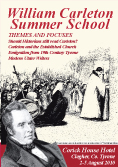
Much of the history and culture of Ireland can be learned from reading the extensive oeuvre of William Carleton.  There is no better place to explore this than in the William Carleton Summer School of the William Carleton Society of given every August since 1992 by the William Carleton Society.  Here is the description of the school from their very informative web page

The annual William Carleton Summer School, one of Ireland’s most significant literary festivals, has since 1992 celebrated the life and writings of the novelist William Carleton, 1794-1869. The School is held from the first Monday in August until the Friday of the same week in Carleton’s own district, the Clogher Valley in Co Tyrone. In addition to the main programme of lectures and debates, the School offers  bus tours of places that have Carleton associations, in neighbouring counties. The tours are led by well known local historians and Carleton scholars, and evening entertainments include drama performances, traditional and classical music and storytelling.

I hope to be there in August  2013.


Please consider joining us for Irish Short Story Week Year Two, March 12 to April 11 (yes long week).   All you need do is post on one short story by an Irish author and send me a comment or an email and I will include it in the master post at the end of the challenge.  


Irish Short Story Week Year Two was scheduled for March 12 to March 22.   I an finding such a richness of material that I have decided to add on a kind of bonus week focused on short stories that deal directly with the folk and fairy tales of old Ireland.   This decision was prompted by my reading of some of the works in Fairy and Folk Tales of the Irish Peasants by William Butler Yeats.   There are stories about changelings, ghosts, witches, giants, the devil, legendary Kings and Queens from the very old days, and lots of fairy stories.   There is also, of course, a wonderful story about a leprechaun that makes shoes for fairies.   There are stories by William Carleton, Oscar Wilde's mother, and lots  of  authors I have never heard of but whom Yeats says are great writers.   I will be posting on a story or two a day from this collection.   You can download it as I did from Manybooks.

I hope you will join us.  All you have to do if you want to participate is to do a post on a Short Story by an Irish  author and either leave me a comment with a link to it or send me the post data by e mail.  I will announce the posts and will also do, as I did last year, a master post spotlighting the participating blogs.   Last year posts were done by book bloggers from all over the world on a total of sixty short stories.


"Oh Rory, I guess as there will be a story
about you this week":-Carmilla
From March 23 to March 29, I will be posting on short stories taken from William Butler Yeats's collection Fairy and Folk Tales of the Irish Peasants (1922).   As I mentioned in my post of yesterday, Yeats was deeply involved in Irish Folk tales and beliefs.   It is not far off, I think, to think that these folk ways were in many cases viewed almost as an alternative religion or a set of older beliefs that exists side by side with Christianity.  William Carleton (1794 to 1869, Dublin) on whom I posted on March 12 for his brilliant short story, "Home Sickness" has two stories about fairies included in the collection.   Carleton mostly writers about life in Ireland either in the 1840s just before the famines or about the famines times.  I am currently reading his novel The Black Prophet:  A Tale of the Irish Famines.   Yeats, he has his issues socially, refers to Carleton as a "Peasant" in his remarks on him and I guess in Yeats very patrician mind this may give Carelton some extra authority.

I will be keeping my posts short this week as all of the stories in the collection are short?

"Frank Martin and the Fairies" deals with an interesting question.   What did  most people really think of people who completely believed in Fairies and their worlds, people who saw Fairies and talked to them on a regular basis?   What forces might drive someone to think he was surrounded by fairies only he could see?

A belief in Fairies was not a cute diversion or a source of fun to everyone, many believed this world was very real.   It would be easy to explain it as pure escapism brought on by the  history of Ireland in a times when there were no  medical treatments mandated for those who saw themselves as living among invisible to all but them characters.   Walk into a modern emergency room and tell them you are being accompanied by a troop of twenty invisible fairies, talk and argue with them as if they are very real  and see what happens.


Frank Martin was "as sensible, sober and rational as any other man;  but on the subject of Fairies the man's mania was particularly strong and immovable.   Indeed, I remember that the expression of his eyes was singularly wild and hollow, and his long narrow temples sallow and emaciated".
"Leprechauns are NOT  fairies,
keep you remarks to yourself,
Carmilla"-Rory

Frank had a wonderful relationship with the fairies.   He  would conduct long conversations with them, laughing hilariously at times, they even slept in his bed with him.   When people would come into his weaving shop they would ask him how the fairies were and he would say, "There are a dozen in the shop now".  People just accepted this and did not seem to see him as crazy at all.      Now Fairies if you make them mad can be dangerous but when Frank was baptized the priest gave him a special baptism that protected him from Fairies.   (Irish Fairies were not like Tinker Bell, often stole children and adult.   They also put curses on those who disrespected them.)

This is a very well done story that lets us see from the inside what it might have been like to live in Ireland in the 19th century and be a strong believer in Fairies.


Mel u


Tuesday, August 2, 2011

William Carleton-Two Short Stories by Leading 19th Century Irish Author

'Shane Fadh's Wedding"  (12 pages, 1840)
"The Rival Kempers" (6 pages, 1842)

Irish Short Story Week I

I read over the last couple of days two more of his stories.   I just want to spot light them briefly and provide links where they can be read.   Both of the stories have one big thing in comment-they celebrate story tellers.   From  them we can see the huge import story telling had in Ireland in the first half of the 19th century, especially in a partially literate society.   The stories are also about laughing past the grave yard and  surviving terrible hardship through solidarity.   My comments will be brief.

"Shane Fadh's Wedding" is very much about story telling.  In it Shane is challenged by his friends to tell the story of the wild events associated with his wedding.   Carleton does narrate this story, and others, by introducing briefly a character at the start  of the story and then having this person tell the story.

You can read these two stories (and more) HERE

There seems to be a lot of arguing and near fighting about who has the "bragging rights" for lots of things in the world of the Irish Short Story.   In "The Rival Kempers" we see a friendly competition between unmarried young female weavers.   Big social events where also important for young people looking for a marriage partner.   A young woman that was a good weaver was probably also going to be good at a lot of domestic tasks and a great candidate for marriage.  Here is a good sample of Carleton's prose style:

"In the north of Ireland there are spinning meetings of unmarried females frequently held at the houses of farmers, called kemps. Every young woman who has got the reputation of being a quick and expert spinner attends where the kemp is to be held, at an hour usually before daylight, and on these occasions she is accompanied by her sweetheart or some male relative, who carries her wheel, and conducts her safely across the fields or along the road, as the case may be. A kemp is, indeed, an animated and joyous scene, and one, besides, which is calculated to promote industry and decent pride. "


Mel u


Featured Post

Imperial Reckoning: The Untold Story of Britain’s Gulag in Kenya by Caroline Elkins - 2005 - 701 Pages

  Imperial Reckoning:     The Untold Story of Britain’s Gulag in Kenya by Caroline Elkins - 2005 - 701 Pages 2006 Pulitzer Prize Winner From...