Showing posts with label Huruki Murakami. Show all posts

Friday, January 18, 2019

The Commendatore: A Novel by Huruki Murakami - 2017 - translated by Phillip Gabriel and Ted Gossen, 2018, 702 pages


Works I have so far read for Japanese Literature 12 


  1. “Insects” - a Short Story by Yuchi Seirai, a post Atomic Bomb work,2012
  2. The Great Passage by Shion Miura, 2011, a deeply moving work centered on the creation of a Japanese Language Dictionary 
  3. "The Whale That Fell in Love with a Submarine" A Short Story by  Akiyuki Nosaka- 2003- translated from the Japanese by Ginny Tapley Takemori - 2015
  4. “Bee Honey” - A Short Story by Banana Yoshimoto- 2000 - set in Argentina during the annual Mother’s March for Disappeared Children.
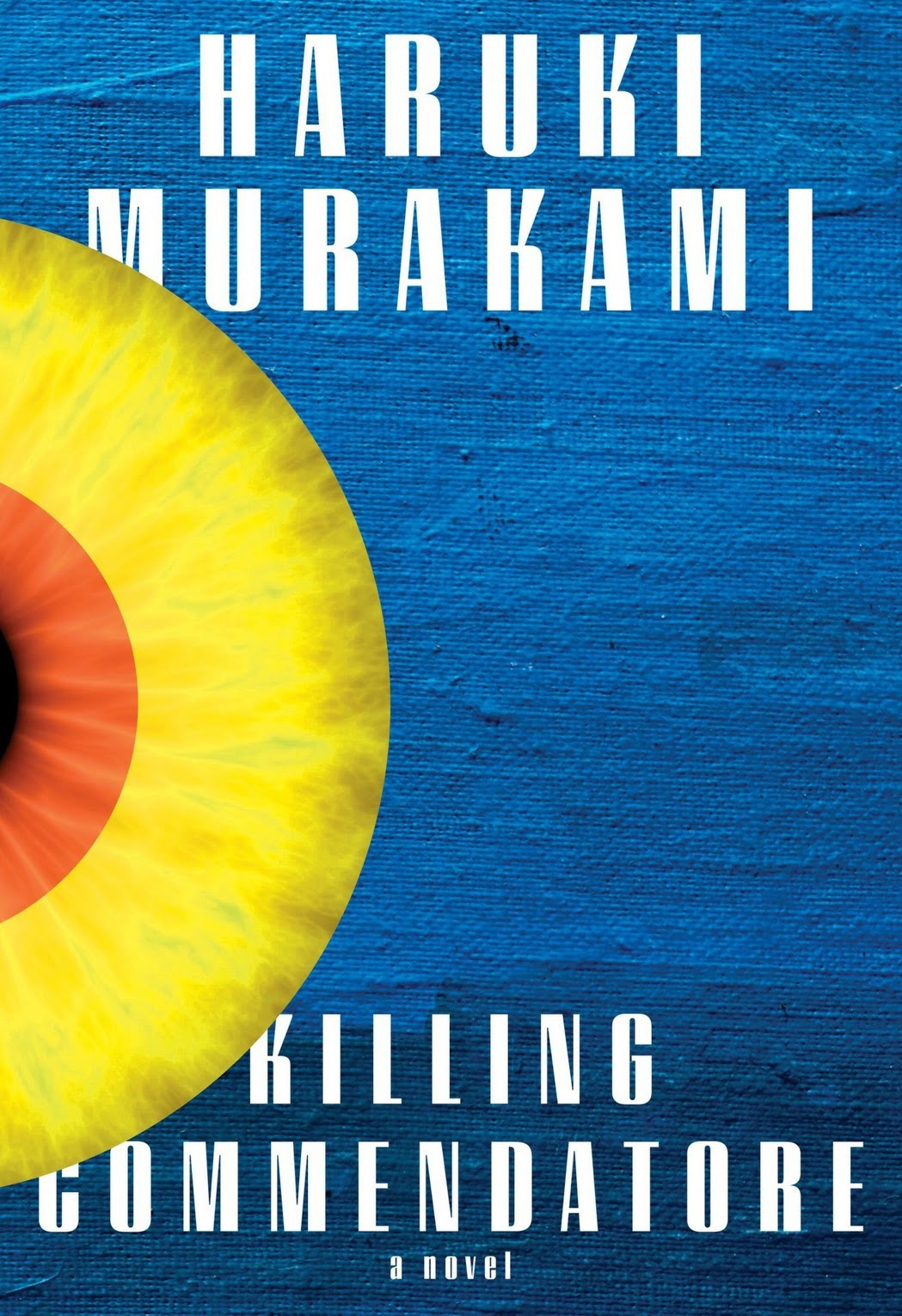
  5. Killing Commendatore: A Novel by Huruki Murakami- 2017

After Midnight by Huruki Murukami was my introduction to Japanese literature.  I read it in 2009 during JLC3.  As of today, I think I have read all his novels but Secret Library, plus several of his numerous short stories.

Killing Commendatore, his latest novel, has all the elements we have come to expect in his work.  The narrator, a 36 year  old recently divorced portrait painter, having given up his ambition to be a master artist to support his wife and himself.  When we meet him he has moved out of the apartment he shared with his wife.  He drives around at random for a while but soon settles in a house in the mountains owned by an old friend.  The friend's father, a famous artist, lived and worked in the house for a long time but is now in a nursing home.  The narrator, we never learn his name finds in the attic a painting the man left.  It is based on a scene from Mozart's Don Giovanni in which a character, Commendatore, is killed.  Thus the title of the book.  The narrator becomes obsessed with the painting.  He wonders why it was left hidden in an attic when it should be in a museum.  This becomes intregal to everything that follows.

The plot is involved, lots of unexpected things happen.  I don't want to layout thenplot, just make some observations.

There is lots of magic realism, characters out of the painting come to life, all are little people.  There is a mysterious wealthy neighbor.  Lots of great classical music references, jazz also, plus modern rock music.  There are plenty of literary allusions.  The narrator teaches art and is having an affair with one of his students, a married woman a bit older than him.  He meets his neighbor who commissions him to paint his portrait, offering him a very generous fee.  The neighbor asks him to do a portrait of a thirteen year old girl, one of his students.  The wealthy man thinks the girl might be his daughter.  From here things begin to get very weird so I won't go on.

I am preplexed by the constant references, sometimes two a page, to the breasts of the female characters. The thirteen year old girl is obsessed with worry over her lack of development and talks about it with the narrator as he paints her.  There are also numerous descriptions of nipples.  Every female character has her breasts judged, the bigger the better.  Just seems odd to me.

There are lots of great descriptions of the mountains, of food, of clothing, and much more.  There is a very suspenseful plot starting about halfway in that kept me wanting to know what will happen next.

I really enjoyed this book.  The characters are all very well developed.  There are literary tropes to ponder.  Murakami fans like me will smile through the little people, the magic realism.  As to all the constant breast references, well maybe Murakami just has a fixation or perhaps there are deep symbolic meanings.

What do you think?

Somethings are subject to cultural relativism.   I checked and the age of consent for sex is 13 in Japan.  In the Philippines it is 18 as it is in most of the USA and UK.   The Los Angeles Review of Books reviewer said Marukami's obsession with breasts seems a bit "pervy".     Does it seem that way to you?


Tuesday, October 14, 2014

"Scheherazade" by Huruki Murakami (October 13, 2014, The New Yorker)


I really hoped I would be writing this post in observation of Huruki Murakami winning the 2014 Nobel Prize for Literature.  Now that that has not happened, I am posting on his just published story in the current issue of The New Yorker in order to simply journalise my reading of it and to let my readers know they can read the story for free, for a while, on the webpage of The New Yorker.

Set in an unspecified locale, it is the story of a man named Hebara and a thirty five year old woman he calls Scheherazade who regularly visits him, brings him food and books. He seems to be in a situation kind of like house arrest or maybe he simply fears to leave his apartment.  It is purely a business arrangement and does not feel sleazy.  The woman is married with children and a husband.  She is past her prime in looks but still attractive.  She shops for Hebara and visits his apartment every few days.  She always has sex with him. She always inspects the condom to be sure he completed and when on her period she uses her hand.    It is pretty much part of her job.  She is not quite a prostitute, in fact we don't know what to call her.  The man does not give her cash but clearly she is getting paid.  Maybe she feels if she does not have sex with him she will be dismissed.  She does not hate it, just kind of all business.  

After sex, she tells him a story, just like the fabled Scherezade did.  He always wants her back to hear the next story.   One day she tells him a real story about her teenage years that was really fascinating.

"Scherazade" just begins and ends in the midst of a social setting we do not really understand.  Maybe in part it is a male fantasy of no strings sex.  It was a lot of fun to read.

You can read the story here


Mel u

Saturday, October 26, 2013

"Samsa in Love" by Haruki Murakami - published in The New Yorker, October 2013


Haruki Murakami is one of my favorite contemporary novelists.  I have read and posted on most of his translated novels and some of his short stories.  My main purpose in this post is to let my readers know there is a new story, "Samsa in Love" in the public online area of The New Yorker.  

"Samsa in Love" is a very strange and intriguing story in the tradition of magic realism.  As this told in the first person story opens something wakens in a bed to find he had been transformed into George Sasma, the name of the central character in Kafka's "The Metamorphosis".  He does not really recognize or understand his new human body.  The opening of the story, we find about four pages into the six page story, that it is set in Prague, at a time the city is being invaded.  The greatest mystery in this marvelous work concerns what was Sasma before his transformation or is it all a delusion.  Things get really strange when a woman locksmith  shows up to fix a broken lock on one of the bedrooms. To make it all the odder, she is a hunchback.   There is a hint that the narrator might have been kept locked in that room, his parents are out, it seems anyway.  

What does this story mean?  Haven't much of a clue I care to advance.  It is very much a fun story to read. 

Have you read "Samsa in Love"?   What is your take on it.


Featured Post

Imperial Reckoning: The Untold Story of Britain’s Gulag in Kenya by Caroline Elkins - 2005 - 701 Pages

  Imperial Reckoning:     The Untold Story of Britain’s Gulag in Kenya by Caroline Elkins - 2005 - 701 Pages 2006 Pulitzer Prize Winner From...