Sunday, October 10, 2010

The River Ki by Sawako Ariyoshi

The River Ki by Sawako Ariyoshi  (1959, translated by Mildred Tahara, 243 pages)

In July I read and  posted on Sawako Ariyoshi's most popular book, The Doctor's Wife.   Ariyoshi  is among the highest regarded female authors to emerge in Japan after WWII.    She graduated from college in 1952.   Her area of concentration was the performing arts with a special interest in Kubuki theater.  After graduation she went to work for a publishing house and began to contribute articles to literary journals.   In 1959 she received a Rockefeller Grant to study performing arts for a year at Sarah Lawrence College in the USA.    By 1968 she was able to devote her full efforts to writing novels, short stories and essays.   She never married or had children and died peacefully in her sleep in 1984.

When I posted on The Doctor's Wife readers told me that the author's The River Ki was a better book.
The River Ki begins around 1900 just before the Russian-Japanese war and ends in the middle 1950s as Japan begins to enter its period of post WWII prosperity. It is set on the banks of The River Ki in the Osaka area.    The book focuses on the lives of three women in the same family, a grandmother and her daughter and granddaughter.    Ariyoshi does a very good job of developing the characters of the women.   I found them all very believable.    She also presents the effects of the historical events that take place in the background in a way that lets us see what it would have been like to live in Japan during the period of the novel.   We also get a good look at the dynamics of the mother-daughter relationship.    I think I agree this is a better novel than The Doctor's Wife.     


Mel u

Saturday, October 9, 2010

"The Duchess and the Jeweler" by Virginia Woolf

"The Duchess and the Jeweler"  by Virginia Woolf (1938, 6 pages)


The Reading Life Virginia Woolf Project

"The Duchess and the Jeweler" by Virginia Woolf   (1882 to 1941-England) was first published in 1938 and then republished in A Haunted House and Other Stories in 1944.     This story is a straight forward traditional short story about a fabulously wealthy jeweler who now has among his clients the richest people in London.   He began his life in a very different way.    I found this work really beautifully written.     Oliver has come along a long way since his young days:

"Behold Oliver," he would say, addressing himself. "You who began
life in a filthy little alley, you who… " and he would look down at his
legs, so shapely in their perfect trousers; at his boots; at his spats. They
were all shapely, shining; cut from the best cloth by the best scissors in
Savile Row. But he dismantled himself often and became again a little
boy in a dark alley. He had once thought that the height of his ambition—
selling stolen dogs to fashionable women in Whitechapel

Oliver receives a call from Duchess of Lambourne, "daughter of a hundred Earls".    She awaited him in the  office of his shop.    Oliver derives an immense pleasure from thinking how a man of his origins could make the Duchess wait.     

I will tell no more of this story as the ending is really well done.   There is a controversy about whether or not this story can be construed as anti-Semitic.    It was a well known fact that all the wealthy jewelers in London were Jewish.    Woolf knew her readers knew this.    Many  will construe the  references to the long quivering nose of the jeweller as playing to anti-Semitic stereotypes.    


he was the richest jeweler in England; but his
nose, which was long and flexible, like an elephant's trunk, seemed to
say by its curious quiver at the nostrils (but it seemed as if the whole
nose quivered, not only the nostrils) that he was not satisfied yet; still
smelt something under the ground a little further off. Imagine a giant
hog in a pasture rich with truffles; after unearthing this truffle and that,
still it smells a bigger, a blacker truffle under the ground further off

In just  few short pages Woolf takes us deeply into the mind of the jeweler in this very interesting (leaving aside what else it might be) story.    I saw a few posts on this story indicating some people greatly dislike it for what seems to be its anti-Semitic  tone.   Of course that does not affect the literary merit of the story.     


This story can be read  online here

Mel u


Friday, October 8, 2010

Welcome to all Book Blog Hoppers

Welcome to all Book Blog Hoppers


Every Friday Jennifer of Crazy For Books hosts The Book Blogger Hop-The Book Blogger Hop is a great chance to meet new to you bloggers, find some new blogs to follow and gain some great readers for your own blog.   Every week about 200 or so bloggers from all over the world participate.    I have found some excellent new blogs this way and gained some wonderful readers.    I follow about 500 book blogs  and am always happy to find more.   If you follow me I will follow you.

Here is Jennifer's question for this week:
"When you read a book that you just can't get into, do you stick it out and keep reading or move to your next title?"

I hate to do it but I normally will move on to the next title.   Life is too short to read bad books!

   My blog for the last few months has been one third Asian literature, one third classics and one third short stories but I do read contemporary fiction also and even some YA once in a while.    I have various reading projects I am working on also.    My latest one is short stories by Australian writers of the 19th century and I also just read  five stories by African writers in competition for the Caine Prize.    I am very into Katherine Mansfield and Virginia Woolf.  

If you visit me please leave  a comment so I can return the visit-

I will follow all who follow me-if I don't let me know please either in Google Friend connect or Twitter.

thanks

Mel u.

"The Daughters of the Late Colonel" by Katherine Mansfield

"The Daughters of the Late Colonel" by Katherine Mansfield (1921-34 pages)


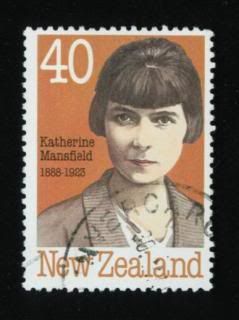
"The Daughters of the Late Colonel" by Katherine Mansfield (1888 to 1923-New Zealand) was first published in 1921 in The London Mercury.     It was reprinted in a collection of her stories, The Garden Party and Other Stories in 1922.    It is one of her better known stories.

The primary characters in the story are the two adult unmarried daughters of the Colonel, a widower who served in Ceylon where his son Benny still lives.   The story does a brilliant job of capturing the daughters'  feelings about their father, his death and their lives.   It is told from several points of view and does not follow a strict time narrative.    I thought the conversations between the daughters were wonderfully done.    Both daughters come very much alive for us.   The account of the relationship of the maid to the family was very interesting.

This is an excellent example of a modern short story.    

Mel u


Thursday, October 7, 2010

"At The Bay" by Katherine Mansfield

"At The Bay" by Katherine Mansfield (1922, 59 pages)

The Reading Life Katherine Mansfield Project


"At The Bay" by Katherine Mansfield (1888 to 1923) is one of the longest of Mansfield's stories.    It was published in a collection titled  The Garden Party and other Stories.    Mansfield dedicated the book to her husband, John Middleton Murry.    This collection, from which I will now be reading, has some of her most famous stories.

1922 saw the publication of James Joyce's Ulysses in Paris, "In A Grove" by Ryūnosuke Akutagawa in Tokyo, Siddhartha in Germany by Herman Hesse and The Beautiful and the Damned by F. Scott Fitzgerald in the USA.    "At the Bay"  belongs  in this list of master works of literature published between the world wars.   

"At The Bay" is set on the  New Zealand seacoast.    The first paragraph is a wonderful paean to the natural beauty of New Zealand.    I think Mansfield exposure to the great beauty of New Zealand while growing up had a very deep effect on her sensibilities.    

"At The Bay" is divided into 12 sections.    Each section centers about a family or an individual living in a house on the bay.   It is sort of like a small community where everyone seems to know everyone else.     This is a story with no plot, no middle, no end.    "At the Bay" just sort of plunges us into the lives of the people living around the bay.   "At the Bay" is not hard to read like Ulysses or Jacob's Room also published in 1922.  Anyone who loves beautiful prose will cherish it.      Ryūnosuke Akutagawa and Katherine Mansfield  would, I like to imagine, have been mutual admirers.  Anyone who has ever worked at a mind numbing job they hated will relate very strongly to section X of "At the Bay".

“It seems to me just as imbecile, just as infernal, to have to go to the office on Monday,” said Jonathan, “as it always has done and always will do. To spend all the best years of one’s life sitting on a stool from nine to five, scratching in somebody’s ledger! It’s a queer use to make of one’s...one and only life, isn’t it?


Mel u

Wednesday, October 6, 2010

Leonard Woolf-A Life by Victoria Glendinning- More than Mr. Virginia Woolf


Leonard Woolf-A Life by Victoria Glendinning (2006, 529 pages)


Leonard Woolf is known by most people only as Virginia Woolf's husband just as John Middleton Murray is remembered only as the husband of Katherine Mansfield.     Readers of Victoria Glendinning's recent biography of Leonard Woolf will learn that he was much more.    He was a very successful British Empire colonial administrator in Ceylon (Sri Lanka), a distinguished journalist and near leading left leaning English political thinker.     He wrote several highly regarded novels as well as historical works.    Leonard Woolf (1880 to 1969) married Virginia Woolf  (1882 to 1941) in 1912.  

Glendinnig's biography is simply a wonderful book.    Every page is full of new information,  not just about Virginia Woolf or Bloomsbury figures,  but on a wide range of topics ranging from Jewish life in England in the early 20th century to colonial life in Ceylon to the nature of the book publishing industry in London.  Leonard  Woolf comes to life as a full person for us.   We see how he did all he could to help his wife through her periods of madness.

We also learn about a number of the fascinating people that were among the associates of the couple, including   Virginia's sister Vanessa Bell and her family, G. E. Moore, Lytton Strachey and John Maynard Keynes, Vita Sackville-West and a host of others.    We can follow the events of Leonard's life after Virginia died (he lived on another 28 years), we see how he did his best to have her legacy protected and we go along on his trip to Israel.

Leonard Woolf was a wise, compassionate man in a difficult marriage to a genius.    He will always be Mr Virginia Woolf but at least now we will see the whole man.  

On a personal note, I  loved it  when I read that after Hitler took over Germany (but before WWII started) Leonard wanted to see Germany for himself so he could report on it for the publications he wrote for.
Leonard was a great animal lover and had a pet marmoset monkey, Mitz, that he loved and who slept in his bed (unlike his wife, it seems).     He took Virginia and Mitz along with him on the trip and as they drove through Nazi Germany Mitz sat on his shoulder.    This is an image that will always, I hope, have the power to make me smile.

Not long ago I read Victoria Glendinning's biography of Vita Sackville-West, an intimate of Virginia's and the inspiration for Orlando.    I was very glad when I saw in a local book store her biography of Leonard Woolf.

I highly recommend this book for anyone interested in Virginia Woolf and her era and circle.   It is a very informative information rich work.

Mel u

Tuesday, October 5, 2010

"Poison" by Katherine Mansfield

"Poison" by Katherine Mansfield (9 pages, 1921)


"Poison" by Katherine Mansfield (1888 to 1923-New Zealand) is the last story in a collection of her work published by her husband shortly after her death, Something Childish and Other Stories (1924).    If John Middleton Murry intended to conclude the collection on a brilliant, passionate note he has succeeded.   

"Poison" is set in a hotel in France.    As I have already seen, a lot of the stories of Mansfield take place in hotels or boarding houses, normally small ones.   The central characters in the story are Beatrice and her lover.   Beatrice has been married and divorced twice.    We do not know much about the past of her lover.  I am taking the lover to be male as he speaks of wanting to marry Beatrice.      I found his expression of love for Beatrice (I see this as an echo of Dante) in the passage below both moving and hilarious:

And when she lay on her back, with the pearls slipped under her chin, and sighed “I'm thirsty, dearest. Donne-moi un orange,” I would gladly, willingly, have dived for an orange into the jaws of a crocodile—if crocodiles ate oranges.
Unlike Australia there were no crocodiles or alligators in New Zealand so maybe this is a Peter Pan reference as for sure Mansfield knew her share of Peter Pans!

Beatrice seems to have had bad luck in her marriages (most commentators would come close to saying the same thing about Mansfield).      Here is Beatrice's  reaction when her lover suggests they marry:

The only reason why so many couples”—she laughed—” survive, is because the one is frightened of giving the other the fatal dose. That dose takes nerve! But it's bound to come sooner or later. There's no going back once the first little dose has been given. It's the beginning of the end, really—don't you agree? Don't you see what I mean?

The male character in the story is twenty four and assuming Beatrice is about the same age (we have no reason to assume to the contrary) this can be taken either as the shallow wisdom of a callow youth or as a warning to the man not to fly to close to the sun.

Mel u 

Featured Post

Imperial Reckoning: The Untold Story of Britain’s Gulag in Kenya by Caroline Elkins - 2005 - 701 Pages

  Imperial Reckoning:     The Untold Story of Britain’s Gulag in Kenya by Caroline Elkins - 2005 - 701 Pages 2006 Pulitzer Prize Winner From...